108 Natives Will Contest
pp. 21-143 · Read in the full issue
First P-NG Election
When nominations closed for the Papua-New Guinea actions to be held March 18, it was obvious that while native f ndidates had offered themselves in enthusiastic numbers, me Europeans who had seemed likely starters had had cond thoughts.
►SING date for nominations r as February 7 and this was le list of candidates after that
W Guinea Highlands
'.TO RATE : Mr. lan Downs jposed); and 40 native can es.
W Guinea Coastal
'TORATE : Mr. Lloyd Hurrell ig European member, un led); seven natives,
W Britain Electorate:
Don Barrett (sitting member); T. L. Chipper; 12 natives.
W Guinea Islands
'TO RATE: Mr. W. Meehan; Paul Mason; 25 natives.
Stern Papua Elec
iTE: Mr. Craig Kirke (sitting ier); Mr. R. Slaughter; 13 es.
Stern Papua Elec
TEE: Mr. J. R. Stuntz (un >ed); 11 natives., s makes nine European can es for six European seats and lative candidates for the six e seats.
Native Candidates
tive candidates of special in ; include John Guise (Eastern a) ; Willie Gavera and Marua a Rarua (who was formerly a nated member of the Council); for Western Papua; Simogun (formerly nominated) and Salum (both for NG Coastal) ; s Boralamit and Epinery mr (New Britain); Anton ei, Boski Tom and Paliau Maloat Islands) and Kondom, for the highlands.
The Party
e European candidates are ed between United Progress r candidates and anti-party dates, and that is probably the electorate will vote also, ;ome Territorians have yet e convinced that a political of any sort is necessary at present stage of political opment. e party was founded by Messrs.
Barrett, R. F. Bunting and
Simogun Peta after the last Legislative Council meeting in October. The candidates who are standing as Party candidates are Messrs. Downs, Barrett, Meehan, Slaughter and Stuntz. The others are independents, if not actually anti-party.
Mr. Kirke, sitting member, and an independent in this election, said that while there is a permanent
Administration majority in the Legislative Council the existence of a party meant only that there would be a split in the unofficial minority—that is, if members of the party voted on party-political lines.
He could see nothing new in the party’s platform and in his view, non-official members of the next Legco must continue to be in dependent and co-operate with each other as they had done in the past.
Mr. lan Downs let off a counter blast in reply. He said that the UPP was not premature, but overdue and that Mr. Kirke would, in three years time, wish that he had joined it.
The UPP’s main concern was the future of the Territory and its development along non-racial lines.
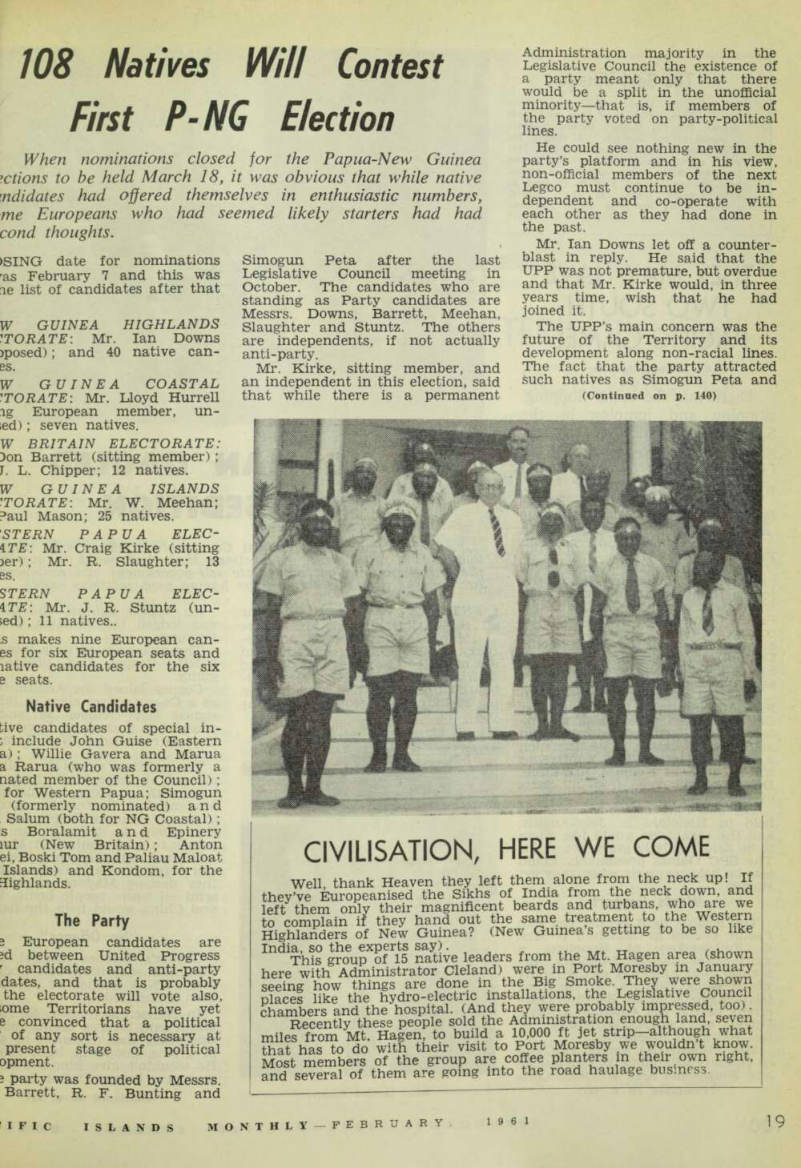
The fact that the party attracted such natives as Simogun Peta and
(Continued on p. 140)
Willie Gavera was justification ; itself.
Late Moves In the last month Mr. Ron a Kokopo planter, who ha signified his intention of standii against Mr. D. Barrett, the UP candidate, withdrew and Mr. J. ] Chipper has taken his place.
The Eastern Papuan electoral which didn’t appear to have candidate at all up to beginning ( February had a late nomination ( Mr. J. R. Stuntz, of Samarai, t the UPP party.
On March 18, European electoi who are in the mood (and in th Territory voting is not compulsor and in the past only a minorit have exercised the privilege) wi vote in the normal way. For th natives, election of their six can didates will be more complicate< In January, 36 natives went bad
school in Port Moresby when msion Service lecturers hi nted them how it was to be ;, so that they in turn could jack to their districts and ex i the process to their people.
This is the Theory
iis is the procedure for the re people, based on an “electoral ge” of 364 Papuan and New iea representatives who will their votes on behalf of nearly 00 people. these 364, 220 representatives be appointed by the 39 Native 1 Government Councils in the itory, and the other 144 will be nated by the 33 other electoral ps who were listed in a special of the P-NG Government tte in January. Generally, electoral groups, while they not yet formed Local Govern- Councils, are regarded as meed”. e 364 members of the electoral ?e, for practical voting pur ;, will be split up into six 3ral colleges, one each for the ‘lectorates—which means that me electorates, the number of [dates will be just about equal ie number of voters, the Highlands Electorate, for pie, there is likely to be about nembers of that particular )ral college, while at the same no less than 40 candidates offered themselves to the )rate. yone who knows anything - New Guinea natives and the mts they have to undergo to any sort of simple choice, understand something of the ilties that will face those 50 5, representing different sec ond patterns of thought and ;ies, over the whole vast ands area, trying to pick one out of 40 who will also repre widely different patterns of ht and loyalties. •ee days before March 18, the sparate electoral colleges will in Goroka, Lae, Kavieng, jl. Port Moresby and Samarai lively to have the system ex id to them, talk, and be ssed by candidates “if con d necessary”.
March 18, the college mem vill cast their votes. In places 'tew Britain, it will probably normal ballot papers, as most ? members of that college will resumed to be able to read ames of the candidates, places like the Highlands, the >d of voting has not yet been id on. That is being left to judgment of the returning , Mr. M. E. Ford, he New Guinea natives have introduced to our form of ;racy, a start has to be made /here —but there are a lot of
people who wonder if the com plicated electoral college system is going to prove any easier for these people to digest than a straight out system of universal suffrage— even if the candidates had to be represented by symbols and the voters had to use thumb prints.
Many people in New Guinea, are agreed, however, that it should be a lot of fun, while official Australia is taking it more seriously and was sending Mr. R.
Maslyn Williams, of the News and Information Bureau, in Sydney, to NG with a camera team in early February.
The team will stay in the High lands area, right through till after the elections, getting the High landers first brush with Democracy down on film for the benefit of the United Nations Trusteeship Council—among others.