Big Increase In
pp. 19-149 · Read in the full issue
Harrassed Fiji And Its Many Problems
Unemployment
From a Staff Correspondent The economic-racial-politico situation in Fiji is not static, iwly and with considerable evidence of pain, it is growing d developing. But it is largely an unguided development. No e knows where Fiji is going from here.
RING the past few weeks, the tuation has been affected by lajor and minor factors, plain ,11 to see. They could mean , or little. Here are some of —not necessarily in order of *tancB * The cane-crushing season is L, and CSR Co. has laid off hundreds of mill-workers than usual. Because of the ■led strike of growers, the g season was much shorter usual. is, into this pool of unemployed porkers—more than usual and less money than usual —has a large body of semi-skilled :ers, from Lautoka. The new are built, and the builders are ig other work. In the present of the Colony’s economy, there iw jobs for them.
Politically "Quiet"
anuary in Fiji was politically The cane-farmers had noth > say about the closing of the mills on the due date (Jan. r planting is going on, but, ling to some, not in the ity necessary to ensure a full uota next year. 1960-61 crush, as anticipated, bort of quota by about 60,000 ■the balance for shipment be ade up from the 1959 surplus, ause of unemployment, both is and Fijians in the North ire offering to work for much lan the basic 1/9 an hour paid le PWD and some trading t of the building trade is paid ii per hour and some un ilous employers are paying less than this. se are the people who cause nployees to adopt the go-slow which is a feature of so many mtracts,
fter the Inquiry, What?
Government has the remedy, s established a more-or-less vage for its PWD workers. Why ■t a basic wage for the whole 7? rhe economics of the sugar
industry are being examined by British experts, to see whether the CSR Co. should —or can—pay more, or less, for cane and for labour.
The outcome of this official in quiry is vital to Fiji’s future. It could mean a new and perhaps happier relationship between the company and the thousands of people who depend on the sugar industry for a livelihood. Equally, it could mean the withdrawal from Fiji of the CSR Company.
It is an open secret that the com pany, with its immense ramifica tions, is not enthusiastic now about its investment in Fiji.
The world’s consumption of sugar
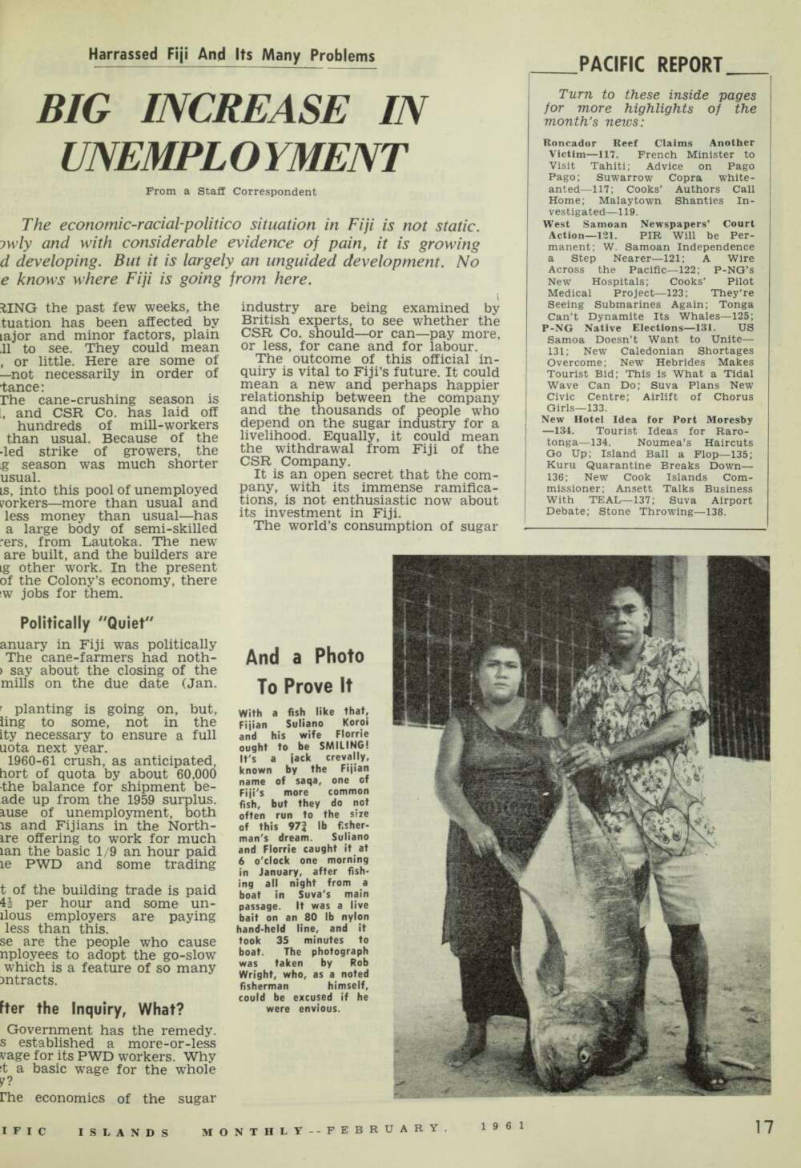
And a Photo
To Prove It
With a fish like that, Fijian Suliano Koroi and his wife Florrie ought to be SMILING!
It's a jack crevally, known by the Fijian name of saqa, one of Fiji's more common fish, but they do not often run to the size of this 97¾ Ib fisher man's dream. Suliano and Florrie caught it at 6 o'clock one morning in January, after fish ing all night from a boat in Suva's main passage. It was a live bait on an 80 Ib nylon hand-held line, and it took 35 minutes to boat. The photograph was taken by Rob Wright, who, as a noted fisherman himself, could be excused if he were envious.
is huge, and increasing. But sugar is sold in an intensively competitive market, wherein low-wage producers have a great advantage.
Every man of vision in Fiji wants better living conditions there for all classes. But if the price of the Colony’s chief product is governed by factors far outside the Colony’s control, so that the return from sales does not permit a fair return to the four classes concerned (grower, mill-worker, producer and marketer), a number of unpleasant possibilities arise.
How is the return to be divided?
The official inquiry is expected to provide the answer, or data on which an answer can be based. But what happens if one or other of the classes concerned will not accept the answer?
Mr. Lakshman
• Mr. B. D. Lakshman, MLC, chief spokesman for the mill workers’ organisations in Fiji has been in Australia, and in consulta tion not only with Australian trade union leaders, but also with some of the chief officers of the CSR.
Mr. Lakshman, in the past couple of years, has shown some sense of public responsibility, and breadth of vision; and, if another crisis should develop in the sugar industry, he probably will try to induce mill workers and miscellaneous workers generally to face realities and avoid extreme action.
But the stark fact is that a labourer, seeking a means to provide food for a family, is just as likely to be one-eyed in relation to national economics as a company director faced with a cut in legiti mate profit rates.
And, in the field of Fiji’s national economics, the outlook is very grim.
Mr. Lakshman’s labourers. Mr.
Potts’ company directors and Mr.
Patel’s cane-growers are facing the
(Continued on p. 147)
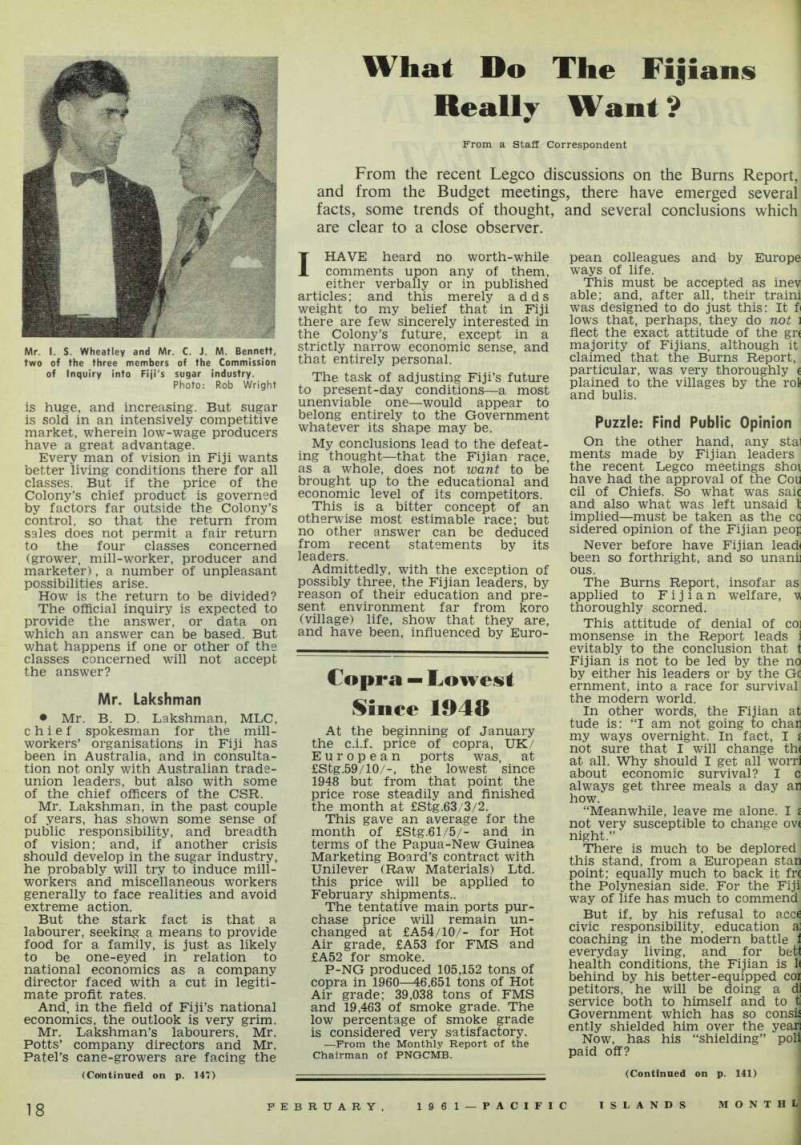
Mr. I. S. Wheatley and Mr. C. J. M. Bennett, two of the three members of the Commission of Inquiry into Fiji's sugar industry.
Photo: Rob Wright
same blank wall of incontrovertible fact. A succession of unimaginative, routine-serving Governors has failed to make adequate provision for population growth and land un availability, so that there now simply is not enough employment to take care of the oncoming workers, let alone the now surplus workers from sugar mills and completed public works.
What Of The Fijians? • Three representative Fiji- Indians, led by Ratu Mara, most highly-respected of the younger Fijian chiefs, have gone to India, as guests of the Indian Govern ment, to examine Indian culture, in stitutions, outlook on life.
This kind of thing could lead Fiji a long way, to a happy destiny.
Here is a lovely country, rich in natural resources. Here is one of the more gifted races of Islanders.
Hence came a small community of Europeans, to introduce Western customs and outlook. And here has been established a vigorous branch of the Aryan-Indo race, with per manent root in Islands life.
Whether these things were wise, or good, or bad, is now beside the question.
Here now are three strong com munities, each dominant in its own field. United, they can establish a strong, healthy, happy nation in the South Pacific. Divided, they surely will fall. • The attitude of the Fijians to the Burns Report—which represents a far-reaching official effort to deal adequately with Fiji’s problems—is dealt with in a special article on page 18.