Durrell Gets His Beef Alive
pp. 87-88 · Read in the full issue
The Month's New Reading
With Judy Tudor
Most people have very decided views, pro and con, the use of Idgin English, but not even Professor Robert Hall, who has written irnedly on the con side could become unduty enthusiastic over the -itish Cameroons variety.
E didn’t know, until we read Gerald Durrell’s latest animal book, A Zoo in My Luggage, anyone at all in Africa spoke sort of Pidgin. Unfortunately do, and to prove it, a great of Durrell’s book is written in Thus (describing the arrival of 3 of the local lads with speci s): lorning Masa,” they chorused, ning. r a whatee all dis ting?”
'a beef, sah,” they said, bent down and picked up a a bag and held it aloft. “Na h man bring dis?” a me, sah.” r a whatee dere for inside?” a squill-till, sah.”
That,” inquired Jacquie (Mrs. -ell), as I started to unravel strings on the bag, “is a squill haven’t the faintest idea,” I re l. 7ell, hadn’t you better ask?” ested Jacquie practically. “For /ou know it might be a cobra imething.” es, that’s a point,” I agreed, ing. I turned to the hunter was watching me anxiously, a whatee dis beef squill-till?” a small beef, sah.” a bad beef? ’E go chop man?” a, sah, at all. Dis one na squill smalt, sah . . . na picken.” ius fortified Durrell opened the et and found a very small rrel. But it’s obvious, even from sample, that British Cam us Pidgin is badly in need of ather Milhalic to codify and leticise it, and a Professor Hall lake an honest language of it.
With Hand Like Man
ie key to the above italic pas is, of course, the word beef: ’ you tumble to the fact that in Cameroons this term covers /thing in the animal line from uirrel to a monkey (beef with I like man ), you can work most tie rest of it out. For Durrell, ;ourse, was always concerned beef in one form or another. : has written a number of de ful books (starting with My ily and other Animals ), which e basically about animals and lal collecting in tropical
countries, also contain a lot of amusing comment on places and people.
This latest book, apart from its excursions into so-called Cam eroons Pidgin, is no exception and has some hilarious passages about the adventures of Durrell, his wife, his assistant and his secretary on this expedition to West Africa.
Throughout the years he had spent collecting animals for zoos and other institutions, he had nur tured an ambition to have a zoo of his own, and how he got this and what he did when he got back to Bournemouth, with the winter coming on and no place to put it, is the background of this book.
The party, after arriving in Vic toria, Cameroons, proceed up country from the coast in an im
pressive convoy of local lorries and took three hot, dusty and uncom fortable days to reach a town called Mamfe where they had been told to contact the manager of the United Africa Company.
The manager’s house was im pressive and perched on a conical hill with (of course), the best view in Mamfe. Along the road some where Durrell had acquired an ex tremely rare creature, a baby, black footed mongoose. It was an inquisi tive animal and for safe-keeping Durrell eventually put it inside his shirt where it had spent the first half hour walking round and round his body, sniffing loudly; and the rest of the time trying to dig a hole in his stomach, sucking vigorously and hopefully at large mouthfuls of his abdomen, while irrigating him “with an apparently unending stream of warm and pun gent urine”.
This in no way improved his already dusty and sweaty appear ance as, with mongoose tail dang ling out of his otherwise buttoned shirt, he marched up the steps of the house and as nonchalantly as possible into a brightly lit living room.
Three people were seated round a card table and looked at him with inquiry. .. “Good evening ,” I said. “My name’s Durrell.” (Over)
It was not, I reflected, the most telling remark made in Africa since Stanley and Livingstone met. How ever, a small dark man rose from the table and came towards me, smiling charmingly. ... He held out his hand and clasped mine, and then, ignoring my sudden apvear ance and unconventional condition, he peered earnestly into my face.
“Good evening,” he said. “Do you by any chance play Canasta?”
“No,” I said, rather taken aback.
“ I’m afraid I don’t.”
He sighed, as if his worst fears had been realised . . . then he cocked his head on one side and peered at me closely.
“What did you say your name was?” he asked.
“Durrell . . . Gerald Durrell.”
“Good heavens,” he exclaimed, realisation dawning, “are you that animal maniac head office warned me about?”
Friendly relations thus having been established, he was asked to have a drink, told to bring the others in and to make themselves at home. But as Durrell turned towards the door his host seized him by the arm and drew him back.
“Tell me, dear boy,” he said in a hoarse whisper, “I don’t want to be personal but is it the gin I’ve drunk or does your stomach always wiggle like that?”
“No,” I said gravely. “It’s not my stomach. I’ve got a mongoose in my shirt.”
He gazed at me unblinkingly for a moment. “Very reasonable ex planation,” he said at last.
“Yes,” I said, “and true.”
He sighed. “Well, as long as it’s not the gin I don’t mind what you keep in your shirt.”
Mamfe was, however, just a step
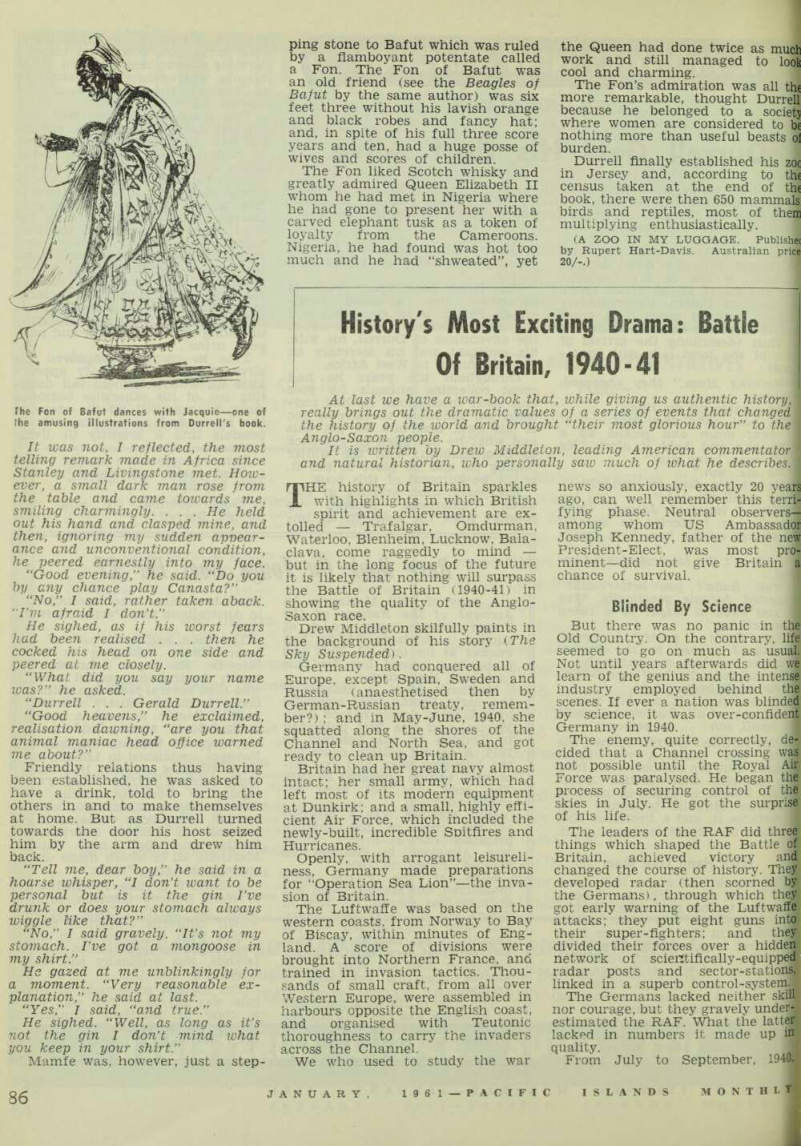
ping stone to Bafut which was ruled by a flamboyant potentate called a Fon. The Fon of Bafut was an old friend (see the Beagles of Bafut by the same author) was six feet three without his lavish orange and black robes and fancy hat; and, in spite of his full three score years and ten, had a huge posse of wives and scores of children.
The Fon liked Scotch whisky and greatly admired Queen Elizabeth II whom he had met in Nigeria where he had gone to present her with a carved elephant tusk as a token of loyalty from the Cameroons.
Nigeria, he had found was hot too much and he had “shweated”, yet
the Queen had done twice as much work and still managed to look cool and charming.
The Fon’s admiration was all the more remarkable, thought Durrell because he belonged to a society where women are considered to be nothing more than useful beasts ol burden.
Durrell finally established his zoc in Jersey and, according to the census taken at the end of the book, there were then 650 mammals, birds and reptiles, most of them multiplying enthusiastically. (A ZOO IN MY LUGGAGE. Publishes by Rupert Hart-Davis. Australian price 20/-.)
The Fon of Bafut dances with Jacquie—one of the amusing illustrations from Durrell's book.