It Was A Long Way
pp. 80-101 · Read in the full issue
Back To Maprik
By Judy Tudor
When Mr. Ted Taylor learned a couple of months ago that I intended to go hack and take another look at Wewak, he wrote to a mutual friend ( Tolala ) and said: “What on earth does she want to go hack to that God-forsaken hole for?” There have been times when I might have heen inclined to agree with Mr. Taylor—hut not now. As outports go in New Guinea, Wewak must he pretty near the top of the list of those with the mostest.
TWAS not always so, although, when I first saw the place over 20 years ago, I was not out to be impressed. I was simply set on being a pioneer and for this pur pose Wewak and the whole Sepik District was admirable. I would have preferred Africa —having read a great deal of the literature that had been produced about that Con tinent—but New Guinea was nearer, my immediate family was there, and what was far more to the point, it cost a lot less to get there. Something round £2O from Sydney, I seem to remember, for which sum Burns Philp kept you for about three weeks while their Macdhui nosed into every port on the route.
Wewak, on its lonely point, then consisted of not very much more than the District Officer’s house, the District Office and a small hos pital, Unless you had business at these institutions you kept away and stayed at Boram Plantation, on the southern point of the gently curving bay.
Boram was the meeting place of labour recruiters, miners and every other non-official person who had business on the coast “when the Macdhui was in”. Boram had a Blood House where they lived in
rowdy harmony and a smaller building next door where the very few women and married couples who came that way, put up. Boram also had a store where beer, canned goods and bush gear (in that order of importance) could be bought.
All this, of course, is now no more. During the war, the Japs dug themselves in around Wewak and Boram and the whole area was well plastered by Allied bombers. Boram, as a coconut plantation was de stroyed and never rehabilitated after the war. Where the planta tion homestead and the store and Blood House once stood, now they are building the new regional hos pital that is to cost the usual three quarter million pounds or so.
There are two airstrips where there used to be many acres of productive coconuts—one, a private strip, belonging to the Catholic Mission, and the other the official air-port which has, for reasons un known, the best air terminal build ings in the Territory.
In early 1936 however, there were only two ways of getting anywhere —one was by sea and the other by foot, and for us it was the latter.
Away over the hills somewhere inland there must have been a village called Maprik on the edge of the Sepik plains but although
we lived within a day’s walk of it we didn’t hear of it for a year-J not, in fact, until Ray Parer hat some of the kunai grass cut dowi and landed his plane there.
After Ray came Guinea Airway* and Stephens and instead of walk ing to Wewak you flew out to Worn or But and then took schoones, launch or canoe and waddled along the coast to the Metropolis.
In the next couple of years some Chinese stores were built below Wewak Point and Bob Parer opened a freezer and a rudimentary hotel.
But all this, too, was swept away in the war and out of the ashes a new Wewak grew. There are some good stores there now; Wewak Point is crowded with bungalows and flowering shrubs, and the hotel, standing on the cliff above the sea, has got the best site of any hotel in the Territory.
Wewak has also got roads—and it was the roads that lured me back.
By Road or Bust A few years ago the then District Commissioner told PIM about a road that they had built from We wak to Maprik—about 100 miles of it —and I tucked the information in the back of my mind for future reference.
I had no delusions about the kind
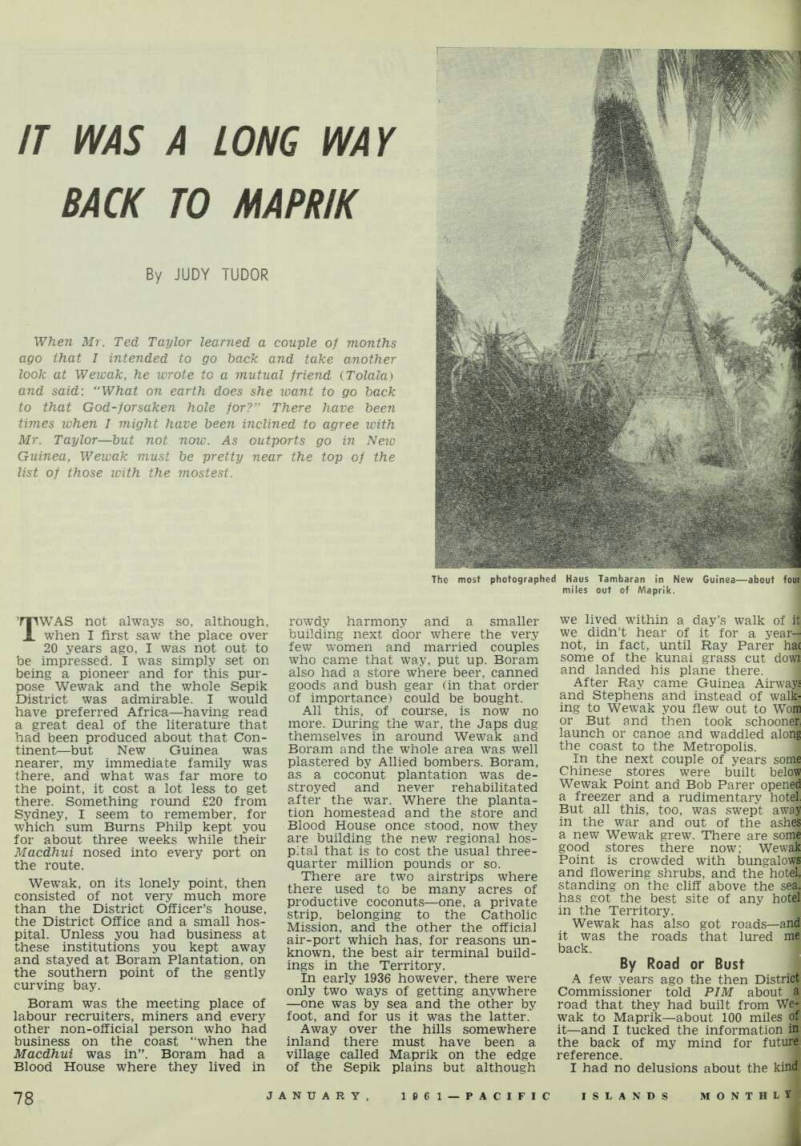
The most photographed Haus Tambaran in New Guinea—about four miles out of Maprik.
'oad it would be. I didn’t expect dee stations every hundred is or espresso coffee bars every rter mile, but so long as any i of four-wheel vehicle could tally get along it, it seemed to to be the perfect pay-off for ,e five days to a week that it : us once to walk it; for the hes that had sucked our blood, the bush-mokas that had made hell; for the mud and the heat the sweat of over 20 years as we had plodded up hills, •ugh the village on top, down other side only to repeat the :ess ad infinitum, was 15 miles a day then, if were very lucky, and if your ence, powers of persuasion, in don and invective didn’t give up re your carriers came to the of their territory and refused venture onto “foreign” soil. > a vindication of those days gone, I was determined to try Wewak-Maprik road —when I d get around to it, and when ed out to be November, pik’s District Commissioner, R. Cole, had promised to nise the transport for me, so Wednesday I paid my air fare ladang and flew up to Wewak. e arrived mid-morning and ) R. R. Webb, to whose un iy lot had fallen the job of get me out to Maprik, was out at airstrip to meet me, with one itient eye on the black clouds were already building up be [ the mountains.
Let's Go hen I asked him when we d leave, he said, “Now.” Latest rts were that the road was able; if we waited till the morn it might well be “out” and en knew when it would be “in”. leaving at once we might get j that night which would give ilmost two days for Maprik or ler out. They’d arrange for an frustration charter plane—“or sthing”—to pick me up Friday noon. * went to Webb’s house and Webb made us sandwiches and i tea; I threw a few things a big suitcase into a small one put on a pair of slacks: we ;d up a small Buka policeboy another native, and we were yce Webb is a big, fairish man can make a Land-Rover do tically everything short of ac y climbing a tree. In daylight s —initially anyhow—he is al monosyllabic. It is only after , after the third can of beer, the transformation takes place as the night wears on and as imiability increases, he becomes i and more the accomplished ersationalist. At the stage e other men’s eyes are crossed they are saying the same things and over, Royce, with perfect nimity, is indulging in a high-
level dissertation on things in general.
It’s really quite remarkable—or maybe in this case it was just the relief of having got me to Maprik and out of his hair and into the jurisdiction of ADO Bob Bunting.
Anyway, that first day we had no time for long conversations. This
particular journey developed into real work, and by the time we had got to Maprik Hotel at 6.45 that night, we felt as though we had dragged that vehicle up and down every hill between there and Wewak and in and out of most of th f_ nV^rS . Wel !: , .
The first few miles out of Wewak
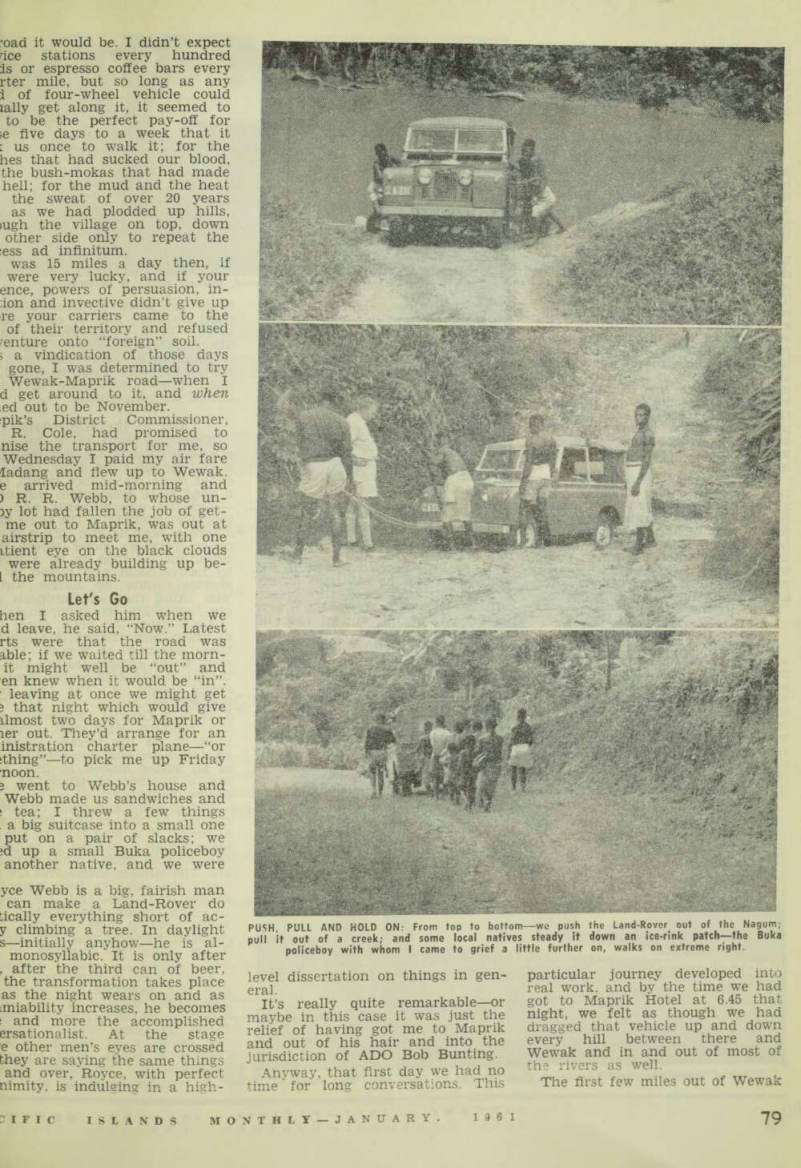
PUSH, PULL AND HOLD ON: From top to bottom —we posh the out of the Nagum; pull it out of a creek; and some local natives steady it down an ice-rink patch—the Buka policeboy with whom I came to grief a little further on, walks on extreme right.
and over the range are like driving up the middle of a dry creek bed and it doesn’t take much more than this stretch to show you why this road isn’t the main supply route to Maprik.
Better by Sea
Most Administration stores for Maprik are sent down the coast by sea and then the several hun dred miles up the Sepik River to a place called Pagui. There they are loaded onto 5-ton trucks for the 30 miles by road to Maprik.
During the wet, sections of the Maprik-Pagui road that are still dirt get churned up, but trucks somehow manage to get through.
This road was originally hand made but they now have a grader and tractors working on it, and some genius has discovered that a few feet under the apparently use less Sepik plain there are deposits of gravel. When it is broken down, it is about the size of small peas but the natives dig it out in lumps the size of footballs and stack it up in pyramids beside the road where it looks like the piles of peat you see beside the roads in Skye in summer.
Over the range from Wewak, the rain clouds were nearer but although we never got more than a few spots, the results were soon felt. It was obvious that there had been heavy rain in the last 24 hours. The whole country oozed water like a saturated sponge, primitive culverts had been washed away and there had been big “tides” in the streams.
Push and Pull
But with chains on the wheels, someone to shovel and others to push or to pull we always managed somehow. Where there was a village handy, it was easy; where there was not, it was a case of all hands on deck. To make matters worse, most of the road has a grass surface over the special, vicious slippery clay of the area. It needs only a few points of rain to turn it into a skating rink.
We pushed and pulled up the
worst of the rises, and then going down the steepest descents the rope would be taken from the front axle and tied to the back and every one hung on to act as a brake. The effect of this manoeuvre was purely psychological; nothing short of the anchor of the Queen Mary would have had any result and the Land-Rover inevitably pro ceeded crab-fashion, while Royce Webb fought the steering wheel and assumed the appropriate ex pression for someone about to em bark on the Cresta Run.
On one of these down-hill spasms, the inevitable happened and the police-boy who was on the rope in front of me lost his foot ing, fell backwards and knocked me over. As he struggled to rise, I slid under him and he sat hard on my stomach and knocked the breath out of me. Together we slid thirty feet down the hill and at the end of it I was covered in mud and grass and poor Buka was frozen solid with confusion.
No debutante who has fallen over her feet and flat on her face in a Buckingham Palace drawing-room could feel worse. It was bad enough to knock the Missus down—but to sit on her stomach! It took a long time to get him to see the funny side of it.
Maprik Hotel, like that air ter minal at Wewak, seems to have got there a bit before its time. But
there are more surprises about it than its mere fact of existence. It is run by a young Dutch couple, Mr. and Mrs. R. Peters, who came direct from Holland a few years ago simply for this purpose, which, in itself, must create some sort of a record in adaptability.
Ritz in the Wilderness
With the help of a kerosene operated deep-freeze unit they pro duce the kind of food that you could more reasonably expect from a good class Amsterdam restaurant —and the appointments and vice are precisely in the same style.
There is nothing else like it in any other Territory hotel where it is usual for all food to be murdered by native cooks and served by the shortest route by native waiters who think that all European eat ing habits are eccentric, anyhow, i Apart from the hotel, there isn’t as much basic change in Maprik as there has been at Wewak, The air strip is the central feature still, al though now a golf course meanders round about it. The two, huge, two-storied houses that Mr. Tom Ellis, now District Commissioner of the Western Highlands, originally? built up on the terrace above the airstrip have long ago gone the way of all native houses. In their place are a number of regulation type native bungalows.
Nor is there any great or obvious change in the native inhabitants, although it is true that in the vil-, lages where they used to go naked, they now all wear a bit of dirty lap lap. The villages themselves are pre-| cisely the same as they were back* before the war—and for a few thousand years before that. The whole area is now, however, misl sionised by one sect or another*!
There were no missions in the 30’s.
Apart from a very small crocol dile skin industry and an almosi negligible production of copra —neither of which would balance P-NG Treasurer Reeve’s budget-J the economy of the huge SepiM District is based solely on nativa enterprise. It would be a very!
(Continued on page 99)
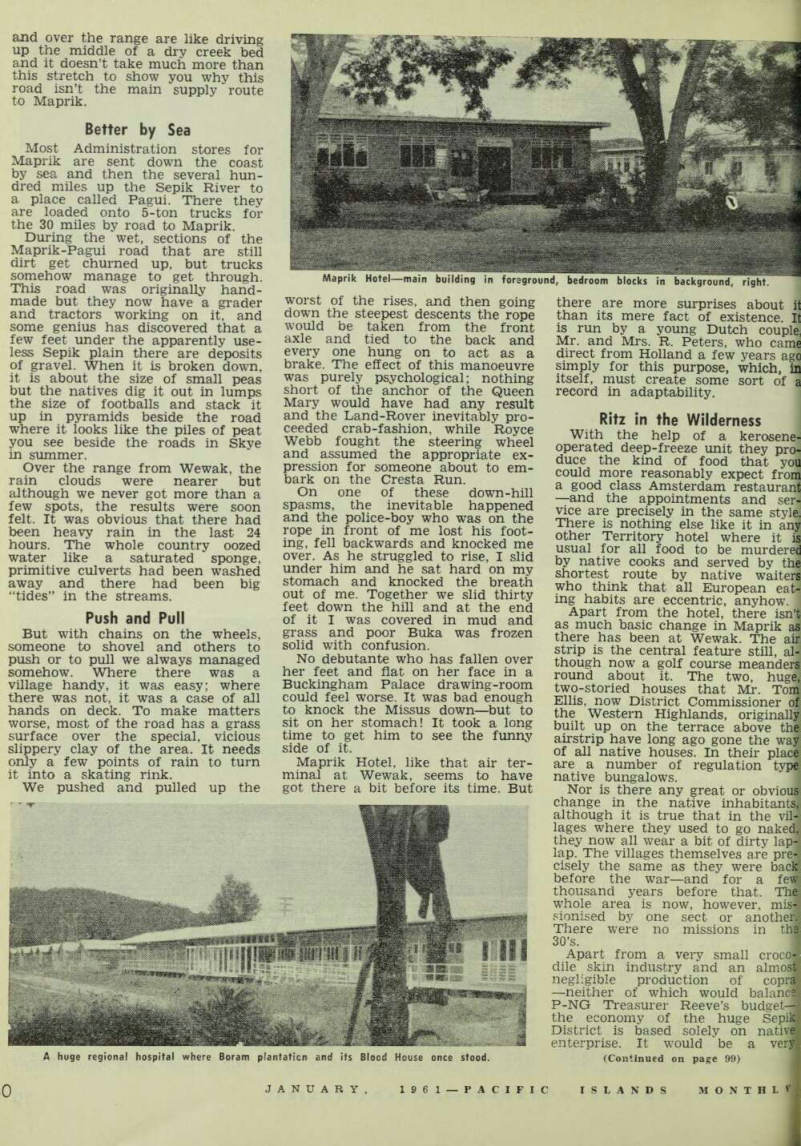
A huge regional hospital where Boram plantation and its Blood House once stood.
Maprik Hotel—main building in foreground, bedroom blocks in background, right.
hirc, therefore, if o ne could that the district bubbles :ethes with native enthusiasts the fields and hoeing the and building industries with aare hands. \ do, I understand, grow 'ice—and in fact I saw some m bags—but if you expected thousands of acres of waving you’d be sadly disappointed, are also being “encouraged” w Robusta coffee and I saw
one or two quarter acre plots of this along the road.
In total, just a drop in the bucket of what could be. However, we’ve probably not given them enough time, as yet; the next thousand years are likely to make a whale of a difference.
Anyone who believes that New Guinea would be better with its European settlers tidily disposed of, should go and have another look at the Sepik District. As I remember these natives, they were never great ones for embracing new ideas. The fact that they did not “savvy” this or that “fashion” was usually the end of the line in any argument and they don’t appear to have changed much since.
European Know-How
Progress, therefore, depends on the powers of persuasion of the Ad ministration officers who are there to lead them to enlightenment. The task is made just that much more difficult for said offi cers because there are no successful European enterprises to show how it’s done. It’s surely no accident that the Sepik District, the only district of New Guinea, which has no network of established European coconut, cocoa or coffee plantations or any industries, is the most economically backward in the Trusteeship Territory, Nature hasn’t been over-kind to the Sepik either, and the vast areas of grassland that it contains are judged by some so-called experts to be useless. It’s hard to believe this, although the results achieved by Yambi Agricultural Station would shake the confidence of the most optimistic.
Yambi has been there on the plains between Maprik and Pagui for the last six or seven years try ing to prove something. Corn, rice, rubber, cocoa, with and without fer tiliser, coconuts—all have been completely unsuccessful. Just now they are trying an experiment in “pasture improvement”—apparently as a last resort.
Yambi, today, consists of a timber bungalow flanked by a row of yellow, dispirited coconuts which have never grown more than five feet high, sitting down on a vast open space where not even the kunai seems to grow with any en thusiasm. It all adds up to the utter negation of human effort.
The man in charge is a lone Englishman who came there from Kenya. I asked him why on earth he left Kenya for the loneliness and frustration of the Sepik plains, and he said that he was still trying to figure it out. I should say that death at the hands of the Mau Mau would be a kinder fate than a two year sentence at Yambi.
On Friday morning Royce Webb started off in the Land-Rover back to Wewak and Bob Bunting left for Drekirkir, a patrol post further
out. They both told me that a plane would pick me up that afternoon— The District Officer, Wewak, was organising it.
I filled in the morning profitably, and in the afternoon settled down to await the plane. A huge storm blew up at lunch time and the mountains were blotted out with purple cloud, but there didn’t seem any reason why the plane wouldn’t eventually arrive.
Air-Borne Bishop
Several other messages came from the District Office—the plane was coming, sometime. The DC had the matter in hand.
Good old DC —w hoe v e r he might be. I still thought so right up to 4 o’clock when the Wewak control tower, appealed to directly, reported no intending flights from Wewak to Maprik that day. That seemed to be that, and I had already reconciled myself to stay ing at Maprik, to not catching the next day’s plane to Lae or the Sun day plane to Port Moresby, when out of the dark sky appeared a blue and white Cessna which landed halfway up the strip.
I didn’t know whether this was the mysterious DC’s doing or not, and I didn’t much care. In no time flat I was down at the plane, complete with baggage, had asked the pilot for a lift to Wewak and had been told to “hop in the other side”. It wasn’t till the tall, American pilot in the white shirt, slacks and sun helmet had climbed in too that I learned that he was the Most Rev. Leo Arkfeld, Roman Catholic Bishop of Wewak.
The Bishop took his Cessna off like a bird and when we had flattened out at cruising level he got out a black book, propped it up in front of him and read his office.
I watched the scenery beneath and in half an hour we were in Wewak.
That evening I met the District Officer. He was very charming, didn’t seem to be unduly surprised to see me there, but asked how I’d got in. I said I’d hitched a ride with the Bishop—and to that he replied that it had been very sensible of me.
I didn’t ask what happened to this plane that he was alleged to have had in hand. For one thing, some time about dusk, a plane may have called at Maprik for me, in which event he would have had every right to be mad because I’d already hopped it. If, on the other hand, the stars had not been right in their courses for a plane that day, or if he hadn’t known about the plane he was supposed to be “organising”, there was no point in bringing it up. The vital thing was that I had made it, hale, hearty and in one piece.
It just went to prove again that, in New Guinea, if you remain calm, don’t panic and just wait, some thing—up to and including a flying Bishop—is certain to turn up.