Magazine Section
pp. 77-78 · Read in the full issue
Pacific Islands Monthly
The Horrors That Came To
Fiji With “Pillar ” Dollars
By R. W. Robson
o ulling out some coins to pay for 'ool drink, in a Suva bar, Maurice ott displayed a large silver coin, out the size of our old, discarded piece.
A Pillar dollar” he explained, ist come to light in Taveuni. me from the ‘Eliza’ wreck on the irai reef. You know!”
UT I did not know, and I ex amined the object with much curiosity, t bore the date, of 1797, under i profile of a gentleman with a braic nose and a close, cruel uth, who was labelled “Carolus I, Dei Gratia”. On the other e was the coat-of-arms of Spain Hispan et Ind Rex”.
Ship carrying 30,000 of ’em got icked on one of our reefs a long le ago, and the coins got loose ong the islands,” said Mr. Scott. sed to be quite a lot of them >ut, up to about 1930; and an asional one turns up, still.” fossicked through some early iks on Fiji, and got on the track the Eliza wreck; and then, in the ? R. A. Derrick’s most excellent tory of Fiji, I found the main ts of one of old Fiji’s most
colourful stories. It concerns the Spanish dollars, the career of the infamous Charles Savage and the introduction of fire-arms to the warring tribes.
Precious Sandalwood
Within the first half-dozen years of the 18th Century, European traders began to hear exciting accounts of a tree being found in Fiji Islands, called sandalwood.
The wood has a number of qualities, chief of which is an aromatic oil of peculiar merit.
Sandalwood from the Pacific Islands had been known to the Asians for a long time. About 1800, they apparently never could get enough of it, and would pay any price for it.
Over 150 years ago, when Euro pean traders began carrying South Seas Trepang (or Beche-de-Mer) from the Islands to China, they dis covered the high value of sandal wood, and that fortunes could be made by those clever and brave enough to get sandalwood logs out of the Fiji islands, from under the noses of the generally hostile and susnicious natives.
Following the trail, the more
venturesome sailors learned that there were quantities of the precious wood on the shores of Bua Bay (western end of Vanua Levu).
Within very few years, the bay be came widely known as Sandalwood
Ba;VropetnThlrcaptaiS llekinl
aua*money h P pt ’ k g y y ' , Wreck of the Eliza Th American Brig Eliza sailed out of Svdnev in Mav 1805 on trad in * an d sandal wooding intent In her cargo were muzzle-loading muskets and ammunition and about 4n 000 o nan i s h dollars Mv re searches have not shown why so many dollars were carried and why they were (and still are) called “Pillar” dollars
. Toneatabii
jhe Elizawent .first to Tongatabu, prepared lor tne long nop into gand -came B ?wo sailors— Husk and Chafes Savage— survive™ from the of g fhe S massacred bv the Sagans P in Corev Tonga:ns m 1804. Captain Corey a dded them to his crew The Eliza, running for Vanua Levu, got off course and became a
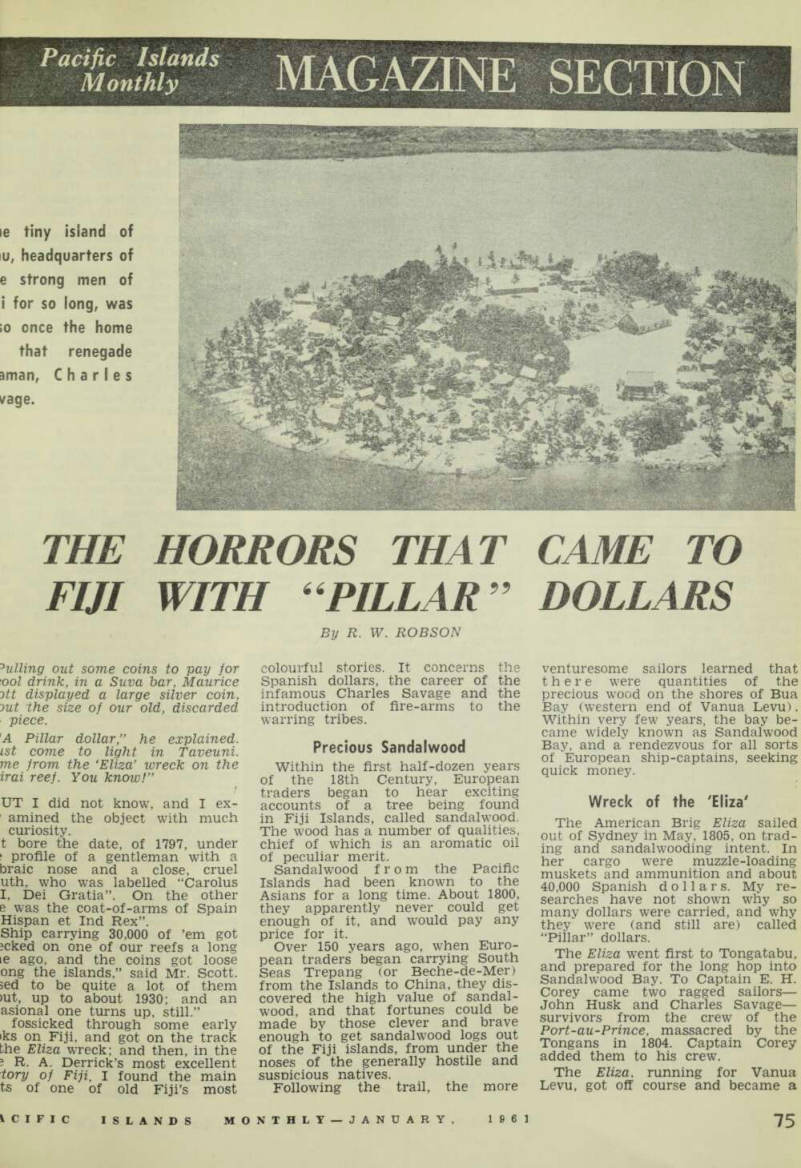
[?]e tiny island of [?]u, headquarters of [?]e strong men of [?]i for so long, was [?]o once the home that renegade [?]aman, Charles [?]age.
total wreck on Mocea Reef, nine miles south of Nairai Island.
The weather was calm, and the whole crew got away in the long boat, with equipment, supplies, arms, ammunition and some 34,000 dollars. They landed on Nairai, and had buried most of the dollars be fore they were visited by a large party of Fijians.
Savage, in Tonga, had learned enough Tongan and Fijian to make himself understood. The castaways were not killed, but the natives grabbed everything in sight, includ ing the whites’ clothing.
Eventually, the Europeans were allowed to leave Nairai, and each party carried away some arms and some dollars. The Fijians then were covetous of muskets, but still did not know how to use them. They were not interested in the dollars, except as personal ornaments.
The captain and four men got to Sandalwood Bay; and others over to Batiki Island But the chiefs of warring tribes were eagerly seeking muskets, and would pay anything to white men who would come and show them how to use fire-arms. Canoe-parties from various localities went to Nairai and carried off half a dozen men (including Savage) for their chiefs The whites went willingly. Already, there were tales around of how runaway Europeans sailors, con victs, beachcombers had become mentors to savage kings, with power, privileges and unlimited harems.
Savage at Nairai joined a large canoe going from Lakemba to Bau,
where he became the right-hand adviser of the Vunivalu, or king— one Naulivou. Derrick thinks it likely that Savage later led a Bau expedition back to Nairai, for arms.
At any rate, Bau war parties, directed by Savage, did deadly work with fire-arms in the Rewa and other nearby districts.
Savage lived at Bau for five years and, as the king’s favourite, he did what he liked.
Those Spanish dollars had become widely distributed among the Fijians, and could be got for a few trinkets. This fact, and the king’s eagerness to acquire marksmen, at tracted from other islands about a score of low-class European ruffians to join Savage at Bau. They lived in most depraved fashion; the historians say their chief demand, apart from alcohol, was for women.
Savage had numerous wives and fathered many children; but the Fijians, with an eye to the future, allowed only his female children to live.
Roasted and Eaten
In 1813, Savage went over to Sandalwood Bay to assist the Hunter to obtain a cargo. He came into conflict with the natives of Wailea, some 60 miles along the coast. He led an expedition inland, to burn a Wailea village.
On the way back, the party was ambushed. Savage, Dillon (of the Hunter) and some eight others, in cluding two Bau chiefs and a Chinese, took refuge atop Black Rock, near the coast, where they successfully defended themselves.
After some hours’ siege, the im patient Savage, accompanied by the Chinese, went down to negotiate a truce. The Fijians seized them; and then tried to persuade the people on the rock to descend.
When they refused, the Fijians clubbed the Chinese, and held Savage’s head under water until he was drowned. Then, in the sight of the Black Rock party, they cut up the two bodies, roasted the pieces over a slow fire, and enjoyed a can nibal feast, with trimmings.
When the Rock party had been reduced to three, Dillon and two companions went down to surrender.
Instead, they grabbed a Fijian priest, put a rifle at his back, and threatened to shoot the holy man if any one of the other savages laid a hand on them. Thus guarded, they reached a boat, and escaped, to tell in detail of the very horrible end of a very unpleasant gentleman.
Savage, as a leader in the process of arming the Fijians for inter tribal warfare, and showing them some of the worst aspects of de praved European character, did an enormous amount of harm to early Fijian-European relations.
The Eliza brought “Pillar” Dollars, Savage and fire-arms in the same voyage to Fiji; and—as I have de scribed it—a “Pillar” Dollar still shows up now and again to remind us of it.
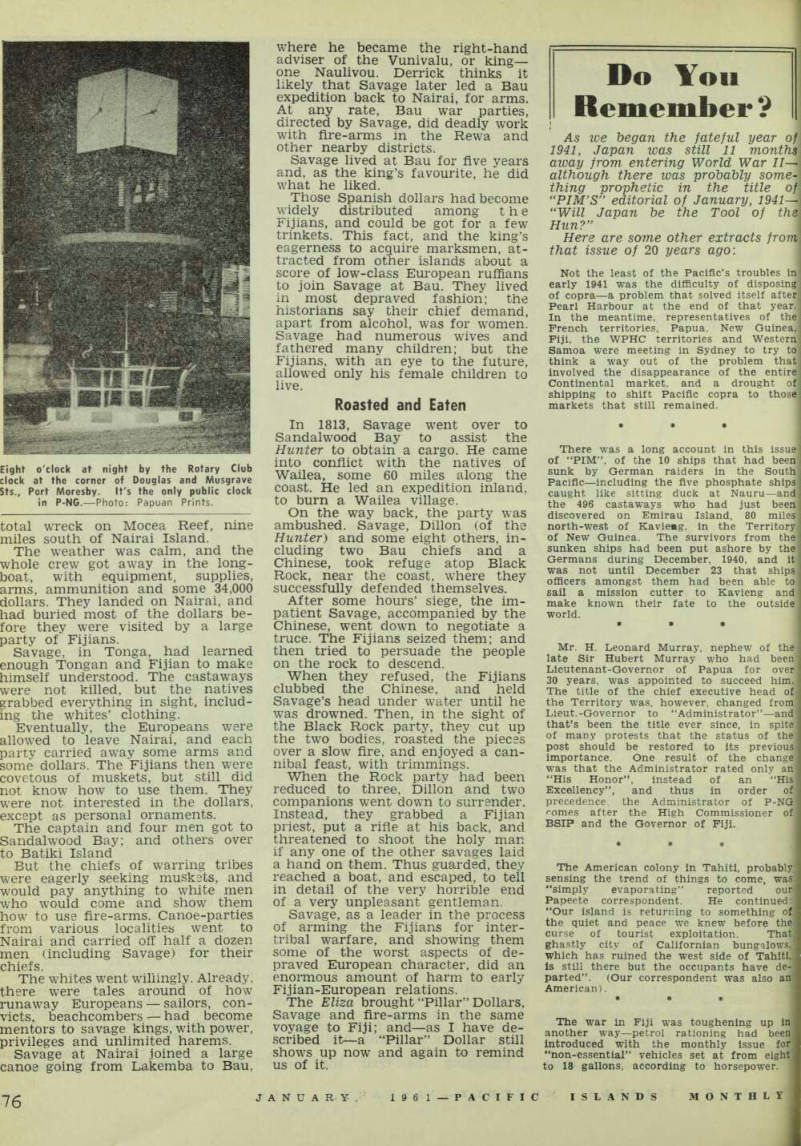
Eight o'clock at night by the Rotary Club [?]clock at the corner of Douglas and Musgrave [?]Sts., Port Moresby. It's the only public clock in P-NG. —Photo: Papuan Prints.