Garaina - Ng's Valley Of
pp. 73-75 · Read in the full issue


Isolation And Tea
By a Staff Writer
If Papua-New Guinea some day has a success -1 tea industry it is likely to be based on a totally fferent set of circumstances to those in other a-growing countries.
THERE has been some private . sporadic commercial interest in tea growing in the Territory in e last 10 years but so far it has me to nothing. In October-No mber this year, other overseas terests were examining the pos )ilities of tea growing in the >rthern District of Papua but eir conclusions and plans, if any, e at present not known. This mid be low-level tea—the highest flding and, from the commercial int of view, the cheapest grade.
The greatest development in tea awing in the Territory is the Ad nistration’s pilot commercial tea mtation in the Garaina Valley, the Morobe District, south of Lae d right on the Papuan border.
Garaina is at an elevation of out 2,000 feet, so the tea grown ere will be mid-level tea and of a isonably good commercial type, he grade of tea to be grown in b Territory is not important any w, according to the experts, as ery ounce of it would have a irket in P-NG as native-labour :ion tea.) \part from its elevation and
climate, Garaina as a tea-growing proposition, is different in just about every way from tea growing in places like Ceylon or India —but that’s not to say, of course, that be cause it’s different it will be a failure. Garaina could be exactly right for New Guinea tea growing success.
No NG Labour
In old-established tea growing countries, the industry is based on skilled, plentiful and cheap labour.
New Guinea has none of these, and so far as Garaina is concerned, it is a case of there being no local labour, period. It is one of those areas—frequent in the Morobe Dis trict —that has little or no indigen ous population.
The tea project is, therefore, based on the proposition that there has to be devised some mechanical means of plucking tea—or there just won’t be any industry.
For this reason, the tea itself is
planted flat on the valley floor, in geometrically precise, spaced rows, and does not sprawl haphazardly up almost perpendicular mountain sides as it does in Ceylon and else where.
Exactly what form the mechanical pluckers will take doesn’t seem to be known yet, although the idea is not new, of course. Mechanical plucking has been tried in Ceylon, although the haphazard way the bushes have been planted and the terrain on which they grow, make it difficult, if not impossible, there.
The biggest snag in mechanical plucking, according to Ceylon ex perts, is that the machine is not selective enough and instead of tak ing the “two top leaves and the bud”, as the human plucker does, it is likely also to chew off half the twigs and stalks on the bush. How ever, Ceylon is more concerned with a high quality product than New Guinea is likely to be for some time, and special methods of pruning, with tea planted on flat ground, may overcome this trouble of selectiveness in time, in the Terri tory.
Needs High Rainfall
Tea requires a high rainfall and good drainage, and the fact that Garaina’s tea was planted on the valley floor created some problems, but judging by the several hundred acres of flourishing tea I saw there recently, the problem of too much water has been successfully over come.
A large, two-storey prefabricated tea factory that has been lying around in crates for some years is now in the final stages of being put together and when the machinery is installed, should be functioning early this year.
There is no doubt at all that tea will grow well in parts of the Terri tory; and no doubt, after the usual teething troubles, that a reasonably
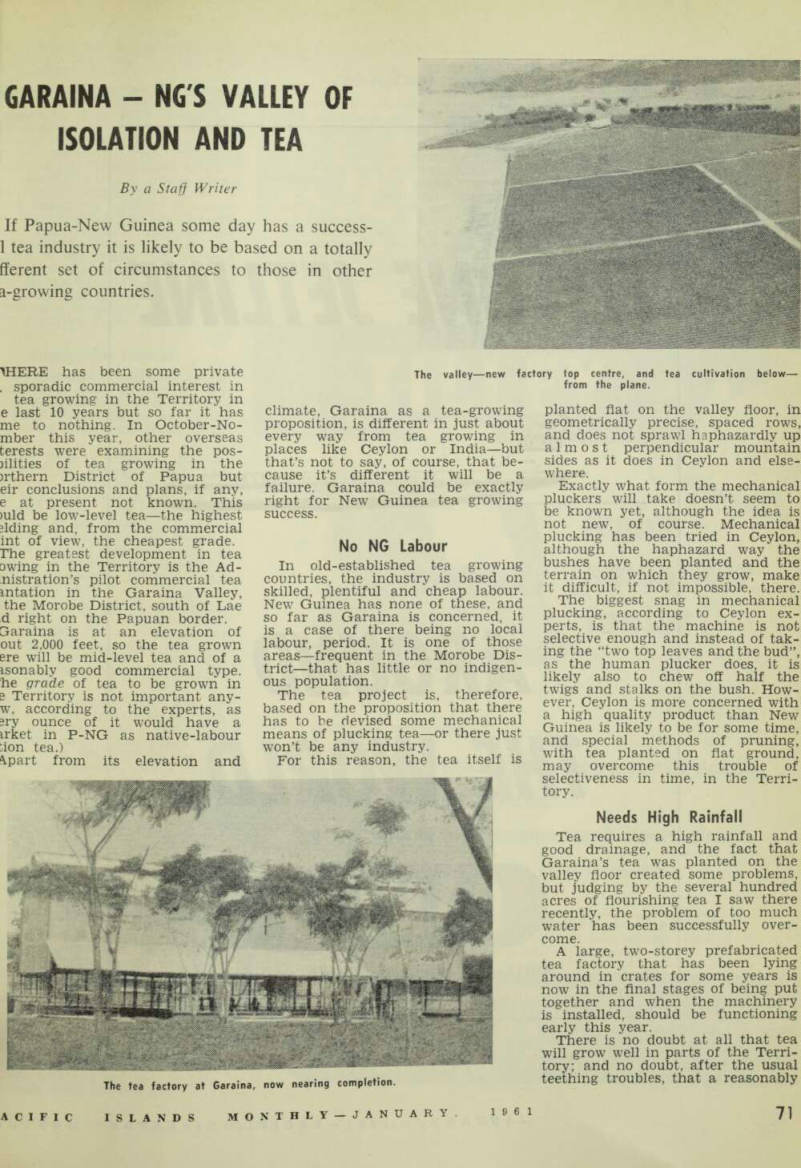
The tea factory at Garaina, now nearing completion.
The valley—new factory lop centre, and tea cultivation below— from the plane.
)d product will be produced. The question then will be how much ‘s it cost? lany minor, promising industries rted in the Territory have fallen pieces in their early stages be ise they could not compete with ducts imported from other pical countries, or even Australia, spite of the “cheap black labour” t Australian trade unions often d about, Papua-New Guinea is ery expensive country in which produce anything. At the moment probably “enjoys” one of the best cost-of-living scales of any ntry in the world, due in part the fact that many local enter ics do not base prices on cost of duction, plus a reasonable profit, on what a similar article costs ;n imported from abroad.
Commercial Future?
Tiile Garaina is probably ideally ed for a pilot project of this , it is doubtful if, under present iitions, it would be as ideally ed for a large commercial enter e. you draw a straight line be ie n Port Moresby and Lae, aina is a little on the Lae side ic half-way mark. A Papuan Air isport plane calls there about ; a week on a service between Moresby and Lae; but Garaina icultural station (which is ama), is supplied by an Admin -tion chartered aircraft once :ly from Lae. le plane is a single-engined r. You fly out over the Huon , probably in sunshine, cross coast with Salamaua on your and head south into the otain mists and storms of )be. out 50 minutes out you go nd a mountain and go through all pass and there is the valley raraina before you, green and lant with the new tea factory m that distance, like a shiny :oy—at the far end of it and •atterns of tea plantings rapidly ig shape beneath. In a way ma coming at it like that, is a ke the Vale of Kashmir, with he poplar trees, the mud and iwarming people. untains are piled up all around valley and to the south and i-east there are some peaks go up around 12,000 and 13,000 5 things are these days, uld be incautious to say that tne time in the future this tea 7 will not be linked by damised roads with the sea But it is certain that it won’t I a year or two yet. In the time, whatever goes into in way of supplies, inery, plant and buildings goes air, and any tea that is pro must come out the same way.