Some Brief
pp. 49-52 · Read in the full issue
Encounters
Islands Notes Made By
Judy Tudor
I met a couple of Kai Vitis in New Guinea when I was e recently. One of them liked the place; and one couldn’t
anything good about it.
VITI, of course, means born Fiji. Number 1 was Grainger tinson, son of Mr. and Mrs.
Johnson, of Suva; and one reasons he likes it is that i a fit mood to like anything sent. vas married early this year j and his young wife have a it, small bungalow not far the Rabaul harbour shore — le novelty of keeping house worn off. other was Bob Miller, of the 1 Medical School, Suva. He me sort of travelling Fellow >r South-East Asia; but as a inary canter he was having veeks in Papua-New Guinea, ay he wasn’t liking it much be the understatement of the 7. He looked gloomy most of ne and said, at frequent in : “This place is 100 years be riji.” way Mr. Miller and I “found” ther didn’t make him think iore of the place, either, rrived at the hotel on a Sun fternoon when the regular /as off duty and there had
been some argument over an air conditioned room I’d been promised that wasn’t aavilable. Finally, I was told that until the thing was straightened out on Monday I could have the room permanently re served for Mandated Airlines pilots.
The room was near the end of the corridor and, as well as the door into that, there was another in a side wall. I opened it, and it led into a shower cabinet; the front door of the cabinet was open and through it was the rest of the men’s bathroom and lavatory. There wasn’t anyone there, so I took a good look around to get the lay of the land.
There weren’t any keys in either of the doors in my room; and dur ing the afternoon I brooded about it a bit. Knowing something of how things happen in New Guinea, it was almost certain that, at some time, someone would try that door out of the shower cabinet and walk into my room when I least expected it.
When I returned that evening, and was part-way through chang ing, it suddenly occurred to me that if I sneaked in through my private door, shut the front door of the shower cabinet and snibbed it in side. no one could get into the cabinet, certainly, but they couldn’t walk into my room, either.
No sooner said than done.
I could hear water running some where in the bathroom; but, mixed up with the air-conditioner, it didn’t sound as though it were just through the door, so I turned the knob cautiously and pushed gently.
When it was about two inches open something grabbed the knob on the other side and started to pull. I pulled back and after a short tug of-war I won.
I sat down and waited five minutes, until the sound of running water had stopped, and then I tried again. Exactly the same thing hap pened; but this time the struggle was fiercer, before I got the in fernal thing shut. With a premoni tion of what was about to happen I leapt for my dressing-gown and I was standing in the middle of the room just tying the girdle when the “secret” door was flung open and there stood a tallish, thin man, with
a smallish bath-towel draped around his lower portion and a rapidly extending look of utter confusion covering his top half. It was Mr.
Miller, though I didn’t know it then.
Apologising profusely, he backed into the shower and out into the lavatory and disappeared—and I followed and snibbed the shower door.
The next day I met him in the passage, and wouldn’t have recog nised him had he not apologised again, and demanded to know what kind of fool arrangement was it that had bed-rooms opening into public lavatories?
He said he’d noticed the extra door in the shower cabinet and, when he saw it open a couple of times, he’d concluded it was a cup board and that a native was some how trapped in it. Finally, he threw the door open to rescue the native
[?]edler and friend, in the Baliem Valley, Netherlands New Guinea.
id walked into a strange female’s ■oom. found afterwards that a similar a on the other side of th 3 idor opened into the women’s iroom and lavatory. Quite an , so long as the hotel clerk re ibers to keep the sexes segre d.
With
s Schoedler
hen I was passing the Country len’s Association building in ang I thought I’d look in to see bey served tea there, as the does in Port Moresby, found that they didn’t; but s how I met Miss Lilian iedler, of New York, e was living at the CWA and ediately offered to make me f tea —if I didn’t mind it being 3 with a “tea-ball”. So long had some resemblance to tea, ; then I didn’t care what she 3 it of, laresay that, in her time, Lilian edler had broken too many ds and shattered too many, mceived ideas to keep count, says she is a “tourist”—but the most untypical American st I’ve ever met. She’s one s more interested in what she than in the plumbing, e went to New Guinea for a ie of weeks in August, 1959, she was still there in November, trying to make up her mind her to go back to Australia or ) Borneo.
She Likes It
3 has been having alternative of work and travel for almost ;ars and now, in her late 60’s she’s using up her old-age iy on a final fling. She doesn’t as though she’d need that V for some time to come, any having top flight executive ons most of her working life, Schoedler has been able to
keep several people besides herself, and travel as well—jobs like executive secretary to the first com mittee to control atomic energy; and assistant to the chairman of the American consultants’ group at tending the San Francisco Confer ence that set up the United Nations Organisation.
She arrived in Australia from the United States in 1957, and later went on to New Zealand where, in June, 1959, she saw an advertise ment for the Matua round-trip through Fiji and Polynesia. As usual, it was booked up solid, but her luck was in and she got a last minute cancellation. She spent three or four weeks in Fiji on that occasion.
In August that year, she got the same kind of cancellation on the Bulolo. She had intended to spend a week or two in Papua-New Guinea but when I met her she had been there over 13 months.
In that time she had been all over New Guinea and spent some months as well in Netherlands New Guinea. She had visited the remotest spots, gone out on patrols, stayed with Administration officers on out stations; and her enthusiasm was
firing on all eight cylinders, right to the bitter end.
I’ve never seen such a happy visitor to New Guinea; and I’ve never met an American like Miss Schoedler.
As I was looking through the last of the hundreds of photos she has taken in the wackiest places and situations, I said: “What’s the first thing you do after getting back to civilisation, after one of these expeditions?”
“Make straight for a hairdresser,” she said.
Well, thank God the woman’s human. It’s exactly what I do my self.
The Uniqueness
Of It
But one Lilian Schoedler doesn’t make a happy tourist industry.
It was in Madang that I met a London director of an overseas shipping company and a Sydney executive of the same firm. They had a pretty tight schedule and had had the bad luck to be copping planes that no seats (but tin benches along the sides) all along the line.
For some reason, this seemed to affect our London friend more than all the other P-NG shortcomings put together. He just couldn’t get over it, and kept remarking how good the Boeing 707 service was from London to Sydney—as though to reassure himself that there was a world outside like that, and air craft like that.
What's It Really Like?
I doubt if Territorians really have any conception what P-NG seems like to many overseas visitors. The slap-dashness of it, the attitude that anything is good enough in New Guinea; the utter disregard, outside of private homes, for the ordinary amenities and comforts;
Worm's Eye
View
This RAAF Hercules transport is NOT in the right place. This is a worm's eye view of her after she had run off the Wewak (NG) airport while landing in heavy rain recently. She buried her undercarriage in the soft earth, but got off under her own power.
Photo: D. W. Hawksley
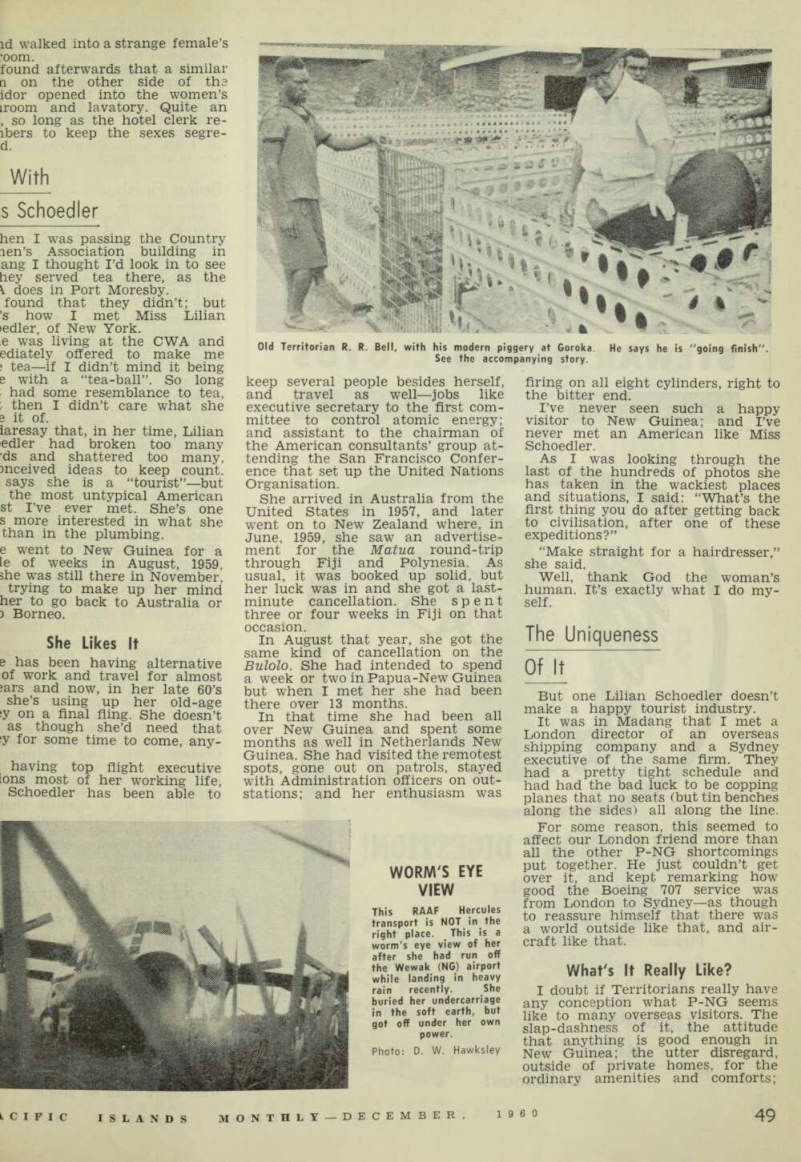
Old Territorian R. R. Bell, with his modern piggery at Goroka. He says he is "going finish".
See the accompanying story.
and sometimes the utter disregj of normal social behaviour as w There is much talk of a toui industry up there, at present. So people are saying that the Territi has something to offer that is ab lutely unique in this world. T 1 are right, of course, and someth] in more ways than the one tl are talking about.
Going Finish
Another long-time Territori who is soon “going finish” is ] R. R. Bell, seen overleaf in motel for pigs at Goroka.
Dick says he’s resigning from i Government this month, though will probably go back to the Tei tory after Australian leave another two years with a priv organisation.
His road, since he arrived Papua in 1921, has had more th the normal number of turns in His first job in Port Moresby v to acquire “two old bombs of cai take them apart and put them gether as one car. With this started a hire-car business, the fl one Moresby had.
Later he became a schoom master and it was he who took Ce tain Frank Hurley on his pho graphic expedition up the Fly Riv He worked for the Sandy Cn company when the Morobe go' fields were booming and went to t Wewak gold-rush in the m: thirties. He tried Wewak again af the war but the gold was pre well worked out and uneconomic higher cost of production. Since 11 he has been in charge of the Admi istration agricultural station Goroka.
The piggery is a development the last few years. It covers seve: acres and by using large river stor and a plentiful supply of gover ment cement, each of the bit blooded animals, some of which e the size of young rhinos, has private apartment and sun balco] Cement paths and drafting pe help keep the whole thing cle but although it is impossible to li pigs very much even under th( conditions, it is obvious that t whole set-up is the apple of Di Bell’s eye, as well as a monume to his nine years service in t Administration.