For Native Music
pp. 43-47 · Read in the full issue
Alfred Hill Did A Lot For Native Music
By Lew Priday
Nobody more than the Australian composer Alfred Hill, tio died recently, condemned the commercialisation, the Tin m Alley perversion of Polynesian life and music.
_,L worked throughout his life— nd he was 89 when he died— or the preservation of what ined to be preserved of the old i chants, realising they would priceless treasure not for New nd alone but for the whole lesian world. tenever he called in to the Aus n Broadcasting Commission in Pitt Street, Sydney, where I 3d (the last time was in April rear) or when I went out to see it his Mosman, Sydney, home, he 1 talk a great deal of the music le Polynesian, the Melanesian the Papuan, and of the Aus n aborigine. Some of his stral works echo these themes, illustrate his point, he would ace his conversations, eyes ling and manner animated so you forgot his great age, with hes of Maori songs; these I also heard him introduce in over the air. (Yet his Waiata vill probably remain his most as). >n after World War I, Hill was imental in getting New Zea author James Cowan and a rnment photographer to go into :ing Country with a dictaphone ake recordings of old Maori and chants—“and I told them ike sure to have them sung by lersons so that we wouldn’t be 1 by what might be only an tion of the voice”. This is a that recorders of island music : well remember.
Priceless Records
ise Maori records, Hill would ie, were priceless, irreplaceable.
Grainger was of the same m. Yet what happened to ? They were buried away for 30 in New Zealand Government n-holes and allowed to crumble many islands, of course, it is iy tod late, but not, he would ie, in Papua and New Guinea, i as well as Australia-con d. There, away in the hidden s, a wonderful job still awaits nan with the tape recorder, lame may perhaps be said of a id number of islands well away shipping and air traffic routes, hey fail in seeing this job suc illy done, the Dutch and Aus n authorities will have even excuse than the New Zealand
authorities have in failing the Polynesian world by not preserving their portion of the heritage o'f age old chants.
New Guinea Music
The “discovery” of native music in New Zealand was also much in Hill’s thoughts.
It was to “the master”, as he always called him, that soon after the war young West Australian Ray Sheridan brought back annotated music in manuscript form (often enough written on the back of old envelopes) as well as drawings of native instruments made during long walkabouts through the mountains and along the coasts of New Guinea.
Later, with Hill’s backing, Sheridan received a grant so that he could travel about and collect music and legends, the idea being to encourage the natives to develop their own art —not to copy that of the European.
Back in Sydney, they worked over the harvest together, the result be ing the publication of “Alfred Hill’s New Guinea Songs”, with Sheridan’s background notes. The nine songs in the book range far and wide, from a dirge by the Orokaivas to a sunset song from New Britain, Hill’s contribution being the English words and the arrangement. It is a com panion book to Hill’s “Maori Songs”.
Hill used to tell me this type of New Guinea music was rather more sophisticated than the Australian aboriginal music, and was probably not so very old.
I am glad that Hill lived long enough to welcome and sing the praises of the long playing record “Music of New Guinea”. ( PIM, Dec., 1958). This joint record from the Sheridan and Dr. W. E. Smythe collections contains over 70 songs with Sheridan’s annotations, from all parts of Papua-New Guinea, in cluding Bougainville. As one of the richest collections of native music to come out of the Pacific, it has won recognition overseas. (“I believe,”
Hill told me, “that Sheridan’s work is of inestimable value to Aus tralia”.) Sheridan has since done the piece about New Guinea music in the “Australian Encyclopaedia”.
It is a long cry from the modern tape recorder to the days before World War I, when the Australian anthologist, Dr. Poesch, the first apparently to collect native songs in New Guinea, visited the Rai Coast and Eastern Madang with an old cylinder recorder. It is to be
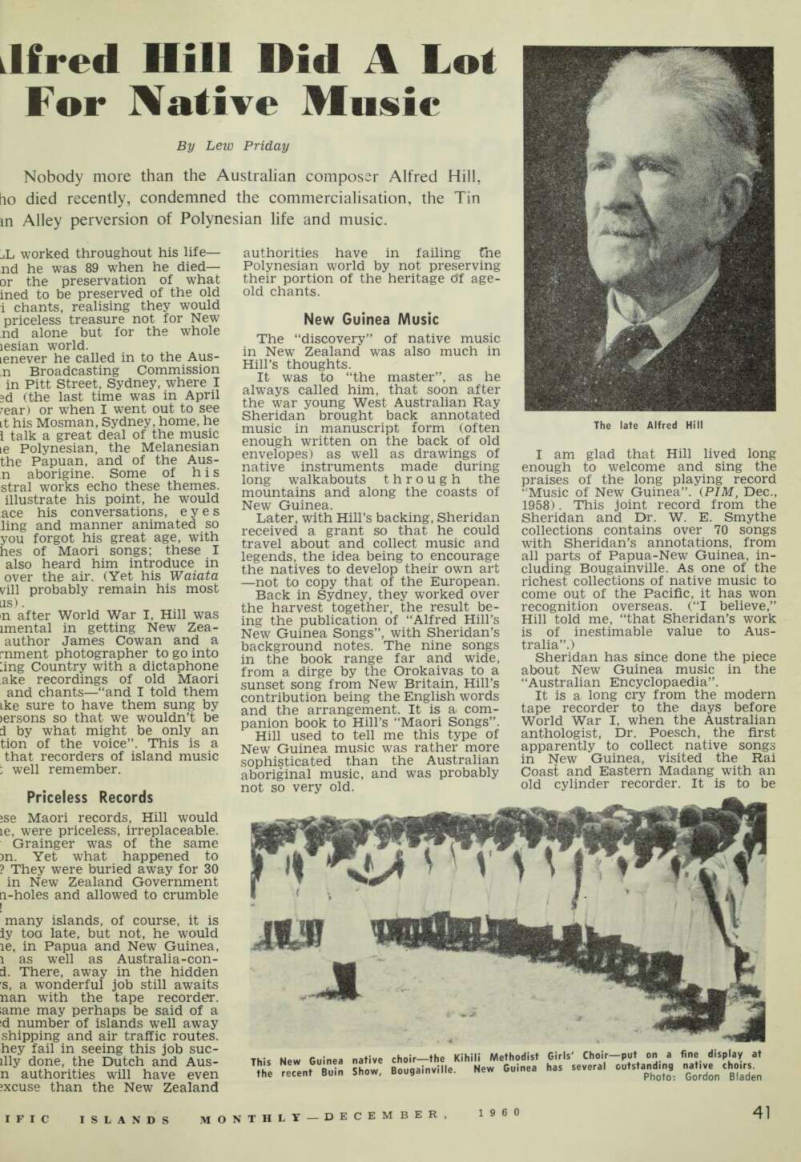
The late Alfred Hill
This New Guinea native choir—the Kihili Methodist Girls' Choir—put on a fine display at the recent Buin Show, Boogainville. New Goine has several outstanding native choirs.
Photo: Gordon Bladen
d that in their home in the er Kunst Museum in Vienna, are better looked after than the Maori cylinders' in Well m. fred Hill was fond of telling me le wonderful collection of Aus an aboriginal music brought from Arnhem Land by the ex :ion led by C. P. Mountford. ( said: “Mountford brought all recordings to me. I found a th of material in them —enough lild a whole school of Australian c. It has a wonderful rhythm /4 time. Its range is very ex ed, sometimes more than an ve, whereas Maori music has a limited range. Usually this c starts high and comes down ie end of a phrase. We had the of our lives putting it on ir ” 11 used some of this music as basis of the third movement of “Australia” symphony, just as ised Maori music and Maori les in his New Zealand works : once spoke of his published ction of Maori songs as his
apuan Melodies on an
Old Edison
a footnote to what has been ;aid about Alfred Hill’s interest n Pacific Island music, mention Id be made of the recordngs ;tly from Polynesia) made for New York Natural History jum by members of the Fahns h expedition whom I met in nea early in 1940. Their fine t was subsequently wrecked on Great Barrier Reef, ie of the Fahnsworth brothers to New Guinea after his try entered the war, and was ig the first Americans to be i there. Their mother, who was
on board the yacht, wrote a book called I Went to Sea at Fifty.
At isolated Pacific islands at which they called, they would assemble the old folk, who became so drugged with chanting that they could go on all day and all night.
Apart from Ray Sheridan, two well-known Australians have recorded New Guinea music, Captain Frank Hurley and (more recently and for the ABC) Colin Simpson.
Captain Hurley went to Papua soon after World War I, and made Australia’s first full-length feature film, which ran in Sydney, New York, and for three months at the Philharmonic Hall, London. While the New York run was on, melodies from Papua were heard for the first time ever in one or two New York
night clubs—and that was in the early 1920’5!
Braille Translations
Simultaneously the story of Cap tain Hurley’s safari was published by Putnams in New York. Like °ther Hurley books, it has been transcribed in braille.
Another result of the expedition was the publication in 1921 by the Sydney firm of W. H. Paling and Co., of Pearls and Savages : a Cycle of Papuan Melodies, “gathered for the first time” by Captain Frank Hurley and arranged on Hurley’s return by “Manny” Aarons, for many years organist at Sydney’s State Theatre.
Captain Hurley told me: “We re-
Hill's Maori and New Guinea song albums.
I on the old wax cylinders, had a lot of experience with gramophones, and I went with ate Alan McCulloch of the ilian Museum, who was quite )d musician. We were the it in some places in the Gulf pua and also right into the >r, among the Ononge tribes, igmy negritos of the Owen ys, and on the far coast ; the Orokaivas. We gave a pretty fair coverage, got these fellows to rehearse y what we wanted and then it the cylinder, afterwards g it back to them, and so of we became very great witch s indeed. We had tremen ►ower over these tribes, bring ck to them in this music the of their tribal ancestors, sounds were of things ir to them, rivers, winds, and ort of thing.”
Played in New York tain Hurley recalled that ilia’s first feature film ran Dme months at the old Theatre in George Street, sound track had not yet i, the orchestra synchronised aying of the native music to action of the picture, of the New York bookings t Carnegie Hall, where the tra also played the native in the same way. This, plus light-club playings already med, were the first opportunity lan audiences ever had of g New Guinea music. ■ Papuan visit was quite a ring effort,” he said. “The vas, for example, were quite e of knocking you on the head itting you in the pot. I had of help from the missionary , but there we were quite be heir province. We found that of the melodies were so old hey had outlived the tribal . Words of a forgotten past frequently sung, words that ave no significance. The in ;e answer the natives gave i paradox was, ‘they are the of our fathers!”’
Unending Repetition
ain Hurley noted that the Asians of the littoral, the most invaders, had the least music ?m. Their songs, generally n a highly pitched falsetto, nontonous chants of unend ipetition. During a singing ; in the Mekeo, he heard the hant repeated 72 hours with termission. He rather grimly “The three notes of that still linger in my memory.”
Dund the inhabitants of Cen ipua, the aboriginals of the Y, set the highest musical rds, in a memorable setting. >ongs of the mountain men ndered in a rich bass, the tribe generally chorusing in iy. When the moon is shed
ding her silver beams over mist filled valleys and the mountain men, high up in their homes on the pinnacles, are singing, Central Papua is a place of rare enchant ment.”
Plenty of Troubles
All the same, the recording of such music on the old Edison phonograph presented a multitude of difficulties. Sometimes great difficulty was experienced in even inducing the timid and wild people to face the machine.
Captain Hurley can certainly claim to have pioneered a field which students of native life today are not neglecting. The songs pub lished so long ago by Palings in clude Song of St. Joseph’s River, which renders the stream’s rising and falling cadence as it plunges into a gorge; The War Song of
the Orokaivas ; I am Looking for the Children of the Birds, a nature song of the Ononge tribe; a charm ing Chant of the Ibila River Tribes, “which sounded good when we tried it over on a piano”; and a grotesque Song of the Headhunters, from Western Papua.— Lew Friday.