Territories TALK-TALK
pp. 35-38 · Read in the full issue

TOLALA writes from his hospital bed.
When I mentioned Bishop Leo Scharmach’s book, “This owd Beats Us All”, in a previous issue I had only read the tinning of the story in a serialised form. I had not then seen bound volume which, I must admit, rather disappointed me.
IOOK of this value —and the formation set out in its pages of inestimable value —is de g of something better than a cover carrying a clownish ation. I cannot associate the d, with all his poise and y, with this tawdry cover, attitude of the Bishop in g with the Japanese was un ?dly responsible for obtaining ‘ considerate treatment for Crowd” on many occasions their captors. His technique rogance and injured dignity I many a trick in his favour, him in action on more than ccasion and I marvelled at le got away with it. explanation which I worked ?as that the Bishop’s self nce and fearlessness, coupled the fact that diplomatic re ; with the Vatican Cily were 3eing maintained by Tokyo, the scales in the Bishop’s ■ when decisions were being id by the Japanese High Brass w Guinea. ... It may have Jius. the Bishop’s description of the ng raids, the Japanese char ities and conditions generally, ig during those three and a ears, were all very realistic, oked in vain for some refer -3 the personalities whom he so sheltered and cared for dur tiose years; for the expert tent he was able to give “Blue- Rundnagel, a diabetic sud cut off from his normal drug is, but who showed remark mprovement in health after herbal medicine prescribed e Bishop, who had made a 5 study of botany in his ir days. *e was the kindly care he gave Ire James Benson, of Gona, rrived from the Kempeitai in 1 a mental and physical wreck und a haven and loving kind idth the Bishop and his go 's. And the Tills, the Hoerlers rs. Kaumann-Juker, the latter unately dying a few days be ie Australians arrived. •e is only one outstanding vith which I join issue with id that is concerning the re lat those who were sent away Montevideo Maru were not vay at all, but were massacred
and their bodies buried on Matupi Island.
I actually heard about the sailing of the Montevideo Maru with troops and civilian personnel aboard a day or so after it departed from Rabaul, and the embarkation was described to me by both Asiatic and native eye-witnesses.
One particular incident I re member having been described was the execution of a young soldier who was discovered to be in possession of a small radio receiving set. I was told he was hurried off the boat, taken a short distance from the gangway and shot
The bodies found in a common grave on Matupi Island, as men tioned by the Bishop, were, in my opinion, those of Allied airmen and Australian civilians who were executed—most of them during the first year of the war.
Amongst the civilians I feel sure was the Victor Pratt party, who were captured in a hide-out on, I think, Raniolo plantation during August, 1942. Montevideo Maru sailed in the latter part of June, 1942. In the Pratt party was “Tommy” Thomp son, accountant with W. R.
Carpenter in Rabaul and it was his wristlet watch which was identified and mentioned by Bishop Scharmach.
I cannot, from any angle, agree with the Bishop’s report that the troops and civilians—some 1,100 of them—did not sail on the Monte video Maru. I have heard the rumour before, but cannot remember seeing an official denial. This should be done so the matter can be settled once and for all.
"A Memorial's
History"
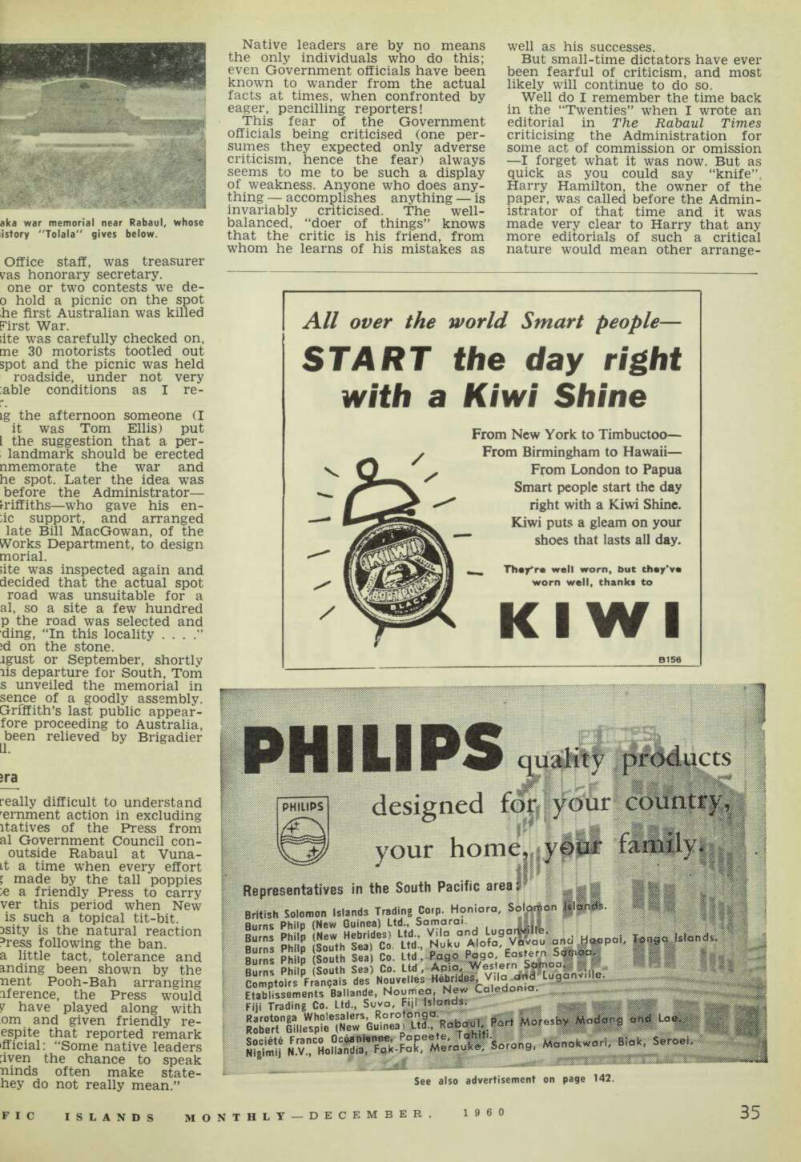
The reference to the Bitapaka war memorial (PIM, Oct., p. 143) recalls the interesting series of events that ultimately led to its erection.
In 1934 an automobile club was formed in Rabaul and was called the Automobile Club of New Guinea.
Its first president was Phil Coote (BP’s manager), Tom Ellis, of the
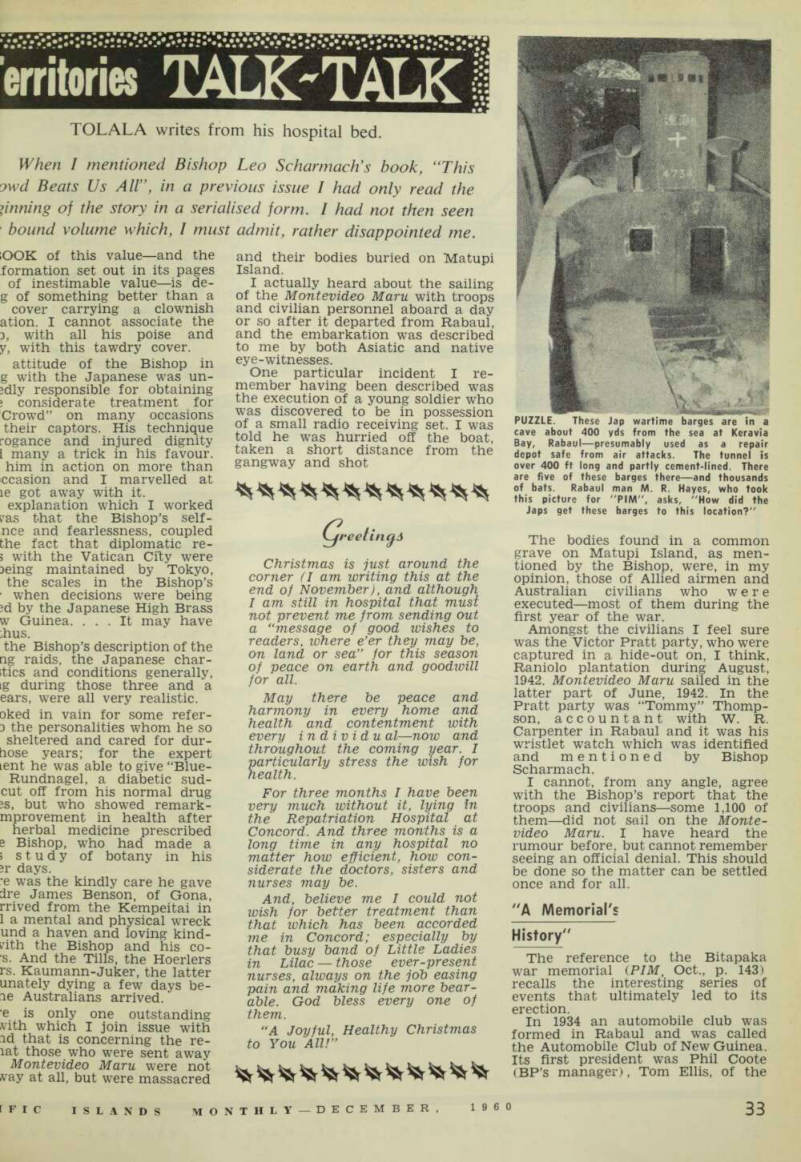
PUZZLE. These Jap wartime barges are in a cave about 400 yds from the sea at Keravia Bay, Rabaul—presumably used as a repair depot safe from air attacks. The tunnel is over 400 ft long and partly cement-lined. There are five of these barges there—and thousands of bats. Rabaul man M. R. Hayes, who took this picture for "PIM", asks, "How did the Japs get these barges to this location?"
Office staff, was treasurer vas honorary secretary, one or two contests we de -0 hold a picnic on the spot he first Australian was killed First War. ;ite was carefully checked on, me 30 motorists tootled out spot and the picnic was held roadside, under not very ;able conditions as I re ig the afternoon someone (I it was Tom Ellis) put 1 the suggestion that a per landmark should be erected nmemorate the war and he spot. Later the idea was before the Administrator— Griffiths —who gave his en :ic support, and arranged late Bill MacGowan, of the Works Department, to design morial. >ite was inspected again and decided that the actual spot road was unsuitable for a al, so a site a few hundred p the road was selected and ding, “In this locality . . . .” ;d on the stone, igust or September, shortly lis departure for South, Tom s unveiled the memorial in sence of a goodly assembly.
Griffith's last public appear fore proceeding to Australia, relieved by Brigadier »ra really difficult to understand r ernment action in excluding itatives of the Press from al Government Council con outside Rabaul at Vuna it a time when every effort I made by the tall poppies :e a friendly Press to carry ver this period when New is such a topical tit-bit.
Dsity is the natural reaction 3 ress following the ban. a little tact, tolerance and anding been shown by the nent Pooh-Bah arranging iference, the Press would 7 have played along with om and given friendly re espite that reported remark ifficial: “Some native leaders ;iven the chance to speak ninds often make state hey do not really mean.”
Native leaders are by no means the only individuals who do this; even Government officials have been known to wander from the actual facts at times, when confronted by eager, pencilling reporters!
This fear of the Government officials being criticised (one per sumes they expected only adverse criticism, hence the fear) always seems to me to be such a display of weakness. Anyone who does any thing accomplishes anything —is invariably criticised. The well balanced, “doer of things” knows that the critic is his friend, from whom he learns of his mistakes as
well as his successes.
But small-time dictators have ever been fearful of criticism, and most likely will continue to do so.
Well do I remember the time back in the “Twenties” when I wrote an editorial in The Rabaul Times criticising the Administration for some act of commission or omission —I forget what it was now. But as quick as you could say “knife”, Harry Hamilton, the owner of the paper, was called before the Admin istrator of that time and it was made very clear to Harry that any more editorials of such a critical nature would mean other arrange
aka war memorial near Rabaul, whose istory "Tolala" gives below.
merits being: made for Govern] printing, which was then Ha main source of revenue.
Editorials ceased altogether 1 but I had a great longing to i the story of How the Press Gagged. I didn’t. We had not h so much of the Equality of Ma those dark days.
A Dokita in
The House
It is with considerable inti that I have been following the a ment about calling a “doctor doctor when he isn’t one.
At a casual glance it seems it is a case of officialdom ben over backwards in an effort pander to the good graces c Papuan individualist who has the ear-marks of becoming a pop leader amongst his people.
Native individualists need car handling by officialdom. On t treatment depends whether the dividualist steps Right or Left.
If officialdom insists on cont: ing the practice of calling an Asj ant Medical Officer a “doctor”, might ask what will the reactioi in future years when natives 1 graduated as fully quali Bachelors or Doctors of Medici What about a compromise calling the AMO’s “Dokita”, with abbreviation of Dk?
If this same pandering polic] to be maintained consistently, I one may expect pronounced 1 dividualists in the Pacific Isla Regiment to receive the couri rank of Major or Colonel be] they have actually qualified.
And in the Auxiliary Public S vice, such persons with poten political pull would soon become! sistant Directors or Commission I think the British Medical I sociation will settle the argud somehow.