nployment Registrations
pp. 115-139 · Read in the full issue


Pacific Report
The month’s round-up of news and pictures of people and :nts, from P/M correspondents in the South Pacific.
len Rise in Fiji
nployment Registrations
; Fiji Government’s Labour 1 was faced with a sudden and
ing rise in unemployment
rations in October. But it was j artificial. •ing September, two businesses iva closed their doors, which sd a real increase in the ier of unemployed. G. B. Han, ,ng manufacturers, paid their iployees and sent them home, 3ish Ltd., an engineering firm, off between 60 and 70 ern es. (P/M, October, p 31.) : these did not account for 600 registrations made during >er. flood immediately followed a .ng at Suva’s Century Theatre ►ctober 5, called by Mr. James ony, secretary of the Wholesale detail General Workers’ Union.
Anthony advised the audience, ated at about 700 people, that iployed persons should act ptly and register at the Labour " additional number of regis ms was attributed to a rumour the Labour Department was iting workers for jobs in New md. The Government issued a il but men kept coming to ter for New Zealand jobs, e Labour Department said the trations would have to be /sed and checked before the es would be of any use to the rtment. Some of the registra tor jobs in New Zealand might been made by men who ,dy had jobs in Fiji, d there were many other >ns why registrations could be 3 without there being a sudden of real unemployment.
ansion Plans: New
an for Fiji Airways
preparation for the expansion s overseas services Fiji Airways purchased a third Heron air from NZ National Airways oration. The aircraft was to be ered from Christchurch via :land, Norfolk, and Tontouta
before the end of October following certain equipment modifications required for its new Islands’ service.
Negotiations with the Governments of Western Samoa, New Zealand, American Samoa, the French and British Administrations in the New Hebrides, the British Solomon Islands, and the United Kingdom were proceeding in connection with the planned services to Western Samoa and the Solomons, but due to so many different authorities being involved this took time, and
no date for the commencement of such services could be forecast yet.
Parallel with the company’s own negotiations, the Fiji Air Licensing Authority had its own negotiations to carry out and until its work was completed there would not be a hearing of the applications made by Fiji Airways to operate these ser vices.
Student Interchanges
With New Caledonia
The New Caledonian Government announced in October that an office of student interchange had been created within the Ministry of Education, and it would organise ex change visits between New Cale donian, Australian and New Zea land college students.
Mr. Jacques Laplagne, Professor of English at Noumea’s La Perouse College, is in charge of the office.
The first organised tour will be from NZ’s University of Canterbury.
The students in this tour are all studying French.
A special programme has been arranged by the Ministry of Educa-
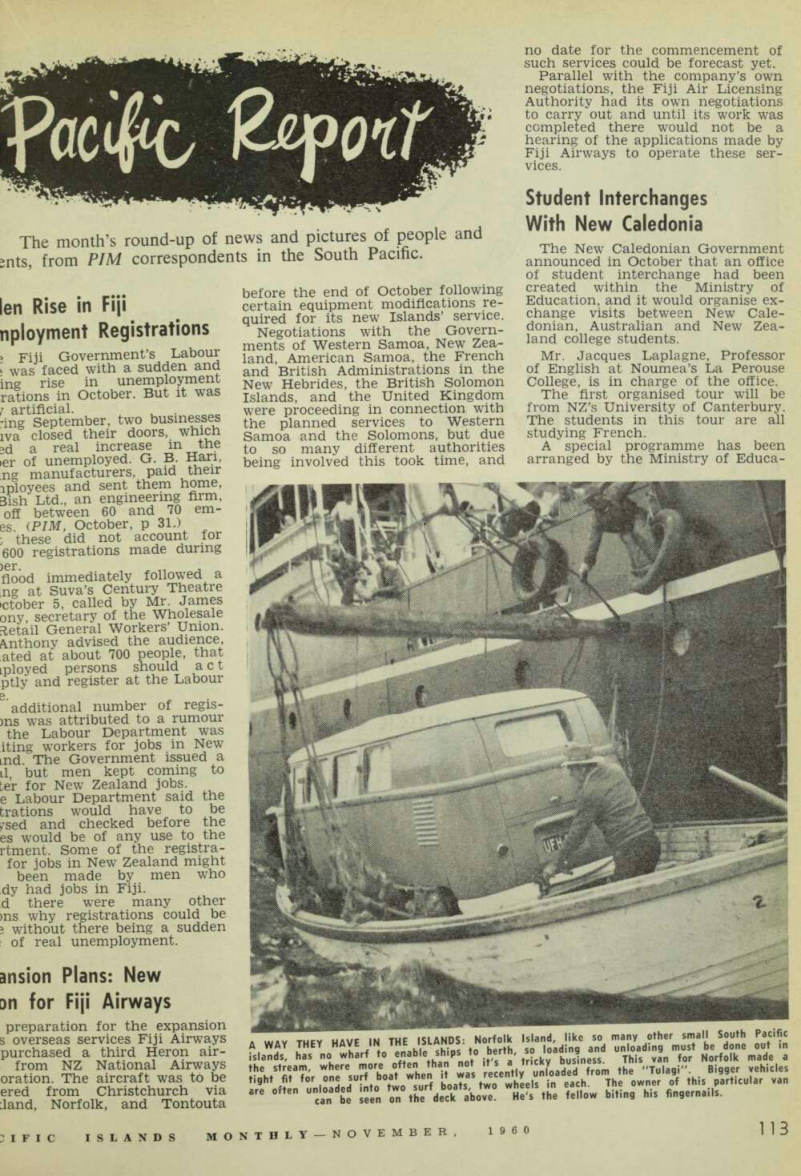
A WAY THEY HAVE IN THE ISLANDS: Norfolk Island, like so many other small South Pacific island, has no wharf to enable ships to berth, so loading and unloading must be done out in the stream, where more often than not it's a tricku business. This van for Norfolk made a tight fit for one surf boat when it was recently unloaded from the "Tulagi". Bigger vehivles are often unloaded into twò surf boats, two wheels in each. The owner of this particular van can be seen on the deck above. He's the fellow biting his fingernails.
tlon, comprising talks in French! literature, history and geography New Caledonia. Tours will be ma The Ministry is responsible! arrangements and accommodati for the students, who will be New Caledonia for about a mon For 1961, the New Caledoni Government is also offering t scholarships to Australian stude: to permit them to perfect th French. They will continue th studies at the La Perouse Colie Cost of the voyage and other 1 penses are paid for by the Govei ment and about £5 a month is a supplied as pocket money.
Australia offers similar schol ships to New Caledonian student
American Film Expedition
To Dutch New Guinea
An American anthropologii film expedition will travel throu NNG’s Baliem Valley in Mai next year to make scientific dod mentaries of the natives.
The team will be led by I Robert Gardner, Director of Hs vard Film Study Centre, and v consist of Peter Matthiesson, nati writer, Eliot Elisofen, photograph of Life magazine, and Michu Rockefeller, of Rockefeller Musei for Primitive Art, in New York.
Mr. J. Th. Broekhuyse, Nethe lands New Guinea Governme ethnologist, who is already in t Baliem Valley, will join the tea: American and Netherlands fina cial assistance to the expediti has been secured.
A BBC television team was i Norfolk Island in late October 3 a short visit of film making, ai US cameramen were TV filming Fiji in early November.
Dutch Council's
Voting Arrangements
The Netherlands New Guim Government in October gave d tails of voting arrangements f NNG’s first New Guinea Counc which is expected to be operatii next March.
The Council is a first step in 10-year-plan aimed at bringing tl Dutch Papuans closer to sel government. However, no targi date has been fixed by the Dutc who have made it clear that overa political progress will depend c progress made with the Council.
The official Dutch statemei said: — All inhabitants of Dutch nation ality and all Netherlands subjec who have lived in Netherlands Ne' Guinea since January 1, 1958, an have reached the age of 21 at th time of the elections, will have th right to vote for the New Guine Council.
Elections will be held in 14 elec toral districts, in 12 of which peopl
vote according to two-stage )ts. the townships of Hollandia Manokwari one-stage (direct) ions will be held, ithin the 14 electoral districts names of those who meet the e requirements for franchise, have lived in the electoral dis concerned since July 1, 1960, registered. These voters lists are almost completed, soon as the voters’ lists are y, each community in the 12 stage electoral districts will se a number of voting repre atives (men or women) in pro ion to its population. The lod used in the first stage is the ;m of the “whispering ballot”, rs whisper the name of their [idate to a committee of three ons. Immediately after the bal he names of the elected repre atives will be published. the second stage the voting esentatives will use ballot irs. the discussions of the Upper se of the Dutch Parliament on draft concerning partial revi of the Netherlands New Guinea -which implies the institution he New Guinea Council—pro as fast as recently in the er House, the two-stage elec s may be held in November.
January, 1961, the voting rep ntatives and the voters in the dots with direct election may i submit the names of their can ,te members of the New lea Council. nomination may only contain name of one candidate. How , there is no objection to hav one’s name included in several Linations. ext, the lists of candidates for i electoral district are drawn
up and published for the voters and voting representatives to take these into consideration.
There is a possibility of groups being formed in the electoral dis tricts to support certain candi
dates. Barring unforeseen circum stances the voting for the candidates may take place in Feb ruary, while the first session of the New Guinea Council may be held by the end of March, 1961.
The session will last about two months.
In addition to electoral districts, there are some areas where candi dates are appointed by recommen dation. Collecting these recommen dations means, in fact, holding informal two-stage ballots. Meet ings will be convened at which the names of candidates may be put up, to a maximum of three.
The number of lists of proposed candidates to be submitted is not permitted to exceed the number of meetings held.
This system will give the Gover nor an idea of the preferences of the areas concerned.
In a few very primitive regions the Governor has the right of ap pointment without being required to observe any regulations in this regard,
Levuka Offers You a
Good Organ, Cheap
Does anyone want a famous church organ, at a bargain price?
If so, they may acquire what is described as an excellent instru
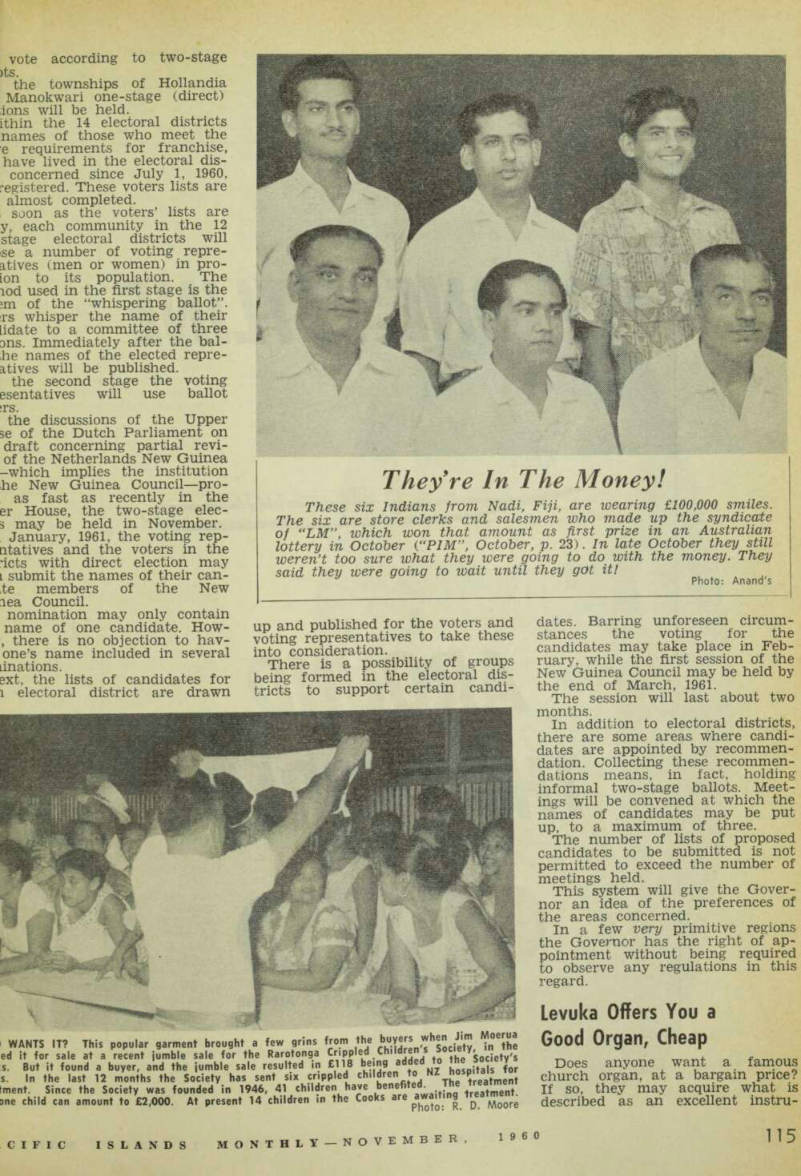
WANTS IT? This popular garment brought a few grins from the buyers when Jim Moerua [?]ed it for sale at a recent jumble sale for the Rarotonga Crippled Children's Society, in the [?]s. But it found a buyer, and the jumble sale resulted in £ll8 being added to the Society's [?]s. In the last 12 months the Society has sent six crippled children to NZ hospitals for [?]ment. Since the Society was founded in 1946, 41 children have benefited. The trea tment. one child can amount to £2,000. At present 14 children in the Cooks are awaiting treatment.
Photo: R. D. Moore
They re In The Money!
These six Indians from Nadi, Fiji, are wearing £100,000 smiles.
The six are store clerks and salesmen who made up the syndicate of “LM”, which won that amount as first prize in an Australian lottery in October C‘PIM”, October, p. 23) . In late October they still weren’t too sure what they were going to do with the money. They said they were going to wait until they got it!
Photo: Anand's
built over 50 years ago by dlled Mr. Casson (father of jwis Casson) and installed in Anglican Church in Levuka, Lbout 1904. he last quarter century, what led a depression has fallen Levuka, and the fine old got into a bad condition. m Archdeacon Whonsbon took over the parish recently, cided that the organ should ested in its downward career; was taken to pieces and sent 1, Norman and Beard (Aust.) Ltd., in Melbourne, where it een completely renewed and t; and it now is for sale as ids there. It is suitable for a I or a private house, one interested should write to idea c o n Whonsbon-Aston, a, Fiji.
of Artificial
for Yate
r Caledonia’s Yate Dam was ig headlines again ih October. have recently been rumours, d by the roneo news-sheet Le mien ( PIM, October, p. 141) the dam foundations not be tfe. These were denied as be antastic. The work being d out was said to be normal igh it had to do with re ing the foundations, mea’s daily newspaper, con -1 by the Nickel Company, in er took up the question of the ery work” being done on the and also pointed out that were fears that there was
insufficient water in the dam’s lake to assure a continuous supply of electricity to the nickel furnaces in Noumea. The paper said the level of the dam was falling rapidly and there was little hope of rain falling for some months.
The most that could be “hoped for” was a cyclone!
The article in the paper said a study was being made of the possi bilities of artificial rain-making over the Yate basin. If the authori ties had any success they would ex tend the experiment to other parts of New Caledonia.
Australia, of course, has had much success in artificial rain-making over its giant Snowy Mountains hydro scheme.
Fiji Hopes to
End Leprosy
Dr. P. W. Dill-Russell, Director of Medical Services in Fiji, in October expressed the hope that leprosy in the Colony could be eradicated.
He said that there were about 300 cases of leprosy in Fiji. In the past six years the number of cases ad mitted to the leprosarium at Mako gai had varied from 26 to 44 a year.
In 1958, a total of 121 cases were discharged as cured and last year 131 patients were discharged.
Mr. Dill-Russell added: “These figures give a clear indication of the efficacy of modern treatment and give great hopes for the future.
“New drugs may be discovel even more effective than those! present use, but even without t the end of Makogai appears to in sight and with a ratio approach to the problem a patience, the disease will 1 eradicated.”
Is It Possible To
Save Levuka?
“Surely it is possible to save ] old town and port of Levuka fn complete extinction,” said Arc deacon C. W. Whonsbon-AstonJ Fiji, when in Sydney recently.
For years, Levuka lived on \ business of assembling and shippi copra from all points around i Koro Sea. Regularly, the sm planters—and especially the Fiji planters—sailed their little ships Levuka from their plantations the Lomaiviti area, and pla farther afield; discharged and si their copra while their wives a children went shopping; and th returned home with most of th copra money represented in mar factured goods and foodstuffs. Tl was Levuka’s economic backgroul “Then Carpenters built th crushing mill in Suva, and pc cash on the wharfside there fori copra brought in,” said the Arc deacon. “Now, most of the cop goes there, and Levuka is nea: dead. Furthermore, many nati growers will not cut for the Su market.
“I suggest a three-ways co ference between Government, Cs penters and the Levuka businei men, to see if Levuka cannot i made a copra-shipping port aga: Because it would stimulate nati copra production, and save Levul it might be worth the Fiji Gover ment’s while to subsidise Carpente to make more use of Levuka.” \
Stone Age Objects
For The Missions
New Guineans in the Easts Highlands are turning over to] priest-enthnologist implements fro their dying stone cult.
“According to native belief the stones possess magical powers,” sa Rev. Dr. Henry Aufenanger, SV. a member of the Divine Wo!
Missionary order which has bet active in the New Guinea Highlara since they were first discovered! 1933.
The missionary said that tl stone implements were former greatly honoured in specially col structed houses and were believj to shield and help their wOrshippe in time of war. Some of the stoi mortars are referred to as “Oi Grandfather” or “Our Grant mother” still today.
Dr. Aufenanger said that mar of the mortars, pestles, birds ar other stone cult objects show?
t artistic skill and that some ; of great enthnological value, ’he New Guinea Highlanders » no real explanation for the n of these objects, are unable to oduce them, and maintain that are the work of the spirits,” aid.
High And The Low
New Guinea s Stamps
ipua-New Guinea stamps twice e news in October.
Sydney stamp dealer, Mr. Kevin ■y, of Lane Cove, paid £1,700 for sheets of New Guinea stamps 3h were sold by the Port esby post office for 36/- earlier year. According to Mr. Duffy, stamps are worth at least £2,300. tie reason for their rise in value hat the words “postal charges” e been double overprinted, be stamps are New Guinea “post due” stamps used for taxing srs with insufficient postage. )gether 5,000 stamps were over ited, but Mr. Duffy thinks he the only two sheets of stamps t were overprinted twice, he low mark of the month, Drding to the Melbourne Herald, . reached by the designers of le new P-NG stamp issues to be on sale on November 10. The nps are one at sd, showing cacao s, one at Bd, showing the Bulolo vood mill, and one at 2/5, show cattle. ommented the Herald under an :orial headed “Klinki Makes a v Mark”: While the less sophisticated of Papuans may be lining up full ardor at grass-thatched post ces to buy the New Guinea naps that go on sale on November the designs reproduced today are likely to excite people with more tivated philatelic tastes.
The stamp depicting the plymill Klinki may make a profound Dression on the indigenous in stants without arousing admira a in circles in which the Klinki mill is unfamiliar.
The whole unimaginative issue ms to confirm the Australian station for generally corny and lid stamps that do little to mark as an original people.”
Che Herald was wrong in placing » mill at “Klinki”, however. The 11 is at Bulolo, and it handles inkii pine, which grows in the
valleys and ranges around Bulolo.
Why the stamp refers to “Klinki plymill” (one “i”), we don’t know. .. .. .
Hawaii Planning
an T n
A PaCltlC Games
A Mosman (Sydney) rowing club official, Mr. Eric Holford, who visited the Rome Olympics reported in Sydney on his return that he had had discussions in Honolulu about a proposed Pacific Games. He said the first one would probably be staged in Hawaii next June, and 30 nations would probably be invited to compete. Tentative plans had already been drawn up to stage most Olympic sports, together with big-
game fishing, polo, equestrian and other events.
Prime movers in Honolulu were Mr. Robert Sawtelle (“Mister Row ing”) and Mrs. E. Fullard-Leo, who is a member of the American Athletic Union, and who has man aged American Olympic teams.
Their committee consists of busi nessmen, representatives of local sporting bodies and the US Armed Forces.
Mr. Holford said the president of the International Olympic Com mittee, Mr. Avery Bundage, was ex pected to guide the programme through the AAU so that it would have authority to proceed very soon, When this happened Mr. Holford said he would contact Australian amateur sporting bodies. (Over)
j added, “Swimming contests likely to be staged between in, America and Australia, and i provide a spectacle equal to Olympic Games.”
y Work For
ir Pocket Money
ur young men and two girls re ly arrived in the British tnons to do a year’s voluntary : in Government and mission ols. tey arrived under a scheme d Voluntary Service Overseas, h is backed by the Royal Corn wealth Society. ie organisers arrange for young le who have just left school to voluntary work in under-de ied Commonwealth territories. r receive a small amount of ke t money. Governments or lons are responsible for their mmodation, maintenance, and et money, although the fares 3aid by funds raised in the UK. ie scheme sent 58 grammar and sh public schoolboys overseas .958 and hopes to send 125 iteers this year. to of the recent arrivals in the 3 are working with the Mel ian Mission, two with the lodist Mission, one with the iolic Mission and one at the jrnment’s King George VI ol at Auki.
y Feet Error Could
in Some Wet Feet
i aerial survey error has de i by four months a £1,000,000 o-electric project 15 miles from Moresby. l Administration spokesman said ctober that the survey had been by 40 feet in determining the -water mark of the huge dam e built across Sirinumu Gorge. 100-foot high wall will dam rs of the Laloki River, flooding
about five native villages and isolat ing several others.
The Administration cannot buy from villagers the land needed for the project until the survey is done again.
Building of the dam is the first stage in a long range scheme to de velop hydro-electric power for Port Moresby.
Work on the dam is now scheduled to begin next March.
A spokesman said the Adminis tration had wanted to start im mediately negotiating with natives for land needed but now had to wait for a second survey to be com pleted.
The Administrator, Brigadier D. M. Cleland, later agreed that a “regrettable error” had been made.
He said he had been advised that an initial survey had shown that about 6,500 acres of land would be flooded by the dam.
Four native villages with a total population of 235 would be in undated and others would lose “significant” areas of land.
The survey had shown that one entire clan of about 50 people would be left without any land at all, his advisers had said.
Mr. Cleland said that the natives concerned had been approached and after initial reluctance had agreed to a resettlement scheme.
A total of £50,000 had been allocated for this purpose, together with another £20,000 for land acqui sition.
Mr. Cleland said agriculture and forestry surveys had been started, land ownership had been investi gated and the site for an access road routed.
A physical land survey had then uncovered the high-water mark error.
A whole new survey of the land needed was now underway and it appeared as if the original 6,500 acres would be increased to about 13,000 acres.
Wild Dogs Are Worrying
The Solomons
The British Solomons, as with Fiji, is having a dog problem.
Members of the Agricultural Ad visory Committee, at a recent meet ing in Honiara, said the large number of wild dogs found in vari ous parts of the Solomons was a danger to poultry. It decided to ask the Administration to see what it could do about reducing the menace.
The Committee suggested that a small poultry unit should be run
by the Agricultural Department
which would import and breed cockerels for sale to Solomon Islanders. ... .
It felt that the importation of ex pensive cattle to form a breeding stud was not of primary importance and should have a low priority.
The Agricultural Department in
the BSIP has asked for money to improve pig-breeding stock and hopes to import several different breeds, including Tamworths.
Joseph Follows In
Father's Footsteps
A 20-year-old New Guinea bank clerk, son of a father famous in New Guinea, was one of two new native members appointed to the
At The Polynesian Association: Recent
visitors to the Polynesian Association in Sydney were (top), Ruth Framhein, from the Cooks and Tahiti, with a garland pre sented to her during the evening, and (lower), Madame Leau, Monsieur Souky, and his wife Sophie, of Papeete. They showed a film of life in Tahiti.
Lae Town Advisory Council October.
He is Joseph Bula, the son] Simogun Peta, P-NG’s Pidgi speaking MLC and war hero.
Bula was educated at the Dregi hafen Administration School, a has been on the staff of the Co monwealth Bank for the last f( years. He is treasurer of the I Native Sport Club and takes p in other group activities in town.
He will represent the 700 or Sepik people who have made th homes in Lae over the past 1 years.
The other native member appoin is Joseph Beata, a former Papi from Kairuku, who has been liv: in Lae for about ten years, and employed in the building trade, will represent the 1,000 Papuans Lae.
There are native members on District Advisory Councils in ' Territory, and on Town Advis Councils in areas where there i! permanent native urban populati
Theirs Is A
Scorched Earth Policy
A Native Affairs patrol throi primitive country in the Nipa Val] west of Mendi in the Southern Hi* lands of Papua, reported in Octol that the Nipa people were ( ponents of an uncompromis: scorched earth policy.
Attackers, not content with cai ing a few deaths, aimed at the co plete destruction of all prope owned by their opponents.
Houses were burnt, food-beari trees cut down, and trees of ce: monial value ring-barked.
When defeated groups were dri\ off their land, the land was rar occupied by the victors, but beca: waste ground or was left idle : use in future skirmishes.
The Nipa post was establish about a year ago.
The Nipa Valley is at an altiti of 5,600 feet and has a rainfall: about 120 inches a year.
The patrol, which was away j 41 days, was led by Patrol Offi( R. A. Hoad.
New Guinea's "Old Vickers'
Is Now In Oils
A New Guinea war episode invol ing Australian troops has been pe petuated in a painting just hu in the Australian War Memori Canberra. The painting was spei ally commissioned by the Memor: from the South Australian artist, a: former official war artist, Ivor He The painting, 10 ft by six ft, entitled “Taking Old Vickers Poi tion, Bobdubi Ridge, 28th July, 194; The Minister for the Interior, IV Gordon Freeth, said the action d picted by Mr. Hele was the storr ing by troops of the 58th/59th Au tralian Infantry Battalion of a Ja]
strongpoint on Bobdubi Ridge g the advance on the enemy il base of Salamaua.
Dwn as “Old Vickers”, the posi constituted a troublesome :le to the attackers, whilst the y regarded it as vital to their ces and had resisted previous cs with typical ferocity. For il weeks Australian troops re litred the area and planned an it assault on “Old Vickers”, s commenced on July 27 with •tar and artillery barrage. Next icon the attack was launched Company, 58th/59th Battalion, ffective were the supporting ires that the Japanese had just lenced to emerge from their luts when the leading Aus n platoon reached the crest, amid a shower of bursting ,des, they swept into the posi ae of the enemy evacuated, but s remained, and a series of e hand-to-hand fights ensued, i lasted for about 90 minutes. ;nemy survivors then withdrew •ds another position known as Coconuts”, pursued by Aus ,n bullets. s enemy felt the loss keenly, ver, and during following days :hed no less than 14 fanatical ;er-attacks without success. . Freeth said that the various aphical features encountered ig this campaign were named le troops. the same area as “Old Vickers”
“Charley Hill” and “Davidson —the Christian and surnames ie present Postmaster-General, C. W. Davidson, who led the nsland 42nd Battalion in the naua Campaign.
Id Vickers” is thought to have ved its name because earlier a 3rs machine-gun post had been dished there.
Rich Timber Stand
Had A Hollow Ring
P-NG Forestry officers have dis covered that more than 100,000 acres of timber in the Cape Hoskins area of New Britain Island is “de fective”.
Timber which was believed worth hundreds of thousands of pounds was offered for tender in July.
The P-NG Administrator, Briga dier D. M. Cleland, announced in October that the tenders notice would now be withdrawn.
The notice offered 200,000,000 super feet of timber to be taken from the area over a period of 10 years.
Japanese firms are known to have
shown keen interest in taking up a lease.
Forestry officers had rated the area one of the Territory’s richest in timber.
In his statement, Brigadier Cleland said that an Administration officer had first noted defective timber in the lease area in August.
“Volume defect study was im mediately carried out.
“This showed that a great majority of the trees were so defective that timber could not be economically harvested,” Brigadier Cleland said.
“In view of this I directed that the tender be withdrawn.”
An Administration spokesman said the survey had shown that the bulk of the trees were hollow.
P-NG Basic Wage Up Agai
New Urban Wage Soon
The P-NG Legislative Council, October, passed legislation incre mg the native basic wage in Pai and New Guinea for the sect time in three weeks.
The present minimum wage of a week will rise to 8/6 a week the first year of employment i 9/9 for the second year.
The increase, expected to aff an estimated 60,000 rural work will take effect January 2.
The increases were contained ii bill amending the Native Labi Ordinance.
The ordinance, passed by i Legislative Council in 1958, ca into effect only at the beginning October.
It increased the basic wage by shillings a year and gave bet overtime and compensation rates.
Introducing the Amending B the director of Native Affairs I J. K. McCarthy, said the new : crease had stemmed from reco] mendations by the Native Emplc ment Board.
He said the Board had recoi mended a basic wage rise from shillings every four weeks to 32/6 calendar month for the first year employment, and 37/6 a month J the second year.
The new rates are 30/- and 3£ respectively every four weeks.
Mr. McCarthy said they we “reasonable and acceptable”.
“They will improve the nati standard of living without having serious affect on the Territor economy,” he added.
Employers will still have to pr vide workers with food, clothiri accommodation and medical carej A recent agreement between en ployers-employees fixed a minimu wage of £3 a week for urban worke in the towns of Port Moresby, Li and Rabaul. (PIM, Sept., p. 20).
The new legislation included i clause giving the Administrate power to recognise such industrii agreements.
Observers said the new urba rate was now likely to be ratifie in the immediate future, and j come into effect in November i had been proposed in the agree ment.
Col. J. K. Murray Takes
Another Look at P-NG
The bulk of European settlers hai “seen the writing on the wall” am were accepting the changing politica climate in Papua and New Guinea Colonel J. K. Murray said ii October.
lonel Murray, a former Admin tor of the Territory, was speak to reporters at Port Moresby’s son’s airport. ked to comment on relations een the white and black in ia and New Guinea, he said: nee I left here in 1952 there been a remarkable change in attitude of Europeans towards problems of rule of a plural ty. r hen I suggested that three es should be included in the Legislative Council (in 1951) general reaction was quite le. ow, nine years later, most le here are accepting quite ly, the fact that next year the icil will have 11 native mem added, “Papua and New ea will always have a ‘hard of antipathetic Europeans, tie bulk of white people, how have seen the writing on the and are accepting the inevit changes.” lonel Murray was the Terri s Administrator from 1945 to went to Port Moresby in Oc ■ as an official guest to the ing of the fourth Legislative icil’s new chambers. later made a quick tour of fhe r centres of the Territory, fore returning to Australia, lel Murray said changes now ig place appeared certain to • even as far back as 1900. ow Papua and New Guinea is ressing politically, I hope it nues. atiye representation on the ilative Council must continue ■ow until the day self-govern ; comes.
“And I can’t see this happening inside a quarter of a century.”
Colonel Murray said that a common roll in the Territory was something of the “very near future”
“It would work in many areas now,” he said.
“But in others, it would be abso lutely hopeless.” (Over)
SERVICE: Here is the tanker "Pacific [?]rise", expected in Lae, NG, at the end [?]ovember to inaugurate an inter-island service for the Vacuum Oil Company, [?]nker will soon be a familiar sight in [?]uth Pacific, for she will service outport [?]als now being built for Vacuum at Wewak, [?]g, Tarawa (GEIC), Vila and Santo (New Hebrides) and Honiara (BSIP).
Commenting on his tour, he sai the Territory’s progress since 19! was something in which the Am tralian Government could take i “great satisfaction.”
“Any reasonable person worn say the general progress was high creditable to those concerned,” 1 added.
Much Ado About
Crash Teacher Trainees
The 60 young men Papua ar New Guinea had recruited fro: Australia to implement its eras education programme were in fi some shocks, Mr. Don Barrett, Mb said in Port Moresby in October!
Many would have to live in bus huts and face extremely primitfl conditions, he said.
Mr. Barrett, one of the Counca three elected members, was speakii during the Budget debate in tl Legislative Council.
He attacked the Government policy of an increase in educatic programme in favour of econom development.
Mr. Barrett said enormous hou ing problems faced the programni “I know that in at least one dii trict Administration officers wi have to accommodate five teache more than they can possibly handle he said.
“These men will just have to li in huts built of native materials.
“I imagine this position exists many other areas.
“Men will have to be able to sett down here in the face of extreme primitive conditions.
“I can foresee there will be thoi who will drop by the wayside.” I A nominated mission leade Father J. O’Dwyer, supported M Barrett.
He said the new programme wou] come up against many problems.
The first teachers arrived at tl beginning of November, and thus heralded by such advance com ments as these—the Pacific’s moi contentious education experimei of recent years had begun in P-NC The experimental nature of tt scheme lies in the fact that tt trainees are below the usual] acceptable educational level fc teachers, and that their initij training course will last only si months. They will be trained i Rabaul and will then teach nativ pupils of primary standard. (P/ik Sept., p. 138.) Some idea of the bait in th way of opportunity that wa dangled in front of the trainee can be gained from the fact tha more than 1,000 men aged between 18 and 54 applied for the initis 60 positions.
There seemed little doubt, to( that some were using the scheffl as a lever to break into the teach ing profession in Australia afte completing their initial terms ii P-NG. This will, of course, increas
ffective cost of the scheme to r, but will not necessarily e the value of the scheme. trainees have come from ■ types of jobs in five Aus n States, and their course is being conducted at a training ;e in the grounds of Malaguna aical Training Centre, Rabaul. ticism of the scheme has been sive, and understandably so. greatest outcry has been ist the lowering of educational lards required of teacher ees. Other criticism has been ed against the impossibility of ;r training in six months, at “lucky dip” nature of the :ion scheme, and at the alleged mess of the scheme to fully ed teachers already in the j service. a broader scale critics have jed Australia of “whipping up ; education scheme which will no practical purpose except window dressing for the United ms.” ere is every reason to believe, :ver, that if the scheme works as planned the direct educa .l advantages to the native ren will be great. But the » can see danger even in this •. Don Barrett, MLC, in the dative Council, expressed a that the natives may be
,ted initially to a standard too for their own economy to irt, leading to discontent and nditions ripe for Communism. ; scheme is a bold one which be extraordinarily successful.
P-NG Education Department lefined its obligations in edu i—universal primary educa md universal literacy in Eng and has set about meeting bligations. addition, the P-NG Director ucation, Mr. G. T. Roscoe, has ied what the trainees will be ted to achieve among the ; children. His outline makes ar that the requirements are ;r highly nor purely academic, hat the trainees can progress ; more advanced and academic hes of teaching if their re and studies are satisfactory. ; headmaster of the training e at Rabaul, Mr. Joe Salt, frawn on history to demon how emergency recruiting raining schemes have success met many challenges. examples include a recent 1i s h emergency education le, and the aircrew training le adopted during the war.
ammed Tora
lifted of Charges
i Fiji Supreme Court in early nber acquitted union leader, i Tora, alias Mohammed Tora, wo charges of having de ed money with menaces with ; to steal. a’s arrest in August caused • in the Colony. At the time vas in the middle of a dis is sugar dispute and tension ligh in North-West Viti Levu. i alleged victims of the charges
were Indian canefarmers and brothers from Vitogo, half a dozen or so miles from Lautoka, where rifts among various factions had led to several shootings earlier this year.
The brothers, Atma Ram Sharma (an ex-constable) and Vishnu Deo, alleged that Tora had told them an escaped prisoner, Sairusi Nabogi bogi would shoot them unless they paid Tora £5OO.
Vishnu Deo in evidence in the lower court claimed that Sairusi, after Tora’s alleged threats, had shot him and his young daughter at Vitogo.
Tora, in the Supreme Court, gave an alibi for one of the occasions on which the alleged threats were uttered, but the Acting Chief Jus tice (Mr. Justice Hammett) re jected this.
The Crown case fell down on some unsatisfactory factors in Atma Ram’s evidence which, the judge said, were not adequately ex plained or accounted for.
The judge also said that the brothers were slow in reporting the matter to the police, and there was no really independent evidence to support the story.
While Tora was winning his ac quittal in the Supreme Court, the Wholesale and Retail Workers’ Gen eral Union, of which he is president, suffered loss of face in the indus trial field. , This union called the December, 1959, oil strike which culminated in two days’ rioting in Suva and a handsome improvement in pay and working conditions for employees in the oil industry. ..
In February this year there were signs of a rift among the oil
workers and an abortive strike at the Vuda Point oil depots, between Lautoka and Nadi Airport, led to a breakaway union coming into existence.
The leader of the new group was Ratu Meli Gonewai, who was presi dent of the Wholesale and Retail Workers’ General Union before Tora replaced him in March, When the oil workers’ award came up for renewal in October the oil companies said they would deal with the union which had the greater number of members in the industry. They turned the matter over to the Registrar of Industrial
Mohammed Tora.
RESEARCH IN TONGA. These members of the Kyoto University Explorer's Club returned to Japan in October after a three months' expedition to Tonga. The team, in charge of Professor Y.
Yabuuchi, Professor of Geography at Osaka City University (centre), made investigations into a wide range of subjects including agriculture, botany, geography, archaeology and educational mattters.
The professor hopes that further Polynesian expeditions can be arranged for Japanese teams.
Photo; J. P. Shortall
dl^de a th? S B ' L ’ GregB) t 0 decide the issue.
Mr. Gregg called for various books and papers, which were forthcoming from Ratu Meli’s union in satisfactory fashion, but he had le^bv dl Tnrn b the ot V her b /?5 y ’
James th secretary (Mr j Tbra tSn 11 „ Tora and Anthony finally walked Mf Oregg who then ruled eafnln? Um ° n had bar ‘ gaming status.
Ratu Meh, with officials of his imion, mcl representatives of the Co ? l P anies (Shell and came up with a few ga i? s .- ...
Naturally, after the big increases
Mowing the strike (and made retrospective to October 24 1959) he did not get any pay increases but there were improved fringe benefits. These included a service allowance of 5/- a week after one yea f’ s service, provision for three annual leave for employees f. ho have completed 10 years’ con tinuous service with either com pany, and a five-day week of« hours, the last-named to operate from November 25, and higher wage rates for shift workers g In addition, the oil companies have undertaken to consider how best local employees can advance in the organisations.
Even though it was Ratu Meli’s
union which negotiated the agre ment, the new award will apply all oil workers.
Yet Another P-NG
Shipping Link
To give New Zealand export an opportunity to enter compi itively into the Papua-New Guir export trade, especially w: primary produce, the Crusat Shipping Company of London, subsidiary of the main Briti shipping lines operating to N Zealand, will make calls at Pi Moresby and/or Rabaul These will be on the north-bou runs of its vessels which are alrea operating a frozen meat trade fn New Zealand to Japan. The serv will be experimental at first passengers will be carried The new connection is to be i augurated by MV Crusader , whi leaves Auckland December 14, ca at Port Moresby December Rabaul December 23, and arrives Yokohama December 30.
Subsequent calls at Port Mores and/or Rabaul will be conditior sufficient cargo offering, t MVTurakina will depart Auckla northbound on February 7 Ap 4, and June 7.
Shaw Savill & Albion Compa managing agents in Auc land. The vessels call at main N Zealand and Japanese ports.
Damages Claim Creates
Wide Interest in BSIP
The Acting Judicial Commi sioner in the BSIP (Mr. D. Berwicl awarded Mr. A. C. Dowling, chi stevedore of the BSI Ports Authoi Jy J 2 >49 3 /4/2 in a claim against t] BSI Trading Corporation. Dowlii had claimed £30,000.
Dowling was a passenger in corporation bus which crashi into the Matanikau Bridge March, 1958, and was injured abo the face and a leg. He underwe: a plastic surgery operation in Sy< ney, and a further operation hi yet to be done.
The case created great intere in the BSIP as the amount claime was far in excess of anything i the past.
Uphill Wau Strip
Claims Another Victim
Three RAAF airmen were ir jured when a DC3 crash-lande and caught fire at Wau, Ne 1 Guinea, on October 23. The plam from Richmond (NSW) had bee: making practice landings at Wai which is built on a hillside.
The three airmen, who suffer© burns and shock were flown fror Wau to Lae with seven other pas sengers from the crashed aircraft
b Will Increase
Pacific Services
in American Airways plans to ease its trans-Pacific flights feen the US West Coast and tralia from two to three each c. From December 4 PA A will Boeing Intercontinental jet air :s into Sydney on Sundays, sdays and Thursdays, le PAA increase corresponds l a reduction from six to five in Qantas trans-Pacific services, 'ever, the sixth Qantas service, Dduced on September 1 was for mited period only. This service end on November 20. \A, as soon as President Eisen er ratifies agreements, will i two new Pacific routes—one reen Sydney and Djakarta and ion-stop express service from r York to Honolulu. The Sydney iarta run will probably be ex lion of the flights which now linate at Sydney, tie New York-Honolulu express ice is expected to step up the ;rican tourist trade to the South ific. long with the increased services es news of possible fare reduc s. The International Air Trans ; Association has been discussing fare structures and indications that tourist, or economy, fares be reduced by another 5 per [;• mong agreed changes already roved by the lATA traffic con nce are low excursion fares be m Fiji and India.
Samoa Banana
>rfage—And Copra Check
robably due to the long dry spell erienced for the past few months possibly to the ravages of the chy top disease in some dis ts, W. Samoa banana ship its in October were still short of cations and shipping space Liable. The last T drawer a was cases short of the allocation of 00 cases.
An Apia correspondent reported that with production in Fiji and Tonga increasing, it was thought probable that allocation to these producing countries would be in creased owing to the uncertain supply in Western Samoa.
Copra production also seemed be low normal, so that the estimated export figures for 1960 may not be reached.
Some Apia commercial firms en gaged in copra buying, have been found by the Copra Board to be careless in supplying the Board with declarations of copra stocks. The details are necessary for the Board to enter into selling contracts to dispose of Samoan copra overseas.
It has been found that these stocks are in many cases reported as much higher than actually on hand, so that the Board could be held liable for damages for short shipments under contract.
The Copra Board in October re quested the Government to investi
gate the copra records of all copra buyers, and particularly the statu tory declarations of stocks made at times when the local buying prices for copra have been changed. It is thought some of the buyers may have been considerably overpaid for copra purchased at their trading stations before the price was re duced. The report of the Board on its investigations is to be published.
New Papeete Airstrip
Now Open to Traffic
Three overseas airlines and one internal operator are now using the new airstrip at Papeete, which opened to traffic about the middle
Justices For
The Cooks
The Cook Islands re cently appointed these three Justices of the Peace —from left, Mr.
Glassie Strickland, Mr.
Manea Tamarua, and Mr. David Metuarau.
Provision had existed for such appointments for some time but none had been made. They have power to take minor criminal and civil courts. Appointment of these three men—all outstanding - is an important step in the Cooks.
Photo: R. D. Moore
tober. Planned as a jet strip, a runway of 10,000 feet, the strip has reached a length )0 feet and can accommodate -engine and jet prop aircraft, gh none of the latter type ling it yet. nan Empire Airways, which aver to DC6 operation on the Route early in September, the old wartime Bora Bora ;ill the first flight to Papeete, ropriately among those on the ’EAL Nadi-Papeete flight was in J. S. (Joe) Shephard, who EAL’s senior flight captain on )ral Route for six years. Cap- Shephard flew the TEAL last flying-boat service left Laucala Bay on Septem ipletion of the air strip will ant jet liners using Papeete connecting link between the cas and Australia and New id on round-the-world ser- L will use DC6’s on the Route till March, 1961, and hen change over to Electra props. Trans Aerians Inter entaux will use jet DCB’s on which will originate and late at Paris after a flight the world. h Pacific Airlines already e a Super Constellation ser 3tween Honolulu and Papeete, new jet strip may lead to a jrvice between South America ustralia, operated by an air wned by the Government of
es Stinson Is
i Mayor of Suva
ncillor Charles Stinson, on urne Cup day (Nov. 1) as office as Mayor of Suva for second year in succession, serving as a councillor and puty Mayor for seven years cceeded Cr. A. D. Leys as in November, 1959. first term of office could be described as smooth, and ured in several clashes with i councillors, one of whom, P. Bidesi, walked out after sicularly stormy argument.
Stinson is rather an aggres rpe when it’s a matter of the ;ts of the city, and he is to cut away red tape if it getting something done.
Deputy Mayor this year and pped for Mayoral honours in is Councillor Bruce Lawlor, > now entering his fifth year ‘city father”. He succeeds Cr. . Madams (formerly City i Officer), who is now execu secretary of the Housing rity. he annual Suva City Council vo Indian councillors retired itation and both were re l. They were Cr. C. M. Gopa i medical practitioner, who ad many years’ service and
Cr. B. R. Karan Singh. Cr. Stinson and Cr. Mark Israel were earlier returned unopposed.
Cr. Karan Singh was the victim of an unfortunate incident at Suva only a few months ago when a person attacked him near Broad casting House and broke a leg.
Some believed the assailant may have been connected with one of the men who proposed to stand against Cr. Karan Singh in the election.
At Lautoka an election was neces sary for one seat only, caused by the retirement of Cr. Pradgi Sidha, Mr. O. N. Singh beat Mr. D. S.
Naidu, who had served on an earlier council, by 30 votes.
Prison Escapee Keeps
Fiji Police Busy
A Fiji prison escapee, Sairusi Nabogibogi, a former student at the Nasinu Training College, has hardly achieved the notoriety of Simmons and Newcombe (who led the NSW police a merry chase last year), but he has had a longer period of liberty.
Sairusi escaped from a working party outside Lautoka Gaol on May 28, and although he is believed to have been seen since, he has not been recaptured. His name cropped
up several times in a recent Sl in re Sffo C nf rt tnal * informntinn°fpfn + £loo , for information leading to his recapture no one seems to have gone to the P °Hnwpvpr 6 S® S* Was S i tiU S?’ at ~S uva early this month, the police received word that Sairusi had been seen in the area surrounding the city, and set w?s r in d vai“ ks with armed men - tt One police patrol at Lami, just to the west of Suva, fired several shots at a taxi, which drove on. ■ A fortnight before, the police and the Fiji Military Forces made an unsuccessul search for Sairusi in the Tavakubu area, near Lautoka.
Sairusi’s escape threw the spotlight on the inadequate security
system in force in Fiji gaols It is not an uncommon sight near the Suva S aol > and also at Lautoka, to see a working party of up to a dozen carrying cane knives in char g e of no mSS than tw? warders, armed with batons, c::: r_..
''I 1 oranT ror
Timber Research
The Fiji timber industry, which has a great potential, but which has been handicapped through lack of development finance, will re ceive something of a shot in the arm from a UK Government grant of £5tg.!0,466 for a research pro ject.
The scheme is designed to help
to develop the Colony’s wide n of timber wealth which, till has lacked the proper scientific technical know-how.
A small full-time timber rese unit will make local investigal and tests and will prepare san of the different species of tii for detailed scientific examins at the CSIRO, Melbourne.
The UK grant will come j Colonial Development and We' funds.
Burns Report For
November Legco
Sessions of the Fiji Legisli Council have been lasting n longer in recent years—not ne sarily because members may more verbose, but because of increasing amount of legisla which has come before the Hoi The 1960 Budget session, w is scheduled to open on Novel 25, will be no exception. The c< cil can generally expect the de on the Budget to last for four c and even longer, and this members will have plenty to about on the proposals of Government to raise money to c Fiji through a difficult 1961.
The Budget debate will not the session, for the council consider the report of the Bi Commission. Consideration of report was scheduled for the I tember session, but was postpc because of the sugar troubles.
Apart from the Budget and Burns Commission the Council several bills to consider, and usual motions relating to Gust schedules, reports of the Stan< Committee on Finance, Governn guarantees of loans, etc.
Nearly 200 ASOPA
Students This Year
The School of Pacific Admii tration—the Australian institul at St. George’s Heights, Sydi where young officials receive special training for service Papua and New Guinea—has j year given instruction to betw 150 and 180 students.
Selected patrol officers have n there for one year’s training; i a large proportion of the stude now are represented by young m selected by the Department!
Territories, assisted by the N South Wales Department of Ec cation, who are being given spec tuition to qualify them to meet j ever-growing demand for scho teachers in the Territory.
Diploma Day—the ceremq when successful students are f( mally handed their certificate will this year be on December 7J 8. It is a function usually attend by the Minister for Territories.]
s Log Is
)r Sale
ralian and New Zealand es will co-operate to try to aptain Cook’s log book and 1 at auction in London on her 28, but they could have competition from the United The principal librarian of p’s famous Mitchell Library escribed the documents as valuable”. manuscript, log book and 1 cover Cook’s first and journeys. The log book con if a contemporary transcript iok’s log of the Endeavour his voyage to the South between 1768 and 1771. journal covers his second > in the Resolution when he 5d the South Atlantic, Indian acific Oceans, the documents are contem , authenticated copies, signed ptain Cook himself.
Steps in Solving
Problems
s politico-economic problems ery urgent; and when the al Under-Secretary was in i late October he was pressed 3 some indication of what the ■overnment proposes to do. the British Government Did financial support from the 7 if the Colony does not give to the major recommenda of the Burns Report? he was on October 27.
Amery did not answer the on directly. He said the Re vas “a guide for Fiji, not a irint”. oresumed that, after the Legis- Council had debated the Report, the Governor and his rs would make plans for the pment of the Colony along the indicated: “and the British nment then will decide what :ial help will be forthcoming” ;e then, Mr. Amery has left olonial Office; and, as pointed i a commentary elsewhere, a has passed since the Burns t was written, and it is eight since the Colonial Office was d by the Fiji Legislative Coun at grave problems were being id by rapid population growth.
K NG Council 'Will
jss Target Date'
Netherlands New Guinea ;al party wants the Dutch Ad fcration to fix 1970 as the target for the Territory’s Independ i party is the multi-racial nal Party which although id less than three months ago apidly gained political promin-
The party’s native executive de clared that fixing of such a date was necessary to create confidence abroad in the Dutch Territory.
The matter had been discussed by the president of the party, Mr.
Herman Wajoi, and Netherlands Minister for Home Affairs, Dr.
E. H. Toxopeus, during the Min ister’s recent New Guinea visit, re ports said.
Dr. Toxopeus had assured Mr.
Wajoi that the target date for self government would be one of the first questions submitted to the Terri tory’s new Legislative Council, General elections for the Council, which will have a native majority, are scheduled to be held in the New Year.
Dr. Toxopeus also conferred in Hollandia with the Dutch New Guinea Employers’ Association.
The organisation had been “most concerned” about the number of Dutch employees leaving the Terri tory to return to the Netherlands.
It had handed a list of figures to the Minister showing that 31 per cent, of medium salaried employees working with 11 of the biggest firms in West New Guinea wanted to go home within the next six months.
The organisation had told Dr.
Toxopeus that there were not enough educated natives to replace them.
It appealed to the Minister for the Government to guarantee free return passages to Holland for all
employees willing to stay three years in the Territory.
The organisation claimed this would not only prove incentive to workers now employed in the Terri tory, but also would be added in ducement in recruiting new em ployees.
Dr. Toxopeus promised the organ isation he would consider its pro posals.
NG's Manam Is
Active Again
Manam Volcano, on Manam Island off the New Guinea coast, is being closely watched again following re newed activity.
Manam is the volcano which erupted violently earlier in the year sending the Australian Press into a flurry of activity, but not disturbing the stoical calm of the local natives.
The Papua-New Guinea Vulcan ologist, Mr. G. A. Taylor, has re ported renewed activity with un settled conditions. Mr. Taylor said sufficient material had been ejected recently to change the top ography of the summit to a marked degree.
He has also given vivid descrip tions of continuous illumination at night from boulder flows.
For the first time in many years there has also been appreciable activity from Mount Ulawan (The Father) on New Britain.
Aircraft flying between Lae a Rabaul pass close to the volca and crews have been giving regu reports to Mr. Taylor. Photograj have also been taken from aircr and passed on to the Vulcanologi Observatory at Rabaul.
Police Station, Barracks
For Hollandia
The construction of a new pol station in Hollandia, NNG, to place the present dilapidated bui ings, will commence in Noveml In addition, new barracks will] ready for occupation in a few wee The new police station, expeci to be completed in the middle next year, will have two floors.
Now They Can't Chew
One Over The Eight!
“If you drive, don’t drink,” 5 the slogans in many parts of I world, but as far as Papua-N Guinea is concerned native driv are finding that chewing can just as expensive as drinking.
It all depends, of course, on wl you chew. In Papua-New Guiri the problem is betel nut, and t police ruled this month that be nut was a drug that could aff( driving ability.
Section Nine of the Papua-N Guinea Motor Traffic Ordinal deals with drivers “under the i fluence of alcohol or drugs”. T new ruling says that “drugs” cov< betel nut, and police have been i structed to take action wh e: warranted.
The matter goes back sevei months to a meeting of Raba Town Advisory Council at whi member Mr. K. Baldwin express! an outburst of indignant horror ■
betel-chewing highway jockeys. ]
Mr. Baldwin claimed to ha witnessed accidents which could traced directly to drivers under tl influence of betel nut. Poli apparently had been reluctant take action regarding the betel n chewing because they were not su how it would stand up in the courl Mr. Baldwin said.
Following Mr. Baldwin’s statemd the subject was taken up with son interest and vigor by the Territory Assistant Administrator, Dr. Joh Gunther.
Dr. Gunther said that betel m contained an alkaloid which induce euphoria. He added that he coi sidered Mr, Baldwin’s remar| “quite justifiable”.
The sequel came in Port Merest in October when the Commissione of Police, Mr. C. Normoyle, sai there was no doubt that actio should be taken under Section Nil] if police suspected a driver ha chewed one over the eight.
Instructions to this effect ha gone out to all police, he said. ]
tottletops,
, Please
content with the traditional ng costumes of their an s, the natives of New Guinea lodernising their costumes for onial occasions. for anthropologists, camera and tourists the change is not ular one. trouble lies in the materials the natives are using to mod their costumes matchbox , chocolate wrappers, cigarette ts, bottle tops on strings, paper, and even saucepan lids, lur Ewing, energetic secretary ; Morobe District Agricultural y, faced up to the problem when the society was plan ts second annual show in Lae aonth.
Governor-General of Aus- Viscount Dunrossil, was to the show and more than 10,000 is were expected to put on a onial dance in his honour.
Ewing told the native leaders; Governor-General do e s n’t to see you decked out in bottle
tops and labels. He wants to see you as your people have danced for hundreds of years.
“Any dancer who turns up decor ated with modern rubbish won’t be allowed to take part.”
And so it was.
Viscount and Viscountess Dunrossil saw one of the most outstanding displays of native dancing ever to be massed at one point.
There wasn’t a bottle top or a label in evidence, and some of the dancers carried on for eight hours.
The only concession to modern times was the paint which some of the dancers used to dye their bodies.
They found it easier and brighter to buy a shilling’s worth at the shops rather than to use natural pig ments.
Everything Volcanic
But The Horses
Pre-war Rabaul residents who, in May, 1937, had to leave their homes and run for their lives, probably never imagined that the cause of it a ll_V U lcan Island which exploded and overnight became a volcanic cone several hundred feet high— would one day provide other Rabaul
ites with an excellent race course.
But that’s how it has turned out, and the present generation of residents turned out in force on Oc tober 3 for the Rabaul Cup meet ing, run on the course at the base of the old volcano.
Apia
Exchange
The new telephone ex change at Apia Post Office is now in opera tion. Above are Line Foreman Sidney Grey, supervisor Sua Loau, Acting Chief Postmaster Edward Williams, and operators Togamau, W.
Crichton, Gataiala and J. Paiepoi. The new exchange has room for 1,200 individual lines and with party lines will accommodate 1,500 subscribers. The old exchange had room for 300 numbers.
Samoana
It could be a point-to point meet anywhere, but it's the saddling paddock, Rabaul, on Cup Day. At top is
Mr. Gus Smales, Rabaul
correspondent for "PIM" and Southern newspapers in a dif ferent role —that of race course announcer.
See story above.
Photos: Gordon Bladen