Pacific Shipping And Cruising Yachts
pp. 99-113 · Read in the full issue
An event of some interest in the maritime world will take \ce next August when oceanographic survey vessels of a mber of countries will meet in Honolulu for the Pacific ence Congress.
I Russians are sending three sssels, probably including the on-magnetic schooner Zarja, Vitjaz, both of which have seen in South Pacific ports in b years. an will send at least two, the ican Scripps Institution of lography will be represented, here may be vessels of other there too. For those interested chnically unusual ships this i be quite an occasion. >TILL AFLOAT: Earlier this we reported that the 242-ton schooner-yacht Te Vega, foron the Honolulu-Papeete ager run, was ashore on a rear St. Kitt’s in the Leeward 3 of the British West Indies in April. It then seemed ful whether the graceful -bowed sailing craft would 'e. She did!
Suva in October, Mr. Ed 3, cameraman to American producer Carl Dudley, told a man that he had seen Te in Martinique undergoing resoon after the incident, and isumes that she is now back vice as a cruise charter vessel e West Indies.
Vega was chartered by the sy organisation to carry the unit to Fiji and Tonga while ing scenes for the Cinerama South Seas Adventure several ago. Soon after that she was and delivered from Papeete artinique.
She then underwent a very ex pensive refit in a European shipyard in preparation for her new job, and had only just returned to go into service when the stranding oc curred.
® “Pom-Pom” Stands
DOWN: The New Zealand Island Territories Department’s 33-year old Maui Pomare was on what was expected to be her last New Zea land-Cook Islands voyage in Octo ber. Arriving back in Auckland about October 19 the old cargo-and passenger vessel was to be disposed of. Whether she is to continue under some foreign flag, or go to some shipbreaker’s yard was not known in mid-October.
Unlike any other ship in the South Pacific trade, Maui Pomare’s long raised fo’csle, and funnel right aft are her distinctive features. In head-sea weather the Pom-Pom scoops up substantial seas which sweep aft along the main passenger promenade deck rendering condi tions on board well nigh insuffer able, as she has no public rooms, The new vessel, Moana Roa, which arrived in New Zealand waters from Scotland during Oc tober, should end all that.
• Greeks Came Marching
IN: Greek-manned ships have been comparatively rare in Islands ports in recent years, but they came marching in in September-October.
To Fiji ports came the 7,203-ton Panama-flag Liberty-ship Allegra-
S, followed by the Greek-flag 5,669ton Neptune, and the 3,727-ton Liberian-flag Parcorali.
No details of Allegra-S are avail able, but Neptune and Parcorali are both owned by Greek companies domiciled in London.
Captain George Kavalieros, of Neptune— who had his attractive Greek wife aboard—said that his company, Hadjilias & Co., also known as the Rex Line, owned about 10 cargo vessels. The ship was built in the UK six years ago.
At Lautoka, while berthing, Nep tune took a bite out of the new and uncompleted wharf but caused, and suffered, no serious damage.
Parcorali is of earlier vintage, as is her master, Captain Nicolaos Mascholios, a fine old gentleman of 80-plus who started his sea career over 60 years ago. Surprisingly, this is his first visit to the Pacific.
He joined the 30-year-old Parco rali when the present owners took her over in 1957. She commenced a 12-months Banno charter on May 19 so is likely to be seen in South Pacific ports on a number of oc casions. Leaving Port Moresby under pilotage in September this ship three times touched bottom but was undamaged and quickly free.
Another Liberian-flag vessel, but owned by a London Yugoslav and manned by Yugoslavs exiled from their country, also called at Fiji in October. This was the very smart four-year-old Japanese-built Ante Topic of 9,943 tons which loaded the biggest cargo of sugar to leave Fiji for some years. She was commanded by Captain B Kovacevic.
• Making Contact: Two
representatives of one of the world’s leading tramp-ship lines, Andrew Weir & Company’s Bank Line, were scheduled to visit Islands
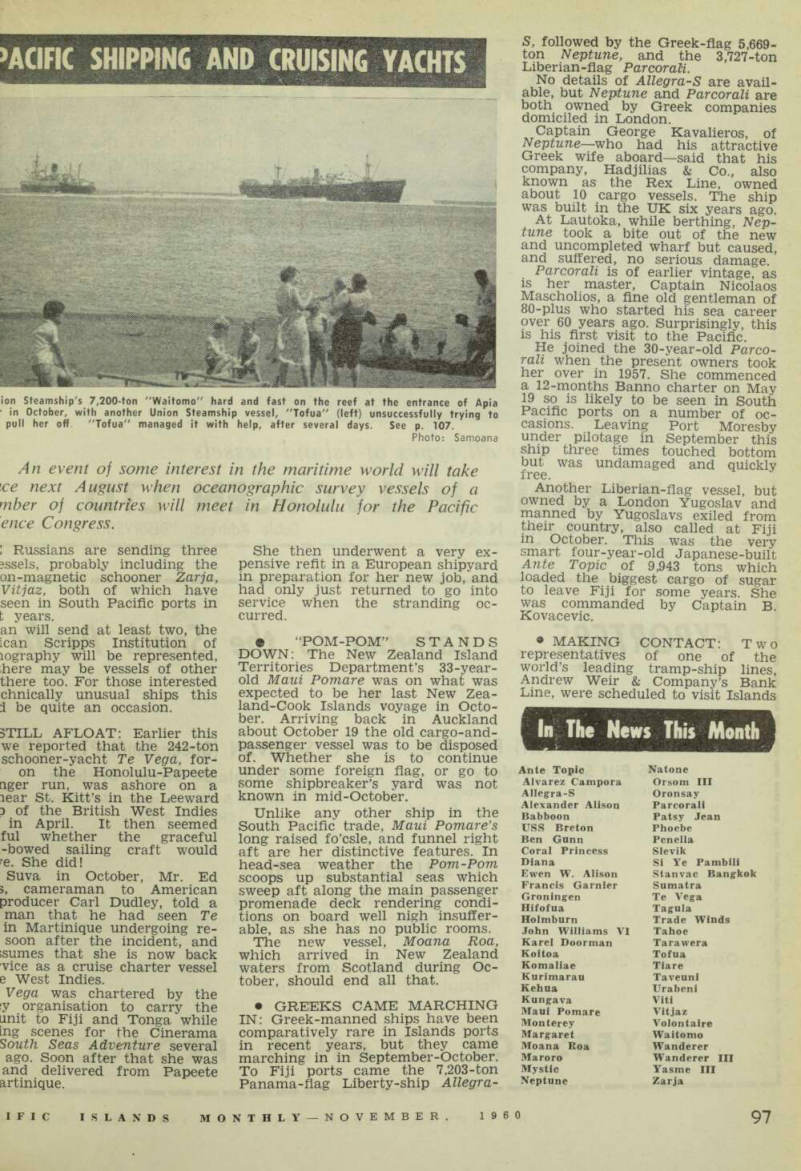
ion Steamship's 7,200-ton "Waitomo" hard and fast on the reef at the entrance of Apia [?] in October, with another Union Steamship vessel, "Tofua" (left) unsuccessfully trying to pull her off. "Tofua" managed it with help, after several days. See p. 107.
Photo: Samoana
in November-December. They Ay. A. C. R. Weir and Mr. J. awkes, both directors of the any. They were to arrive in »n November 22, make a circuit gh Nukualofa and Apia and n to Suva on December 6, then a to London by air.
Don’T Alter Course: If
;ee a line of lighted Japanese tg buoys in the Fiji area at , no need to alter course for ship is not likely to foul any . It will be a tuna long-line the horizontal mainline of i will be at least 15 fathoms the surface, supported bv al droplines from the 12-inch buoys which are usually d at about 200-fathom inter- From each 200-fathom span linline hang about five evenly d 15-fathom lines with one each. ; possibility of a ship fouling of the buoyed droplines is indeed, and there is no pos y at all of fouling the main unless a crossing is made close to a fishing vessel in irocess of hauling or laying— -10 seaman would do that.
Change Of Command:
tin R. D. Matheson who has in command of S. Berge Ship- C ompany’s Suva-based narau ever since that Hong registered vessel entered the Gilberts - Samoa - Rotuma aus service some years ago, id over the command to Cap- P. H. Gosschalk in October, er many years in the Indian service, where he held a • position, Captain Gosschalk to Australia. Through service le explosives vessel Wongala Wyatt Earp ) —later named te —he became well known in New Guinea ports, and was ig in Natone when that vessel ost off the Queensland coast inuary, 1958. He later served ,e LCT Wewak in the stock and in Slevik to New Guinea He has been chief officer in riarau for some time. )tain Matheson is taking leave 3 deciding on future plans.
Mrs. Matheson he returned ickland by air.
• WITH ESCORT: The Noumea vessel Volontaire. often seen in Suva as Tiare when she was a unit of the French Navy, was due back in that port about November 8— escorted by the French Navy’s The American-built YMS-type vessel was decomissioned, put up for sale, and sold to Captain H.
Helbig in April, 1959. He renamed her Volontaire but did not immediately put her to work. She was replaced by a similar YMS — originally the US Navy’s YMS-207 and later the Royal Navy’s Petunia.
It is this craft which was scheduled to shepherd Volontaire across to Suva to go on the slip and presumably be converted for
cargo carrying, though few details were available in Suva in October.
O Has Navy—With Divers:
Fiji has lost its naval unit—but New Guinea still has one, and five of its Papuan members have re cently obtained diving qualifica tions. They are members of the Papua-New Guinea Division of the Royal Australian Navy—an active force,
• That German Cruise: The
German passenger vessel Seven Seas, mentioned last month, will make a cruise from Wellington, NZ, to Auckland, Papeete, Pago Pago, Suva, and back to Auckland next January, leaving Wellington
[?]ptain R. D. Matheson. See above.
auary 7, and returning there nuary 29. The other cruise >ned will be between Aus . and New Zealand ports only. jL BROWN NOW: The Suva cruise-and-charter ketch ) (ex Hifofua) —whose photo y appeared as the new i tug Hifofua recently ?h no fault of PIM shipping Jim Shortall, who knows —is now owned entirely by aster Stan Brown. Imme after our report of last was in print there was a ■ rearrangement of shares :r. Stan Burgess is not now eholder.
Ew Guinea Prawns: In
ty cruise of the south-eastern )f Papua in August-Septem the Port Moresby-based j Research vessel Tagula conclusively that a prawn industry could be established Catches of as much as a ton ir hours were made, the averaging six inches in The prawns are believed to rilable in this area from to November, e are known to be prawns in aters, too, but so far the to develop an industry has en forthcoming.
)R New Oil Depot: Mr.
eart and his family travelled ava to Nukualofa by specially ed Fiji Airways aircraft in '• There Mr. Peart takes up sition of first manager for ell Oil Company of the new •il terminal at Nukualofa, ements for the first shipment /ere not finalised in October.
Rw Direct Uk-W. Samoa
A new direct link between ited Kingdom and Western was established in October
by the Shaw Savill chartered vessel Mystic, and in future regular calls will be made at Apia as car goes require. Previously the first discharge port for this particular shipping service was Suva. A variety of ships are used in this trade.
After discharging at Western Samoa and Fiji they load at New Zealand ports again for the UK.
• New Lights For Ng: De
tails were announced in October of a programme to improve shipping aids in P-NG. Briefly, the pro gramme provides for the establish ment of 11 new unattended light houses, the replacement on a per manent basis of three temporary lights which were established during World War 11, and improvements in the range and character of two existing lights.
Two temporary lights on Sariba Island in the China Strait and at Cape Gazelle, near Rabaul, will be discontinued when proposed new
lights in those localities have been established.
One of the new lights will be erected on Yule Island, 60 miles north-west of Port Moresby, and another on Madehas Island, near the western entrance of Buka Passage, Bougainville.
A light on Yule Island would have a utility as a coastal light for vessels running to the west coast generally and would serve as a land fall or approach light for vessels making Yule Harbour. In addition to the main light, it is proposed to pro vide a beacon light because muddy waters in the vicinity of Yule Island make it very difficult, if not im possible, to detect the limits of the outlying reef.
A light on Madehas Island will provide a valuable guide at night to the many small vessels entering Buka Passage from the eastward.
Because of the extensive outlying reefs, ships are not at present pre pared to negotiate the Passage by night.
At the request of shipmasters, new lights will be provided to assist ships passing through the Vitiaz Strait between the Huon Peninsula and New Britain. One such light will be established at Fortification Point and another on a site to be deter mined.
The additions and improvements will cost more than £60,000 and the work will take at least three years, beginning next year.
O New Mission Launch: The
Seventh-day Adventist New Guinea Mission dedicated a new £22,000, 48ft mission vessel Urdbeni in October.
The dedication was in Brisbane, where the vessel was built. She will be used for medical missionary work in the Papuan Gulf region, and up the Fly River. Factor E. L. Martin arrived in Brisbane in October with five Papuan deck-hands to take the vessel back to Papua.
• Papua Changes Regula
TIONS: In Port Moresby, in Oc-
[?]nga tug "Hifofua", which visited Apia in October to help get the "Waitomo" off a reef.
However, the tug was not needed. See story p. 107.
The Suva-based cruise and-charter ketch "Maroro" (right) is now owned entirely by her master, Stan Brown.
See report on this page.
“Maroro" was formerly the Tongan ketch “Hifofua" - and the new "Hifofua" is a tug (see photo below).
new regulations were and for the Papuan Navigation ace—the idea being to coe all the regulations at prel force for the safety and of passengers. Similar
n.ents b. e *£> the
imea regulations, thus bring- ;h territories into line. 3 apuan regulations came into m October 27. They require 1 ships operating more than ;s from shore must carry a y radio and a radio operator a third-class operator’s a,te.
Marine Board said it hoped aers would install two-way equipment wherever possible : the ship didn’t ply more 5 miles from shore. But it that a legal 15-mile, offimit was a “reasonable com- ; between the theoretical and il views on this matter”. ier major amendment to the ions governs the number of ;ers which may be carried tal vessels. Those in partially id and sheltered waters may s the numbers of deck ;ers. Sheltered waters are to :ifically defined later by the Board. adults travelling without a the new regulations say that .ust have at least 12 square ch on an open sea voyage; : six square feet in partially waters; and at least three feet, or feet of seating, Dth waters.
Id without a berth gets about the clear deck space of an :egulations also set out other
minimum requirements, including provision of meals, the number of crew, life-saving and pumping equipment.
The regulations should make it a i o t easier to deal with the com plaints that have been heard from time to time from native passengers who indicate that on some voyages they get very little for their passage money.
• Not Enough Water: When
the Netherlands aircraft carrier Karel Doorman accompanied by the destroyer Groningen and a tanker, entered Noumea harbour on October 7 on a flag-showing tour, the public were disappointed. Because there was not enough water at the wharf only the destroyer berthed and the carrier remained at anchor in the stream. Earlier it had been an nounced to the public that the carrier would berth and it would be opened for inspection. The present generation of Noumea, have never seen an aircraft carrier close up.
Those with war-time experience re membered the mighty silhouettes of US carriers.
During the stay of the vessels the commander of the Karel Doorman decorated a Noumea volunteer with the Dutch Croix de Guerre, on behalf of Holland. The man, Mr. Francis Cornaille, an ex-parachutist of the Free French Forces, distinguished himself in the fighting in Holland, If local people were disappointed at not being able to board the carrier, they weren’t disappointed with the visit generally, The Dutch sailors made an ex cellent impression by their good be haviour. There were nearly 1,000 of
[?] Netherlands aircraft carrier "Karel Doorman", arrived in Noumea on a flag-showing [?]ctober she had to anchor a few miles across the harbour. The local populace was dis- The destroyer accompanying the carrier, "Groningen", was able to tie up (foreground).
See story below.
Photo: Fred Dunn
ashore each day and not one mt” was reported. Cases of drinking were mild and few. y Noumea people suggested, .ng the Dutch visit, that Aus should send her aircraft ■ on a visit to Noumea.
Karel Doorman later went On dney, where, unfortunately, was one incident. A sailor ;he carrier was charged in a 7 court with the murder of a ite, and he was still in Syd len the carrier left for South ja on her way home to d.
X)KS VISIT: The Matson 18,000-ton Monterey made a Rarotonga in September. No dnment parties went aboard ship stayed only long enough up a number of Rarotongan ?ers taking advantage of a comfortable trip to New Zea plus Mr. T. Rowe, Matson epresentative in the Pacific Rowe had been in Rarotonga ng about the possibilities of rater ey and Mariposa calling regularly—once every three The ships would make berths le to NZ and would also carry t has been suggested that no ?ers would go ashore, but the id four-hour stay would en mtertainment parties, and of souvenirs, to go abroad.
Ti For N. Australia:
frigerated one-time Fiji Gov it vessel Viti, owned by Tas team Ship Co. of Auckland, ported sold in October, for northern Australian waters meat trade. It was not clear, r, whether the vessel is to rozen meat, or is to be con fer the carriage of livestock, was back in Wellington in tober from her oceano research cruise to French ian waters. According to a slands report a member of igineering staff was killed crushed between ship and at Papeete, where the vessel for bunkers. The cruise com from Auckland on Sep -15, Viti passing the Cooks i Bora, and calling briefly at a on the run back from *
Fnual Circuit: Com
i by Captain J. McKenzie the London Missionary So -419-ton John Williams Vl— s perhaps the largest mission the world—was making her circuit of all the inhabited of the Cook Group in Oc ship spends most of her time Gilbert and Ellice Islands, kes an annual run westward as New Guinea and another d as far as the Cooks, carry ;sion and private cargo, and personnel. She was built as Sloane in the UK in 1946.
More For The Cooks:
k 0r ’ £. Brown, Taveum, in the Cooks trade, w r as down in New Zealand another larger vessel to add to his fleet. There were also vessel^ 5 mieht h^°^/ S \ andS rn oS u 1 ? soon be sold to a bv hl annf 1 w be laced mact 3,llo 6r small New Zealand coaster.
• Ttvahtor * *
, SOUTH. First of kJ Bn Jf f 0 wha fleets, headed 99 Q9i h f r? Ct S r S f lp Tona nMaru, 9? eft fv, JaP A n^ on .P ct^ r nliooS 11 u v the Antar ctic. The baleen whaling season (for nontoothed whales) does not open until f^ r i y Q Janu l ry l ’- but . th ® fl ? ets in sperm whaling in the tropics and
Antarctic prior to then as thev move into position. Japan has pur chased the British Balaena fleet so this year, will send seven fleets' south. There will probably be seven Norwegian fleets three Russian • wo f ? ritish ’ and ° ne Dutch operat mg this season. • da P an shows considerably more interest in the non-edible sperm oil than any other nation. Last year Japanese fleets took nearly 18,000 tons of this oil, which comes from a large cavity in the whale’s blunt head. The oil’s natural function is not known - but it forms a base for paints and varnishes and has other industrial applications
* Wetting His Fins: Captain
L. C, Bolton, who was in command
of Maui Pomare for many years who has been employed in a si capacity with the Union Comf in recent years, was putting to again in November on a special livery job.
The 354-ton Du t c h-built coaster Sumatra, sold to the J manian Government, was to 1 for Hobart about November 1 I the former Auckland Harbour 1 Evoen W. Alison (ex George P in tow. The latter vessel had been purchased by the same ernment. She was originally a ney Harbour ferry, bought by Auckland owners after she served in the New Guinea area ing the war.
Another one, Alexander Al (ex Francis Peat) , sank in mid-] man in April this year while b towed to Hobart by the Union C pany’s Kaitoa, indicating that ( tain Bolton’s job could prove teresting if the weather turned ]
• For Docking: The Co
based D. C. Brown ketch Tax) was in Pago Pago in Septern October for dry-docking and effect repairs to a hull leak w had developed. Captain Ai Pickering, of Suva, was in comm
• Alone For A Year:
New Zealanders who for the ; year will have only themselves company sailed to Raoul Islam the Kermadecs, 600 miles no east of Auckland, in the MV H< burn in late October. The men on the staff of the meteoroloj station on Raoul, and once they j over, their chances were that would see no other faces until next visit of the servicing vessf October next year.
Officer in charge is Mr. G Kape, of Gisborne. As well as t< nicians and observers, there 1 farm manager, a handyman ar cook. Raoul has a 40-acre m farm, providing fresh pork i mutton, eggs, milk, butter j cheese. An orchard-cum-garden plies vegetables and sub-tro* fruits, including oranges. The 1
The Cooks-based ketch "Taveuni", which in Pago Pago in October for dry doc[?] See above.
sxcellent. That the life there io bad is probably witnessed fact that two of October’s earn were beginning their consecutive term of the current trip to Raoul will i the station with new tele nications and meteorological ent, and a new prefabricated 0* 3* lENCH VISITS: Fren c, h vessel Francis Gamier, wear flag of Rear-Admiral Matinet Officer, French Naval Forces, i made a three-day courtesy Honiara in September. The was last there in 1958. The crew were popular visitors sporting and social pro e went off with a swing.
French research vessel 111 paid her third visit to a during the same month, ve scientists on board are d in oceanographic studies Coral Sea. Research includes cording of marine currents ieir variations, the analysis rater at various levels where m is found, and the evalua the density of the plankton, e leaving Protectorate the scientists took samples water around Savo, at the of the BSIP Chief Geologist, C. Grover. Analysis of these > will be included with other ) give an overall picture of conditions at volcanic Savo.
Any later variations can then be assessed for possible increased vol canic activity.
• They Have Names: Names
have been chosen for the three BSIP Government vessels now be ing built in the UK. The replace ment vessel for the ill-fated Mel anesian will be named the Coral Princess.
The two Saunders-Roe vessels are to be named the Kungava and the Komaliae. Kungava is a bay in Rennell Island and Komaliae is a bay in the Shortlands. Other Saunders-Roe ships to be built later on will also be K-Class ships and will be named after bays and har bours in the Protectorate.
• Waitomo On Reef: The
Canadian Union Line’s 7,290-ton trans-Pacific freighter Waitomo was in trouble in mid-October. Bound from Sydney to Vancouver by Islands ports the ship went aground on a reef near the entrance to Apia harbour while entering from Nukua lofa on the evening of Saturday, October 15. The Union Company’s Islands vessel Tofua (5,299 tons), which had sailed from Apia for Suva some hours earlier, was re called to give assistance. The Waitomo was carrying about 1,400 tons of general cargo for Apia.
The Tofua made several attempts to pull the Waitomo off without avail, because wire ropes and cables broke. (Over)
[?]nderer", of Auckland, which arrived back at her home port in October.
! Tofua remained in Apia ur to stand by the stranded ►mo and the Tongan tug m was radioed for assistance, the Hifofua and the Union Tarawera were expected to on October 19.
Waitomo was lying on the m about half her hull, while tern was still in deep water, s to have been the last trip le master of the Waitomo, in Sinclair, before his retire jr the arrival of the Tara on Wednesday, October 19, ewed effort was made by the and Tarawera, with the pulling on the Waitomo’s r chains and turning her com -7 around. Then she drew her [eep water. (See photo, p. 97.) Hifofua arrived too late to my assistance. examination of the Waitomo’s by divers found no damage, cargo was landed in per ondition.
Tofua left with four days’ which the Union Company to make up, so that the vessel take the pre-Xmas shipment nanas for the New Zealand ;t in time for distribution to ;rs. grounding created great ex mt along the Apia waterfront.
'Il Terminals Opening:
irst of two big terminals be lilt in the South West Pacific rear by Vacuum Oil will be d at Apia in mid-November, the first terminal constructed a oil company in Western i. Another installation will be d at Madang, NG, shortly
The first tanker to discharge at Apia is expected to be the 524-ft Stanvac Bangkok, 15,000 tons.
The terminal is on Mulinu’u Peninsula, adjacent to the town. It will be completed at a cost of £105,000 and has four bulk tanks, each with a capacity of 180,000 gallons—two for motor gasoline and one each for distillate and lighting kerosene.
A feature of the project is a combination of a six-inch sub marine pipeline and floating line, with an overall length of 3,300 ft., connecting an off-shore tanker anchorage to the terminal.
The Vacuum terminal at Madang will be completed during November and the first tanker is scheduled to call there in the second week of December.
Madang also has four bulk storage tanks—two of 275,000 gallons capacity for distillate and aviation gasoline; one of 155,000 gallons for motor gasoline and one of 87,500 gallons for lighting kerosene.
® O Ron Say’S Visit; Rabaul,
New Guinea, was host to about 1,200 tourists from the Oronsay on October 15. She made it her first port of call on a Pacific cruise from Sydney to Japan via Hongkong and Singapore.
Special tours were organised to climb Rabaul’s infamous volcano, Matupi, and a special race meeting coincided with their stay. Many of the more elderly tourists showed great interest in the natives and there were plenty of photographs taken with them for the “I was there” pictures in their photo albums. Some tourists took the names of natives, promising to write to them.
News of Cruising Yachts
A Big Tasman Race Likely:
The Royal Akarana Yacht Club of Auckland, sponsors of the Tasman Yacht Race, reported in October that already it appeared probable that there would be at least 15 entrants for the next event which commences from Auckland, Jan uary 28, and finishes at Sydney.
Five of these yachts will be Aus tralian. Entries were to close No vember 30, but under special cir cumstances later entries from over seas yachts might be accepted. ® DIANA of England, which Norman Young brought to the Pacific in 1957, again cleared Balboa, September 22, bound for
days before the "Patsy Jean" made an unscheduled trip from Rarotonga to Mitiaro to the shipwrecked crew of the "Margaret" (see story p. 61) she had spent a pleasant day Here was the party aboard, from left: Don Comesky, David Saunders, Brian Crawford, Olive Silk, Bob Boyd, Lilian Moore, Don Silk (skipper) and Alan McQueen.
Photo: R. 0. Moore
Polynesia on the second circuit. With veteran Young is Mark Pridie, Peter Knight, David Merchant, and Gregg Parks —the latter two Americans. Planned route; Galapagos, Marquesas, Tahiti, Samoa, Fiji, New Zealand. • YASME 111 and Danny Weil are heading for the Pacific again. The 50-ft ketch cleared Balboa about September 1 for the Galapagos and westward. Weil lost YASME I in the Coral Sea, and YASME II in the West Indies a year ago.
The present craft, until recently named SANS REGRET, was purchased and fitted out by Weil at Fort Lauderdale, Florida.
Also aboard: Weil’s recently married wife.
A New Zealander, Dave Tremayne, left the yacht at the Canal Zone. Weil is operating on the amateur radio bands. He flies the Israeli flag. • ALVAREZ CAMPORA, 49-ft ketch of Uruguay, manned by a group of naval officers, cleared Balboa, August 5, for
Ecuador, thence trans-Pacific to the Far East and Europe. No other details of route or personnel. • PHEOBE of Durban, with owner Watkin and one companion cleared Balboa for Polynesia in the first week of Sep tember. • BABBOON, veteran American schooner which cleared Suva, August 4, for Honolulu and California, arrived at Honolulu after 59 days at sea, during which the navigator lost his position. The yacht was sighted by the aircraft carrier USS BRETON 450 miles east of Midway on September 7 and given a chart and some sailing instructions.
Honolulu then lay south-east.
The yacht was leaking badly and food supplies were all but exhausted when she was towed into Honolulu for the last mile or two on September 30. The auxiliary engine had failed a week after clearing Suva.
With American Gene Laughlin—who had
been sent to Fiji by the owner to joi navigator—were Suva crewmen B MacPherson and Maxwell Hoeflich, Englishman Charles Chapman. The j had earlier been the source of considei ownership dispute at Papeete and a at Suva, and was in the ownership of Urban J. "Harp” Didier, of Woolland 1 Cal., when she finally cleared Suva afl nine-months’ stay. • WANDERER of Auckland, with Buchanan and crewman Ganley whicb Suva, October 1, arrived safely bad her home port. • WANDERER 111 and the Hiscocl England, also arrived at Russell, NZ, Fiji early in October, 14 days out of S • TRADE WINDS, the Tonga 120-ton ketch, was reported in Vila August and heading for Noumea—fui plans unknown. • PENELLA of England, cleared late in August for Beqa, Noumea, Brisbane. • TAHOE was to clear Rarotonga September for Suva, Noumea, Sydney. • SI YE PAMBILI (we’ve seen a three versions of the name) of Greei England, and BEN GUNN of the US arrived at Suva on October 12 from east. SI YE PAMBILI was originally ketch KOYA. Five young men set from England in her in August, 1951 sail round the world, but, as usual, things as marriage, sea-sickness an longing to stand on dry ground, took \ toll, and the two originals left eventually reached Suva were Roger G< and Bill Baker. With them was a senger travelling to NZ from Tahil Canadian, A 1 Schofield.
The original five were members of British South Africa police in Sout!
Rhodesia. They left their jobs, p« their resources, and bought the KOY She was re-christened SI YE PAMJ meaning "Let us go forward” in Rhode: Skipper was Mike Maude, who had i some river sailing in small boats England. None of the other four ever sailed a boat of any kind.
When they left England, they knew] to put up the mainsail. Everything! had to be learned on the high seas
The "Si Ye Pambili" (translated as "Le[?] Go Forward") which left UK in August year and was in Suva in October en rout[?] NZ. Photo: R. D. W
' Gowen had read some books on ion, so he was the navigator. He with a sextant and chronometer, ave a radio receiver. , we seem to get into the port we’re without much difficulty,” says “On the whole trip, we’ve only couple of days when we couldn’t ighting at all.” cruise has taken them to Lisbon, s, the Canary Islands, Barbados, ilapagos, the Marquesas, Tahiti, ga, Tonga and Fiji. They intend ip at Auckland for re-fitting during rricane season, then sail back to South Africa, per, it’s a sturdy little craft, and od up under a few rough squalls any trouble. Overall length is and it has a 10 ft. 7 in. beam Hi-foot draught. Gaff-rigged, it’s le to keep full sail up when other ould have to reef their sails. It It in Blairmore, Scotland, in 1924. i, who has taken over as skippei YE PAMBILI, expects to reach d about mid-November.
N GUNN will be in Auckland in er. Owned by Henry Horn of Connecticut, USA, she is carrying Mrs. Horn, their daughter Carlile, ndy Svedlund, who joined at ga and will travel as far as d.
1959 16 on ° ?* y f tic ln May ’
Se AfteJ a .»v « i x "tt 1 r?" %-fltt‘inr „ t y P at - Auc^ and f °* continue i » engine, they will continue their journey westward. e di JVh^vfl ^r -* we try Ground the ?a * £ il^rra^ ean ’ bln GUNN h h nm C f P i<«i Sai ?
Massachusetts:' ’
Light"„I Alfyzee«°Ai 5. F I
overall’ ALFY ZEE - She is feet SrfotnV 112 fCet beam ’ and 6 ft ' 2 in< " ’
A “I’m crors a *i, , , P^r d J that people don 1 Selwvn MaHie Sland and Futuna .” said of th? nC °L th ® Pa !: t - OWners ° f * h ® N ®. w Zeala »d yacht KEHUA.
With his partner, Peter Ashcroft, he took KEHUA to the two French islands eju-her this year. They will be returning to Whangarei, their home port, in Novem- Der -
It was their second overseas cruise, but their first time to Wallis and Fuiuna “We were the first yacht that had called there for about three years”, Matheson sa id They established another first by carry ing the bur^ee of the Bay of Islands Yacht Club overseas for the first time. They are also members of the Onerahi Yacht ClUb at WhangareL Travelling with them as crew is John Pettit, formerly of Wh—arei. row of Napier.
KEHUA was amateur-built on plans by Woolacott. She is patterned after the ocean racing sloop GHOST, but has been rigged as a bermudian ketch for ease of handling in weather. Length is 29-feet overall, beam 8 ft. 2 in., and draught five feet, Extensive repairs had to be made to KEHUA at Rarotonga in May, after being caught in harbour by the Chilean tidal wave.
the "Diana", of England, which was in [?]ific in 1956, and is now Pacific-bound [?]econd circuit. Below is the English "Yasme", in which Danny Weil made [?]g of a name for himself after losing the Coral Sea a few years ago. He [?]sme II" in the West Indies a year ago, is now again headed for the Pacific, in "Yasme III".