Tropicalities
pp. 79-80 · Read in the full issue
Pacific Islands Monthly
Magazine Section
Fiji's Governors—ln
Restrospect!
* old resident of Fiji resisted the opinion, offered by another, that the Governor had not i sufficiently “tough” in dealing i the Indian trouble-makers in disastrous sugar dispute. “I ik his patience has prevented se trouble developing,” he said; that view is widely held, governors are lonely souls, away by themselves, and always at t more criticism than praise,” the old-timer. remember the public curses were heaped upon Murchison cher for spending so much ley upon roads. But now we s him for his road-building, we all are looking for another i-builder. rhey used to say that Sir Harry e did not take his life and job ously enough. Now, our mem s of him are pleasant.
Everyone used to acclaim Sir iur Richards—the ‘strong man’ )ur line of Governors —but now ys no one seems able tip re nber anything he accomplished. sir Philip Mitchell apparently ie along merely to make Fiji something in the war—we re nber him best by Negley son’s description: ‘A hunter of game in a colony of imported igoose’. , , Ye did not have nearly enough Jrantham —he left early, to leave mark permanently on Hong g. We remember Freestone tly because he was outspoken the Indians about their big flies. . . , Ye remember Garvey chiefly be se he knew the country so well, he really contributed something ;he first years of his governor- > —only to be let down by the mial Office—or so we think. tes, I think we see our Cov ers most clearly in retrospect, don’t judge the Top Brass too ;kly. No one envies him his job, this Colony!”
Travel Is So Elevating
R, 808 HOWLETT, whose ac , tivities as Secretary of the Fiji Visitors Bureau, a few years , made that organisation hum, something to say in Sydney re tly about the future of tourism Australia. ob, who is now a travel rep
resentative in Sydney, told a travel convention that by 1964 there would be 555,000 travellers to and from Australia, rising to 780,000 in 1969.
This meant the number of travellers by 1969 would have doubled in 20 years.
He added that a “most interest ing point” had arisen from a travel survey he had been making, and one that even had surprised him.
This was that the largest travelling age group is that of 30-44 year-olds.
They constituted 28.7 per cent, of all travellers as opposed to 23.5 per cent, in the 15-29 age group and 23.6 per cent, in the 45-59 group.
The convention was also told that never had there been an era when so many people had so much to spend on leisure, and it was up to all concerned in the travel in dustry to see that a good proportion of that money was spent on travel.
A vital factor in tourism was “keep ing up with the Jones’s”. Travel had taken the place of cars and swimming pools in determining a person’s social status.
The Incredible Frogs
Of Malaita, BSI
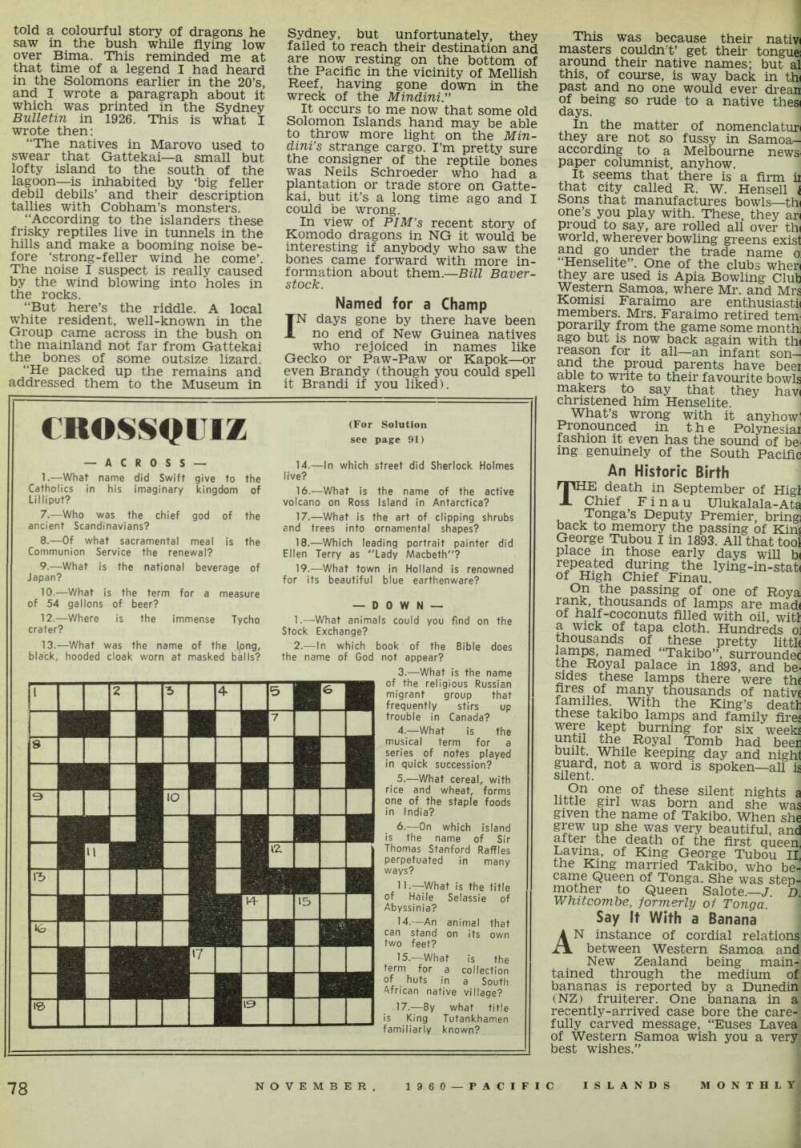
DO you know that the world’s biggest frogs ars to be found on the island of Malaita, in the Solomon Islands?
These are giant frogs, not toads.
I know—l lived there 25 years ago.
At night time, I could hear them barking, like a pack of fox-terriers.
I often thought I might make a fortune by introducing the frog farmers of Western Europe to this variety. lam sure they would have provided a gastronomic delicacy.
Some of them weighed 5h pounds, and measured 27 inches from nose to toe, with legs like a ballet-dancer.
You don’t believe it? Well, here is a photograph I took of my daughter, holding one of them.
I think there might be good money in using these creatures for sporting purposes—you remember, for instance, Mark Twain’s classical story of the betting on the “frog jumping contest”. Something also might be done with selective breed ing—imagine frogs three feet long! —Doug Askew.
One That Didn't Get Away
LATEST intelligence from a Papuan Local Government Council newsletter:
• Walai Village News : On
the afternoon of September 19, Councillor Louis was walking to his canoe after working in his garden.
He had to cross a shallow swamp and in this swamp he saw seven cranes.
He had a stone in his bag and threw it at them, wounding one.
Thinking that it might fly away, he ran very fast to where the bird was lying, but the bird was nearly dead.
Councillor Louis picked the bird up and on its leg was a tin tag with the inscription “WRITE WILD
Life Csiro Canberra Aus
Tralia No. 100-19263”.
He took the bird back to the village, but it was dead when he arrived. The people ate the crane, but they were very sorry for they realised that it must have come from Australia.
• Mail Order Catalogue ;
Recently one of the station staff saw a nice looking chromium grilled radio priced at a low £6/10/- in an Australian catalogue. He thought it was a snap and immediately sent the money for it. When it arrived he asked the QIC why it wouldn’t go. He was told that not only was it electric—and there was no elec tricity—but also it was a radiator not a radio.
What Was "Mindini's" Secret?
MR, KERKHAM’s reminiscences of the Mindini wreck ( PIM , August) have a connection with the recent PIM reports about Komodo dragons having been sighted in New Guinea.
When Alan Cobham made avia tion history in the 1920’s by his flight from Britain to Australia, he
One of the world's biggest frogs?
told a colourful story of dragons he saw in the bush while flying low over Bima. This reminded me at that time of a legend I had heard in the Solomons earlier in the 20’s, and I wrote a paragraph about it which was printed in the Sydney Bulletin in 1926. This is what I wrote then: “The natives in Marovo used to swear that Gattekai—a small but lofty island to the south of the lagoon—is inhabited by ‘big feller debil details’ and their description tallies with Cobham’s monsters.
“According to the islanders these frisky reptiles live in tunnels in the hills and make a booming noise be fore ‘strong-feller wind he come’.
The noise I suspect is really caused by the wind blowing into holes in the rocks.
“But here’s the riddle. A local white resident, well-known in the Group came across in the bush on the mainland not far from Gattekai the bones of some outsize lizard.
“He packed up the remains and addressed them to the Museum in
Sydney, but unfortunately, they failed to reach their destination and are now resting on the bottom of the Pacific in the vicinity of Mellish Reef, having gone down in the wreck of the Mindini.”
It occurs to me now that some old Solomon Islands hand may be able to throw more light on the Min dini’s strange cargo. I’m pretty sure the consigner of the reptile bones was Neils Schroeder who had a plantation or trade store on Gatte kai, but it’s a long time ago and I could be wrong.
In view of PI M’s recent story of Komodo dragons in NG it would be interesting if anybody who saw the bones came forward with more in formation about them.— Bill Baver stock.
Named for a Champ
IN days gone by there have been no end of New Guinea natives who rejoiced in names like Gecko or Paw-Paw or Kapok—or even Brandy (though you could spell it Brandi if you liked).
This was because their nativi masters couldn't’ get their tonguei around their native names; but al this, of course, is way back in th( past and no one would ever drean of being so rude to a native thesi days.
In the matter of nomenclatun they are not so fussy in Samoa— according to a Melbourne news paper columnist, anyhow.
It seems that there is a firm ir that city called R. W. Hensell i Sons that manufactures bowls—th( one’s you play with. These, they ar< proud to say, are rolled all over th< world, wherever bowling greens exist and go under the trade name o Henselite”. One of the clubs when they are used is Apia Bowling Club Western Samoa, where Mr. and Mrs Komisi Faraimo are enthusiasts members. Mrs. Faraimo retired tem porarily from the game some month ago but is now back again with th< reason for it all—an infant son ant the proud parents have beer able to write to their favourite bowls makers to say that they hav< christened him Henselite.
What’s wrong with it anyhow- Pronounced in the Polynesia! fashion it even has the sound of be ing genuinely of the South Pacific
An Historic Birth
r’E death in September of Higl Chief Fin a u Ulukalala-Ata Tonga’s Deputy Premier, bringi back to memory the passing of Kim George Tubou I in 1893. All that tool place in those early days will b( repeated during the lying-in-stat< of High Chief Finau.
On the passing of one of Roya r^ r l?’ 1 ] :llousands of lamps are mad( of half-coconuts filled with oil, wit* a wick of tapa cloth. Hundreds oj thousands of these pretty little lamps, named “Takibo”, surroundec the Royal palace in 1893, and be sides these lamps there were the fires of many thousands of native families. With the King’s death these takibo lamps and family fires burning for six weeks u n -ii i'* le Royal Tomb had beer built While keeping day and night guard, not a word is spoken—all is silent.
On of these silent nights a little girl was born and she was given the name of Takibo. When she grew up she was very beautiful, and after the death of the first queen, Lavma, of King George Tubou 11, the King married Takibo, who be came Queen of Tonga. She was step-] mother to Queen Salote.— J D Whitcombe, formerly of Tonga.
Say It With a Banana AN instance of cordial relations between Western Samoa and New Zealand being main-, tained through the medium of bananas is reported by a Dunedin (NZ) fruiterer. One banana in a recently-arrived case bore the care-i fully carved message, “Fuses Lavea of Western Samoa wish you a very best wishes.”