Samoa Completes
pp. 73-77 · Read in the full issue
Marathon Task
•om “PlM’s” Apia Correspondent
When West Samoa’s Consti
onal Convention completed e in October its task of isidering the 124 articles of Constitution which will ye as the supreme law of
new independent State,
had gone through nine muous weeks of continuous iberation. The Convention
;an by sitting only during
morning, but as time ssed, it found itself sitting the afternoons and even
s, too.
E subject of West Samoa’s in iependence, and the termina ;ion of the present Trustee- Agreement, comes up for dis on in the United Nations on smber 14. Prime Minister Fiame lafa is scheduled to leave here Mew York in the first week of imber, together with his secre- Mr. E. Stehlin, and the Con tional Adviser to the Samoan ;rnment, Professor J. W. David of the Australian National Uni ty, Canberra. ime Minister Mataafa carries him the final version of the >titution—the result of all those hours of the Convention, dependence Day tentatively is for January 1, 1962. iring part of the sittings of the
Convention, the New Zealand Gov ernment’s Constitutional Adviser, Professor C. C. Aikman, was in at tendance together with Professor Davidson and the two Constitu tional experts had the difficult task of explaining to the members the many involved and intricate consti tional, legal, administrative and political provisions of the historical documents.
They answered the numerous questions and recommendations posed by members mostly totally unfamiliar with the problems sub mitted to them.
The joint chairmen of the Con vention, the Hon. Tupua Tamasese and Malietoa Tanumafili 11, and the acting chairman, the Hon,
Fiame Mataafa, and the two Con stitutional Advisers, worked harder and spoke more frequently during the session than any of the 174 members.
One-and-a-half Years' Work
The draft as submitted by the Working Committee of the Legis lative Assembly was the work of nearly one-and-a-half years of con tinuous deliberations and of careful investigation and study by the Con stitutional Advisers. But it could not be described as altogether per fect, and there was considerable criticism and quite a number of motions seeking to amend certain parts of the Constitution.
Yet the great majority of the
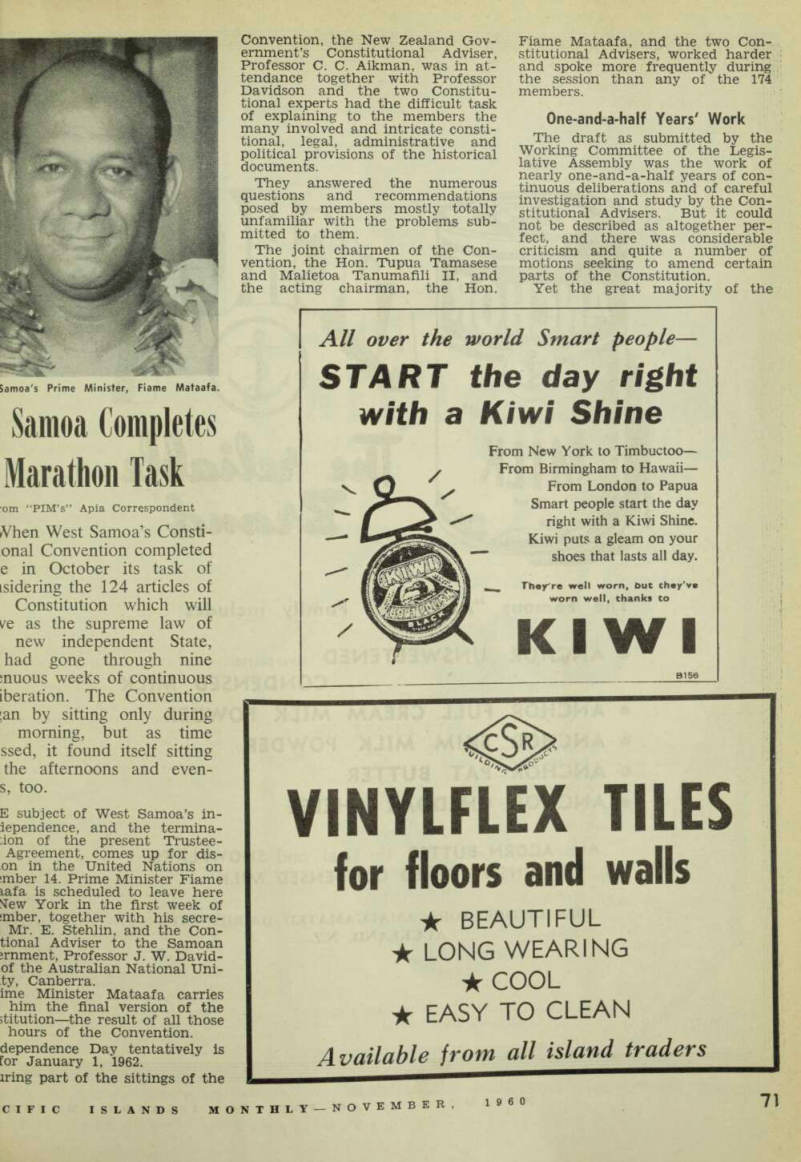
Samoa's Prime Minister, Fiame Mataafa.
ibers of the Convention seemed e strangely adverse to approv □f even the slightest alteration amendment in the draft. They ied to consider the draft as ’osanct”, taboo. As some said, it is written is written” and Id be accepted. lus the strange fact evolved in spite of more than two ths of continuous debates, and ithstanding many controver opinions being voiced from the of the house, in spite of objec i to some provisions and of idments being moved to some le clauses, despite all this, in end not a single line of the : was altered (apart from tech corrections which did not ge the meaning or the purpose le provisions) ! ngthy debate ensued every time ; of the Constitution touched natters affecting Samoan cus and traditions, unbers did not quite realise a modern democratic Govern ; cannot be based on Samoan im, though many of these tional political and social ires of Samoan society can very ntageously be blended with >cratic ideals.
Heated Controversy
ere was, for instance, a heated ■oversy at a later stage of the m, when a representative of ‘Tumua and Pule”, the repre ,tives of certain traditional cts and villages, who have ps taken a privileged place in )an life, attempted to get a m passed by the Convention, ng to have the Tumua and mentioned in the Constitution irt of the Government of In ident Samoa; to have them part in the election of the of State in future, and to ; them 11 representatives e coming Legislative Assembly. is motion by a representative le group, Mr. Toluono Lama, after two days’ debate defeated
by , a^ rg( ? ma 3° rit y- The Tumua and Pule is m fact an ambitious pressure group which has in past lamoTn tr Go d vernmente inflU6nCe °“ Samoan Governments.
Just before the Convention ended its session, a strange incident occurred when an elderly village chief rose and recounted that the previous night he had had in his dream an apparition “in which Jesus and Mary, and High Chiefs Tamasese, Malietoa and Mataafa” appeared to him and said they were well content with the work of the
Convention and that God’s blessing would be on the future State of Western Samoa. « may be safely stated that from the point of view of the Govern nient, the Convention could be con sidered a full success. From the public’s point of view the large expense was probably not warranted cost of the Convention was £31,050).
Nevertheless, it is hoped that during the debates on Western Samoa, the United Nations Gen eral Assembly will have access to
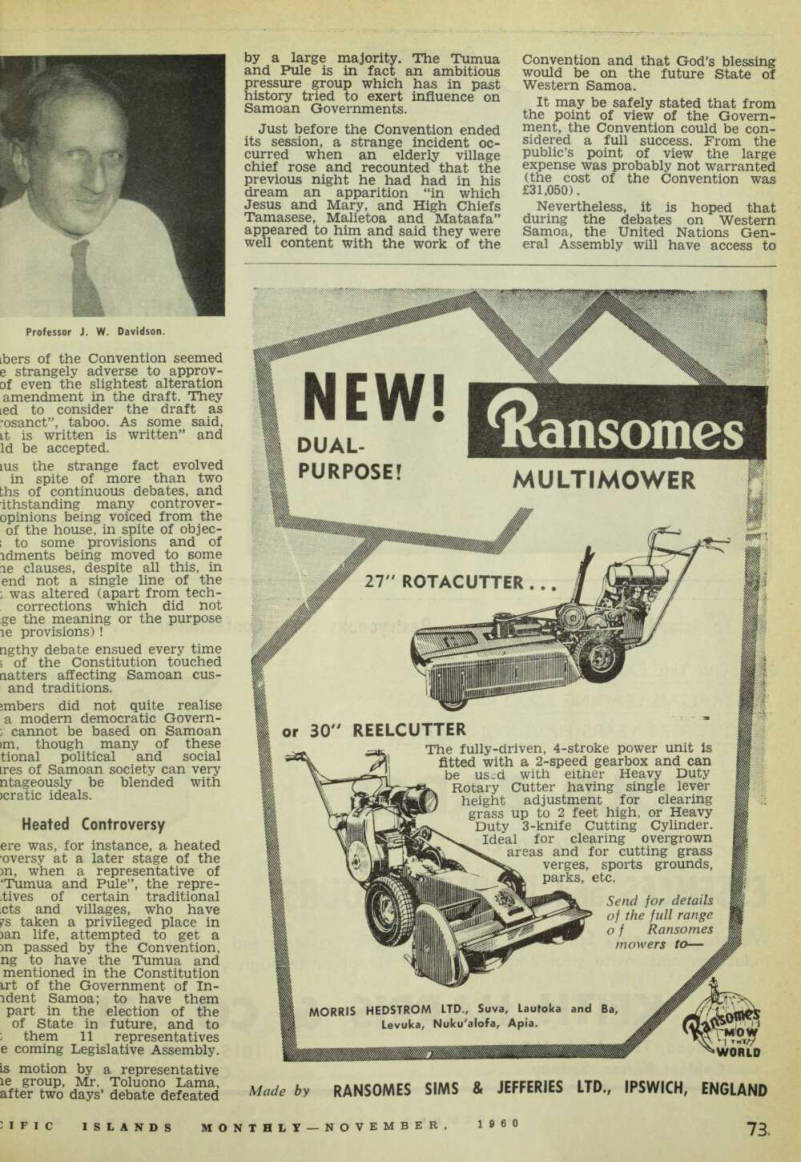
Professor J. W. Davidson.
ninutes of the Convention so realise that the consent given he Constitution was by no s unanimous and that many ?ent views were expressed g deliberations. the other hand, the Working nittee and the Constitutional ers have undoubtedly per -3d a difficult and creditable in drawing up the most im nt historical document in ian history. s probably also true that many ie provisions of the Constitu with the rapidly changing cal, social and economic facets odern times, will need to be id and adapted to more rn conditions.
Question for Plebiscite
3 of the important topics dis d towards the end of the Con m was the plebiscite which is 3 held in Samoa next year : United Nations supervision, in which by universal fran all Samoan citizens over the )f 21 will vote, motion (by Mr. Paitomaleifl) :ating universal franchise for ections to the Legislative As [y (instead of the matai sys as at present) was defeated n overwhelming majority. 3 Convention expressed itself st universal franchise during plebiscite, but reluctantly d to it when members were hat the visiting United Nations cn had insisted that the ple e be held under the universal n. 3 Convention nevertheless re ed the Prime Minister to ask General Assembly that only question should be asked in Dlebiscite —namely whether or he people of Western Samoa d to independence, parently the Convention was
afraid that the question of universal franchise for all coming electurns to the Legislative Assembly mi i xJ 36 inc l uded in the plebiscite, and they seemed to be uncertain what answer the non-matais would S lve - The question of the type of suffrage in West Samoa is not written into the Constitution Af o S k SSI o? of the . c .9 n “ vention on October 21 a resolution was passed unanimously reaffirming S' desir - e °w th f P e °P le of Western Samoa for West Samoa to become an mdependent state” and expressing the hope that the
institute tK
termination of the Agreement.
The resolution expressed the be-
lief that “no reasonable doubt” could be held as to the readiness of Samoa for independence; it also welcomed the understanding be tween West Samoa and New Zea land, “whereby both Governments agree that the sovereignty of West Samoa is to be complete and un qaall£ed and that the two countries should continue to work together”.
The resolution also recommended that the framework of future co operation between NZ and Western Samoa should be laid down in a Treaty of Friendship to be signed after Independence Day.
For a report on what New Zealand do for West
Samoa after independence, see
page 19.
chairmen of the Convention—Tamasese and Malietoa.