They Helped Preserve Order
p. 24 · Read in the full issue
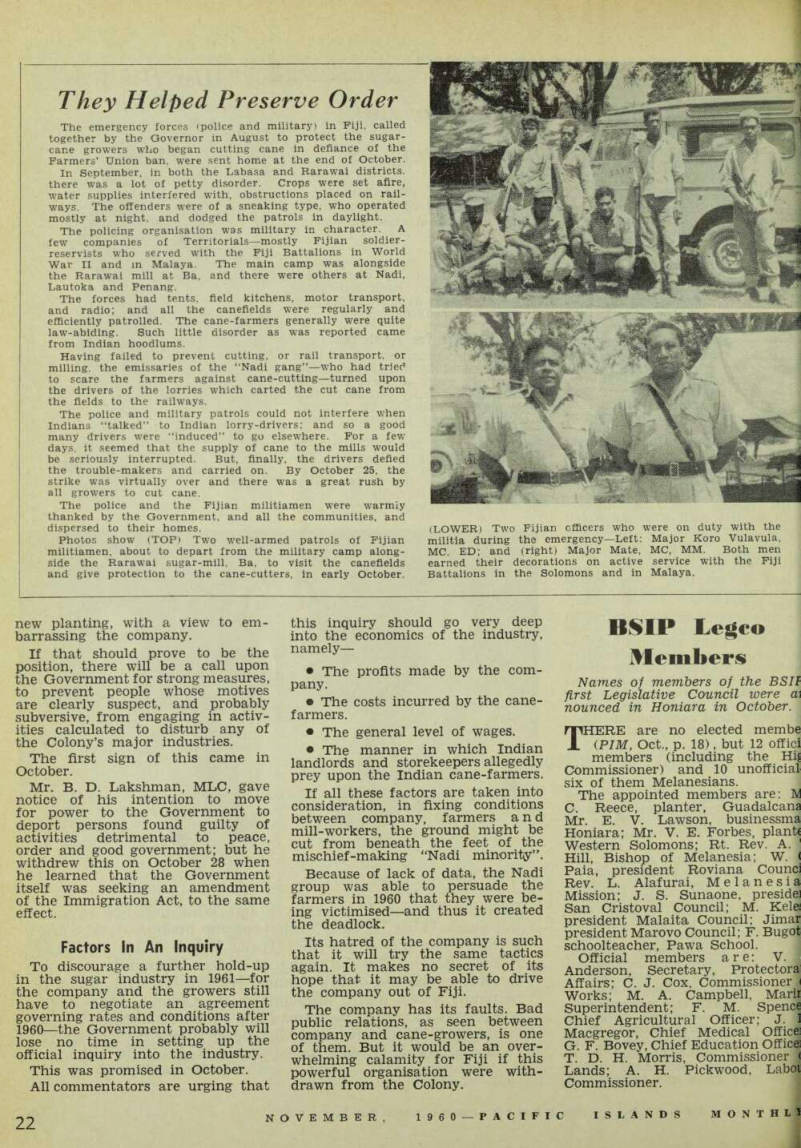
The emergency forces (police and military) in Fiji, called together by the Governor in August to protect the sugar cane growers who began cutting cane in defiance of the Farmers’ Union ban, were sent home at the end of October.
In September, in both the Labasa and Rarawai districts, there was a lot of petty disorder. Crops were set afire, water supplies interfered with, obstructions placed on rail ways. The offenders were of a sneaking type, who operated mostly at night, and dodged the patrols in daylight.
The policing organisation was military in character. A few companies of Territorials—mostly Fijian soldier reservists who served with the Fiji Battalions in World War II and in Malaya. The main camp was alongside the Rarawai mill at Ba, and there were others at Nadi, Lautoka and Penang.
The forces had tents, field kitchens, motor transport, and radio: and all the canefields were regularly and efficiently patrolled. The cane-farmers generally were quite law-abiding. Such little disorder as was reported came from Indian hoodlums.
Having failed to prevent cutting, or rail transport, or milling, the emissaries of the “Nadi gang”—who had tried to scare the farmers against cane-cutting—turned upon the drivers of the lorries which carted the cut cane from the fields to the railways.
The police and military patrols could not interfere when Indians “talked” to Indian lorry-drivers; and so a good many drivers were “induced” to go elsewhere. For a few days, it seemed that the supply of cane to the mills would be seriously interrupted. But, finally, the drivers defied the trouble-makers and carried on. By October 25, the strike was virtually over and there was a great rush by all growers to cut cane.
The police and the Fijian militiamen were warmly thanked by the Government, and all the communities, and dispersed to their homes.
Photos show (TOP) Two well-armed patrols of Fijian militiamen, about to depart from the military camp along side the Rarawai sugar-mill, Ba, to visit the canefields and give protection to the cane-cutters, in early October.
(LOWER) Two Fijian officers who were on duty with the militia during the emergency—Left: Major Koro Vulavula, MC. ED; and (right) Major Mate, MC, MM. Both men earned their decorations on active service with the Fiji Battalions in the Solomons and in Malaya.