Of Fiji
pp. 23-24 · Read in the full issue
Fiji's Calamitous Sugar Deadlock
Growers Surrendered Too Late To Catch The Market
“Miss Hibiscus”
Of Fiji
After nearly four months of frustration and delay, the Indian cane owers of Fiji were furiously cutting cane at the end of October; and ie four mills of the CSR Co. were fully engaged in crushing every n that could be rushed through.
JT the break in the deadlock came too late to save the Colony from a heavy loss, he loss is represented by over ’ a million tons of cane (worth ;he growers close to £1,800,000), ch is the difference between it the company would have ;pted and crushed if the season been normal (June to January), what the company can take , with the season restricted by deadlock to a cutting period of tember- January. irly in the year, after the inter onal quota had been fixed, the pany said that it would accept i the farmers enough cane to luce 199,000 tons of raw sugar, lis meant that the farmers Id be left with a lot of uncut ; on their hands; and, under the ction of Messrs. Patel, Koya associates, the farmers in June t to war with the company, and sed to cut their cane unless e cane was purchased, at a ter price, the meantime (as forecast in journal in June and July) the bles in Cuba changed the in ational sugar supply situation; finally the CSR Co. announced •ctober that it had an increased a—212,000 tons of raw sugar (as pared with 199,000 tons) which Fiji’s local consumption made total demand about 228,000 it the change came too late lenefit the unfortunate, misled lers. le company, from its 1959 f-over accumulations, probably be able to supply the whole de d of 228,000 tons; but the differ between what it can crush be n September and January, and ; it C9uld have crushed had the -cutting and the crushing ed in June, as originally pro 1, is represented by 77,000 tons aw sugar, or about half a on tons of cane., i has an enormous crop of in the fields; and the demand ts sugar has increased. But it ot now handle the crop, other words, the company will ts full quota of raw sugar, by ing upon its carry-over from but something near £\% )ns, the value of that half )n tons of uncut cane, which id have gone into distribution
in Fiji through the cane-growers’ pockets, will not be distributed: and the Company itself will enter 1961 with much depleted stocks, as compared with 1960.
Prospects for Next Year
Meanwhile, prospects of a good quota being allotted to Fiji for 1961 are fair. In order to meet that de mand, the company estimates that new planting should be immedi ately undertaken to provide about 150,000 tons.
But there is no sign that the cane-growers have learned any lesson from their 1960 misfortunes.
It is feared that the malign influ ence of the Nadi minority group is still strong enough to discourage
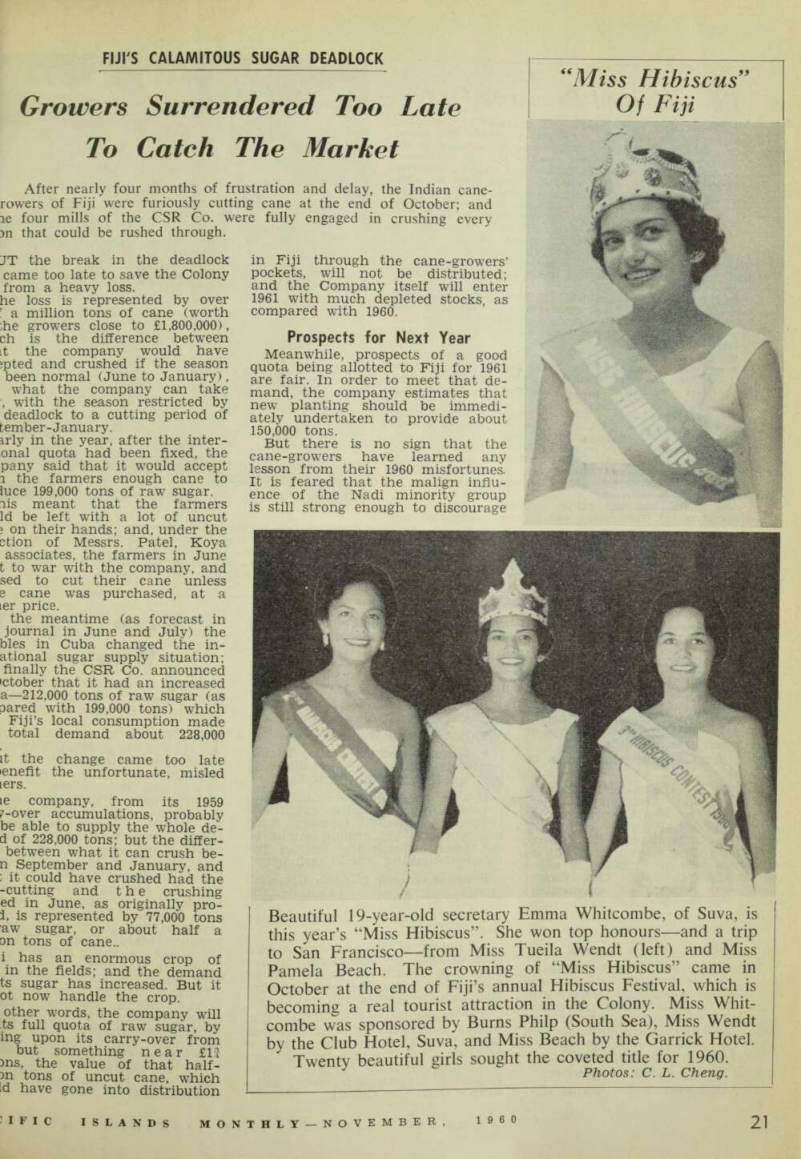
Beautiful 19-year-old secretary Emma Whitcombe, of Suva, is this year’s “Miss Hibiscus”. She won top honours—and a trip to San Francisco —from Miss Tueila Wendt (left) and Miss Pamela Beach. The crowning of “Miss Hibiscus” came in October at the end of Fiji’s annual Hibiscus Festival, which is becoming a real tourist attraction in the Colony. Miss Whit combe was sponsored by Burns Philp (South Sea), Miss Wendt by the Club Hotel, Suva, and Miss Beach by the Garrick Hotel.
Twenty beautiful girls sought the coveted title for 1960.
Photos: C. L. Cheng.
new planting, with a view to em barrassing the company.
If that should prove to be the position, there will be a call upon the Government for strong measures, to prevent people whose motives are clearly suspect, and probably subversive, from engaging in activ ities calculated to disturb any of the Colony’s major industries.
The first sign of this came in October.
Mr. B. D. Lakshman, MLC, gave notice of his intention to move for power to the Government to deport persons found guilty of activities detrimental to peace, order and good government; but he withdrew this on October 28 when he learned that the Government itself was seeking an amendment of the Immigration Act, to the same effect.
Factors In An Inquiry To discourage a further hold-up in the sugar industry in 1961 —for the company and the growers still have to negotiate an agreement governing rates and conditions after 1960 —the Government probably will lose no time in setting up the official inquiry into the industry.
This was promised in October.
All commentators are urging that
this inquiry should go very deep into the economics of the industry, namely— • The profits made by the com pany. • The costs incurred by the cane farmers. • The general level of wages. • The manner in which Indian landlords and storekeepers allegedly prey upon the Indian cane-farmers.
If all these factors are taken into consideration, in fixing conditions between company, farmers and mill-workers, the ground might be cut from beneath the feet of the mischief-making “Nadi minority”.
Because of lack of data, the Nadi group was able to persuade the farmers in 1960 that they were be ing victimised —and thus it created the deadlock.
Its hatred of the company is such that it will try the same tactics again. It makes no secret of its hope that it may be able to drive the company out of Fiji.
The company has its faults. Bad public relations, as seen between company and cane-growers, is one of them. But it would be an over whelming calamity for Fiji if this powerful organisation were with drawn from the Colony.