Wild, Wild Women Of Marquesas
pp. 86-99 · Read in the full issue
When The Mission Ship Duff’ Met The Wild, Wild Women Of Marquesas
Compiled From Old LMS Records by R. W. ROBSON As the full-rigged ship Duff moved slowly to an anchorage in Resolution Bay, Santa Christina Island (now called Tahuata), one of the Marquesas, on a shining morning in June, 1797, the voyagers saw an extraordinary thing. Captain Wilson thus recorded it: “There appeared around the ship, seven beautiful young women, swimming quite naked except for a few green leaves tied around their middles. They remained swimming and floating around the ship for three hours, crying ‘Vahine, Vahine’, which means ‘Woman’.”
None among the ship’s company witnessed this fascinating sight with more interest, or concern or both than Messrs. William Crook and James Harris. These very young men Crook was only 22 had been chosen by the London Missionary Society to be the very first Christian missionaries in the Marquesas Islands.
CROOK watched the Marquesan girls’ performance in the water without apparent emotion —his associates described him as “a strong and thoughtful young man” —but the timid and imaginative Mr.
Harris really was shocked.
Already, they had been to Tonga and Tahiti, and 27 of the ship’s complement of LMS missionaries, recruited for service in the unknown South Seas, had been left at one or other of these places.
Mr. Harris had been greatly upset by what he had seen in Tahiti.
Already, Captain Wallis, Captain Cook, Commander Bougainville and Captain William Bligh had reported upon the social habits of the Tahitians, and the LMS missionary ship Duff knew what to expect— namely, complete freedom between the sexes up to the point of marri age. and the firm conventions of Europe unknown in Polynesia so far as they related to the clothing of the body and the act of love.
The LMS missionaries generally saw these as the habits of “a heathen people”; and they were not greatly upset, except that they dis played something like fanaticism in trying to introduce European standards.
But Mr. Harris had been much disturbed by what he had seen, and greatly hoped that in the Marquesas he would find a different kind of people.
Gazing down now from the ships rail at the light-skinned young girls floating gracefully around the ship, Mr. Harris was filled with forebod ing. These ladies had even less sense of modesty than those of Tahiti!
She Knew Not Shame Canoes arrived, and several men were allowed aboard. One, a young chief, made urgent representations.
A Tahitian among the crew in terpreted this as an appeal that his sister, one of the swimmers, be per mitted to come aboard.
Captain Wilson agreed, and this is how he described the lady in his book: “She was of a fair complexion, in clining to a healthy yellow, with a tint of red in her cheeks. She was rather stout; but she possessed such symmetry of features —as did all her companions—that as models for sculptors or painters their equals can seldom be found.”
The Tahitian girl aboard the ship, who had adopted European ways, was distressed to see a woman there upon the deck quite naked. She rushed away and brought a length of tapa cloth, and wrapped it around the visitor.
The Marquesan. of course, did not ☆
When the First Christian
Missionaries in the Pacific met the Wild and Beautiful Women of
the Marquesas, not Everybody
was Captivated by their
Charms. For Instance, the
Experience was Just Too Much for James Harris.
realise that she was a figure shame —she accepted the tapa as decoration, swathed herself in and the original Eve showed out the way she preened herself.
The sober Captain Wilson wroi “This set her off to great adva: age”.
All this was witnessed by i girls still swimming alongside: a they set up a great wail—tH wanted to come aboard, for simi treatment.
Naiads Meet Goats So at last they were permit; to climb up onto the deck —♦ scribed by the captain as a V’ remarkable spectacle, as they w completely naked except for th girdles of green leaves.
But the leaves did not renu there long. The Duff had carr some live-stock, which was ] ashore at the new stations for sustenance of the missionaries. £ aboard was a small herd of goa and the goats had had no gn food for a long time. They rusl at the girls.
The girls leaped wildly away fn these strange creatures—may somewhere in their myths, tf had learned of Pan and the dang associated with gods shaped 1 goats. But when they discover that the animals wished to nib'i not their persons but their gr girdles, their terror departed.
“They turned this way and t; to avoid the goats,” says Captl Wilson’s chronicle,” but they w attacked at each side alternate and completely stripped naked.] The young women were prepat to be very friendly: but the offio presently cleared the decks, s shoo’d them away. Most of thi simply jumped overboard, and swj shorewards.
When Chief Tenai learned tl he was to get two mission! teachers, he was delighted, t promised accommodation and fp Next day, Captain Wilson td Messrs. Crook and Harris ash-:
low them their new home. It a, pleasant place, and the light led Marquesans gave evidence uch goodwill. e strong and thoughtful Crook he would remain there, but of maginative Harris the Captain b: “He behaved as if fear had i possession of his mind . . . in short, seemed entirely to lost his firmness and ardour.” . Harris pleaded that he did vant the job; but the captain Id not contemplate leaving k there alone, and it was de [ that the two should be taken re, with their luggage, the next June 7, 1797, Crook, with some age, was established in a green y near the anchorage, but is was allowed to stay aboard to up their goods and chattels, iase in carrying.
June 8, the natives crowded rd and the fearful Mr. Harris that the women among them naked, as before. They had given “Tahitian cloth” wherein othe themselves; but the Cap -5 book explains that the tapa ipart in the water, so when the s got ready to swim they took leir new garments, and arrived d. e crew were busy scraping and :ing, and the native girls were ’ to help them in their tasks, sailors were more than ready to )t their help; but (says the tin) the officers kept the whole >any under firm restraint, note was received from Mr. k, expressing “perfect satis on” with his accommodation treatment. The captain sug d that Mr, Harris now might him. Mr. Harris refused to i the ship, and his fear was so ?nt that the captain let him was evident that by now Mr. is’ terror of the Marquesas’ women was the joke of the ionary ship.
A storm came. The bay was exposed to giant rollers, so the ship w'as taken away to sea. to ride it cut. e-pi-- "Duff rpturnpH nn Tune 14' bufthfrf stm“ bad J we e ather about and, to avoid taking Mr.
Harris away in a sudden, necessary departure Mr. Harris, despite his reluctance, was put into a boat, with bag and luggage and sent to join Mr. Crook in the village.
shhfaealn
the P 2l?nhewe t nt balka&in. into tbP hnv wZr/ deum bmirp on thp 24th When dawn broke on the belch S n was^Wentifle J d. Ct in o better
rftUng"dismally"<m*his chest"™'
M for- Mr Harrlt No Wife for Mr. Harris It appeared he had settled in with Mr Crook, in a neat little native house After a week, it was arranged they should go with Chief Tenai to examine a distant valley, where there was another communitv Crook was more than ready, but Harris finally refused to go.
The friendly and amiable Tenai arranged a food supply for Mr.
Harris, during their absence; and he left for Mr. Harris, despite the latter’s urgent protests, his fav ourite wife.
Crook and .Tenai departed and Je ctof's wife.
“i 0 M r g Y enough with Mr. Hams, The language in which Captain Wilson’s journal describes the in cident is very restrained—after all, the book is dedicated to the King heads?nSe LMS—lbut the sequence of T e '' entS J S f . Clear f e e no fuMlled Mr The chief’s wife fulfilled Mr.
Harris’ worst fear by displaying an pop-prness to care for him; and one gathers that she was very firmly re
aS^ Yhl
chief’s wife carried her grievance to the other wom en of the village.
They (according to the solemn record) “became doubtful of his sex”. , That night, while Mr. Harris was asleep, the chief’s wife and a couple of her friends crept into his hut, to find out if he were a man or a woman. I quote the captains nar rative:
(Continued on page 97)
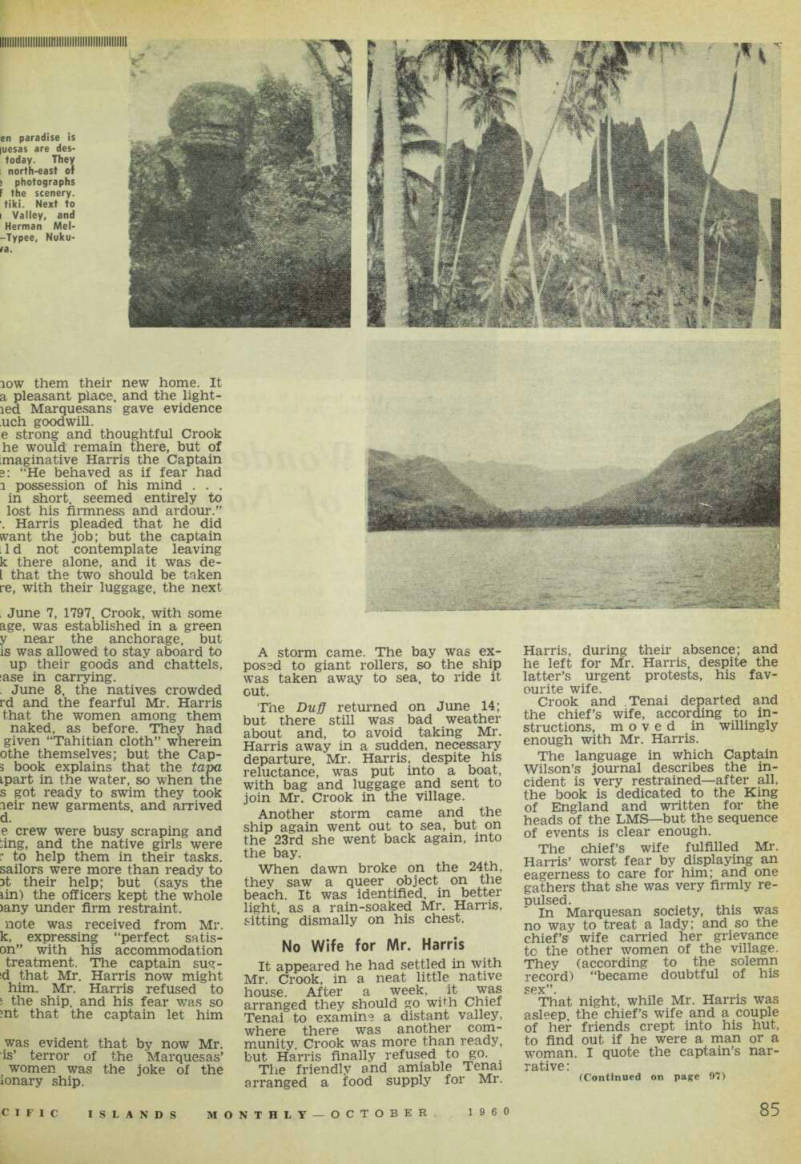
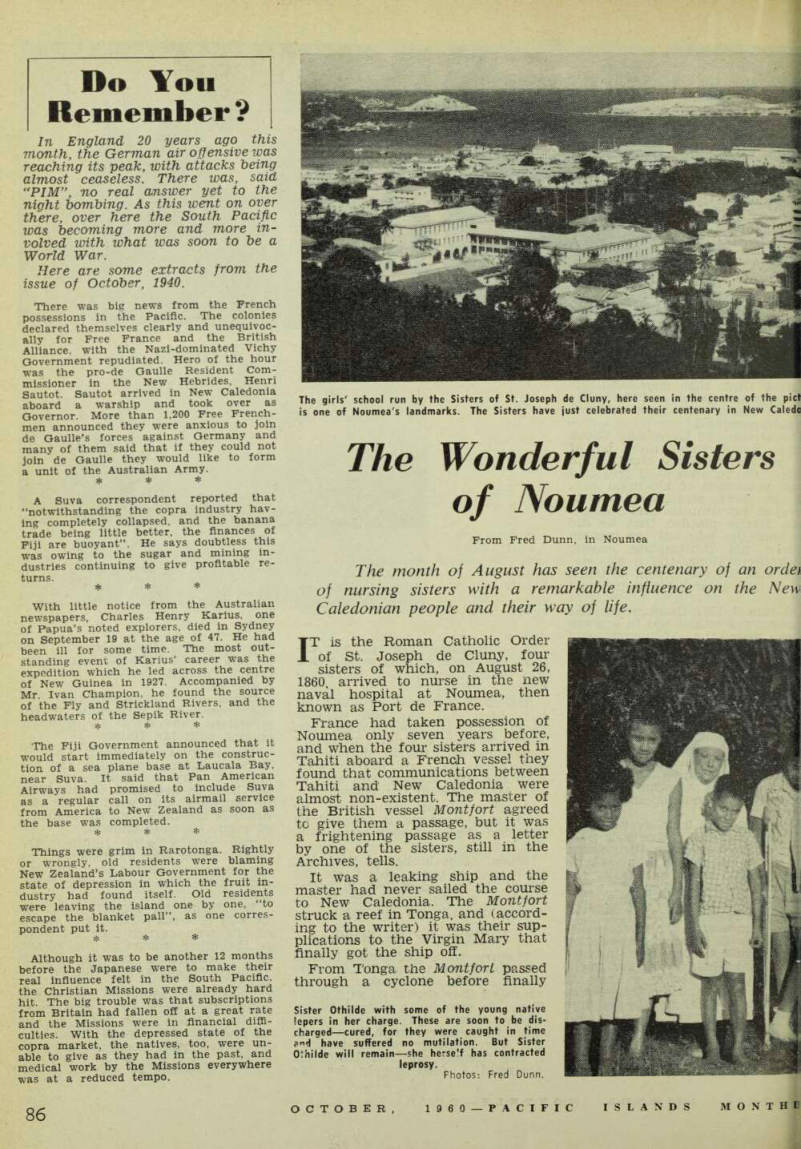
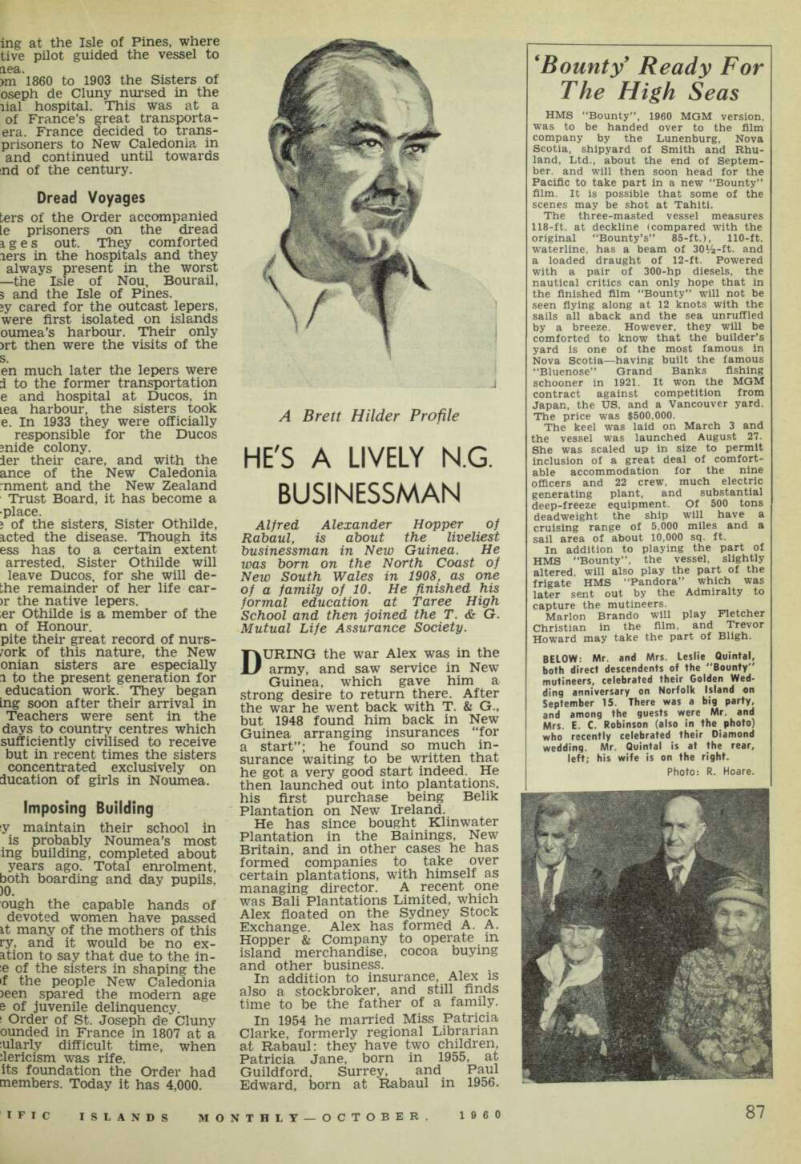
[?]en paradise is [?]uesas are des today. They [?]north-east of [?]photographs [?] the scenery, [?]tiki. Next to [?] Valley, and Herman Mel [?]-Typee, Nuku [?]va
“They satisfied themselves con cerning that point . . . but not in such a peaceable way that they avoided awakening him.”
When Mr. Harris awoke and found his hut full of women, “he was greatly terrified and was de termined to leave a place where the people were so abandoned and given to wickedness.”
So Mr. Harris forthwith packed his chest, and carried it down and around to the beach, to a place opposite the ship, which had just returned to her anchorage. He failed to attract attention from the ship, so settled down beside his chest.
During the night, some natives came and behaved in such a way that Mr. Harris took to his heels and hid in the bushes. They got away with some of his personal gear.
When the ship’s officers discovered Mr. Harris, the sea was breaking badly on the shore, and they could not despatch a boat. So they sent a native swimmer with a line, and Mr. Harris was hauled ignomini ously out through the surf, and aboard. ■When they found that he had not fled from an attack upon the missionaries’ house, but only from the amorous advances of the village ladies, they treated him with con tempt. and sent him below to be dried out, while the swimmer went again ashore with his line, for Mr.
Harris’ chest.
Thenceforth, the unfortunate Mr.
Harris disappears from the captain’s chronicle—one presumes that he was taken back to Tahiti and left with the larger mission community there.
Crook remained in the Marquesas, where he appears to have gained approbation as a hard-working, conscientious missionary.