Is Going To See
pp. 23-24 · Read in the full issue
Fiji Facing The Graver Issues
What Mr. Julian Amery
A Report From R. W. ROBSON
Suva, Oct. 7
Although Fiji’s sugar-cane troubles are by no means over see the outline on opposite page) the country is turning, ’ ryly, to a belated consideration of its early future, in relation i (a) over-population, ( b ) the implementation of the Burns l eport, and ( c ) this idea now sweeping the world that ll communities, no matter how awkwardly placed, must become nmediately “self-governing”.
r ENTS are pressing in on Fiji, in an embarrassing way. The Government, and all community ers, should have been giving b urgent attention to the itry’s condition, immediately the is Report (itself ten years late) published, six months ago. le sugar quarrel diverted public ition elsewhere and it also has ened the politico-economic out generally. le present economic structure leither big enough nor wide igh to take care of the needs rapidly increasing population, country cannot get the economy a higher gear for better pro > while it is out of adjustment ilation to the rights of the Fijian nunity, in relation to non-land e, and in relation to the Indian nunity (which —now learning the way that there are not enough for its young men—is more and ; inclined to become anti-Euro ). janwhile, the Fijians are de ling an anti-Indian complex. tendency has become much i noticeable as the result of social feeling aroused by the r trouble. cause the recommendations of Burns Report tend to make life r for the Indians—the Fijians -dy are economically secure, as indigenous owners of the lands j Fijians, in their present ►er, have developed sharp re nce to the major proposals of Bums Report. is is an acute embarrassment the Governor, Sir Kenneth docks, who is most anxious to >n with the Burns Plan, e anti-Burns sentiment of the n chiefs was demonstrated ly at the Council of Chiefs in ist-September, and would have ifested itself at the Legislative icil meeting late in September, it the Governor, wisely, decided the Council should deal first the critical quarrel in the sugar
industry, and postpone considera tion of the Burns Plan until the next Council meeting—three or four months hence.
Exasperating Delay
It is an exasperating delay in dealing with the Colony’s politico economic problems; but it was a sound decision. If the Burns Report had come before the September Legco, it would have been torn to pieces.
The Council, instead, got its teeth deeply into the sugar industry problem (see report p. 49) and all communities worked off a lot of strong feeling there. Maybe, next session, judgments will be calmer and prejudices less in evidence.
The Legco session had one most comforting angle. It has been sug gested that the European com munity is weak in leadership, this decade; but whether or not this is sc it now is apparent that some first-class men —thinkers, who can talk on their feet, and take wide
and tolerant views—are showing up among both Fijians and Indians.
This could be the salvation of the Colony. Fiji needs not only sound leadership, but also a relationship between community leaders which w* ll a l lQ w all communities to go forward m tolerance and unity.
Into this sea of troubles comes Mr. Julian Amery, British Under Secretary of State for the Colonies, accompanied by some high officials of the Colonial Office. The party is due in Nadi on October 12, after a tour of Papua and New Guinea, Solomons and New Hebrides, and a brief visit to the South Pacific Commission, now sitting in Noumea, All classes in Fiji are waiting for Mr. Amery. Although both Govern ment and Press have insisted that Mr. Amery is merely here to take a look around the British countries of the South Pacific—he is going to visit Gilbert and Ellice Islands
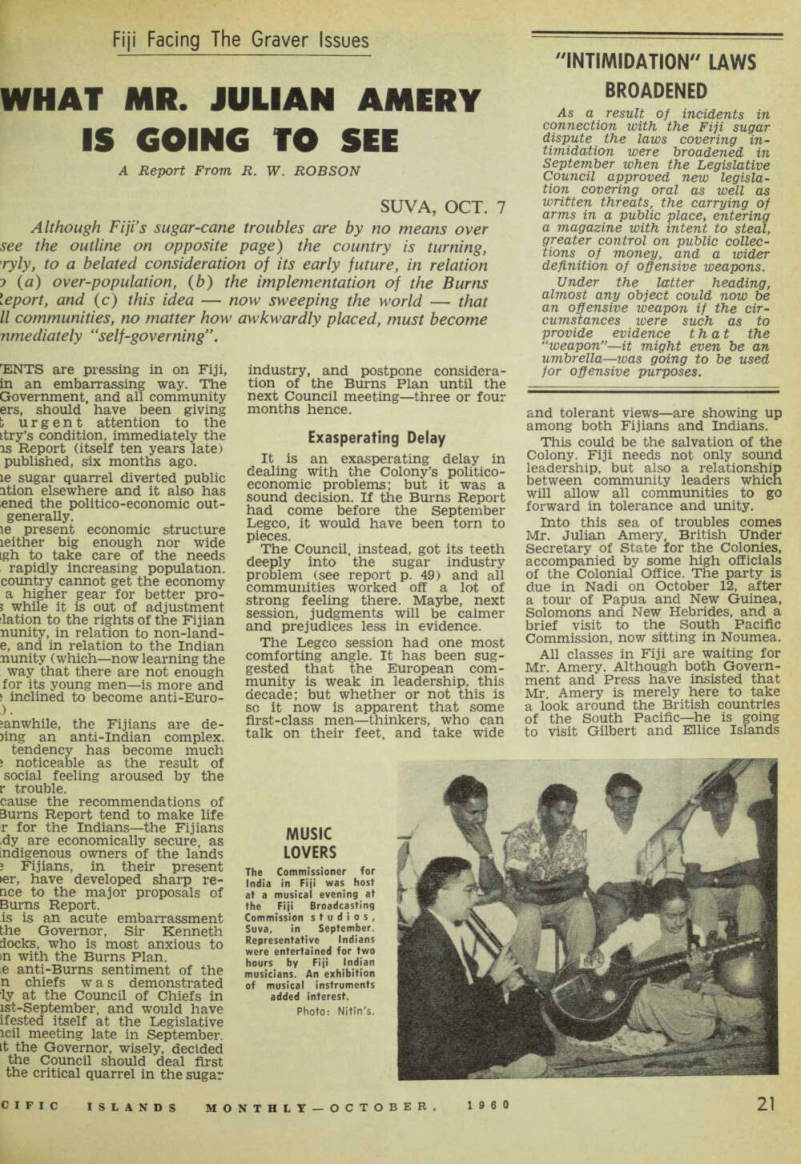
Music
Lovers
The Commissioner for India in Fiji was host at a musical evening at the Fiji Broadcasting Commission studios, Suva, in September.
Representative Indians were entertained for two hours by Fiji Indian musicians. An exhibition of musical instruments added interest.
Photo: Nitin's.
and Tonga by Sunderland flying boat, using Suva as his base—and make no over-riding decisions, some of the Fiji community think he is about to devise a new heaven and earth for this Colony.
The programme shows that this Colonial Office party will certainly look Fiji over very thoroughly, in the light of 1959 developments (which include the Burns Report).
But the future surely will depend upon what Fiji itself does with the Burns Report.
A Forecast This writer’s forecast is that if the major recommendations of the Burns Report are adopted, the Colonial Office will throw weight and influence behind plans for the more rapid development of Fiji’s resources, and the financing of same. Mr. Amery and his officers will then be in a position to help, promptly and effectively.
If the Report is crippled by Fijian opposition, then the future of Fiji will become a Number One Colonial Office headache and Mr. Amery and his advisers will be able to attack it with some local knowledge.
It also is forecast thab, while here the Amery party will give con sideration to the constitutional position.
There is no discernible demand at present for reform in that direction, among Fiji’s communities; but there almost certainly will develop soon, under outside influences, a move ment towards a larger amount of self-government. Recent events in the British Colonial Empire show that Britain is extremely sensitive to such demands.
At present, Fiji seems satisfied
with what it has got. Any demand for big changes—especially if it were suggested that these four large, dis similar communities should elect representatives on a common roll— would surely lead to fierce disputa tion, embarrassments, and worse.