Pacific Report
pp. 121-148 · Read in the full issue


The month’s round-up of news and pictures of people and ;vents, from PIM correspondents in the South Pacific.
Lost: Big Sea
arch Fails
,NZAF Sunderland flying-boats
n Laucala Bay, Fiji, and from jsonville, Auckland, made a wide 'unsuccessful search for a vessel the Japan Marine Products ;hership tuna fleet south of Fiji the end of July and the begin -- of August. She carried 22 men. ue to some misunderstanding in request for the search made to RNZAF by the Japanese Gov ment, it was wrongly reported b two fishing vessels were miss flien the mothership Nojima -it, came in to Suva for bunkos August 2 it was learned that the sing vessel was the modern, steel, ;on Chitose Maru No. 1, corn ed only in April, he had sailed for the South iflc from her home port of ihama on June 9, had discharged irgo of fish into the mothership t of Fiji on July 18, and had i headed south to an area about miles south south-west of Suva 400 miles roughly north of New land. .. , 0 radio contact with the vessel been expected by the mother > for the first 24 hours, but some cern was felt when she failed nake contact on the second day. he longliner was also supposed iave a regular daily contact direct 1 her home station in Japan, he business manager of the hership fleet. Mr. Yukio Kato, I in Suva that there was no ex lation of the loss. The vessel equipped to the most modern idards. She had separate main emergency transmitters, and i if these failed she was equipped i three or four radio beacon ys with low-power transmitters. ; weather at the time of the arent loss of the ship was fine i only very light breezes, he chief refrigeration engineer he mothership said that the only Able explanation of the loss eared to be an explosion, and t the only likely cause of such explosion seemed to be from nonia gas used in the refrigera l machinery. hitose Maru No. 1, unlike many ;r fishing vessels, had such
equipment. Such explosions, he said, were extremely rare, but they might explain this and other similar losses.
Last season the same mothership lost the 99-ton, six-year-old Kasugu Maru south of Ocean Island under almost identical circumstances —she failed to make radio contact after leaving the mothership. This did not explain the complete absence of wreckage over both the search areas, unless perhaps a big hole was blown in the bottom of the ship causing her to sink very quickly with all her glass floats and other floatable gear still securely lashed so that it could not break adrift.
This would be logical in the case of a vessel not actually fishing.
It Was Nice To Be
Without The Bedbugs, Too
The BSIP has begun a malarial eradication programme after the same style as the mosquito spraying
programme now going on in Papua- New Guinea. The entire Solomons will be done eventually.
First work has already been com pleted in the Shortlands, which are close enough to be seen from the New Guinea territory of Bougain ville. There is quite a lot of native movements between the two areas, despite difference in Government, so the BSIP and P-NG Governments got together on a combined scheme to help both areas at once.
Spraying teams will work through the Western Solomons to the other areas. They spray the inside walls of houses.
After the Shortlands spraying was finished, a local Government newsletter commented, “The villagers in the Shortlands noticed some very good things soon after the spraying finished, because the medicine killed a great many flies, cockroaches and bed bugs These will come back but it is nice to be without them, even for a few weeks.”
Important Precedent
For Fiji Labour
Following some months of quiet negotiation between the Fiji Public Works Department Employee’s Union and the PWD, an agreement involving important improvements in labour conditions for the Depart ment’s workers was announced on August 6.
As a result of the dispute in the oil distribution industry last year, and the subsequent award of im proved conditions in that private
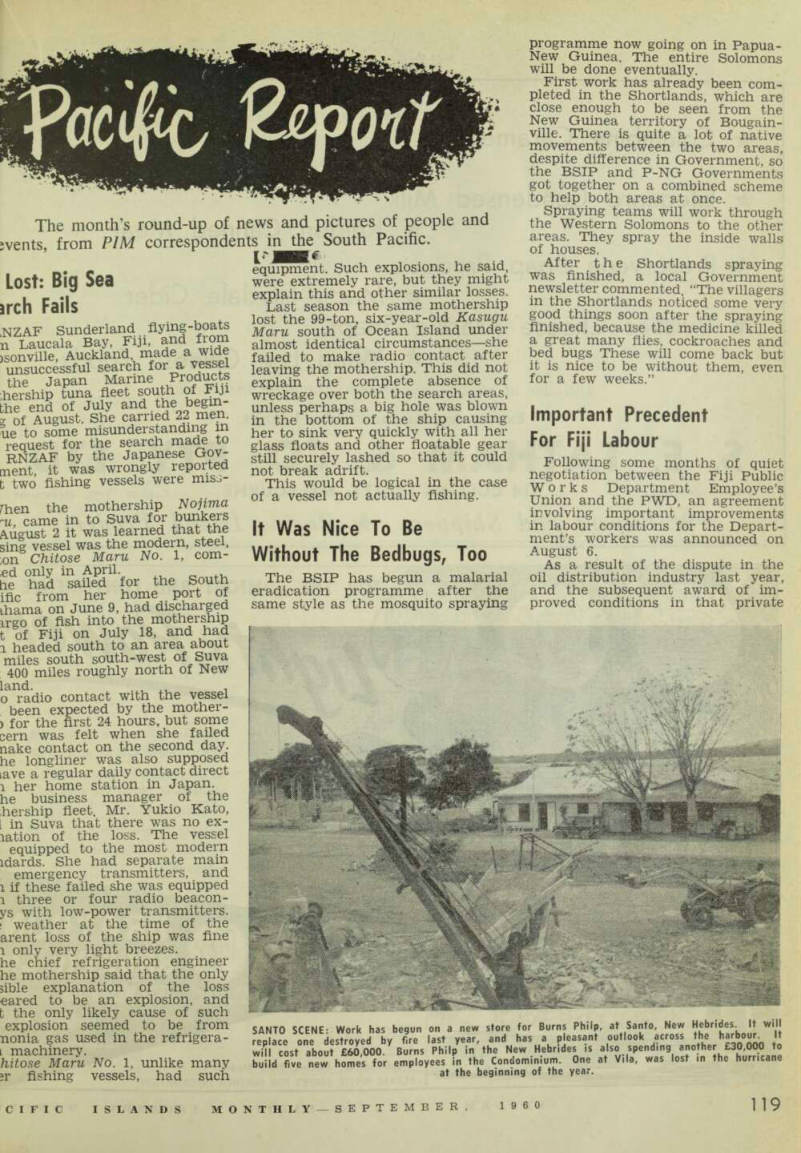
SANTO SCENE; Work has begun on a new store for Burns Philp, at Santo, New Nebndes. lt will replace one destroyed by fire last year, and has a pleasant outlook Son to will cost about £60,000. Burns Philp in the New Hebrides is also spending another £30,000 to build five new homes for employees in the Condominium. One at Vila, was lost in the hurricane at the beginning of the year.
ustry, the PWD agreed to an rease in the basic rate of pay its employees. Such improve rs were inevitable. The PWD •kers were seeking other im vements in conditions and, owing lengthy negotiations, have r been granted some of them, erhaps the most important ad ce is the introduction of umulated sick leave for hourly i workers. Where formerly such worker became an in-patient in ospital he received no compensa i at all. nother clause covers pay rates workmen who are transferred a one job to another within the lartment. bonus rate has also been intro ed for men working under wet or ;cially dirty conditions, and *e is a similar bonus rate for i handling certain special tools, he new concessions can be scted to have their repercussions jrivate industry.
>ks Co-operatives "An
imple To Others"
r V. D. Stace, economist for South Pacific Commission and t author of the economic and al survey of the Cook Islands, le together with Professor Bel v in 1955, revisited the group in mainly to study progress in sing and in co-operatives, r Stace said before leaving otonga that the sound basis and dy expansion of co-operatives in Cooks under the wise and ex enced leadership of Mr. J. L. kes (now retired) had already vn other territories that co •ation has a very important part >lay in the Pacific Islands, feel I should mention especially enlightened attitude of some of trading firms in the Cook ads towards the development of •peratives,” Mr. Stace said.
This attitude is refreshingly dif nt from the entrenched opposi sometimes encountered else re.” r. Stace also noted that this is only Pacific territory where the ciples and methods of co-opera were taught in the schools, r. Stace expressed the hope that re many months the first steps Id be taken to establish the De pment Committee in line with recommendations made in 1955, reby there could be closer liaison reen government departmental is in co-ordinating policies and slopment activities, r. Stace was also making a gen survey of capital formation in 3PC territories. 5 part of this he has been in igating the promotion of savings investment among Islanders bv ial methods; the provision of term loans for productive pur :s; the use of development Is. marketing boards, special s for development purposes, etc.;
special help to Islanders in agri culture; methods of encouraging in vestment in local industries to pro mote employment for Islanders; co operative societies, credit unions, etc., and the direct use of labour in capital formation on plantations.
Death Comes to a
Lone Hander
Guy Clabaut, doughty French “lone-handed yachtsman” who sailed from Morocco to New Cale donia alone in his tiny Eole via Tahiti and Rarotonga, in Noumea in late August sailed on his last voyage. He passed away at the Noumean hospital where he had been a patient for two months.
Death was due to the privations of his voyage.
Guy Clabaut during the war fought with the Free French naval forces and was badly wounded. He spent three years in hospital and never regained his former good health.
In Morocco he built a small vessel, 30 feet by 9 ft, called it Eole (God of the Wind) and decided to sail around the world alone.
He crossed the Atlantic and arrived at Tahiti last year where ill health forced a stay of eight months.
After convalescence Clabaut set sail for New Caledonia touching at Rarotonga on the way.
On June 24 he landed at Mare Island, southernmost of the Loyal ties, gravely ill.
He was flown urgently to Noumea where in hospital he showed signs of improvement. However the strain and hardships of the lone voyage was too much for his war broken health, and he died on August 22.
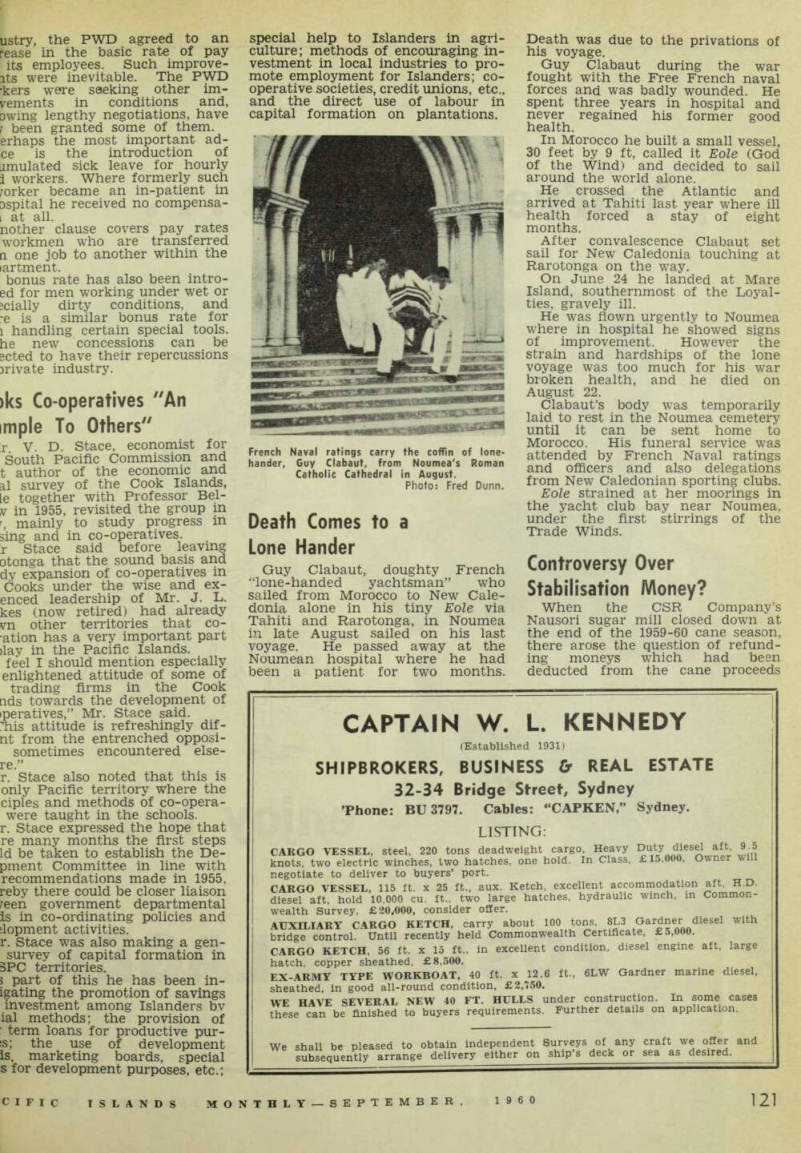
Clabaut’s body was temporarily laid to rest in the Noumea cemetery until it can be sent home to Morocco. His funeral service was attended by French Naval ratings and officers and also delegations from New Caledonian sporting clubs.
Eole strained at her moorings in the yacht club bay near Noumea, under the first stirrings of the Trade Winds.
Controversy Over
Stabilisation Money?
When the CSR Company’s Nausori sugar mill closed down at the end of the 1959-60 cane season, there arose the question of refund ing moneys which had been deducted from the cane proceeds
French Naval ratings carry the coffin of lone hander, Guy Clabaut, from Noumea's Roman Catholic Cathedral in August.
Photo: Fred Dunn.
contributions to a stabilisation i over a number of years. There signs that a controversy may cuilding up over the system of nd which has been adopted by government. i all there is about £102,000 for nd and 750 farms are involved, :ing an average payout per farm about £sB—according to figures n in the Fiji Legislative Council ;he Financial Secretary in April, he point at issue is that while •e are 750 farms involved, there apparently a good many more ners. Farm have changed ds during the period, and others ;rted to Native Land reserves on iry of lease. Thus varying amts of the fund belong to the ;essive lessees. The government id that to investigate the situa for each of the 750 farms would out of the question and the sion was made to pay the full l to the farmer actually in session and registered with the ers as a cane supplier on ember 10, 1959. his could mean that in some is a farmer who had taken over lediately before this date would entitled to receive the full £5B, his predecessor of a number of rs who supplied most or all of cane would receive nothing. correspondent reports that in ’s present political and industrial late this could represent the dngs of yet another dispute ;n the payout commences in r ember.
ituku Gets a
idical Once-over
'he high island of Matuku in the i group of Fiji was the object of intense medical survey in August, ry man, woman, and child being sely examined, blood-tested, and terally given a thorough health ick.
A team of medical practitioners and medical students from all parts of the Pacific who are based at the Central Medical School at Suva, made the survey. It was the third survey of its type in the Fiji Group.
The island of Gau was surveyed in 1958, and Naviti, in the Yasawas, was selected last year.
In addition to checking the health of the population a careful survey of housing, sanitation, and the general environment was also being made.
It is expected that a good deal will be learned when the individual islands are re-surveyed after a lapse of several years.
Tourist Consultant
Takes a Look
An American economic consultant, Mr. John F. Child, Jnr., a director of the associated firms of John Child and Co. of Honolulu and Child and Waters Inc. of New York, who specialise in the development of tourist resorts, was taking a look through the South Pacific in August.
Mr. Child was mainly interested in Australia and New Zealand but he was taking the opportunity to hold discussions with government and private interests in Fiji, New Caledonia, and Tahiti and to look over possibilities in these areas.
Mr. Child’s firm, which has acted as consultant for some of the largest American tourist interests, has now opened an office in Sydney,
TV Importers Receive
A Short Circuit
A good many people returning to New Zealand from Fiji have been buying English television receivers under bond at Suva and landing them as personal effects at a cost
far below that of the New Zealand made sets.
The sets have been subject only to three per cent, import duty. They could be purchased in Fiji for only £7O-£BO Fijian currency. Other sets were being purchased in the duty free stores aboard the big passenger liners by New Zealand passengers.
The “leak” raised a howl from the New Zealand manufacturers and in July parliament passed a revision to the Customs regulations raising the duty to 33-1/3 per cent, and charging a 20 per cent, sales tax. In addition all such sets are being impounded unless their owners produce a New Zealand import licence, which would pre sumably only be granted if the sets are bona fide personal effects and perhaps of a certain duration of ownership.
To cap it all, as from August all TV set owners in the Auckland area have to pay an annual licence fee of £4. The TV service there is on very restricted hours, and as the hours are extended the fee will also be increased.
Italian Cruise Ship
The first Italian liner to appear in the Pacific Island cruise trade since the war—the Genoa registered "Aurelia" was in Nukualofa, Suva, and Noumea in August. During the war she was a U-boat mothership, but since then she has been completely modernised. Her Italian owners intend to make more Islands cruises.
See page 115.
rlon Turns The
ids in Tahiti
ahiti’s prettiest and most nted girls have been swooning over the place lately, hoping to :h the eye of the ex-GI film star •lon Brando who has been there :ing a leading lady for the new \iny of the Bounty film. 3me preliminary shooting was ig done and researchers were r busy at the home of the late man Hall of the Hall and doff team which wrote a trilogy :he mutiny upon which the most ous Bounty film to date was 3d. Mrs. Hall owns an extensive ary of books on the mutiny ected by her late husband. ; is understood that a model of S Bounty will be brought to liti for the shooting of the main les next year. eople who met Brando in Tahiti July-August were surprised to I him a much blonder type than films have lead them to believe, jy also found him pleasant and iroachable. He was stopping at ley Gooding’s new Hotel Lotus Punaauia.
je's Woven Goods
)de is Expanding
■here is every indication that the nufacture of baskets, table mats, I other similar woven goods at ie Island is at last headed for le degree of prosperity, ome months ago, through the
initiative of a government official in taking samples of goods directly to New Zealand firms and in subsequently organising a Niue Weaver’s Association to control production, marketing, and quality of goods, a valuable connection was established with a Christchurch, NZ, firm.
The firm gave a trial order for £250 worth of goods a month. It is anticipated the order will be increased in the near future.
Other outlets are being investigated in New Zealand and also in the United Kingdom, where samples have been taken by another salesman for the Island’s goods who was travelling there on vacation.
Apart from the shopping baskets, sewing baskets, clothes baskets and table mats which have long ’been produced by Niue there would seem to be definite openings in other lines like waste-paper baskets, office correspondence trays fem-stand baskets for Islands hotels to give an Islands atmosphere. Woven screens for use in cafes or restaurants and large woven lampshades might be other possibilities, Two enterprising young men in Fiji have established a profitable busi ness in wrought iron furniture sold largely to hotels. There may be equal opportunities there and perhaps even in Tahiti, for the Niue weavers. (Over)
Saw the Error
Of Their Ways
At the Seventh-day Adventi outstation at Hambuari, in tl Southern Highlands District Papua, there was a celebration mark the decision of this “figh ingest” of the Huli clans to fini with war. The chief had asked Past L. T. Grieve of the Mission arrange for the Assistant Distr: Officer, Mr. W. Crellin, to be prese and witness the destruction of th( bows and arrows as a public r nunciation.
In his speech, the chief, Pingi, tc the gathering that for a long tir he and his people had been wea of their former ways, especially the constant alarms of war and : consequences. They had by this tir learned something of the laws of t white man and wanted to abide ' them. For this reason they h chosen the mission to provide the with a teacher to help them chan their ways and become law-abidi] people.
Responding with appropriate r minders of the benefits of peace ai the keeping of the law, Mr. Crell congratulated the people on th( decision to renounce war, and e: pressed the hope that many oth groups would follow their example The bundle of weapons, includii women’s arms, was then taken in the centre of the assembly and young man who had undoubted joined in many battles and probab enjoyed every one of them, pr ceeded to cut them up with tomahawk.
When all were rendered useles they were placed in a forked sti« by the side of the main road, I which the station is built, for s passers-by to see the sign of tl people’s renunciation of war.
This is a sign apparently w« understood by the Huli people mean that no armed man can $ by or through that area; arm* men now go around by devious jung tracks in obedience to the messaj of the sign.
Big New Grants For
Fiji Institutions
Two substantial grants for F; from the Colonial Development Fur have been made by Britain —£162,0( for additions to the War Memorii Hospital in Suva, and £152,000 assist in building the new tecß nical school in Suva (total estimate cost £169,000).
Fiji is going ahead with plai for training its own local-born higll class technicians, and discouragin the introduction of trained pe:; sonnel from abroad.
The new grant brought a wa from Lautoka, where a new hospit: is urgently needed. The Goveric ment replied that provision woifj
made in the new developmental is for 1961-70 for a new hospital Lautoka to cost £500,000.
ia Company Seeks
reased Quota
he Taiyo Gyogyo (Ocean lery) Comnany of Tokyo, largest ing company in the world, ch operates one of the two tuna :hership fleets in the South :ific each year, has applied to Japan Fishery Agency for an reased South Pacific tuna quota ; year.
'he business manager of the thership Tenyo Maru No. 3 said Suva on August 24 that the ipany was seeking an increase of 10 tons to its permit. The quota present stands at 11,400 tons for 3 company and a similar amount the opposition Nippon Suisan pan Marine Products) Company.
T enyo Maru No. 3 was to hand r her fishing fleet to the cipany’s mothership Koya Maru the end of August and return to >an, but if the additional quota is nted she will probably return the Fiji area on a second assign nt in November.
Japanese University Team
Busy in Tonga
A seven man Kyoto University Explorer Club research team which arrived at Nukualofa on July 10 is busily engaged in its research project in Tonga.
According to a Tonga Govern ment statement the programme calls for research into land usage, the collection of botanical speci mens, marine life, and archaelogical specimens, the study of folklore, traditional ceremonies, community productivity, arts and crafts, and the Tongan educational system.
In addition the anthropologist in the group, Mr. Yosinaru Huziuka, is
to conduct a survey of human weights and heights using what is known as the Rorshach technique.
The project will include a large number of the Tongan islands in its scope, and is expected to be completed by early October when the students will return to Japan.
The party is headed by Professor Yoshihiki Yabuuchi. Professor of Geography, and includes the anthropologist mentioned above, also Mr. Takashi Hasegawa, B.Ag. (specialising in agricultural en gineering) ; Mr. Mitsuru Hotta, B.Ag. (specialising in botanical subjects); Mr. Hiroshi lida, student of geographical subjects; Mr.
Naomichi Ishige, archaeologist; and Mr. Bin Okada, educationist and sociologist.
Tonga Broadcasting Soon,
Plus Radio Aids
The 200 ft, aerial mast f Nukualofa’s first broadcast!] station was being erected in Augu and the 10 k/w transmitter whii had arrived from Australia w being installed.
When the station comes on t: air with test transmissions in t near future it will be heard « 1,020 kc/s in the broadcast band.
A bill to establish a Toni Broadcasting Commission was ii troduced in the Legislative AssemU in August.
Meanwhile, the Tonga Gover ment has ordered from the Unit Kingdom a medium-frequency rac beacon transmitter and a mob radio telephone transmitter to £ in the safe navigation of aircn in the Tongatapu area.
The beacon will be used by eith flying-boats or land aircraft locating the island in poor visibilii and the mobile transmitter can used either in a control launch 1 flying-boats, or in a Land-Rover Fua’amotu Airport for landplane
Fiji Council of Chiefs
Considers Burns Report
The Fiji Council of Chiefs met session from August 16 to Augu 27 and a statement was issued lat which said that five days had bei taken up in considering the Bur Commission recommendations. Ott subjects listed included the sug industry crisis, housing, and educ tional problem.
All resolutions are submitted the Governor and are eventual published as a Council Paper, i sessions of the Council are in p: vate.
New Suva Store Is
"The Islands' Largest"
Claimed to be the largest sto in the Pacific Islands, Morris He strom Limited’s new Suva sto was opened on September 1.
Under construction for the ps two years, the store occupies ti site of the old Carpenter premia on the Thomson Street fronts and extends back through the blcr to occupy what used to be tl Walter Horne drapery premises Ren wick Road.
The new building thus adjoin the old MH building which extern along the bank of the NubukalC creek to provide the subject matt for the “Venice of the South Ses photographs. This old building w now be rebuilt to form part of ti one large new building.
The new structure is a two-ston building, with offices and bulk sto age on the upper floor, and tl ground floor laid out with nume, ous display counters and racks
I modem department-store style, [’he new store incorporates a new rellery department, Morris Hed oms having bought out the well Dwn business of Mr. T. C. Widdow i opposite the post office and nsferred the stock to the new re. rhe sales gtfis wear bright yellow iforms—saris in the case of the nan attendants. rhe new building was designed by rnck and Derrick, and built by ‘ Reddy Construction Company of va.
ral Route Moves: Latest
i The Airlines
rEAL’S last surviving Solent fly r-boat made its final flight the Coral Route from Fiji to hiti via Western Samoa and the oks on September 1.
Fhereafter until Electras are ailabie for this route about next irch the old DC6’s. brought out mothballs (where they were
ced following breakdown of a r sale to an American airline lier in the year) will fly from jkland to Bora Bora via Nadi, alls will be made at Aitutaki in Cooks on the return flight only, jrmittently. No calls will be made Samoa. removal of the flying-boat from route will mean that seven air v and 27 other staff, plus families, illing in all about 43 persons liv in Fiji, will be transferred to v Zealand. >nly a very few TEAL people will stationed at Nadi. Staff equip at and some buildings will also involved at Faleolo (Western noa) and Aitutaki. although the new Papeete airport expected to be ready for Electra rations in October, the TEAL ctra fleet has to undergo modi itions in line with recommenda is made as the result of over s air disasters, and this will mean ,t aircraft will not be available the TEAL Coral Route sooner ,n March. The DC6’s will also be rating trans-Tasman services for ;ime.
Intil August, it appeared that stern Samoa’s only air connec i with the outside world after i withdrawal of the flying-boat, nld be by way of the two local er-Samoa air services to Tafuna, lerican Samoa, where there is at isent a regular Pan American ways connection with Nadi and nolulu and beyond. On August 22, vever, Fiji Airways announced it they were making application ‘ permission to operate a Nausori-
Faleolo Heron either fortnightly or weekly, flying to Samoa on one day and returning the next in daylight flights. The permit was sought to cover a period of seven years.
Fiji Airways also has made application to operate scheduled services from Suva to Tonga and Honiara. The intention to seek permission was published on July 14 but up to August 23 the applications had not been dealt with by the licensing authorities. The nominal commencing date had in these cases been given as August 15. The airline is already operating a monthly non-scheduled service to Tonga.
It is possible that one or other of the local Samoan airlines might oppose such an application though they do not appear to be in a position at present to offer a similar air
connection. In August, in fact, both were temporarily grounded, Polynesian Airlines’ pilot, Cap tain R. Barnewall, had suffered a stomach injury when he fell from a ladder while making an aircraft inspection, and Samoan Airlines Limited’s sole DCS suffered an engine breakdown. The absence of an air link between Western Samoa and Fiji would presumably boost traffic loadings on the Tafuna-Faleolo route.
The Heron aircraft would be capable of carrying eight adult passengers and their baggage quota on the Nausori-Faleolo route, with the possibility of higher loadings under certain conditions, Fiji Airways said late in August that it was probable that their application for the Solomons, Tonga,
d Samoa services would all be isidered at the same session of ; licensing authority.
Vith the removal of TEAL’S ;e establishment from Fiji, Suva 1 be missing some well known :es and none more than that of ptain “Joe” Shephard, DFC, who 5 been on the Coral Route service m start to finish, le piloted the last flying-boat on j Tasman service in June, 1954, I he made the last Coral ute flight and the last flight from i to New Zealand. laptain Shephard is understood have put in about 14,000 hours flying-boats; he flew Sunderlands i Catalinas in the RAF and [ZAF during the war. le is now “converting” to Electras, ; in future will be alternating ween Tasman and Islands routes i will not be stationed in Fiji.
moa Doesn't Want
(vice on Birth Control
rhe West Samoa Legislative As nbly in August debated at length important report by Dr. P. Dill ssell, Inspector-General of the nth Pacific Health Services, iling with a long term plan for astern Samoa’s health services.
Dr. Dill-Russell’s report criticises jsent conditions of Samoa’s health ■vices, particularly the organisa n of the Apia Government ispital. It makes concrete recom mdations for improvement.
During the debate, some members d that some of the recommenda ns were not applicable to con ions in West Samoa. It would t, for instance, be possible to ild a completely new hospital at iia in the near future. There was II great difficulty in obtaining rior medical staff from overseas, d there were only four senior jdical practitioners on the staff at ssent.
Fhe Assembly passed a resolution posing the suggestion by Dr. 11-Russell for the Health Depart snt to give advice on family inning and birth control to those io wanted it.
ve Days As
istaways
A. terrifying story of castaways is revealed from the Catholic ission Station at St. Louis, 10 lies from Noumea, in August.
Three natives from the Isle of len, a small island on New iledonia’s southern tip, left the and in an outrigger canoe at 5 d. on August 14 to attend ligious ceremonies at St. Louis e next day.
Two hours out, the canoe psized, and the outrigger was st. The three men clung to e upturned hull all through that ght, through the next day and to
the morning of the 16th —the prey of winds and currents. Once they found themselves near a lighthouse but too far off to attempt to swim.
Finally on the morning of the 16th they risked swimming to a small reef—and found they had just sufficient strength to make it.
The reef is uncovered at low tide, but at high tide it is covered by 4 ft of water.
From the morning of Tuesday 16th, to Friday 19th at midday, the three natives remained on the reef —sleeping there in a crouched position at low tide, and subsisting on shell fish. At high tide, they were compelled to stand in four feet of water. Finally, the half dead trio managed to attract the atten tion of a fishing boat.
The Catholic parish newspaper Semeur in reporting the details, said that only faith in God had kept the natives alive. They had prayed continuously, and had encouraged each other.
US Motor Yacht
In Trouble
The big twin-screw wooden con verted US Navy “Yard Mine sweeper” (YMS) motor yacht Wild Goose 11, of Seattle, USA. was re ported leaking badly 290 miles south of Honolulu en route from Papeete to Honolulu via Penrhyn on Sep tember 1.
A US Coastguard plane from Hawaii dropped pumping equipment to the yacht and she was later re ported to be in no danger and con tinuing her voyage.
Wild Goose 11, commanded by Captain J. Blackburn, and with owner Max Wyman and crew and guests totalling 17 persons, called at Christmas Island, Penrhyn, and the Societies south-bound from Hono lulu in May. Northbound in August the yacht had picked up the four year-old adopted daughter of Mr. and Mrs, M. MacCauley, of Penrhyn —Mr. MacCauley has been Resident Agent there since March—to under go a heart operation at Seattle.
Former Islands Man
On Serious Charge
In the Court of Petty Sessions in Sydney on August 31, Alfred Vercoe, 43, photographer, now of Newcastle, NSW, pleaded guilty to a charge of having attempted to obtain by false pretences about £25,000 from the father of the 8-year-old boy, Graeme Thorne who was kidnapped on July 7 and subsequently found murdered.
Vercoe was committed for sentence at the Sydney Quarter Sessions on October 4. , .
Vercoe is an Australian by birth but worked as a photographer in Apia, Western Samoa, for some years after 1949; and subsequently, in the same capacity in Pago Pago,
icrican Samoa. He left there last ir.
Lt the Sydney court, a statement *ged to have been made by Vercoe 3 tendered by police. A great a of this had nothing to do with i Thorne kidnapping case but was extraordinarily involved account Vercoe’s alleged attempts to nggle watch parts and opium into jtralia after he arrived back re. r ercoe said that a man named usen had paid him £1,300 to get x h parts and opium and he had ie d unsuccessfully to do so ough the Fijian and Noumean ws of certain ships.
Vhen Clausen began pressing him the opium, he stalled by telling i that he had some floating in air-tight tin in the Hunter River Hexham (Newcastle). He went re with Clausen in the latter’s but had first tipped off the stems Department in the hope ,t the appearance of police or stems officers would scare Clausen I give Vercoe more time to pro :e the opium (according to •coe’s alleged statement).
The boy, Graeme Thorne, was napped shortly after he left his ne for school on July 7. Within ouple of hours, a man contacted mother by phone, demanding ,000 for his return, but by this ie Mrs. Thorne had already in med the police of the boy’s dis jearance and a police-sergeant 3 with her. The sergeant spoke the phone to the kidnapper and s may have caused those con ned to panic. The Thornes were rer again contacted by the kid- Dper—or kidnappers—but the •tly-decomposed body of the boy 3 found about a month later on vacant piece of bush-covered d. ?his kidnapping case was the
first of its kind in Australia and has shocked Australians in the same way that the Lindbergh kidnapping once shocked Americans.
During the month that the search for the child went on, the Thorne family was plagued not only by eccentrics of various sorts, but by others who sought to extract money from them by pretending they knew the whereabouts of their son.] According to the statement pre sented in court in Sydney, Vercoe said he read in the papers about go-betweens in the Thorne case. At first he did not think about getting money from Thorne; he just “wanted to make myself big in confronting Thorne”. He was actu ally at home in Newcastle the day the boy disappeared and did not even know where the Thornes lived.
He went to Sydney and contracted Mr. Thorne through a newspaper office. They met out ide the New town station on August 4 (a few days before the child’s body was found). He told Thorne that he had been in the street when two other men, relatives of his, had taken the boy. He said that the boy was alright, except for a cut on the face, and that he was in Queens land. Vercoe is alleged to have said in his statement; “I told him that he would need to have £5,000 in American dollars which would have to be handed to the Catholic priest at Cessnock and when he paid the other £20,000 to the priest his boy would be taken to Cessnock and handed to the priest.” .
A statement made by Mr. B. H. P.
Thorne, father of the boy, was also tendered to the court. In the course of the statement, Thorne said that conversations he had with Vercoe at their meeting caused him to doubt that Vercoe knew anything about the boy. He drove Vercoe back into the city and asked him to ring him at his home that night. Vercoe did not ring.
Vercoe appeared in the Newcastle Court on August 19 and was re manded on bail until August 26 when his counsel caused a sensa tion by alleging that Vercoe had been beaten up by police; the Court adjourned while photographs could be taken of his alleged bruises and injuries.
When the case was resumed in Sydney on August 31, Vercoe said that he had not been beaten at all, but that the story that he had was “entirely a fabrication” on his counsel’s part.
Just an Old Dreamboat,
After All!
An outbreak of Cargo Cult in the Rabaul area of New Britain in August was really a “submarine cult” but in the end it turned out to be a “dreamboat cult”.
It all started when a young Tolai, named Leonard, lured 200 men 40 miles from Rabaul to board the sub marine, and left the party stranded and hungry. The submarine, which Leonard had told his followers would take them to America, wasn’t where he said it would be.
Leonard collected his followers
At The
Beach
According to the lines which came with the photograph from Hono lulu, this is one of the most charming new ad ditions to the Waikiki Beach scene. She is Miss Penny Hunt of Hawaiian Airlines Wai kiki sales office, who is well known in Fiji where she was born 20 years ago. Her father is Harvey Hunt of Suva.
The attractive Miss Hunt was runner-up in Fiji's Miss Hibiscus com petition in 1958. But what is she doing wjth the ukelele?
after a vivid dream about the submarine. Most of his followers didn’t believe him exactly but they went along anyhow on the chance that something might turn up.
But all that happened was that they went hungry, were forced to buy food from local natives at high prices or steal from market gardens, When a Government patrol, headed by ADO Jack Emmanuel with PO M. Cockburn left Rabaul to follow the dreamboat force, they found them alright—disillusioned in a temporary camp on the coast.
But Leonard was missing. He had escaped into heavily timbered country only a few hours before the patrol arrived. (See “On the Trail of the Cargo Cuitists”, page 57.)
n. nrtK i r.-l, i* KepOil On LOOK IS.
I ahnni* fnnrlitmnc
Ladour Lonqitioiis
The results of an investigation into labour conditions in the Cook Islands made by a special com mittee set up by the Administration some months ago, were made avail able to the Legislative Council in July.
The main points of the report were: • As the system of industrial agreements operating under the Cook Islands Industrial Union Regulations, 1947, had worked satis factorily no major changes in the machinery for the settlement of industrial disputes was necessary or desirable.
• A single union had operate satisfactorily in the past an appeared more suitable for loc: conditions than a number ( separate unions. • A recommendation that thei should be a minimum wage fixed 1J law to apply to all workers over : years of age. • A recommendation for legish tion covering a 40-hour weei holiday pay for regularly employe workers on more than three montli engagements. ® A recommendation for legisls tion laying down minimum requin ments for safety, health, an welfare of workers. • A recommendation for legisls tion regarding conditions < employment of women and childre; • The desirability of Worker Compensation and the impracti( ability of it unless employers cou'. cover their liability by insurance Moving the adoptiion of the r» port, the Treasurer of the Coc Islands said that it was felt in son quarters in New Zealand that tt Cook Islands did not have adequa legislation dealing with tt employment of workers. The in vestigating committee had four that New Zealand laid down cor ditions of employment by law whii the Cook Islands laid them dow by agreement between employer ar employee. The committee had four that the Cook Islands system ws the best for local conditions, was agreed that Worker’s Con pensation and minimum wag should be covered by legislation The report was adopted.
They're Cracking Down
On Noumea's Motorists
Noumea is still cracking down a negligent motorists. In the secon quarter of this year, 75 more licence were suspended—the period c suspension ranging from one wee to periods up to a year, with eigh licences suspended indefinitely, ant one for life. In the first quarter c the year, 85 driving licences wen suspended. Thus this year’s tots already is 160 compared with 140 fo the whole of 1959.
Anthropologist Refused
Entry to P NG
When, in August, Professor Mat Gluckman was refused a Permit ft Enter Papua-New Guinea for three-week visit, it caused consider able comment in Australia anr elsewhere. (See Commentary). I was alleged that (a) he was thru unable to cany out important won for the National University in Carr berra; and (b) that because n reason was given for the refusal the Professor was put in an invidiJ ous position.
Professor Gluckman is a Soutt African, but is now attached to thi
irtment of Anthropology at the rersity of Manchester. He holds ig views on South African and r African racial policies and irently has had a great deal to about these things in the past, jays he isn’t a Communist. »r some months he has been at ed to the Australian National rersity in Canberra but is soon eturn to Manchester. for Permits to Enter na-New Guinea are nominally rred to the Administrator of aa-New Guinea. The Minister Territories and the Prime Min ■ of Australia have both stated the Administrator turned down essor Gluckman’s application, three have refused to comment he reason for refusal, although r as hinted by the Minister for itories that it was on grounds ecurity. le Commonwealth Government itains a security officer in the •itory. It is understood that the ent officer is an Englishman has had previous experience in of the African colonies. l September, Professor Gluck l applied for a visa to visit lerlands New Guinea, but this ;ed another minor international lent, this time behind the scenes, Prof, Gluckman withdrew the iication presumably to save and and Australia from an iment.
anese "Floating Fair"
the South Pacific
Japanese “floating fair” might at Rabaul early in November the course of a trade-seeking
cruise to 13 ports in New Zealand, Australia, and South East Asia.
The 7,733-ton twin screw motor vessel Aki Maru of the Nippon Yusen Kaisha fleet has been chartered by the Japanese Industry Floating Fair Commission to show off Japanese machinery, electronic goods, cars, textiles, jewellery, and other wares.
Twelve officials will accompany the display, and about 80 salesmen representing the companies dis playing goods will follow the vessel as air passengers.
This will be the third such exhibition ship that Japan has sent overseas in recent years. One went to South East Asia and another, last year, to Central and South America.
Aki Maru’s first scheduled South Pacific port is given as Wellington, where she is due to arrive on November 14.
Electric Power
For Labasa Soon
Labasa, largest town on Fiji’s second-largest island of Vanua Levu, has no public electric power supply, but the indications are that it might have one soon.
Mr. H. B. Gibson, MLC, who operates the town’s Grand Eastern Hotel and is partner in a leading legal practice, was the successful tenderer for an electric power installation which until recently was supplying the requirements of Nadi
Airport and its expanding coi munity. Tenders were called • the six diesel alternator sets by 1 Civil Aviation Administration.
Mr. Gibson is now faced with t problem of getting the mass : equipment off the airport within reasonable time and delivered Labasa.
The new installation should very welcome, if only to supi street lighting.
New P-NG Plan to
Speed Up Education
The P-NG Administration early September announced dets of a five-year plan to speed native education in Papua-N Guinea.
The plan aims at boosting by f tunes the present number of & ministration-trained native teache increasing native school enrolnu by 53,000 and setting up 608 n schools.
The Director of Education, I G. T. Roscoe, said the scheme v, a major step forward in the ter tory’s development.
The main feature of the plan the recruiting from Australia es year of batches of unqualified mi primary school teachers.
Applicants need have only intermediate or junior certifici and be aged between 18 and They will be given a six mont special training course and placed in charge of native prims schools.
He Wants To Work
In Australia
Fijian-born Indian Ram Jat got some support from Sydu workmates when the Australi Immigration Department in Augr threatened to deport him as prohibited immigrant.
Jatan, 23, came to Australia fro New Zealand about 15 months s and has been working in Sydney a carpenter—his present job bei on the construction of a buildi for the University of New Sou Wales School for Wool Technolo< The Immigration Department t* Jatan that he could remain in At tralia only as a student, but Jati said he wanted to work.
Jatan’s union made approaches? the Immigration Department or several months in the hope stopping the deportation, witho success, so his workmates decid: to lend their weight.
In early September they a pointed a carpenter and a paini to accompany Jatan and a uni official to Canberra to see it Minister for Immigration M Downer himself, Jatan told the Sydney Prr meanwhile that his two brothers ; Fiji had offered to support hr during his studies in Australia 11
[id not want to accept their help they had enough to do with r money. It was a “bad time”
Fiji at present and he didn’t t to go back there. 5 added that he was a British ect, but if he wasn’t allowed to in Australia he would try to to England.
Will Look More
sely at Samoan Economics
ie US Senate in July agreed to aside $20,000 to finance a study tied at improving American oa’s economic position, nator Murray told the Senate little or no effort had been e to develop a self-sustaining Lomy, living standards and rity in American Samoa since administration of the islands ted from the US Navy to the artment of the Interior. 3 added, “The political situation tiade more acute by the fact . in neighbouring West Samoa, 1 self-government and the Lomy have developed to the t where the West Samoans attain full and complete in cidence in 1961.”
n Guinea Residents Being
oed Through the Mail Box
Listralia’s Minister for Terri 3S, Mr. Hasluck, is apparently ting back in an effort to con le New Guinea residents that ■e is no insecurity in the ritory for them. Residents, of *se, have been saying, with good ion, that they do feel insecure, i late August, two 15-page iphlets setting out Australia’s cy for the political future of i Guinea began appearing in the 1 boxes of Territory residents, he pamphlets were printed by Commonwealth Government iter, and one of them bears the ds “Issued under the Authority
of the Minister for Territories .
The pamphlets emphasise the need to clear away misunderstand ing and they carry excerpts from statements by the Prime Minister and by Mr. Hasluck in recent months. One of the statements was made by Mr. Hasluck to native leaders in Rabaul, Lae and Moresby in July, when he said, So long as you want us to stay you can depend on us not to desert y °The second pamphlet presents the full text of the statement of Aus tralia’s New Guinea policy made by Mr. Hasluck in Parliament last month.
Anti-Blood Transfusion
Pamphlet Upsets P-NG
A pamphlet condemning blood transfusions and sponsored by the Jehovah’s Witnesses sect, caused some trouble in Papua-New Guinea in August. The pamphlet, published in Sydney and outlining the sect s usual arguments against blood transfusions, has recently been dis tributed among natives by sect members in Port Moresby. It was doubtful whether most natives who read it could understand it; never theless the Administrator, Brigadier D. M. Cleland, roundly condemned it as stupid and dangerous and issued a request to natives to ignore the arguments put forward.
The President of the P-NG Red Cross, Mr. C. Normoyle, who happens to be the Police Com missioner, also issued a warning about the dangers of the pamphlet.
P-NG’s Crown Law authorities agreed they were unable to take any action against the pa.mphlet. (The authorities are. in fact, un able to take any action against members of the sect on some of their other activities. There have been reports that natives at picture theatres have been recently refus ing to stand for the National Anthem, and that this has some thing to do with the teachings of
the sect. However, there are others who think that the explanation to tliis is that the natives have simply not recognised the Anthem or re alised the picture being flashed on the screen at that moment happens to be the Queen.) Following Brigadier Cleland’s con demnation of the pamphlet the matter was mentioned by some members of the New South Wales Parliament. Members described the propaganda as “mischievous” and suggested NSW should do something about the pamphlet.
Natives Jump
BGD Claim
Five New Guinea natives got gaol sentences of between two and six months each in August for a determined effort at claim jumping.
The “claim” that they jumped happened to belong to Bulolo Gold Dredging—in fact, was part of a BGD lease in the Bulolo River.
The natives were warned several times after they began operating there about six months ago, but persisted. They were arrested in June. At one time they had 13 sluice boxes working and were em ploying about 50 native labourers at 30/- per month.
During the court proceedings it was stated that it was impossible to say how much gold had been taken out by the claim jumpers, but that it had been estimated from bullion records that it was worth at least £1,200.
NNG Natives Will Have
A Look at Holland
Seven outstanding native officials from various Government depart ments in NNG will leave there on September 13 on a two months visit to Holland. All except one speak Dutch fluently. This is part of Holland’s plan to speed up Papuan development in NNG. (Over)
Japanese
Leftovers
Rabaul fire officer Ken Bonnett examines a cache of Japanese aerial bombs recently found in an old Japanese tunnel about a mile from Rabaul. Bombs like this frequently turn up in that area.
Photo: M. Russell Hayes.
le men were chosen because of r close contact with the native ilation. The natives will be the its of the Dutch Government, will show them around to er, and then give them an jrtunity to study in the dif nt fields in which they have rest. le men are Marcus Kaisiepo, lericus Poana, Aquila Krey. mon Jufuway, Hendrik Joku, >b Taran and Ismail Bauw. Mr. iway is the first Papuan author ave contributed in the scientific thly Nieuw Guinea Studien v Guinea Studies). He wrote tory on the forbidden native ritual.
i Meat-and-Veg. Troubles
New Caledonia
sw Caledonia was having a lot ood troubles in August. By that ; it was obvious that the Colony’s ito crop was going to be an ost complete failure this year, to excessive rain that had caused potatoes to rot in the ground. d do something for the growers, Government decided to increase subsidy it usually pays on seed itoes (which are purchased Australia or France) from four ics per kilo to nine francs. Funds this subsidy come from one of many local taxes on liquor.
Lost other vegetables are in poor ply this year in New Caledonia .though in the cool months there usually excellent local cabbages, liflowers beans and tomatoes, 'fficially, New Caledonia’s meat
strike is still dragging on, too— although most people seem to be getting meat anyway. Quantities of Australian mutton and lamb are coming in on ships trading be tween Noumea and Australia.
Graziers stated earlier in August that they wouldn’t supply beef to butchers under 60 francs a kilo— which is 20 francs above the Gov eminent.fixed price. However, there were indications that some of the smaller producers were supplying some Noumea butchers with meat ne£ Hl fix^ d price and later, when the biggest pastoral company, that also owns the biggest butchery
business in New Caledonia, found that it was losing customers, it also followed suit.
NZ Scientists Begin
Research in the Pacific
Research officers from four branches of NZ’s Department of Scientific and Industrial Research made up the scientific team in HMNZS Endeavour when it sailed from Auckland in September to make calls at islands over a wide area of the South Pacific.
Endeavour’s missions will include carrying explosives to Western Samoa, Niue, Aitutaki, Mangaia and Rarotonga to blast gaps in coral reefs, delivering medical supplies and mail to remote islands, and landing scientists on research missions.
The four research officers are Mr.
J. M. Hoy, principal scientific officer, Entomology Division, Palmerston North; Mr. J. C.
Schofield, scientific officer, Geologi cal Survey, Otahuhu; Mr. A. Hanley,
Carrier At
Hollandia
The Royal Netherlands Navy's aircraft carrier "Karel Doorman" drew many visitors in Hol landia last month dur ing its show-the - flag visit (which caused some repercussions in Indo nesia). Natives in par ticular thronged the ship's flight-deck and studied the Seahawk jets.
Lopevi In Eruption
The Lopevi volcano in the New Hebrides was still rumbling away in August after its violent eruption of July, during which the entire popu lation of the island—about 250 people—had to be evacuated. They will not now return but will be given land elsewhere. The initial ex plosion sent up a mushroom cloud to 30,000 ft., visible from Vila, 85 miles to the south. By the greatest good luck a lethal nuee cloud— (probably the most terrible of all volcanic manifestations, consisting of glowing cinders and ash supported in a cloud of hot ashes) — missed one village by a matter of a few hundred yards. The lethal cloud killed goats and cattle. Eruptions of Lopevi have been reported since 1864—the previous one being in 1939.
This photo shows the nuee rolling down from the top of the main crater of Lopevi.
Photo: Reece Discombe.
scientific officer, Geophysicial SurellingtC ? n; a 4 d J^ r * C ' Gl cSi i ch ’ sen 3£s • officer, So *J. B £. reau ’ Christchurch Mr. Hoy will collect scale insects from various cipoia inccnfc
lre m b”d
established citrus ninnintirmo throughout the Pacific. The collection of specimens will enable wider comparisons to be made.
Mr. Schofield will investigate terrace levels on islands where there is evidence that suggests there have been world-wide fluctuations of sea level with major stand-stills at various heights above sea level.
Mr. Hanley will carry out a
reconnaissance gravity survey while the ship is at Suva > complete the gravity survey of Samoa, and take measurements on other islands.
Mr Vnrpfipb win ivir. vucetich will examine soil
SSaSg^aSTW
ciassmcauion, and will take mea surements of soil radioactivity,
N&W GiiinPA Chnw
INCW oumea inow
Exhibit fnr Anctralia
CAmuir ror An extensive exhibit prepared by the Administration of P-NG and the Australian Department of Territories gained much attention
and flattering comments at t Brisbane Show in August.
It was so arranged as 1 emphasise the progress made in j sections of the Administration especially native affairs—in rece years. Two native officials of the A ministration (Messrs. Buani Ke 1 and Kamea Gabe) were among t: officials who explained the exhibi to spectators.
On August 17, in the Australii Parliament, Senator Scott appeal to the Minister for Territories ‘ arrange that the exhibit shor appear at the principal Agricultui and Industrial Exhibitions in t: other capital cities of Australia; a; the reply was that the requt would be sympathetically co sidered.
Daru Shows It
Can Do It, Too
Daru, capital of the Weste District of Papua, joined the ma; other districts in Papua-Nt Guinea by putting on a Show 1959. In late August this year show that it was no fluke, but like to remain an annual event staged its second Show which 3,0 people attended.
The Western District, as t: Administrator who opened the She said, in an area of contrasts, its southern seacoast, it has be; longer in contact with Austral than any other part of the Ten tory. But at the same time, it an area of vast swamps and u: inhabited regions, and in parts the mighty Fly River and tributaries, and in the mountai: some of the most primitive peor dwell.
The Western District does n produce large quantities of cop or rubber or cocoa or coffee —pr ducts that made many of the oth districts of P-NG rich; nor has any goldfields or other minen resources.
Nonetheless it managed to p on a display that no one in ti District needed to be ashamed • Most of the other Shows in tl.
Territory are dominated by whi Europeans can produce; the Da Show, however, was predominant a native affair—showing what tin. can do with European guidano even when their environment pretty much against them.
Native artifacts from little know regions, crocodile skins (and on e: hibition, one live baby croc.), den antlers from the Morehead Distrit and building and cabinet makin timbers from the Oriomo sawmi were features of the Show.
P-NG Thinks Canberra
Grant Is Too Small
After the publicity that Nea Guinea has received in Au s : tra 1 i a and elsewhere recent!;! and the great pressure that is o
;ralia to develop the Territory ediateiy—and if possible even er—Territorians were generally ppointed in the grant that Aus a made to Papua-New Guinea 1960-61. lis grant of £14,500,000—£1,500,000 ? than in 1959-60 —was an iced by the Federal Treasurer, H. Holt, when he presented his get in Canberra in mid-August, it although some Territorians ‘ disappointed, and said so, rs pointed out that P-NG has ly been able to spend in one the revenues that were avail and that at the end of June i year, those moneys remaining Dent in that 12 months, simply t back into Australian consoli :d revenue. le grant was out of tune with ent-day demands, Mr. H. H.
Dbs, vice-president of the Port esby Chamber of Commerce, there on August 17.
The grant is unrealistic when the is for a speed-up in develop it,” he said. “It should have i a lot higher if progress is to ihead in the Territory.” r. Stubbs said the rise would Dnly just high enough to cover e Administration’s increased es bill for the year, e was supported by Papua’s ted member to the Legislative
Council, Port Moresby solicitor, Mr.
C. P. Kirke, who said that the grant is hopelessly inadequate.
“The Territory needs much more than that to meet all things which need doing now,” he said, but added that he believed, however, that the Administration was not geared to spend large sums of money on de velopment. “It’s no good outlaying a lot of expense on schools if you can’t get enough teachers, and that mainly is how things stand in the Territory at present.”
Legislative Council mission mem ber, the Rev. D. Ure, said the grant was “most disappointing.”
“Most people in the Territory ex pected an increase of at least £5,000,000,” he said.
Former MLC, Mr. E. A. James, emphasised that although the in crease was small, the Administration would probably not have been able to handle a larger increase without having planned for it.
Messrs. Kirke, Stubbs and James all agreed that the Administration should try to “spend to the limit” this year to avoid last year’s posi tion where the grant was under spent by about £500,000.
Ridding P NG Administration
Of Sorcerers
The District Advisory Council of the Gulf District of Papua has urged that a drive against sorcerers
should be made at an elementary level—in the primary schools.
The Council has recommended that courses of instruction explain ing disease and natural phenomena (which sorcerers claim they can control) should be added to the school syllabus.
A member, Mr. P. Preece, said this would be one of the ’ most effective ways of fighting sorcery, “the Territory’s most paralysing force”.
The Council’s recommendation has gone to the Administration for investigation.
Another member, Mr. J. Cribb, told the Council that the view that education was a long-range cure was correct. “But some immediate preventative action to lessen the
effects, and not so much the belief, is essential,” he said.
“Dismissing reputed sorcerers from Administration employ will not lessen public belief in their powers. But it will help to remove the fear that people have of bring ing evidence against such sorcerers and would help to align the Admin istration as obviously against sorcery in the eyes of the people.”
The Council chairman, Mr. K.
Jackson, said he had heard of a native Court Interpreter at Kikori who was renowned as a sorcerer.
“Local people have often joked with me about his being a sorcerer,” he said. “But I think a serious at titude should be taken by all people, particularly the Administration. If this man has practised sorcery he
should be dismissed from his ei ployment”
A Council proposal urging mo positive steps to eradicate sorce was turned down by the Admim tration earlier this year.
The Council had suggested tti a list be compiled of known sorcen and a careful watch be kept them.
In a statement, the Administratl said this had “undesirable p< sibilities” as it would give peoj who dislike a man the opportum of a “persecuting witch hunt”.;!
Education bringing understau ing was the only real solution sorcery, the statement added.
"Malaita" Mishap: Long
Delay Expected
As this issue went to press, t Burns Philp Line motor-vesi Malaita was coming slowly down t Australian coast to Sydney. S broke down in August in Pc Moresby harbour while moving fro her anchorage to the wharf. She carrying passengers, 1,000 tons cargo and is using six of her eig cylinders.
The breakdown was caused by mishap to one cylinder which thn the crankshaft out of alignmei She is expected to be about thn months in dock in Sydney.
The BP ship Tulagi broke cylinder lining while at Gizo, BSI in August, and was delayed at Kie for several days while her enginee worked round the clock to repla it.
New Hebrides Will Look
At Its Liquor Laws
The New Hebrides Condominin. in August held the first meetiii of a special inquiry into the N* Hebrides liquor laws.
The inquiry, which sat in Vila, hi been appointed by the Reside Commissioners to examine and n port on the liquor situation as affects New Hebrideans and to advi on any measures which appear d sirable.
The committee consists of foe New Hebrideans (all members of t'i Advisory Council). three British ai three French citizens, and is pr sided over by the Registrar of tl; Joint Court. Mr. Edmond Buter 1 ;
Mr. Lloyd Hurrell
Wins Morobe Seat
As Minister for Territories Haslua is fond of pointing out, Papua-Ne Guinea is politically apathetic—be residents were more than ordinal* so when it came to choosing tk three European elected membea for the next Legislative Council- Only one candidate nominate for each of the Papuan an New Guinea Islands Electorate
?srs. C. P. W. Kirke and D. •ett respectively) and these i therefore elected unopposed, the New Guinea Mainland elec te, four candidates were nomin —but there the enthusiasm ped. Only 1,313 people had aselves put on the electoral roll of these only about 38 per cent, ally voted on August 27. le general attitude was “What . it matter who gets in—no one take any notice of him, any ” This attitude, which has tys been in evidence in P-NG, been intensified over the last nonths when, after two lots of of elected members the income tax issue, the Coun las been limping along like a 3 duck. It is known, too, that the High Court has decided income tax laws in the Terri are valid, the life of the new ncil will be brief and that tly the Minister for Territories announce its recomposition, me the less, the election of Mr. d Hurrell, well-known Wau tier, as member for the New aea Mainland was very popular.
Hurrell. who was at one time Assistant District Officer, left Administration some years ago
and since, through sheer hard work and initiative, has built up one of the best agricultural properties in Wau.
Mr. Hurrell polled 304 votes; Mr.
Paul Hyman polled 109, and Messrs.
S. Barker and K. C. Watkins will probably be lucky to get their de posits back.
The new Legislative Council meets in Port Moresby in the new Legis lative Council Chambers (it used to be the old European Hospital) on October 17.
Western Samoa in
Copra Trouble
The Western Samoa Copra Board has been in serious trouble since
June due to a fall off in the rate of deliveries of copra. So severe is this fall off that the Territory is having great difficulty in fulfilling its firm contracts with the UK and NZ, and has had to turn down offers from South America at better than world price, Samoans are not cutting the usual amount of copra and although there are several contributing reasons, the main one is thought to be the drop in world price.
At the same time, the publica tion of a financial statement cover ing January-August, 1960, by the Board in August, shows how the Board has been caught in a vicious circle.
The statement shows that during that period, the Board took in
copra to the f.o.b. value i £5tg.725,000. and dispersed evei penny of it. Nothing at all h; gone into reserves this year, ar had it not been for interest < investments and sale of 2,500 to) on the open market (mostly South America) the Board wou have eaten into the reserves bui up over previous years.
The two factors (falling pr duction and falling price) probafc explain the mystery that has bei remarked upon by planters in F elsewhere—why the Samoan Boa in August was paying a f.o.b. pri to producers that was within a f< £’s of the London c.i.f. price, wh producers in other Territories we getting from £lB to £2O less.
Apparently the Samoan Boa feels that if it does not pay pr ducers at the highest possible re over this difficult period (th leaving nothing at all for adju£ ment at the end of the accountii period) copra deliveries will fall j even more.
Cooks Almost Free
Of Yaws Now
The Cook Islands have be successful in controlling a i virtually eradicating yaws over t past three years through a co certed drive by the medical depa; ment with the aid of mode penicillin compounds.
This was stated by Dr. Friedri Tross of the World Health C ganisation, who made a persor survey of most of the inhabit islands of the group in July. 1 Tross said that the improveme had come about through the who> hearted co-operation between t people and the Administration.