Pacific Shipping And Cruising Yachts
pp. 105-119 · Read in the full issue
Last month we mentioned that the one-time Fiji Govern ent vessel <( Viti” was to be chartered for an oceanic survey uise to French Polynesian waters. On September 1, HMNZS Endeavour”, New Zealand’s Antarctic supply ship, was also to ive Auckland with four DSIR scientists to visit Raoul, Suva, iue, Apia, Palmerston atoll, Aitutaki, Rarotonga and Mangaia the course of a scientific cruise, involving work afloat and hore.
GNETIC measurements were one of the sea projects.
Obsolete naval ammunition to be landed at several islands ■eef-blasting purposes. >m San Diego, California, the ■ton 213-ft former US Navy e-and-salvage ship Argo, now r control of the University lalifornia’s Scripps Institution ceanography, was to sail late st on what is known as the ;oon Expedition to the Indian n via the South West Pacific. : 20 vessels of several nations ling the USSR will be engaged e Indian Ocean section of this lition in a major drive to as le every kind of information lis little investigated ocean. io has a crew of 31 and a bific party of 24.
DN THE WAY: Off on an lition of another sort in st, the former Union Steam- Company 11,037-ton passenger Monowai was heading for a kong ship-breaker’s yard. The I, whose last commercial voyage
was an Islands cruise in June, was manned at Wellington on August 11 by a Chinese crew of 47, and a European delivery master, Captain S. M. Barling. The ship will probably have completed her final voyage when this appears.
At the other end of her life span, the New Zealand Government vessel Moana Roa for the Cook Islands service was scheduled to commence her delivery voyage from the UK on August 29, arrive at Rarotonga via Panama and Papeete on October 3, and at Auckland on October 12.
It was announced in August that the post of Purser will go to an Aus tralian, Mr. M. L. Boyle, who has spent six years in the supply and secretariat branch of the Royal Australian Navy. He is 28 and has been with a government depart ment in Wellington for the past two years. He was to make a voyage in the retiring vessel Maui Pomare to acquaint himself with the job before joining the new
ship.
Mr. Dan McMahon mentioned in July PIM as possibly joining this ship as Radio Officer for the delivery voyage, reports that he has in fact now joined. At the time of writing from the Grangemouth shipyard he said that he and Mrs.
McMahon—who went to Europe on a holiday trip—had “just done England, Paris, and Ireland, and are now being ‘done’ by the Scots!”
Apart from the cramped radio station Mr. McMahon reports enthusiastically on the new ship and her amenities and general finish.
Over 6,000 visitors toured the vessel when she was open to the public upon completion. She has a cruis ing speed of 11 knots. The 40 passengers for the run out were mainly single men immigrants for New Zealand. • LUCKY CATCH: When the 1,215-ton Maui Pomare hove in her
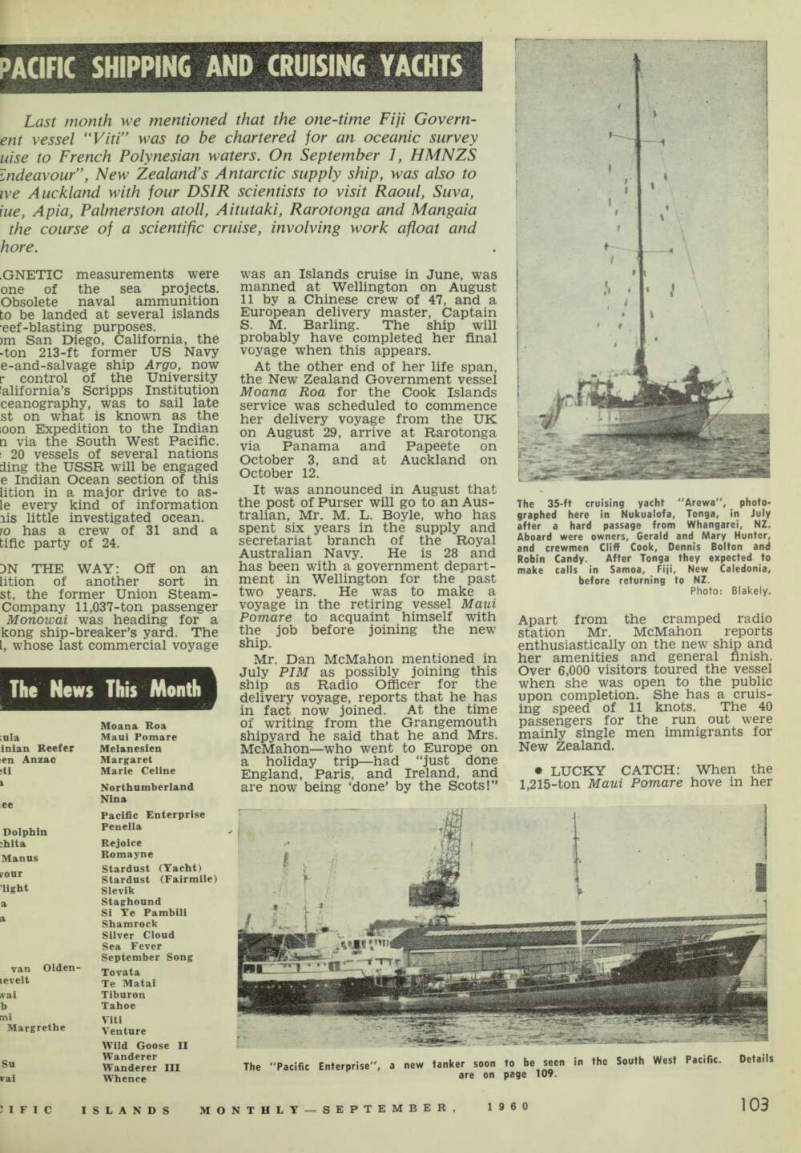
The 35-ft cruising yacht "Arewa", photo graphed here in Nukualofa, Tonga, in July after a hard passage from Whangarei, NZ.
Aboard were owners, Gerald and Mary Hunter, and crewmen Cliff Cook, Dennis Bolton and Robin Candy. After Tonga they expected to make calls in Samoa, Fiji, New Caledonia, before returning to NZ.
Photo: Blakely.
The "Pacific Enterprise", a new tanker soon to be seen in the South West Pacific. Details are on page 109.
on departure from Aitutaki ily she brought up another r and cable, believed to be one ost herself seven or eight ago. »ig anchor which has not so >een recovered is that lost ;ide the Suva main wharf on it 13, 1959, by the 19,787-ton l liner Johan van Oldenbarne s she was heaving up prior to ture. A diver attached a pilot 0 the anchor immediately to its position, but it was deeply Ided in mud and the cable not be reshackled so the liner without it. subsequent days the 8-ton r sank steadily deeper in the lud, and by the time that the writers had instituted salvage bions it was so deep that no nent available in Suva could ?r it. It is now thought to be ;low the mud surface and may be recovered. The replace value was estimated at £5OO.
’Rawlers And Long
RS; With Japanese fishing s very much in the news in 1 Pacific and Australasian s a great deal of confusion is d by many of the leading )apers referring loosely to all vessels as trawlers. ; vast majority of Japanese ig vessels operating in these s are tuna longliners. They ut their floating lines on the high seas in very deep waters,
and, except for shelter for some particular reason such as to transfer fish to a mothership—they have no need or inducement to fish inshore. Their best earnings lie in tuna-type fish which are available on the open oceans far from land, They do not carry trawling equipment and most of them could not possibly find room for such gear in addition to their longlines, buoys, and bamboo marker beacons. They range from about 80 to 150-tons in the case of boats working with motherships, to 250 to 600-tons for vessels sailing independently from Japan.
Trawlers on the other hand have appeared in New Zealand and Australian nearby waters only since
the beginning of 1959 and there are very few of these operating, These are the only vessels which are likely to want to fish within territorial limits, as their opera tions are carried out to a maximum depth of not much more than 200 fathoms, using nets which either drag along the bottom or are hauled along at some shallower inter mediate depth as mid-water trawls, They are also the only vessels seeking fish of types caught by New Zealand fishermen—though blue-fin tuna fishing is done round Aus tralia by Australian fishermen.
Ranging from 1,000-tons upwards they are considerably larger than the longliners.
In short, it is the operations of
trawlers—the shallow-water s fishing for non-pelagic types sh —which the Australasian men need watch. There is no iary inducement for long to fish for other than tuna, if they were equipped to e other types of fishing; and are not sought in inshore s. gliners may, and do, fish close the coasts of many Pacific is, however, because these Is are almost all devoid of Dastal shallows which form the lental shelves and the best ,ng grounds of Australia and Zealand. Tuna, a migratory ar-ranging fish, will be found inshore under these conditions.
"He Week-End Rush: The
le branch of Fiji Customs rtment—the Harbour Master’s on —is not very happy about ng conditions. Unlike the
Customs section proper, they receive no overtime but work on an all-in system—and are in fact quite literally all-in after a rush of over seas shipping, when they are up at all hours for days on end piloting and berthing, handling lines, etc.
To add to the grievance, all the big rushes seem to come at the week-ends. There were some particularly busy periods in July and August when a large number of calls were made by Japanese motherships and by fishing vessels with damage or sickness, together with other overseas ships. • SALVAGE LIEN: According to a New Zealand report, the “surviv ing” barge of the pair which the
Tonga Government’s tug Hifofua attempted unsuccessfully to tow across the Tasman some time ago, was released to its owners, Cleveland Bridge & Dorman Long Ltd., after an insurance company had posted a bond to cover a salvage claim made by the Tonga Government.
The salvage claim arose from the fact that after the tug lost the barge in heavy weather in mid- Tasman, it relocated it and took it in tow again as salvage—the original towage contract being considered void through Act of God. The owners can now make other arrangements for the delivery of the barge from New Plymouth, NZ, to Tasmania. But there will presumably still be legal argument
[?]b Grant, who suffered severe burns in [?] 1957, in a fire aboard the trading [?]"Ve Tega" in the New Hebrides and [?]er flown to a New Zealand hospital, [?]ports from Honolulu. He married a [?]nurse, Marie Calvert, and the pair, [?]n Auckland yachtsman, sailed from [?]d for Samoa, Tahiti, and Hawaii in [?], 1958, where they are settled with Bob [?]ob, but still living aboard "Typee''. [?]w has a 14-month-old son, seen here [?]m. The Grant family is likely to be the South Pacific again some day.
These were the men manning the [?]ia yacht "Babboon" which cleared Suva [?] late July. From left: Maxwell Hoeflich, MacPherson (sailing master), Charlie [?]n (front), and Gene Laughlin (navigator).
whether salvage can be d by the tug owners.
C”S That Man Again;
i Johnson seems to be head r salt water again—and that mean news, for Mr. John name has always been quite linked with maritime its. The ex-subchaser in he drifted from near Hawaii ir Fiji, now stripped of all s, lies at the Whippy boat in Suva, but the last vessel ich Johnson put to sea from V in March, 1956, the Hong milt fishing junk, ended in small pieces a few hours after Since then Johnson has n the war-surplus business at ale, NSW. low hear that he has acquired 1 hull 41-ft x 13-ft and is ng to fit it out in his spare 10 who knows! The Solomons *e he delivered two other trading craft and sold them— e him again. An argumentive crew provided some diversion liara on the occasion of his sit. 3R VILA: The Whippy yard a was to launch in September t x 10-ft launch of sturdy action for Burns Philp (New les) Ltd. It was to have a carrying capacity of 5-tons 20-hp Simplex petrol engine power unit. The launch will pped to Vila as deck cargo.
• ON THE BEACH: Towed to the breakers yard together with the Johnson boat Tovata (ex Purple Sea ex SC-671) last January, the hull of what was the 140-ton Carpenter vessel Komawai, made another sea voyage in early August which will almost certainly be her , The hull has changed hands several times this year and is now owned by Captain M. Whippy, master of the Fiji vessel Ai Sokula.
He has had the hull towed by a Levuka launch to his Yanutha Island property where he will break it up and make use of the good timber.
• Master Sought: The
British Administration in the New Hebrides was advertising in August
for a master, Foreign Going certificate for preference, for its 68-ft patrol craft. Burns Philp were acting as agents for receiving applications.
• Tanker For Sw Pacific-
A newcomer soon to be seen around the SW Pacific will be the tanker recently acquired by the S. Berg Shipping Pty. Ltd., of Sydney, which will be operated on behalf of the Vacuum Oil Co. (The Berg Company operates the 297-tons Kurimarau out of Suva, mainly in the drum oil trade to nearby groups).
The tanker has been renamed Pacific Enterprise. (Since she was launched eight years ago she has been operating as Harold and registered in Rotterdam). (Over)
[?]cht "Wanderer", which was in a in August. See story on page 117.
Photo: R. D. Moore.
'he tanker will be based at Lae, v Guinea, and will service a nber of outport terminals now ag built in the Islands by mum. She will carry supplies motor gasoline and distillate in k to centres in New Guinea, Gilbert & Ellice Islands, the v Hebrides and the British Dmon Islands. he is 193-feet long and has a ed of 10i-knots. She can carry -tons of petroleum products in cargo tanks and is ideally suited the job because she draws less n 12-feet of water. She carries :rew of 12.
'acific Enterprise arrived in gapore from the United igdom in mid-August for a final t. For a shakedown voyage, she [ carry a cargo of petroleum ducts from Palembang to
Wyndham in the north of Western Australia, before inaugurating the Pacific Islands branch inter-island tanker service in late September or early October.
In the initial stages she will carry fuel in bulk to outport terminals now being built at Wewak and Kavieng in NG, at Tarawa in the Gilbert & Ellice Islands and at Vila and Santo in the New Hebrides. She will also service bulk installations at Gizo, Munda and Yandina in the BSIP.
Pacific Enterprise will call at the outport terminal about once every three months and, to maintain the service, she will probably lift supplies from the Vacuum ocean terminals at Lae, Suva and Ducos (in New Caledonia).
The outport terminal at Wewak will have four bulk tanks—two for aviation gasoline with a capacity of 70,000-gallons each; one for motor gasoline with a capacity of 70,000gallons and the fourth for distillate to hold 35,000-gallons.
The Kavieng terminal will have two tanks 70,000-gallons for distillate and 35,000-gallons for motor gasoline; there will be one tank at Tarawa—B7,soo-gallons for distillate.
In the New Hebrides, Vila and Santo will each have two bulk tanks for motor gasoline and distillate.
Each terminal will be linked to the tanker mooring by a pipeline which will be able to handle dis charge at a rate of up to 30,000gallons an hour.
The terminals will service their local areas with tank trucks and their outcentres with drums for which special cleaning and filling facilities are being installed.
• Busy Time At Raro
TONGA: When the Argentinian Reefer and the Maui Pomare sailed
The new "Slevik", which has been in New Guinea on her maiden voyage. See page 117.
On Slovacek of the Sydney yacht "Janis" is on a lone-handed cruise through the [?]nds. Mr. Slovacek was employed on a [?]-known Papuan rubber plantation a few years ago.
m Rarotonga on August 13, they 1 loaded between them a total of 525 cases of citrus, 23,939 cases tomatoes, and 382 cases of other its. it first it was thought that the ps would not be able to take as ich cargo as they did, and as at ‘ present time there is an mdance of citrus and tomatoes the Cooks, the Rarotongan Radio d for some days been trying to ;ice passing ships to call for aatoes.
JSS Northumberland very nearly swered the call, but at the last ment, after numerous messages ;ween the owners, the captain d Rarotonga, decided not to Dart from her schedule. r ruit picking was restricted, but at was picked was able to be pped.
* More Trouble For
ARDUST ; This Fairmile, owned d skippered by Mr. Richard iith, of Sydney, which first :ered PIM’s pages in mid-1959 en it was announced that a crew amateurs would cruise in her to West Indies from Sydney (she 3 spent most of the time since Fiji), was in trouble again in •ly August in the Cook Islands, jeaving Pago Pago on July 22 ind for Tahiti, Stardust ran into 1 luck as well as bad weather, avy seas loosening her top super ucture and short of fuel and sh water, and 400 miles off irse she headed for Aitutaki, then itinued on to Rarotonga. 5he arrived at Rarotonga late Jdnesday afternoon, August 3, d immediately faced difficulties, ing short of fuel, she could not nply with the Cook Islands Plant arantine Regulations, in that a >sel coming from an area where dnoceros beetle was known to be, ist stand a mile off shore for 2 period from 15 minutes before iset until 15 minutes after sun e. After an anxious couple of urs Mr. Smith was able to obtain 5l and stand off shore as he was luired to do, rhursday also brought its mbles, for when attempting to
weigh anchor in the evening, it was found that it had fouled on the harbour bed. It was suggested that
the skipper leave his anchor marked by a buoy, but reluctant to put to sea without it. Mr. Smith con tinued his efforts to free it. Finally, at 8 p.m. the anchor was abandoned and the vessel put out to sea.
Friday afternoon found Mr.
Smith appearing in the High Court charged with a breach of Quarantine Regulations, in that Stardust did not stand at least a mile off shore for the required period the previous night, and as a result he was fined £3. An Agri cultural Oificer giving evidence said that at the present time Rarotonga was free of Rhinoceros beetle, and breaches of the regulations which could lead to the entry of the beetle into the Cook Islands had to be regarded as serious.
Saturday afternoon, after recover ing its anchor from the Avatiu
[?]rdust" —in the news again. See below.
Photo: R. D. Moore.
rbour bottom, Stardust sailed for tiiti, taking a cargo of tomatoes behalf of the Rarotonga Co irative Marketing Society.
Ir. Smith’s impressions of the )k Islands can well be imagined.
Trawler Delivered: A
year-old standard 45-ft wooden •ttish seine-net fishing trawler tmed by 10 persons arrived at ;kland on August 16 from ithwick, Sussex, having left the er port last November 24. After sing through Panama Canal the sel called at the Galapagos, rquesas, Papeete and Rarotonga, j owner-skipper, Lester Royle, Australian, was accompanied by wife Pamela and eight men cted from 300 applicants for the very trip. he trawler is equipped with a r cylinder 300-hp diesel motor well as auxiliary sails and is j being offered for sale at ;15,000. Originally named innyfold, the craft was renamed rdeen Anzac when purchased the Royles.
For Disposal: The Fiji
was calling tenders in August for its vessels Adi i and Venture. The former was t by the PWD at Suva in 1927, isures 531-ft x 14|-ft x 61-ft and wooden vessel, copper sheathed, i a 72-hp Gardner diesel. She a gross tonnage of 49 and a net aage of 34 and has been used for eral government transport of :ials and cargo. enture, a smaller vessel measur -45-ft x 12*-ft x 51-ft, was built Auckland in 1936 and is of 27- 3 gross and 13 nett. Both craft e been laid up for some months.
Interesting Italian
ITOR: An interesting visitor to :ualofa, Suva, and Noumea in :ust, on a cruise from Melbourne Sydney, was the Genoa stered one-class passenger liner elia, first Italian vessel to ear in the Pacific Islands cruise ie in post-war years—and sibly the first ever, though ian vessels regularly call at ieete on the regular Australia ope passenger run. urelia was built in Germany in l as a cargo-and-passenger ;el for German owners and led Huascaran. When war broke she was converted to service as U-boat mothership, and was ■ioned in Norwegian waters after way fell. At the end of the ' she was seized as a war prize i became the Canadian vessel werhrae in 1947. In 1953 she i purchased by her present lers, Cia, Genovese d’Armamento, Genoa—known as the Cogedar e for short—and completely re lt to the most modern standards. ; is a handsome vessel both in ward appearance, with white 1 and moderately streamlined file, and in her internal appoint
ments. A feature of the decorations are the huge photographs of scenes on the Italian Riviera in the public rooms and companionways.
The ship was commanded by Captain Alessandro Tortora. He said in Suva that the company owns two other similarly converted vessels. One, the 8,000-ton Flaminia (ex Genova) , is on the Australia- West Germany run with Aurelia.
The other is chartered to Messagenes Mari times and operates under the French flag between France and Australia via Pacific ports as Melanesien ex Bianca-C, ex Assuncion, ex Indrapoera, built 1925. She was completely modernised ? n Poc I Q'^ ase Italian company m 1958.
Captain Tortora said that his company plans to build two new ships and to place one of its fleet entirely in the cruise trade. Another
Islands cruise will probably be made next year.
Fares for the present 16-day circuit from Melbourne ranged from £AI2S to £AISO. She carried 650 passengers, mainly Australian, and 185 ship’s personnel, almost all Italian but including a few Germans,
• Improved Safety In
SAMOA: All Home Trade ships and Inter Island trade ships registered in Western Samoa are now required to be equipped with radio trans mitters and receivers. Western Samoa thus probably becomes the first South Pacific territory legally requiring this safety measure.
The necessary radio equipment has been made available by the Government, so there can be no de fault on that score (Over)
• Maiden Voyage Of New
, EVIK : The new Slevik completed r delivery voyage from Europe to
ibaul in August, picked up some
rs from the Thompson and right timber lease at Cape »skins and took them to Sydney. the end of the month she was sparing for her first north-bound page—-this time to Lae, with 100 ad of cattle. rhe smart new vessel was built Germany, can carry 1,000 tons of light and has been specially de ned for carrying cattle (north
and) and logs (southbound).
len and if required she will also :ry some general cargo. Her icers are Norwegian and crew inese. The vessel is owned by rlander (NG) Line and F. H. jphens Pty. Ltd. are Australasian leral managers. Elilzdbeth Boye, the same line, is already operat jin New Guinea waters. (The ginal Slevik was under charter Eriama Estates Ltd. of Papua ■ some time and was also engaged the cattle and timber trade; but 3 was sold to South Australian erests about a year ago).
U present there is one timber mpa n y operating at Cape skins, New Britain, but recently ; Administration put another ge timber lease in the same area for tender. The availability of ship that can go right in and k up logs for transportation ect to Australia would be a big :tor in the plans of any
ispective tenderer.
ws of Cruising Yachts
WILD GOOSE 11, the big Seattle motor ht which was in Papeete recently, is arently a converted American naval S type, similar to the French naval ft now stationed in the South Pacific similar to the Pago Pago vessel NU’A TELE. (For later news of a mis to this vessel see Pacific Report ion.) ADIOS and the Steeles, who passed >ugh the Islands some time back, were Darwin in August and likely to remain re for some time.
STAGHOUND, which cruised westward jugh the Islands as far as Noumea Her this year, was doubling back from re to Papeete in July-August.
MARGARET, the New Zealand yacht ch was reported overdue last month, y arrived at Papeete.
Ina, Galatea, Marie Celine,
Ahnee, Iwa, Kyalami, Te Matai,
SI YE PAMBILI were all reported at icete early in August, i TE MATAI mentioned above, was re ted from the Cooks to be owned by Mr. »ert Fraser of Honolulu and of 78 tons ss. Prior to arriving at Penrhyn the ht had blown out mainsail and jib. i PENELLA, of England, with Group itain W. E. Rankin, RAF, and Mrs. ikin aboard, arrived at Suva August 9, i to do several weeks of local cruising, n head for New Caledonia. The yacht i 40 ft. x 11 ft. x 5 ft. staysail schooner. >up-Captain Rankin trained as a RAAF •t at Point Cook, Victoria, in 1930 I the next year transferred to the RAF ere he served until retirement in 1958,
He married in England and he and his wife Dorrie have five children—two sons in the RAF, and three daughters married and living respectively in Montreal, Melbourne and Capetown. That’s the object of this cruise—to visit the children. Cruise was started from UK in December, 1958, and Pacific was entered at Balboa this January.
Since then they have visited Galapagos, Marquesas, Society Islands, Samoa and Fiji.
Next port will be Noumea and then Aus tralia for six months before leaving for South Africa. • SHAMROCK of Wellington and SILVER CLOUD of Auckland departed for Noumea and Vila respectively from Suva on August 9. • NINA of Auckland cleared Suva August 16 for Noumea. Her owners, the Buck thought family, had £4O stolen from them while at a Fiji beach resort. • AREWA also cleared Suva August 16 for Vila. This 34-ft. cutter with Gerald and Mary Hunter, Clifford Cook, Denis Bolton and Robin Candy aboard, had called at Nukualofa, Pago Pago and Vavau before arriving at Suva. Gerald Hunter cruised to Norfolk Island from Auckland as a crewman in MANAWANUI In 1948. • TIBURON of the US, with Ed Vessey and his new wife aboard, arrived at Suva August 22 when inquiries were about to be made regarding his whereabouts. He had advised Suva from Apia under date of August 8 that he was leaving there within two or three days of that date, so was considered overdue. He had called at Niuafoou, Tonga, en route. • REJOICE, schooner of Santa Barbara; TAHOE of Vancouver; KAREN MAR GRETHE, ketch of San Diego; LANG SU of Newport; and BORRACHITA of Santa Cruz, Mexico, were all in Papeete in mid- August according to a brief report. • WANDERER arrived at Rarotonga on August 15 from Tahiti. Tom Buchanan (skipper) and Pat Ganley, both of Auck land, are on the last stages of their journey home to NZ. The yacht carries one passenger, R. McCarthy, an American.
The yacht intended to leave Rarotonga near the end of August, and will visit Tonga and Fiji before returning to Auck land. Mrs. Buchanan, the skipper’s wife, has flown up from Auckland and will join the yacht in Suva. • WANDERER 111, of England, with owners Eric and Mrs. Hiscock spent a week in Nukualofa mid-August and last report was that they were then heading towards Suva. • KELPIE, 63 ft. schooner from New port, Calif., arrived Honolulu July 25, 13 days out of Bora Bora. Skipper George Minney and crew of six plan on heading back home shortly. Left August 16. • CARLA MANUS departed Honolulu midnight July 27, bound for San Francisco via Kauai. • FREE FLIGHT, 34 ft. Atkins ketch of Newport, Calif., arrived Honolulu 22 days out. Ron Linderman and crew of Allen Desatoff, Pete Smllie, and Bob Silver plan on heading south. • KOAE, ketch, of Seattle, Washington, with Mr. and Mrs. Taylor and Chuck Kennedy aboard arrived Honolulu 30 days out of Bora Bora on July 28. They left for home on August 15. • SEA FEVER, 42 ft. Ed Monk-designed ketch, Larry and Margaret Alexander, son John, 6, and two crewmen aboard, arrived Honolulu July 28. They made the run from
San Diego to Hilo in 17 days. Eventually will continue on to Tahiti and New Zea land. • BLACK DOLPHIN, 40 ft. ketch of San Diego with Bill and Marion Rumsey and sons Tommy and Billy arrived Honolulu 24 days out of San Diego, on July 28. • KOCHAB, 40 ft. ketch of London, with Dr. John Evans and crew Dick Pohe departed Honolulu bound for San Diego on July 31. • ROMAYNE departed Honolulu for Vancouver, BC, on July 31. • STARDUST, 34 ft. ketch of Santa Barbara, Calif., with Louis and Jesse Ben dixsen and crew Kenneth Bendixsen, ar rived Honolulu August 9—22 days out of San Diego. Stardust will remain in Hono lulu for the present. (But there is sure to be some confusion between this one and the converted Fairmile of same name, now in Papeete—see page 113.) • SEPTEMBER SONG: This 33 ft. sloop sailed by an American couple, Dr. and Mrs.
W. M. Lee, which has twice in recent months been reported overdue, was in Madang, NG, on August 22. The slooo was the subject of a search late June when she was thought to be overdue in Wewak from Hollandia. It was called off early July when Hollandia reported that the yacht was headed for Fiji. In early August, ships in BSIP waters were asked to keep a lookout as the vessel had not arrived in Fiji. It appears that after leav ing Hollandia, the yacht ran into a 12-day storm off the New Ireland coast and was swept by westerly currents. The Lees de cided to turn south-west to Wewak and from there were sent on to Madang which has a couple of slipways. It seems they may be there some time while repairs are made. They bought the yacht in Hong kong and left there in April, 1959. Their route after leaving Madang is expected to be through the Barrier Reef to Australia (where they have a daughter), then Fiji, Tahiti, Honolulu, down the US coast, through Panama and across the Atlantic to England. • WHENCE of Florida, left Suva, August 9. for Beqa and Vila, in continuation of the westbound cruise.