Genu May Be The Last
pp. 79-81 · Read in the full issue
Wood-Carvers of Bougainville
Of His Kind
By Brett Hilder
Examples of primitive South Pacific art are scattered all over the world m famous museums and private collections , and in a few years that is where Pacific Islands dwellers will have to go to see Item The art of sculpture in all islands is dying out. * 1 ,ie
THE wooden figures of Buka boys and meris from the village of Rorovana are about the only sculpture from Bougainville that one ever sees. This can hardly be called local native art, for the Rorovana people settled in the district only about two generations ago.
They came from Fauro island in the Shortlands, and a few genera tions before that, from Mono or Treasury Island. I suspect that they came originally from Roviana lagoon on New Georgia, the centre for a fierce race of people who built large war-canoes and raided all the sur rounding islands of the Western Solomons, just as the Vikings did in Western Europe.
This was also a centre of sculpture in ebony, mainly of ancestral figures such as those that graced the prow of each war-canoe. The ebony was
inlaid with mother-of-pearl, and as the natives are as black as ebony,, the figures can look very realistic The legends of the Shortlands tell us that about 1840 the islands of Alu and Fauro were invaded by Poreisi, second son of Telekana, chief of Mono. The present land tenure derives from grants made by Poreisi.
The invasion of the coastal strip of Bougainville just north of Kieta occurred about 1900, and w as mounted from Fauro Island. The invaders called their new home Rorovana, possibly with some refer ence to their ancestral Roviana.
One version of the story of this last invasion is that the Fauro warriors were invited to the area to help fight the hill-men who were raiding the coastal strip, and that after the ensuing war, the Fauro men attacked their allies and occupied the land themselves.
Another version is that the in vasion was in revenge for the killing of a white trader.
Copied the House Posts
The present leading wood-carver of Rorovana is a man of 50 or 60, named Genu. He once told me that his father, Mauki, was born on Fauro, but he now says that he was born at Rorovana, although this would not accord with the date of the invasion.
Genu tells me also that the only old carving he knew was on the posts of the open war-house built at Rorovana, from whence the warriors were sent to battle.
These posts had a man’s head carved at the top where they sup ported the roof. The war-house had no walls. Genu was first inspired to carve similar heads on posts, and he later extended the carving to include the body. The original posts of the war-house were taken by the Germans, who sawed off the heads and took them away in a ship. They might be still in some collection in Europe. There are no speciments of old Rorovana carving in the district today.
There were several wood-carvers amongst the Rorovana about the 1930’5, but Genu is now the only survivor. There are two yolmger men, Auwuko and Matua, aged about
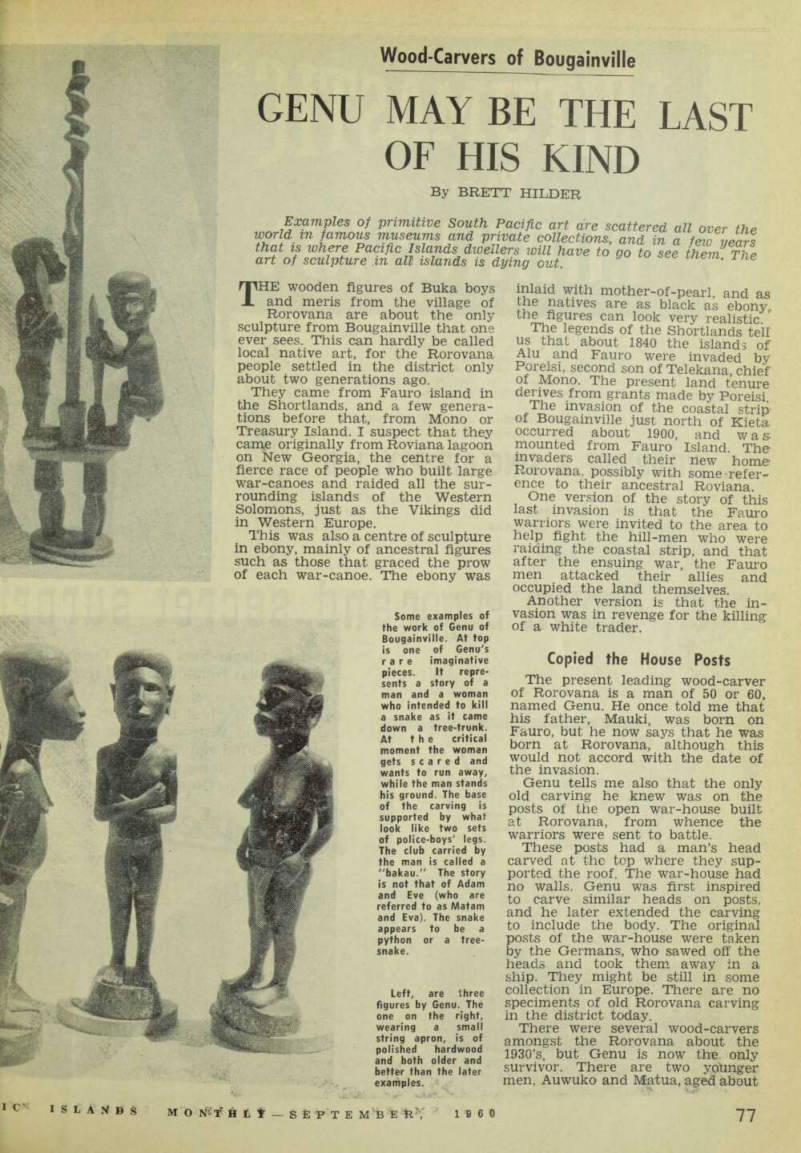
Left, are three figures by Genu. The one on the right, wearing a small string apron, is of polished hardwood and both older and better than the later examples.
Some examples of the work of Genu of Bougainville. At top is one of Genu's rare imaginative pieces. It repre sents a story of a man and a woman who intended to kill a snake as it came down a tree-trunk.
At the critical moment the woman gets scared and wants to run away, while the man stands his ground. The base of the carving is supported by what look like two sets
of police-boys' legs.
The club carried by the man is called a "bakau." The story is not that of Adam and Eve (who are referred to as Matam and Eva). The snake appears to be a python or a tree snake.
ho are disciples of Genu, and do similar carving, s style of the carved figures is n in the photograph of the specimens of Genu’s work, eyes, teeth, belts and arm -3 are cut in and painted white, n the older style these items I have been inset with nautilus coiffure and the bases are red with red powder, which off, and the bodies are painted to resemble the local skin r. The wood used now is said ! Tollis—a light wood of the r of pine. The old figures were lished ebony, or of other hard stained black by immersion angrove swamps.
Built-in Skirts
* figures are generally erect feet apart, and are sometimes i by the addition of a child d by a woman, or standing in of a man. Most of them are but not phallic. ;y are often given a small of cloth or grass when on in European houses, and some ;m now have a similar covering i in the wood. : heads and faces of the figures little difference between males miales, so their nudity is really i to identification, se little wooden figures have erage height of 18 inches, none less than a foot and none three feet. They might be black dolls, though they are too n pose to be thought cuddle- They look more realistic when ?ed in a row, or in a group, tiey strike a distinctive note in ection of native art. iu tells me that he doesn’t use models for his carving, as
SSSJSSKSSS? S°* The fi^ure l do n °t approximate human proportions of a l e to ° shol \ for the torso, and the torso too short ency b * f f2 m T3 the - older ancestral in gl wblpwio e^ Ro T iana war " cana s s * “ S f th f Jl ea( i *2 nearly as bl S RnLvln? 6 ™° d T* • f The Rorovana people are just as vmSr? c S *55? • of v. l the uP°V ga , in " villeans, indeed this blue-black skin colour extends to Choiseul and New Georgia in the Solomons. All these black people have finer features than most Melanesians, suggesting aWl th the Ethiopians rather Genu s parents were both of Jj9. r ° 1S only brother was Kikila. Genu married Akokani and
they have two sons, both of whom are now married with children but with no interest in wood-casing Genu has lived most of his lifp as a Kanaka, equivalent to a ye£ man farmer in England. His only period in European employment was in the early 1930’s when he was a house-boy to General Wisdom, then the Administrator of New Guinea with his home in Rabaul. Genu has never worked on plantations nor has he served in the Police as has offpn been suggested He is now, for a native, an old man, a bit temperamental, and he finds the younger generation dis interested in the traditional lore and art of the tribe. Wood-carving mav disappear from Bougainville when he dies.
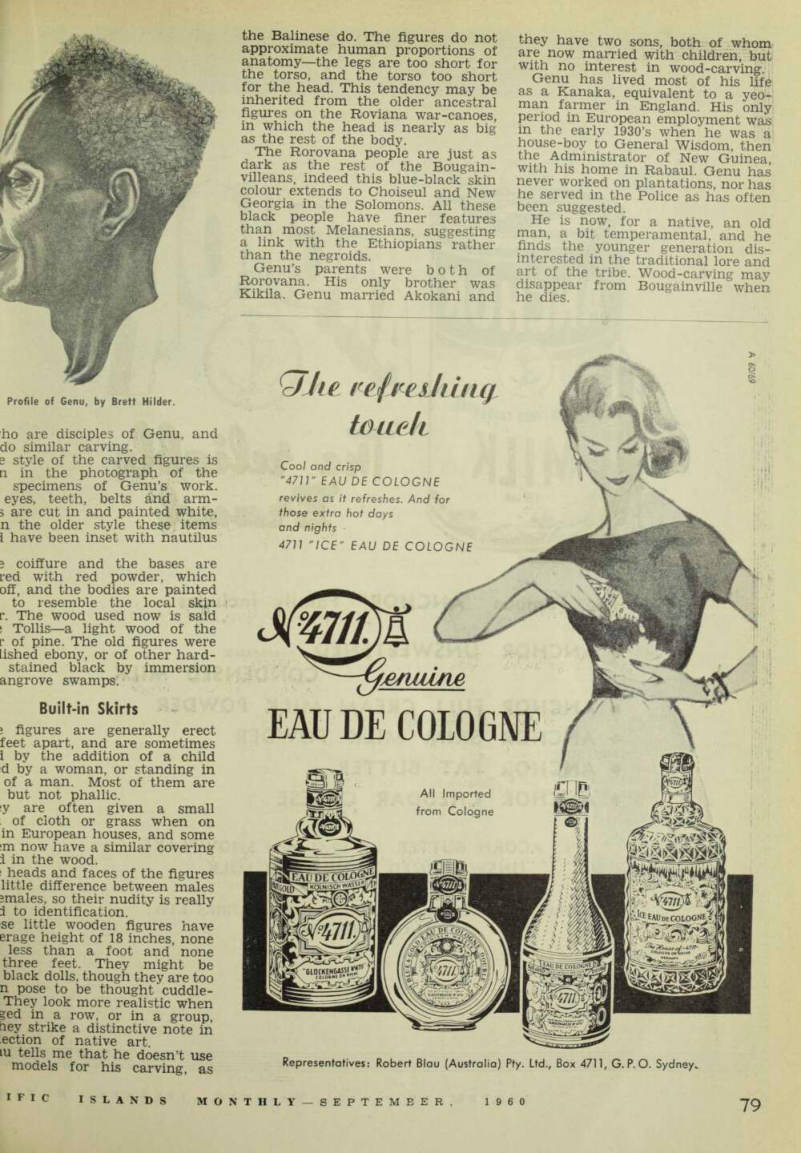
Profile of Genu, by Brett Hilder.