The Viets Are On
pp. 55-57 · Read in the full issue
The Way Home
From a Correspondent in Santo, New Hebrides Market-gardening and the operating of taxi cabs look like being two businesses wide open for the asking in the New Hebrides soon. Both are in the hands almost entirely of the Vietnamese and the Vietnamese are going home.
mHE decision to repatriate them has been made recently alter lengthy and involved negotiations between France and Vietnam.
The New Hebrides’ Viets come under the same repatriation scheme as those in New Caledonia, for they all came to the Pacific under the same indentured labour scheme pre-war.
They were brought from French Indo-China (now Vietnam), under five-year contracts, and the repatriation schemes were working satisfactorily until the war. when they broke down. The Viets were allowed to remain as free citizens.
Comparatively few have been repatriated since the war, again because of political conditions. North Vietnam is now under Communist control, and most of the Viets in both New Caledonia and the New Hebrides come from the north.
In July, the New Caledonian Government announced that agreement had at last been reached for the Viets in New Caledonia and the New Hebrides to choose (1) To be repatriated to Haipong (North); (2) To be repatriated to Saigon (South); or (3) Remain where they are. If they choose to remain they lose any rights to be repatriated and must conform to all the requirements of other foreigners.
There are no definite figures
available at the moment, but probably about 5,000-6,000 Viets will be repatriated from both Territories, which is most of them. And virtually all will go to Haipong. There are at least 2,000 Viets in the New Hebrides.
The first repatriates are expected to leave New Caledonia in October, aboard a British ship chartered at Hongkong. That vessel will carry 550 passengers a voyage, at a reported cost of £A50,000 a voyage, the cost to be met by the French Govern ment.
Canned Veg. Again
The ship will sail right to Haipong. and a French and Vietnamese dele gate will accompany each voyage to iron out any difficulties.
The New Hebrides probably hasn’t realised yet the effect the Viets with drawal is going to have, although people are telling themselves that since they once lived on canned vegetables, they can do it again.
Perhaps they can, but fresh vege tables are pretty good, too, and it is not likely that anything like the past supply is going to be available, since the Viets virtually are the market gardens.
Similarly, where are all the plumbers, carpenters, painters, con creters and odd-job men going to come from after the Viets leave?
Everybody complains about the quality of their work—which is pretty rough work —but at least it gets done and there is nobody else to do it. For a wage of £2 or £3 a day a Viet will turn his hand at just about anything.
Being mechanically minded, it was probably not surprising that they took on local work as motor mechanics and that this led to their interest in the taxi cab busi ness. Nearly all of New Hebrides’ cabs are run by the Viets. They operate 86 of them on Santo alone. (Over)
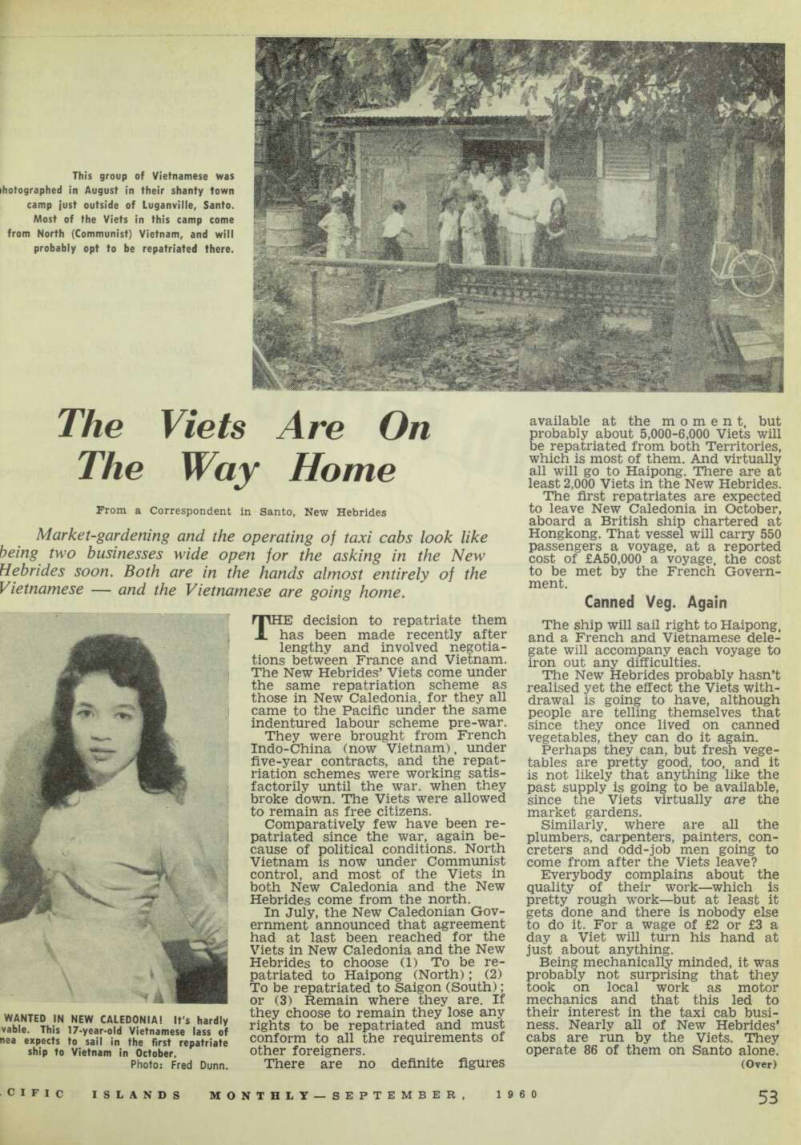
This group of Vietnamese was [?]hotographed in August in their shanty town camp just outside of Luganville, Santo.
Most of the Viets in this camp come from North (Communist) Vietnam, and will probably opt to be repatriated there.
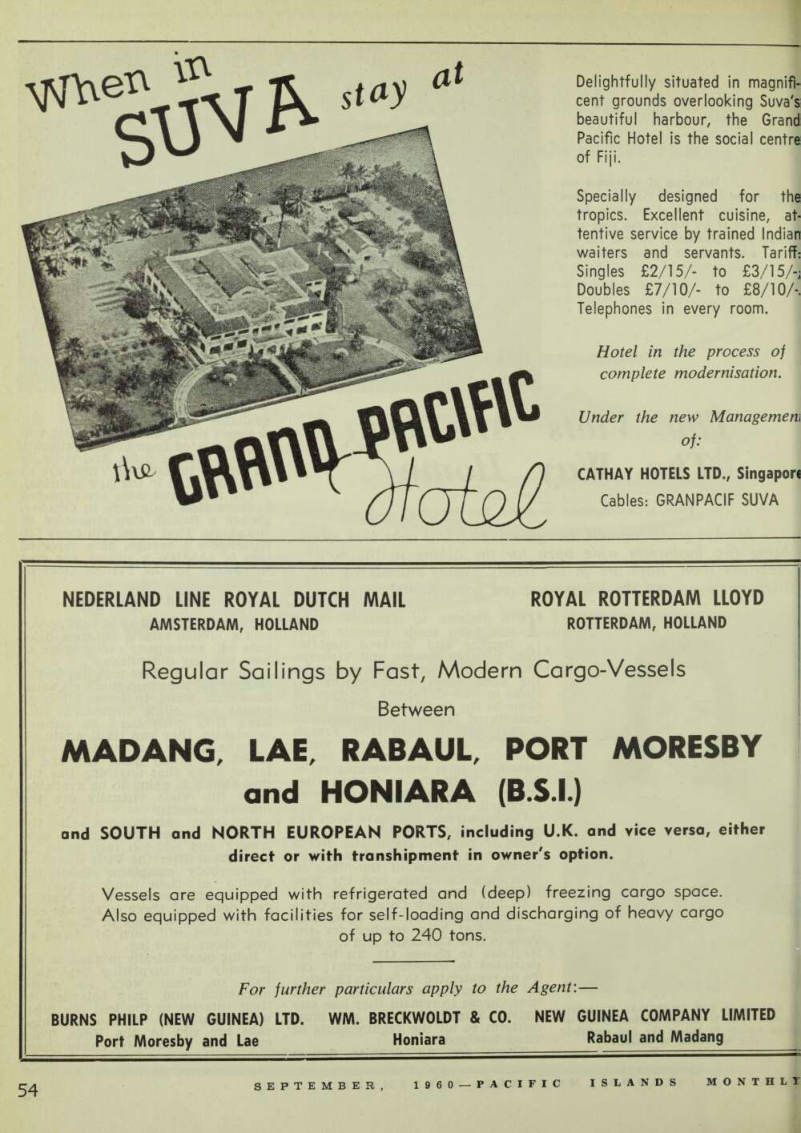
Wanted In New Caledonia! It's Hardly
vable. This 17-year-old Vietnamese lass of [?]nea expects to sail in the first repatriate ship to Vietnam in October.
Photo: Fred Dunn.
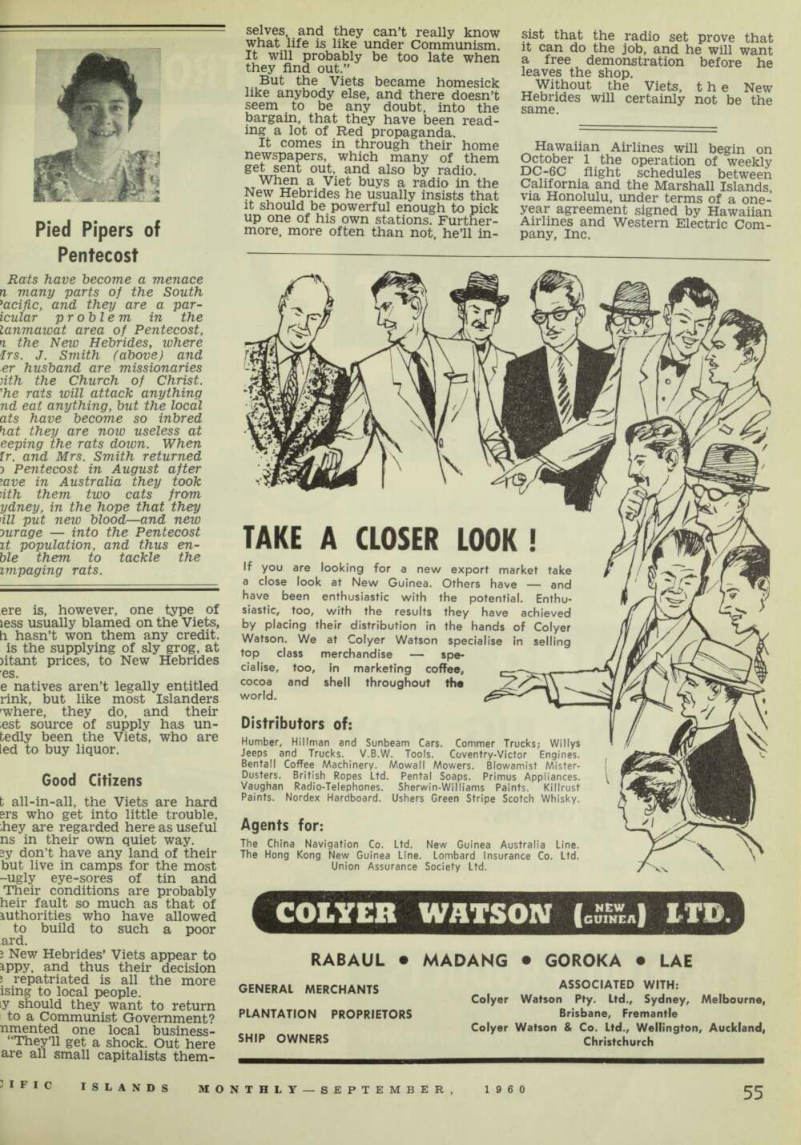
ere is, however, one type of less usually blamed on the Viets, h hasn’t won them any credit, is the supplying of sly grog, at litant prices, to New Hebrides es. e natives aren’t legally entitled rink, but like most Islanders r where, they do, and their ,est source of supply has un bedly been the Viets, who are led to buy liquor.
Good Citizens
t all-in-all, the Viets are hard ers who get into little trouble, ;hey are regarded here as useful ns in their own quiet way. 3y don’t have any land of their but live in camps for the most -ugly eye-sores of tin and Their conditions are probably heir fault so much as that of authorities who have allowed to build to such a poor ard. 3 New Hebrides’ Viets appear to ippy, and thus their decision ; repatriated is all the more ising to local people. iy should they want to return to a Communist Government? nmented one local business “ They’ll get a shock. Out here are all small capitalists them
selves, and they can’t really know what life is like under Communism.
It will probably be too late when they find out.”
But the Viets became homesick like anybody else, and there doesn’t seem to be any doubt, into the bargain, that they have been read ing a lot of Red propaganda.
It comes in through their home newspapers, which many of them get sent out, and also by radio.
When a Viet buys a radio in the New Hebrides he usually insists that it should be powerful enough to pick up one of his own stations. Further more. more often than not, he’ll in
sist that the radio set prove that it can do the job, and he will want a free demonstration before he leaves the shop.
Without the Viets, the New Hebrides will certainly not be the same.
Hawaiian Airlines will begin on October 1 the operation of weekly DC-6C flight schedules between California and the Marshall Islands, via Honolulu, under terms of a one year agreement signed by Hawaiian Airlines and Western Electric Com pany, Inc.