Territories TALK-TALK
pp. 47-51 · Read in the full issue
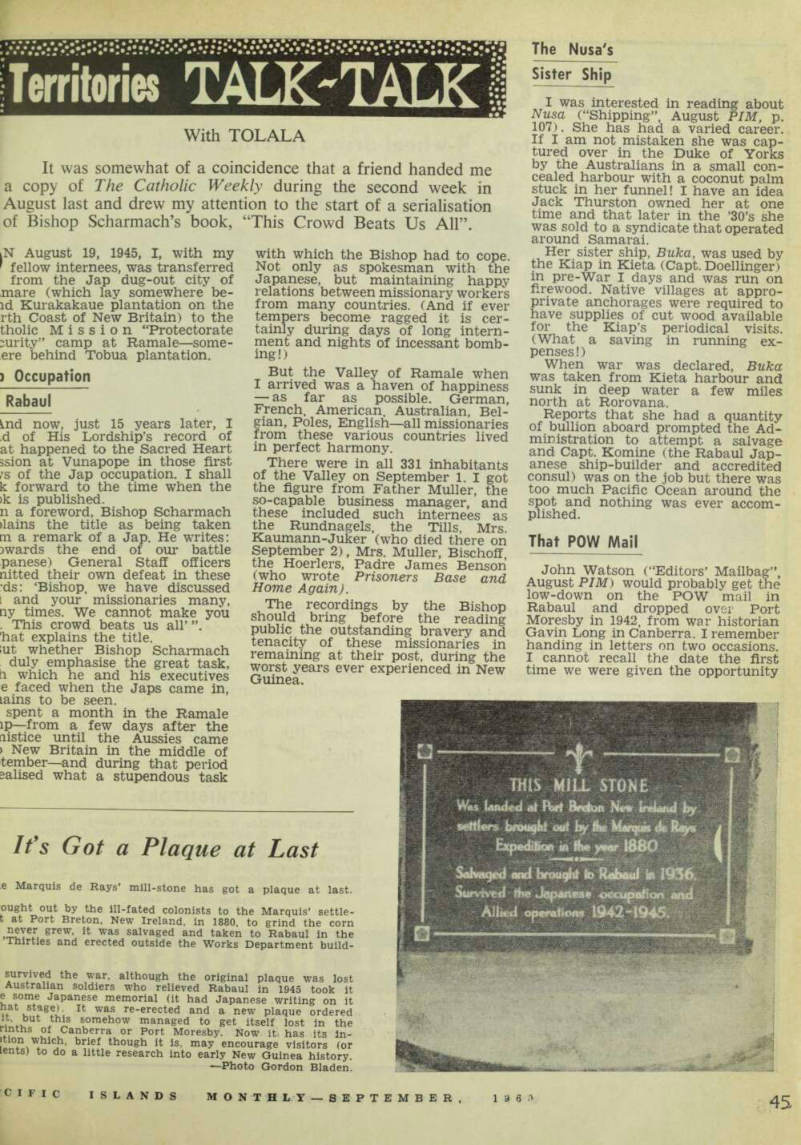

With Tolala
It was somewhat of a coincidence that a friend handed me a copy of The Catholic Weekly during the second week in August last and drew my attention to the start of a serialisation of Bishop Scharmach’s book, “This Crowd Beats Us All”.
|N August 19, 1945, I, with my ' fellow internees, was transferred from the Jap dug-out city of mare (which lay somewhere he ld Kurakakaue plantation on the rth Coast of New Britain) to the tholic Mission “Protectorate 3urity” camp at Ramale —someere behind Tobua plantation.
) Occupation
Rabaul ind now, just 15 years later, I ,d of His Lordship’s record of at happened to the Sacred Heart ssion at Vunapope in those first rs of the Jap occupation, I shall k forward to the time when the )k is published. n a foreword, Bishop Scharmach Jains the title as being taken m a remark of a Jap. He writes; iwards the end of our battle panese) General Staff officers nitted their own defeat in these ■ds: ‘Bishop, we have discussed [ and your missionaries many, ny times. We cannot make you . This crowd beats us all’ hat explains the title, lut whether Bishop Scharmach duly emphasise the great task, ti which he and his executives e faced when the Japs came in, tains to be seen, spent a month in the Ramale ip— ; from a few days after the listice until the Aussies came > New Britain in the middle of tember—and during that period salised what a stupendous task
with which the Bishop had to cope.
Not only as spokesman with the Japanese, but maintaining happy relations between missionary workers from many countries. (And if ever tempers become ragged it is cer tainly during days of long intern ment and nights of incessant bomb ing!) T 0f Ra ™ ale ™ hen 1 a T V f^ Wa L a ha PP mess as - P° sBlbl p- German, .rench. American, Australian, Bel gian, Poles, English—all missionaries from these various countries lived m perfect harmony.
There were in all 331 inhabitants of the Valley on September 1. I got the figure from Father Muller, the so-capable business manager, and these included such internees as the Rundnagels the Tills Mrs Kaumann-Juker ’(who died there on September 2), Mrs Muller Bischoff the Hoerlers, Padre James Benson (who wrote Prisoners Base and Home Again).
Th e recording hv tbp • R i c v lAn v, l ij recordings by the Bishop S®? bef ° re tbe wading fH? 110 .. the outstanding bravery and of these missionaries in remaining at their Post, during the Guinef^ 8 experienced in New
The Musa's
Sister Ship
I was interested in reading about Nusa (“Shipping”. August PIM, p. 107). She has had a varied career.
If I am not mistaken she was cap tured over in the Duke of Yorks by the Australians in a small con cealed harbour with a coconut palm stuck in her funnel! I have an idea Jack Thurston owned her at one time and that later in the ’3o’s she was sold to a syndicate that operated around Samarai.
Her sister ship, Buka, was used by the Kiap in Kieta (Capt. Doellinger) in pre-War I days and was run on firewood. Native villages at appro private anchorages were required to have supplies of cut wood available for the Kiap’s periodical visits. (What a saving in running ex penses!) When war was declared, Buka was taken from Kieta harbour and sunk in deep water a few miles north at Rorovana.
Reports that she had a quantity of bullion aboard prompted the Ad ministration to attempt a salvage and Capt. Komine (the Rabaul Jap anese ship-builder and accredited consul) was on the job but there was too much Pacific Ocean around the spot and nothing was ever accom plished.
That ROW Mail John Watson (“Editors’ Mailbag”, August PIM) would probably get the low-down on the POW mail in Rabaul and dropped over Port Moresby in 1942, from war historian Gavin Long in Canberra. I remember handing in letters on two occasions.
I cannot recall the date the first time we were given the opportunity
sometime in March or April when : were under Army control. The :ond occasion was “towards the d of May ’42” (according to my published MS on Rabaul Boob tys), when a Navy officer told us i could write to our people in istralia and gave us careful in uctions what to put in our letters.
We were sceptical of their ultimate rival in Australia. But I later ard that some of the letters were ;eived by relatives, although mine ver made the grade. I also heard sy were dropped over Moresby but ne bags fell into the sea and were t. I do not know what Jap ladron made the drop. \.s for the old air companies he sntions I cannot recall “Papuan .ways” operating from Salamaua that time. Could he be referring the Pacific Air Transport (PAT) rted by Ray Parer and operating •m Salamaua to Wau? Arthur llins started an air company in haul some time in ’33, I think, b it didn’t last long.
lence the Tolais?
2ecil Hobler, in Port Moresby, ikes some comments on the par DUt the Tolais coming from New
Ireland (June “Talk-Talk”) and mentions that in parts of the West Coast of Southern New Ireland the Blanche Bay dialect is spoken.
“Further, when the Methodist Mission holds its annual ‘Waratibar’ (sic) at Watnabra Mission station some men from New Ireland at tend.”
The New Ireland area referred to by Mr. Hobler used to be (and may still be) know as Topai and, when I was at Watnabra back in 1911, was part of the circuit with head quarters at Watnabra, where the George Brown College was located and all teachers both from New Britain. Duke of York and New Ire land were trained. TTae common language used was the Blanche Bay
dialect, all New Testaments and hymn books were printed in the Tinata Kunua and became a lingua franca amongst Methodists in all districts. The New Ireland and Duke of York natives have their own distinctive languages and dialects. At least they used to have; for I am speaking of nearly 50 years ago.
Mr. Hobler’s reference to “Warati bar” should be Waratabara. The prefix warn before tabara (to give) creates the word “giving” in the Tinata and refers to the annual Methodist May meetings, when the villagers made their gifts in cash for the Good Cause.
In my time on Duke of York they were held at various centres where
7e ral villages would assemble, stage iborate dances, feasts and then ch Church member would donate ; offering by depositing the needful •rman marks (equivalent to about L in those days) in a large white amel basin. }ften several villages would keenly npete with each other and this itest almost reached blows ongst some of the more fanatical mbers. Needless to say, this airy was not discouraged by the ite missionaries.
Veil do I remember the task of nting the harvest of these enamel ins. It amounted to many idreds of pounds. was always careful to pick out bird-of-paradise marks of the New Guinea Kompagnie, and ) the English shillings, of which re was a goodly number, he writer also seeks the deriva i of the word Tolai, stating that word Taulai meaning “married” >ronounced in the same way.
Ithough Tolai is pronounced “tol as he asserts, taulai is pro need “tow” (to rhyme with Wau) cannot say whence Tolai comes, is certainly prefix for a male le. There might be a link up i the word for friend Talai, but t is only a guess, have no Blanche Bay dictionary 3 but there must be many a sionary of New Britain who can ply the answer. My knowledge he Tinata has become hazy with effusion of time. I have no one i whom to use it in this neck he woods!
Roberts-Mah tials tie Public Relations Bureau dling the “Wedding of the Year” labaul last month, certainly did >od job. It made the front pages oth Sydney morning newspapers TV fans had the satisfaction of ng the bridal outfit at their ire. (See elsewhere). regrettable feature surely was ; the caterers were unable to )ly a sufficient number of npagne glasses, and beer glasses to be substituted. Oh, dear. r very non-U! But at least ocratic. should at least be apparent now he Afro-Asian members of the ) that racial discrimination in New Guinea Trusteeship Terri does not exist. Australian □ur politicians should feel less rehensive that a repetition of go incidents might be staged in Territory, at just exactly what impression spasm of leaning over back ds by the whites in regard to gration has on the native’s mind nybody’s guess and personally I
can’t see that it will be too favour able.
If nothing else, the New Guinean —and particularly the Tolais—are born psychologists.
To paraphrase an old adage; He doth lean back too much!
A Query
With P-NG now being accepted as an integral part of Australia by the introduction of income tax, would it not be appropriate to dispense now with customs tariffs, permits for landing and so forth? ”Tis an idea for some legal eagle to work out.