Fiji Planters Are Beginning
pp. 23-24 · Read in the full issue
Copra War Livens Up Fiji Planters Are Beginning To Have Second Thoughts
Frcm Our Fiji Correspondent There are now clear signs that the Fiji copra-crushing mill, operated by a subsidiary of the W. R. Carpenter Co. organisation, is facing a copra supply situation a good deal more restricted than that of recent years, when little or no competition existed in the buying field.
S of August, at least three other buyers had entered the field— Banno Oceania Limited; the Japanese Mitsui organisation rough a New Zealand agent, ;an Trading & Wholesale Co., of llington); and a London buyer h apparently no direct repre tation in Fiji. n the surface it appeared that Suva mill-owners and the Banno pie—buying on behalf of Jap se principals—had reached an eement regarding prices in May, owing a week or so of openly ipetitive trading after Bannos t entered the field, ntil then, Carpenters had ilarly issued prices each Monday ■ning for the three grades of ra for the week ahead.
''hen Bannos started buying, >e prices were withheld for a k. Then again they were issued a, joint, agreed price; and they regularly published, as such, i Monday morning, at it is now no secret that both >e organisations are offering er than the published terms to east the larger producers, and i the entry of additional buyers e May it is clear that competi has become very keen, indeed.
That Other £l4 is now known that at least two he overseas buyers—Bannos and London firm—are ready to buy Suva prices, or better, on the rf at Savusavu, subject only to cient quantities being available lake it worthwhile for an over ship to load there ivusavu has a wharf capable of dling such vessels, though at ent it would only permit work two hatches at a time. Addi al copra storage space might i to be established there before l shipments could commence, but would not seem to be a seri problem. > the differential in the copra ng price between Savusavu and i is at present between £FI3 and l, it is obvious that the Suva ers are going to be faced with ajor problem.
Since the British TVTinistrv nf irri Ml , ni S tr y 01 Food S buying contract ended at the end Of 1957, some Fiji plantation- Owners have maintained that the Fiji mill has not been paying the best price—however that price might (.nmmrp with thof hoimr
Sthe? teriTtoriPs g P
rrrt ,
The Producers Association has been in regular receipt of the London prices; and the planters main tain that, although the local mill stated about the end of 1957 that Fiji producers would receive at least £3 more by selling locally, this has not been the case.
They claimed in August that the differential between the Suva mill price and the London price had recently been about £F2S, which far exceeds the charges that would be involved in shipping direct to the , . , . A , They have stated that they wish to support the Suva mill, provided
the mill is prepared to pay the price that outsiders are offering.
The situation now appears to have reached a showdown insofar as the big Savusavu-Buca Bay-Taveuni producers are concerned and probably one-third of the Colony’s copra is produced by these planters.
Want Copra Board
The Fiji Copra Producers’ Asso ciation held a committee meeting at Diloi Plantation, Savusavu area, in (Over)
August, to discuss the recommenda tions of the Burns Report in rela tion to the copra industry.
After the meeting the president, Mr. R. McGowan, said that it had been decided that the best interest of the industry and of the producers in Fiji would be served by the estab lishment of a Copra Marketing Board, similar to the boards in other Islands territories. Another approach will be made to the government.
One of the reasons given for re jecting the establishment of such a board on an earlier occasion was that it would be creating a monopoly, and that in any case it was not really necessary.
The producers now believe that its necessity has been demonstrated, and say it could co-ordinate the marketing and stabilise the situa tion which is now developing with the entry of new buyers.
The Producers’ Association at pre sent has 89 members, including Fijian and Indian members. The president would make no comment on prices now actually being offered, or say whether these differed from the published weekly prices; but he agreed that the situation was de veloping in favour of the producers and away from the situation under which they had to accept the terms offered by the Suva mill.
The copra grading system under which the local millers and Banno Oceania Ltd. purchase copra, was changed on August 29 from a three grade system which has operated since December 30, 1957, to a two grade system, with the moisture allowance for the top grade—still known as HAD—increased from 6 per cent, to 8 per cent, and the price
differential 30/- between the two grades.
Previously the price differential between HAD and the lowest grading, FM2, was £2/12/6, and the difference between the top and middle grade prices was 27/6.
The new arrangement offers less incentive for the use of expensive copra driers, and is opposed by planters who have invested in them.
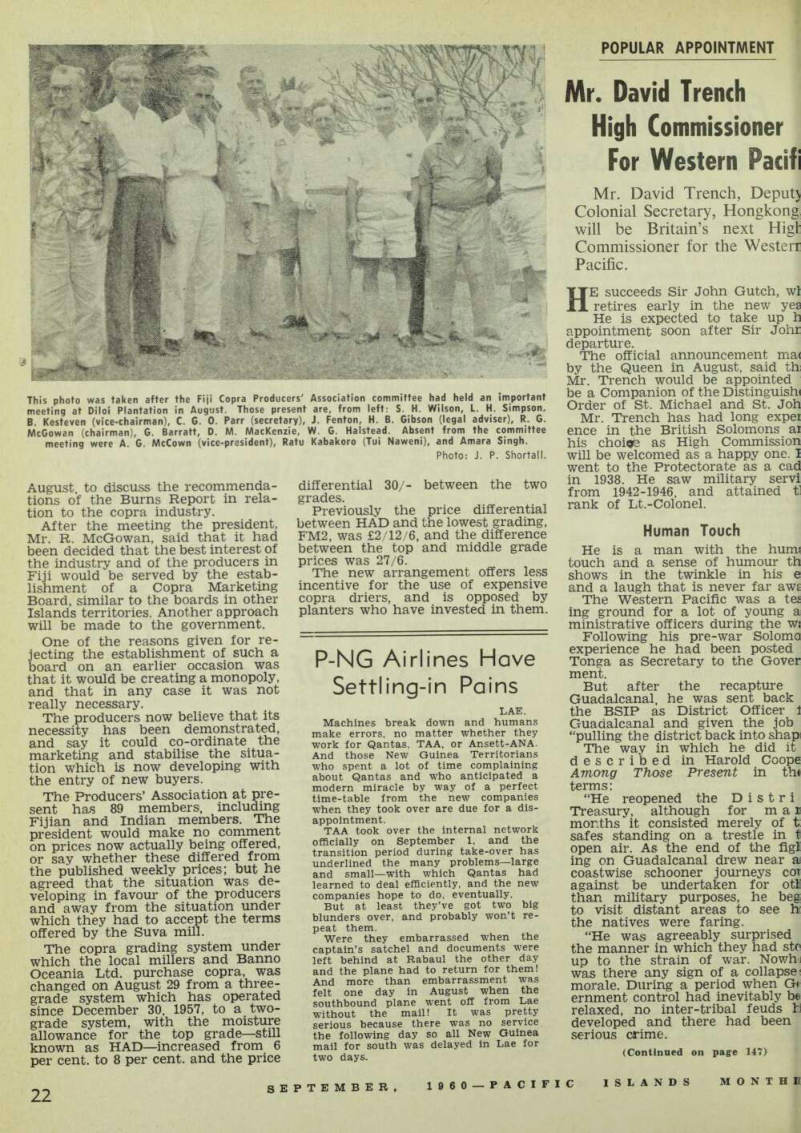
This photo was taken after the Fiji Copra Producers' Association committee had held an important meeting at Diloi Plantation in August. Those present are, from left; S. H. Wilson, L. H. Simpson, B. Kesteven (vice-chairman), C. G. 0. Parr (secretary), J. Fenton, H. B. Gibson (legal adviser), R. G.
McGowan (chairman), G. Barratt, D. M. Mackenzie, W. G. Halstead. Absent from the committee meeting were A. G. McCown (vice-president), Ratu Kabakoro (Tui Naweni), and Amara Singh.
Photo: J. P. Shortall.