[?]overnment "May Relinquish
p. 19 · Read in the full issue
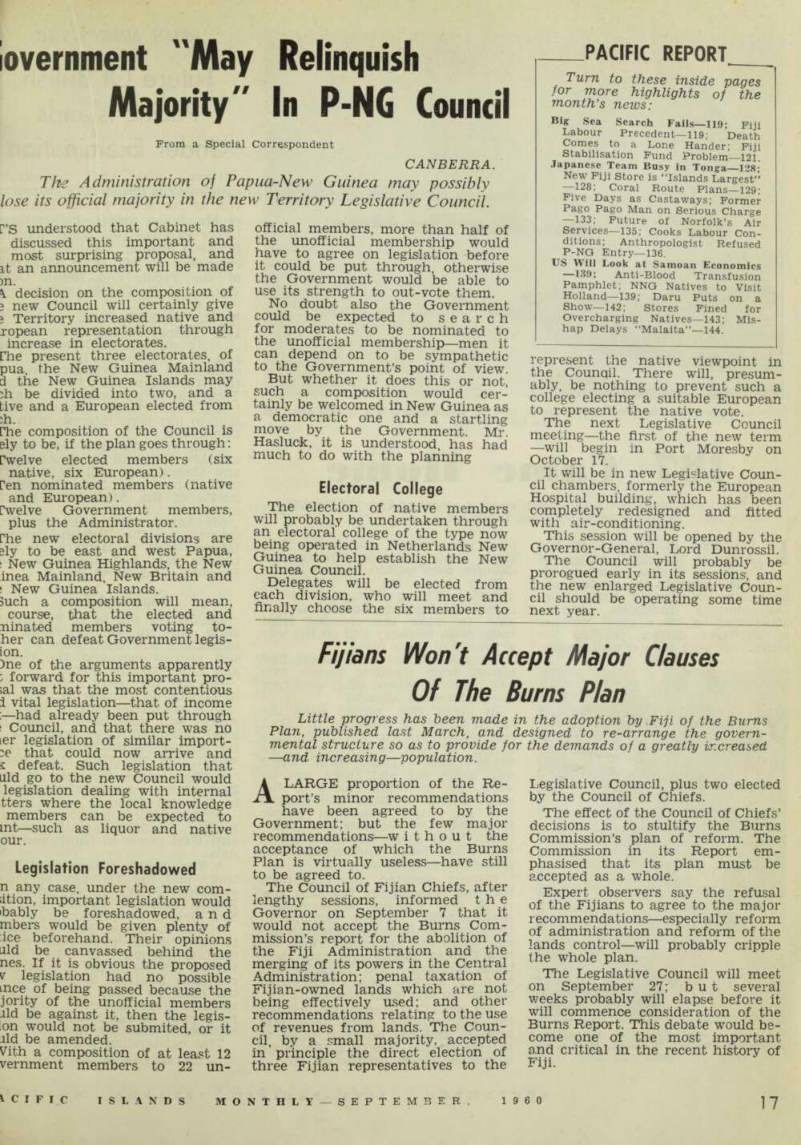
Majority" In P-NG Council
From a Special Correspondent
Canberra.
The Administration of Papua-New Guinea may possibly lose its official majority in the new Territory Legislative Council.
[”S understood that Cabinet has discussed this important and most surprising proposal, and it an announcement will be made m. \ decision on the composition of 3 new Council will certainly give 3 Territory increased native and ropean representation through increase in electorates, fhe present three electorates, of pua, the New Guinea Mainland d the New Guinea Islands may ih be divided into two, and a tive and a European elected from ;h. rhe composition of the Council is ely to be, if the plan goes through: Pwelve elected members (six native, six European).
Den nominated members (native and European). [Twelve Government members, plus the Administrator.
Dhe new electoral divisions are 3ly to be east and west Papua, ; New Guinea Highlands, the New inea Mainland. New Britain and ; New Guinea Islands.
Such a composition will mean, course, that the elected and ninated members voting to iler can defeat Government legis ion. )ne of the arguments apparently ; forward for this important pro ;al was that the most contentious i vital legislation—that of income ;—had already been put through i Council, and that there was no ter legislation of similar import -3e that could now arrive and s defeat. Such legislation that aid go to the new Council would legislation dealing with internal tters where the local knowledge members can be expected to mt —such as liquor and native our.
Legislation Foreshadowed
n any case, under the new com -ition, important legislation would hably be foreshadowed, and mbers would be given plenty of ice beforehand. Their opinions aid be canvassed behind the nes. If it is obvious the proposed v legislation had no possible mce of being passed because the jority of the unofficial members aid be against it, then the legis on would not be submited, or it aid be amended.
Vith a composition of at least 12 vernment members to 22 un
official members, more than half of the unofficial membership would have to agree on legislation before it could be put through, otherwise the Government would be able to use its strength to out-vote them.
No doubt also the Government could be expected to search for moderates to be nominated to the unofficial membership—men it can depend on to be sympathetic to the Government’s point of view.
But whether it does this or not, such a composition would cer tainly be welcomed in New Guinea as a democratic one and a startling move by the Government. Mr.
Hasluck, it is understood, has had much to do with the planning
Electoral College
The election of native members will probably be undertaken through an electoral college of the type now being operated in Netherlands New Guinea to help establish the New Guinea Council.
Delegates will be elected from each division, who will meet and finally choose the six members to
represent the native viewpoint in the Counqil. There will, presum ably. be nothing to prevent such a college electing a suitable European to represent the native vote.
The next Legislative Council meeting—the first of the new term —will begin in Port Moresby on October 17.
It will be in new Legislative Coun cil chambers, formerly the European Hospital building, which has been completely redesigned and fitted with air-conditioning.
This session will be opened by the Governor-General, Lord Dunrossil.
The Council will probably be prorogued early in its sessions, and the new enlarged Legislative Coun cil should be operating some time next year.