Pacific Commerce and Produce
pp. 159-161 · Read in the full issue
From Gold-Getting To Cattle-Farming
Ulolo Co.'S Service
To New Guinea
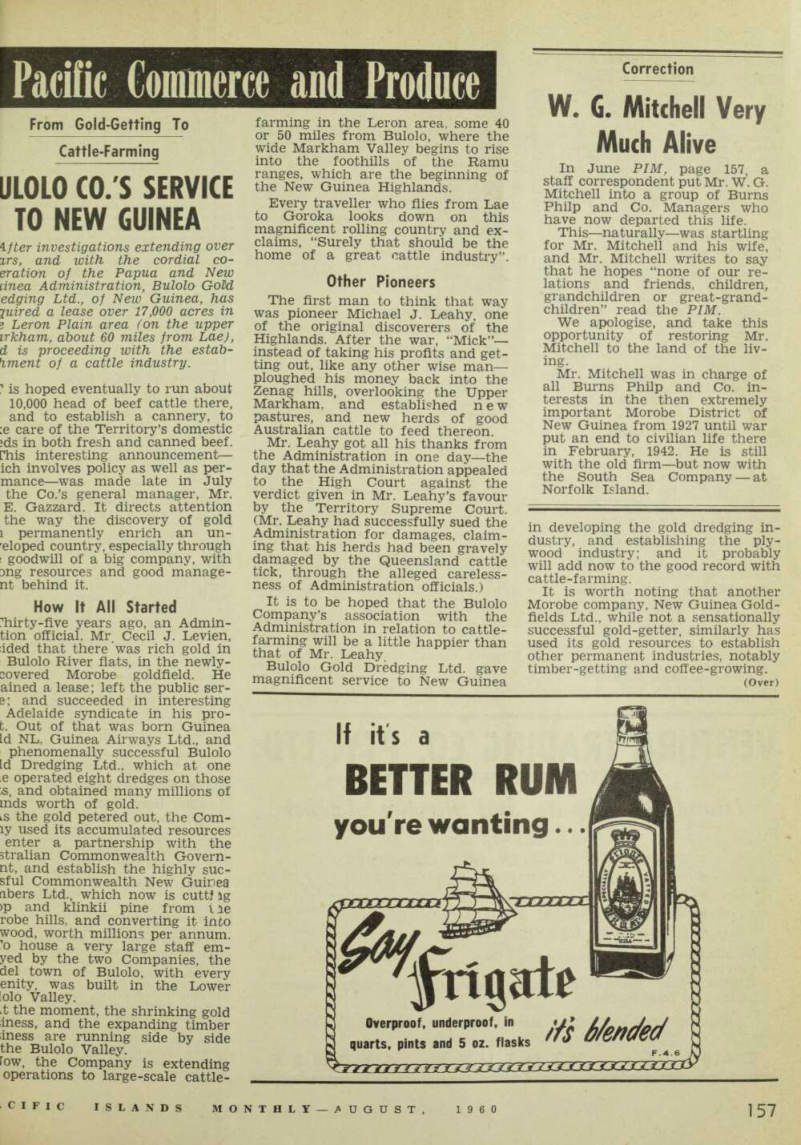
4 fter investigations extending over irs, and with the cordial co eration of the Papua and New linea Administration, Bulolo Gold edging Ltd., of New Guinea, has luired a lease over 17,000 acres in 3 Leron Plain area (on the upper irkham, about 60 miles from Lae), d is proceeding with the estab -liment of a cattle industry.
' is hoped eventually to run about 10,000 head of beef cattle there, and to establish a cannery, to :e care of the Territory’s domestic ;ds in both fresh and canned beef.
Phis interesting announcement— ich involves policy as well as per mance—was made late in July the Co.’s general manager, Mr.
E. Gazzard. It directs attention the way the discovery of gold i permanently enrich an un reloped country, especially through i goodwill of a big company, with eng resources and good manage nt behind it.
How It All Started thirty-five years ago, an Admin tion official, Mr. Cecil J. Levien, ided that there was rich gold in Bulolo River flats, in the newly covered Morobe goldfield. He ained a lease; left the public ser ai and succeeded in interesting Adelaide syndicate in his pro t. Out of that was born Guinea Id NL, Guinea Airways Ltd., and phenomenally successful Bulolo Id Dredging Ltd., which at one e operated eight dredges on those s, and obtained many millions of inds worth of gold. ls the gold petered out, the Com ly used its accumulated resources enter a partnership with the stralian Commonwealth Govern nt, and establish the highly suc sful Commonwealth New Guinea fibers Ltd., which now is cuttf ag >p and klinkii pine from lie robe hills, and converting it into wood, worth millions per annum, ’o house a very large staff em yed by the two Companies, the del town of Bulolo, with every enity, was built in the Lower 1010 Valley. .t the moment, the shrinking gold iness, and the expanding timber iness are running side by side the Bulolo Valley, low, the Company is extending operations to large-scale cattle
farming in the Leron area, some 40 or 50 miles from Bulolo, where the wide Markham Valley begins to rise into the foothills of the Ramu ranges, which are the beginning of the New Guinea Highlands.
Every traveller who flies from Lae to Goroka looks down on this magnificent rolling country and ex claims, “Surely that should be the home of a great cattle industry”.
Other Pioneers The first man to think that way was pioneer Michael J. Leahy, one of the original discoverers of the Highlands. After the war, “Mick”— instead of taking his profits and get ting out, like any other wise man— ploughed his money back into the Zenag hills, overlooking the Upper Markham, and established new pastures, and new herds of good Australian cattle to feed thereon.
Mr. Leahy got all his thanks from the Administration in one day—the day that the Administration appealed to the High Court against the verdict given in Mr. Leahy’s favour by the Territory Supreme Court. (Mr. Leahy had successfully sued the Administration for damages, claim ing that his herds had been gravely damaged by the Queensland cattle tick, through the alleged careless ness of Administration officials.) It is to be hoped that the Bulolo Company’s association with the Administration in relation to cattle farming will be a little happier than that of Mr. Leahy Bulolo Gold Dredging Ltd. gave magnificent service to New Guinea
in developing the gold dredging in dustry, and establishing the ply wood industry; and it probably will add now to the good record with cattle-farming.
It is worth noting that another Morobe company, New Guinea Gold fields Ltd., while not a sensationally successful gold-getter, similarly has used its gold resources to establish other permanent industries, notably timber-getting and coffee-growing. (Over)
Fmnpror Minp Produces A
tmneror mine rroauces a
Million And More To Come
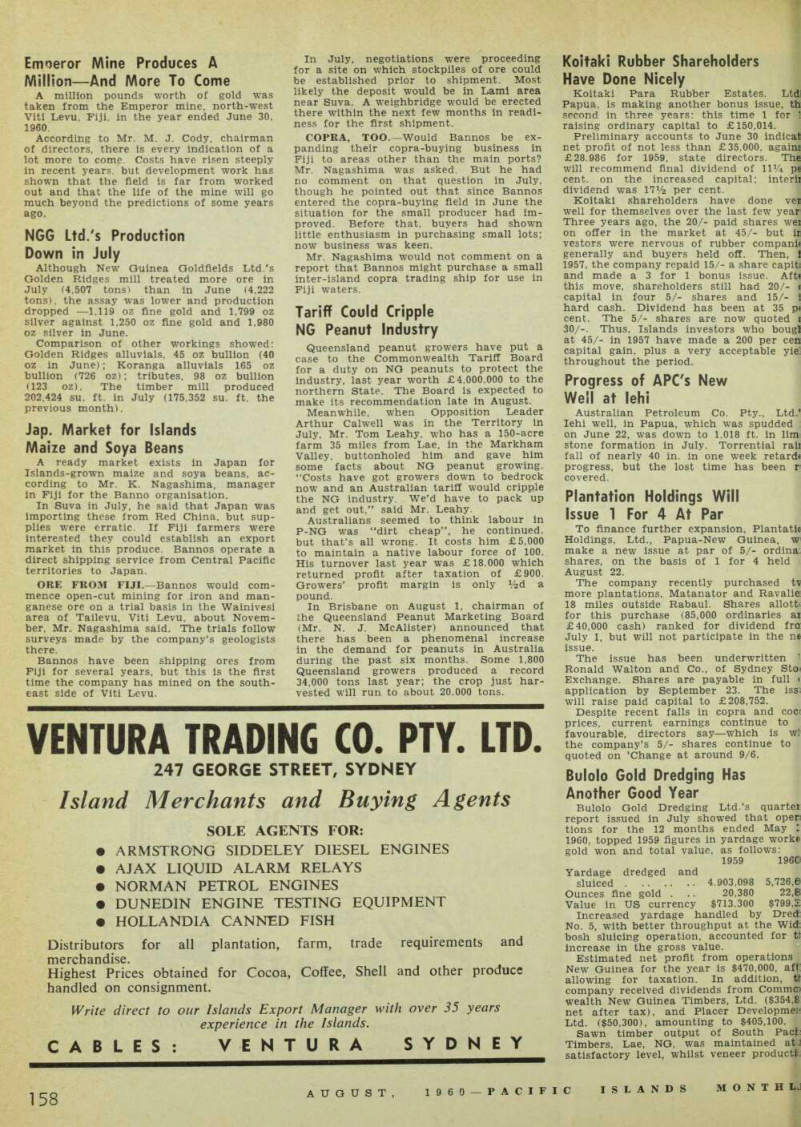
A million pounds worth of gold was taken from the Emperor mine, north-west Vitl Levu, Fiji, in the year ended June 30. 1960 According to Mr. M. J. Cody, chairman of directors, there is every indication of a lot more to come. Costs have risen steeply in recent years, but development work has shown that the field is far from worked out and that the life of the mine will go much beyond the predictions of some years ago.
NGG Ltd.'s Production
.’.j Down in July Although New Guinea Goldfields Ltd.’s Golden Ridges mill treated more ore in July (4,507 tons) than in June (4,222 tons), the assay was lower and production dropped —1.119 oz fine gold and 1,799 oz silver against 1,250 oz fine gold and 1,980 oz silver in June.
Comparison of other workings showed; Golden Ridges alluvials, 45 oz bullion (40 ? z J n alluvials 165 oz bullion 726 oz); tributes. 98 oz bullion J ? pr ° du ?® d 202,424 su. ft. in July (175,352 su. ft. the previous month). i__ m i, . r . i i Jap. iViarKeT Tor islands fWlalyp anfj C<iwa Dpanc . 26 I. BeanS . .
A ready market exists in Japan for Islands-grown maize and soya beans, according to Mr K. Nagashima, manager in Fiji for the Banno organisation.
In Suva in July, he said that Japan was importing these from Red China, but supplies were erratic. If Fiji farmers were interested they could establish an export market in this produce. Bannos operate a direct shipping service from Central Pacific territories to Japan.
ORE FROM FlJl.—Bannos would commence open-cut mining for iron and manganese ore on a trial basis in the Wainivesi area of Tailevu, Viti Levu. about November, Mr. Nagashima said. The trials follow surveys made by the company’s geologists there.
Bannos have been shipping ores from Fiji for several years, but this is the first time the company has mined on the southeast side of Viti Levu.
In July - negotiations were proceeding for a site on which stockpiles of ore could be established prior to shipment. Most likely the deposit would be in Laml area near Suva A weighbridge would be erected there within the next few months in readi ness for the first shipment.
COPRA, TOO.—Would Bannos be ex panding their copra-buying business in Fiji to areas other than the main ports?
Mr. Nagashima was asked. But he had no comment on that question in July, though he pointed out that since Bannos entered the copra-buying field in June the situation for the small producer had im proved. Before that, buyers had shown little enthusiasm in purchasing small lots; now business was keen.
Mr. Nagashima would not comment on a report that Bannos might purchase a small inter-island copra trading ship for use in Fiji waters,
Tariff Could Cripple
K]r D .
NG Peanut industry Queensland peanut growers have put a ca^e to the commonwealth Tariff Board for a duty on NG pea nuts to protect the indU stry, last year worth £4,000,000 to the northern State. The Board is expected to ma ke its recommendation late in August, Meanwhile, when Opposition Leader Arthur Calwell was in the Territory in July, Mr. Tom Leahy, who has a 150-acre farm 35 miles from Lae, in the Markham Valley, buttonholed him and gave him SO me facts about NG peanut growing.
“costs have got growers down to bedrock now and an Australian tariff would cripple the NG i ndus try. We’d have to pack up and get out .. said Mr Lea hy.
Australians seemed to think labour in p . NG was « dirt cheap”, he continued, b U t that’s all wrong. It costs him £5,000 to maintain a native labour force of 100.
His turnover last year was £lB,OOO which returned profit after taxation of £9OO.
Growers’ profit margin is only Vzd a pound.
In Brisbane on August 1, chairman of the Queensland Peanut Marketing Board (Mr. N. J. McAlister) announced that there has been a phenomenal increase in the demand for peanuts in Australia during the past six months. Some 1,800 Queensland growers produced a record 34,000 tons last year; the crop just har vested will run to about 20,000 tons.
Koitaki Rubber Shareholders
Have Done Nicely
Koitaki Para Rubber Estates. Ltdi Papua, is making another bonus issue, th second in three years: this time 1 for ] raising ordinary capital to £150,014.
Preliminary accounts to June 30 indicat net profit of not less than £35,000, agains £28.986 for 1959, state directors. The will recommend final dividend of 1114 pe cent, on the increased capital; interii dividend was 1714 per cent.
Koitaki shareholders have done ver well for themselves over the last few year Three years ago, the 20/- paid shares wei on offer in the market at 45/- but in vestors were nervous of rubber compani* generally and buyers held off. Then, i 1957, the company repaid 15/- a share capiti and made a 3 for 1 bonus issue. Aft* this move, shareholders still had 20/- ( capital in four 5/- shares and 15/- J hard cash. Dividend has been at 35 p< cent. The 5/- shares are now quoted i 30/-. Thus, Islands investors who bougl at 45/- in 1957 have made a 200 per cen capital gain, plus a very acceptable yie) throughout the period.
Progress of ARC'S New
Well at lehi
Australian Petroleum Co. Pty., Ltd/ lehi well, in Papua, which was spudded : on June 22, was down to 1,018 ft. in limi stone formation in July. Torrential rail fall of nearly 40 in. in one week retard* progress, but the lost time has been r covered.
Plantation Holdings Will
Issue 1 For 4 At Par
To finance further expansion, Plantatio Holdings, Ltd., Papua-New Guinea, w make a new issue at par of 5/- ordina: shares, on the basis of 1 for 4 held i August 22.
The company recently purchased tv more plantations. Matanator and Ravaliei 18 miles outside Rabaul. Shares allotti for this purchase (85,000 ordinaries ai £40,000 cash) ranked for dividend fra July 1, but will not participate in the ne issue.
The issue has been underwritten 1 Ronald Walton and Co., of Sydney Sto< Exchange. Shares are payable in full i application by September 23. The iss< will raise paid capital to £208,752.
Despite recent falls in copra and cocc prices, current earnings continue to favourable, directors say—which is wl' the company’s 5/- shares continue to quoted on ’Change at around 9/6.
Bulolo Gold Dredging Has
Another Good Year
Bulolo Gold Dredging Ltd.’s quarter report issued in July showed that open tions for the 12 months ended May I 1960, topped 1959 figures in yardage work* gold won and total value, as follows; 1959 1960 Yardage dredged and sluiced 4,903,098 5,726,© Ounces fine gold . .. 20,380 22,8 Value in US currency $713,300 $799,2 Increased yardage handled by Dred: No. 5, with better throughput at the Wi<£ bosh sluicing operation, accounted for tt increase in the gross value.
Estimated net profit from operations New Guinea for the year is $470,000, aft’ allowing for taxation. In addition, tt company received dividends from Comma) wealth New Guinea Timbers, Ltd. ($354,8 net after tax), and Placer Developmei; Ltd. ($50,300), amounting to $405,100.
Sawn timber output of South Pact; Timbers, Lae, NG, was maintained atd satisfactory level, whilst veneer products
creased. This greater throughput of neer in turn permitted production by 1G Timbers, Bulolo, to be increased dur j its fiscal year ended June 30.
Consolidated net profit of Placer De lopment, Ltd., and its subsidiaries is imated at $1,250,000 (48 cents per share) ■ the year ended April 30, 1960, re nted the company in July. This corn red with $1,152,000 profit last year.