Pacific Report
pp. 115-141 · Read in the full issue



Madang's Show Was Almost Aquatic
The month’s round-up of news and pictures of people and events, from PIM correspondents in the South Pacific.
By all the rules of the game, the Madang Show (July 9-10), should lave been a wash-out because it started raining late Saturday after loon and turned on something nighty like a cloudburst on Sun iay morning.
But when it comes to Agricultural ind Horticultural Shows, Madang ioesn’t let a few inches of rain spoil he fun. True, the sports programme >n Sunday afternoon was held on an >val dotted with small lakes and niniature canals, but that bothered lobody, least of all the competitors.
Madang has its own individual ouch about staging shows and hough its population is small com- Jared with a number of other Terri ory centres —somewhere around 800 Australians in the township and iround the adjoining district, and ,000 to 7,000 natives —it can rouse ip some mighty fine exhibits and un a Show programme with just he right quality of zip and zest.
Any other centre, for instance, ?ould find it hard to match the First *rize Group European Exhibit put n by Kulili Estates (Mr. W. M. liddleton). It occupied floor space f over 1,000 square feet and had verything from a model copra drier nd model cocoa fermentery to oultry, goats and a display of rchids which would have set the ead of any city florist spinning with nvy. If you want an answer to the uery about what New Guinea lantations can produce, drop in on ae Kulili exhibit next year.
The Ambenob Native Local Gov rnment Council carried off the First 'rize for a Native Group Exhibit, •onting its attractive thatch pavilion r ith an eye-catching 14 ft model anoe which would rate a place in ny museum, also demonstrations of ago making and the making of clay ots.
And to show that local skill is not limited to canoes, the exhibit also included a neat model of a coastal trawler.
But the real significance of the Council exhibit was in the wealth
of its produce. Everything edible was there, coconuts and cocoa, yams and bananas, rice, pumpkins and pawpaws and all the other fruits and vegetables that grow in the rich soil around Madang.
The Bogia Sub-District and Kar Kar Island, though handicapped by having to ship all their exhibits to Madang by sea, didn’t let that cramp their style, either. Kar Kar islanders had the bright idea of ex hibiting a scale model of the island complete with 6,011 ft Mt. Kunugui and a volcanic crater (which the tag described as the “second largest volcanic crater in the world”).
The Madang Association of Native Societies Ltd. also had a stand and, with a shrewd eye for business, mounted a trade store on one of its flat-top trucks and had a very nice Saturday afternoon’s trading out of the venture. (Over)
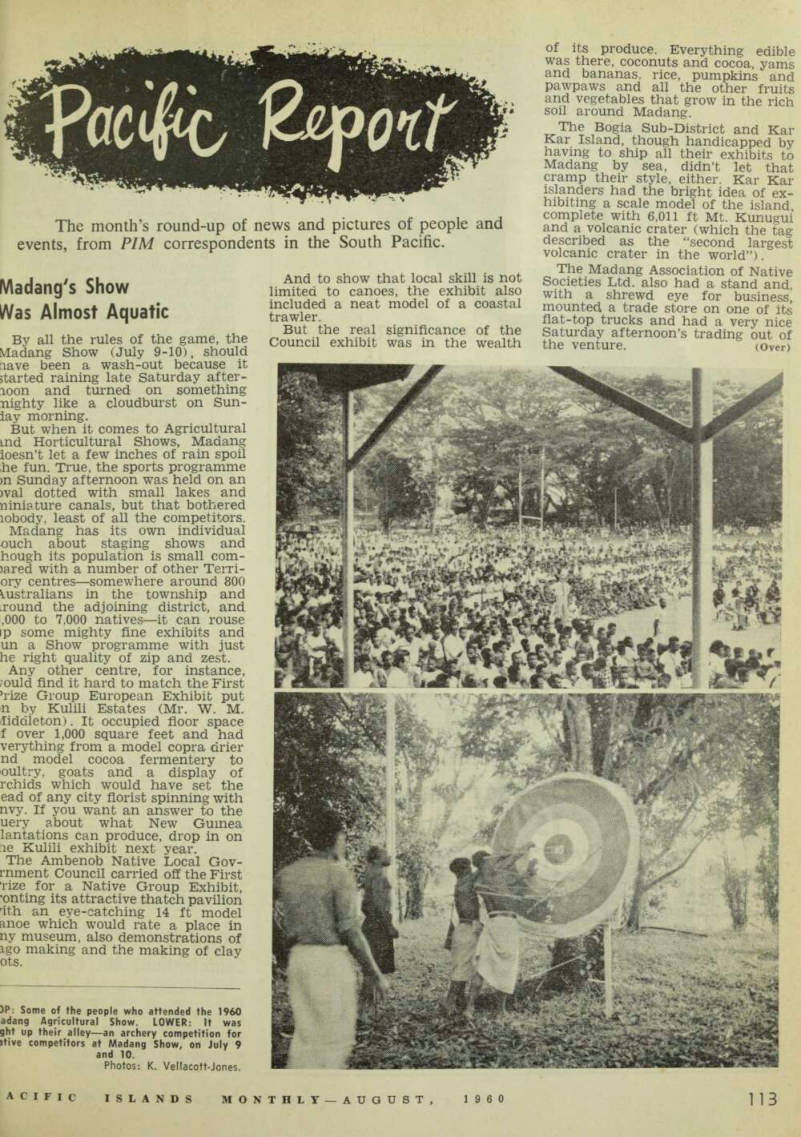
[?]P: Some of the people who attended the 1960 [?]adang Agricultural Show. LOWER: It was [?]ght up their alley—an archery competition for [?]ative competitors at Madang Show, on July 9 and 10.
Photos: K. Vellacott-Jones.
But the highlight of the whole Show was the Opening Parade and Choir Competition in which 20 choirs competed, with the Madang Girls’
Schools winning the Madang Cup.
Led by the Royal Papua and New Guinea Constabulary Band (its first Show-time visit to Madang), 600 school children in colourful school uniforms and each choir carrying its own banner, put on a first-class precision march, singing while they marched.
They , were followed by decorated commercial and two native floats, entered by Ambenob Native Local Government Council. One float de picted a Council meeting with the President hard at work convincing his fellow-councillors on some knotty point; and the second had a road building gang busy shovelling gravel and cement, and wielding picks and shovels with energy. —From P-NG Public Relations Office.
Only a Giggle For
Conscientious Mr. Calwell
After sitting up all night in a plane—one of the major discom forts of an air-trip to New Guinea —the conscientious Mr. Calwell, Federal Labour Leader, on July 23 went straight from the Lae airport to the Lae native market.
According to a Reuter report, he jplashed through puddles and large ireas of mud to shake hands and ;alk with “the milling native crowd”, le interrogated the various groups ibout how much they earned, how nuch tax they paid, and whether hey liked Australia.
Says Reuter: “He spoke to many lative women carrying naked babies, iut they only giggled and turned way when he tried to question hem.”
And again: “An 18-years-old r oman school-teacher came forward d shake the Labour leader’s hand, he told him in perfect English she arned £3/19/3 per fortnight, and ked her work very much. But she ouldn’t find any answers when Mr. alwell asked for her feeling on ;lf-government.”
And much more to the same effect.
One can imagine the thoughts f the experienced District Com dssioners who have to stand 'ound and listen while Australian Dliticians, with as much knowledge f native psychology as they have of le binomial theorem, treat New uinea natives as if they were jwspaper - reading, trade - union mscious Australian electors.
However, Mr. Calwell did have the lurage to lift his voice and declare
a new kind of art form—a non-competitive [?]ry in the Madang (NG) Agricultural Show, in [?], by Mr. G. Katahanas, a teacher at a local [?]ool. He said that it was experimental, but [?]variant of early Byzantine jewel mosaic", group is supposed to represent a native [?]ily of mother, father and child. The figures [?]drawb against a white background and [?] "filled-in" with pulverised brown glass that is brushed on.
Photo: K. Vellacott-Jones.
it New Guinea is incapable of f-government for a long time to ne , . . 30 years, he said in one ce.
e Other Side of
med Tahiti's Glamour
■ravel folders, irresponsible writers, i “shorts”—all present Tahiti as ! of the most desirable and ex ng places in the South Sea inds. There almost always is de ted a very comely young lady, h a beckoning eye and a hula pe. hat is one side of the picture, e is another. We quote from a ort made to the Legislative As ibly of the Cook Islands by its ief Medical Officer, in June. Cook inds, a New Zealand Territory, rahiti’s’ nearest neighbour; and, i Tahiti, the Cooks are occupied an attractive branch of the ynesian race. lie CMO told the Assembly that re has been a disturbing increase venereal disease in the Cook inds, and it seemed probable that is being spread by cases from liti, with which there is air and communication. The report Is: [f there is no improvement, the O will recommend that all sengers and crews of ships com from Tahiti be medically ex ined.”
'ahiti will not like that! ■he CMO added that probably all
leprosy cases remaining under treatment at the special centre on Aitutaki Island, in the Cooks, would be discharged this year. There has been much improvement in the situation; but there were reasons for believing that an infected house, as much as an infected person, could be a source of new cases.
Mr. Nevill To Retire from Cl
Mr. G. Nevill announced at the Cook Islands Legislative Assembly in June that he will retire early in 1961 from the post of Resident Commissioner.
Mr. J. M. McEwen (New Zea land Secretary of Island Territories), who attended the session, referred to the progress made during Mr.
Nevill’s administration.
“It is a long time since one Resident Commissioner has spent nine years in the Cook Islands,”
Mr. McEwan said. “In that time there have been plenty of worries and anxieties, but no other nine years have shown such progress.
The Cook Islands people in time will realise how much they owe this Resident Commissioner. He hasn’t been able to do all he wanted—the Department and the Treasury (in Wellington) have often said, ‘no’.
“However, he can leave with the satisfaction of a job well done, and the knowledge that there has been greater progress during his term of office than at any other time.”
Copra Brings Tonga
£ll Millions P.A.
The Tonga trade report for 1959, just published, shows an increase in copra exports from 13,834 tons worth £1,031,265 in 1958 to 15,901 tons worth £1,558,075 last year.
The tonnage fluctuates with climate, and 1958 and 1959 were not good years. The production level was 27,332 tons in 1957, and 18,796 tons in 1956.
Of last year’s exports, 8,300 tons were shipped away from Nukualofa, 4,618 tons through Vavau, and 2,983 tons through Haapai. Total export duty collected amounted to £155,808 on a total f.o.b. export value of £1 558,075.
The Premier, Prince Tungi, watches his little kingdom’s copra production very jealously. He refused
Tupou (Manu) Taunaolo, the Fiji Visitors Bureau rep resentative who holds the im portant Nadi Airport post, re cently visited New Zealand as a guest of the New Zealand Holiday and Travel Associa tion. He is seen here at a function at a conference at Brents Hotel, Rotorua.
Photo: John Scott Studios, Rotorua.
to tie it to any of the big concerns which would like to purchase Tonga’s whole output. Instead, he always is seeking new ways in which to Tonga’sereater Srofit Tonga ’ to longas greater pront.
Tonga’s total exports in 1959 were rh°e rt^domTeconX a d ° minateS ? liry x „ . 17?nnn a pa Lc^?'? iSS? wSSvJm?? 1 o?7 172,000 cases of them, worth £215,314.
The Tongan farmer will try anything on the NZ consumer—the year’s figures show the export, from Tonga to NZ, of fruit-juice (£7,732), fungus (£9,958), water -melons (£6,776), pineapples (£939), peanuts (£81).
ij p af J: n Ctatmn NCW KdUlO JidTiOn r Pitcairn ror * ITCalin Pitcairn Island should have gre atly improved radio communications facilities with the outside world by the end of the year.
Although the Pitcairn Groui>only the one island of which is permanently inhabited, the others being Ducie. Henderson, and Oeno —comes under the direct control of the Governor of Fiji, all radio con tact is at present via Rarotonga (Cook Islands) and even then there are often occasions when contact cannot be established over the 1,900 miles separating those two points.
During the war years, the Roya New Zealand Navy established ; fairly powerful morse transmitte at Pitcairn and staffed it. At thi end of the war this station wa available for the use of the island But the island had no trained tech nical staff capable of maintainim the station, and the amount of radii traffic did not warrant the expens of hiring overseas staff. So tha station was left idle and a mud smaller and simpler marine-typ transmitter was purchased. It hat a power of only 50 watts.
Since then a young Pitcairnei Thomas C. Christian, has traine in radio with the NZ Post an Telegraph Department and serve: as a radio officer in Union SS Cc vessels. He is now to return to th island to install and man a 250-wat modern station, as the Navy static; is now obsolete.
In July, Mr. Christian was in Fi discussing some of the Island’ peculiar problems with the Fiji Gov ernment, to assist in choosing th sort of equipment best suited fc the job. The new transmitter shoul, be able to maintain reliable contac with Suva, 3,000 miles away.
Thomas Christian is one of Pit cairn’s two licensed radio “hams’
His call-sign is VR6TC. The othe licensed station—Vß6AC—is owne: by Mr, Floyd McCoy, who latell has been visiting the United State: The new Pitcairn station will b 90 per cent, financed by a Colonis Development and Welfare Fum grant.
Mr. D. Lopian, merchandising manager for t[?] Gilbert and Ellice Islands Wholesale Societt who paid his first visit to Fiji recently Wh[?] the Society's vessel "Tungaru" made a tr[?] purchasing voyage to Suva. Mr. Lopian tou over his present post four years ago. Til CWS serves as buying agent for about 30 c[?] operative societies throughout the colony.
t More Money For
ok Is. Broadcasts
Jroadcasting hours have been bi ased from one to two hours per 3k in the Cook Islands recently, i this may extend to four hours, t any organised scheme of educa lal broadcasts, as recommended the Stace-Belshaw Report several rs ago, must be further delayed, ause “there are other more press priorities for government funds”.
Tie Rarotonga station operates 4965 kc/s, in the 60-metre band, m 6 p.m. to 8 p.m, on Wednes rs, local time. This is equal to 0-0630 GMT, Thursdays.
sanese Research
erest in Tonga
. Japanese university professor I six students arrived in Nukua i, Tonga, in July, aboard the :ean ship Pusan.
'he team, from Kyoto University, leaded by Professor Yabuuchi, a ogist, and it will carry out re rch into the animals and plants Ponga. The group left Osaka on ie 10, and will be in Tonga until Member. he University sought permission send the expedition when Prince igi was in Japan last year; and request was subsequently roved by the Tonga Govern it.
port Construction
Pago Pago
n American ship was in Pago o at the end of June discharg further construction machinery be used on the Tafuna Inter lonal Airport job. The latter is pressing steadily, if slowly. he latest consignment of equip it was said to have come from ronesia, where it had been used the American nuclear bomb-test nds.
More and More Children:
An Embarrassment
Within six years, according to the officials, the number of children in the Cook Islands demanding school facilities will have doubled.
In Rarotonga alone there will be a demand for 46 new classrooms and 42 more teachers.
The Administration is biting its finger-nails and insisting that the provision of more public funds for more schools and teachers is very, very difficult.
It is a familiar pattern, repeated ad nauseum in practically all the South Pacific Territories. (Over)
New Guinea High ds' answer to the [?]ive housing problem, [?]se two houses, on [?] Snow McFarlane's [?]apeve Coffee Estate, side of Goroka, are [?]de of big, river [?]hed stones, cemented [?]ether, and with [?]tched roofs. The [?]ises are neater and more durable than local bamboo and [?]ss variety, but one rateful inmate, when [?]ed how he liked [?]m, said that they [?] "cold too much" at night.
What a change from 40-50 years 3. when practically every official every Territory told a story of indling population and native in ference to life!
stable Co-op. Effort
Cook Islands
r orty-five co-operative societies re been established in the Cook mds since the first was organ i in 1955, and there has been cancellation. >f the 45 now registered, 27 are age societies of the thrift and a type; there is one consumer iety; two processing and market societies, 14 school savings .eties; and a co-operative union ch is the bank for all the other eties. he processing and marketing eties increased their export is to £ll,OOO last year, as corn ed with £4,000 in the previous r. The holdings of the savings eties rose from £ll,OOO to £19,000. erne 230 loans, of a total value of 15, were made to members dur the year, mainly for house ding.
Planes Are Back
Lae, NG
ameras clicked and some eyes e even wet when Qantas said i-bye to New Guinea early in . Captain Ross Christianson took last DC4 out of Lae to Sydney; Captain J. G. Morton, who flew first DC3 from Sydney to Lae n Qantas began its Bird of idise service on April 2, 1945, ; the last Constellation out of ; Moresby it it was a case of “the King dead —Long live the King”, because Lae people were to see the big planes back, this they thank Mr. Reg. stt who said he’d put Lae back :he map—and did—by deciding in the DC6’s through to termin there instead of Port Moresby.
Vlien Qantas introduced Super stellation aircraft to the Bird ’aradise Service 18 months ago, terminated at Port Moresby use Lae was unsuitable for these 'aft. A shuttle service with nasters operated from Port esby to Lae], big crowd gathered at the Lae linal to welcome TAA’s first t in on July 10 —a real test on iden slippery strip—and watched interest as the big ’plane, after larging passengers, went through paces of take-offs and landing. isett-ANA was similarly welthe following Tuesday, iring the first week of July, TAA ■ some of the local residents * first taste of inter-Territory surised travel when they were
invited to accompany Sir Giles Chippindall (Australian Director- General of Posts and Telegraphs and a member of Australian National Airlines Commission) and his party on an “evaluation and goodwill flight” from Lae to Madang and Goroka, in a Fokker Friendship air- TAA had intended flying the Friendships from Port Moresby to Lae, as Qantas has flown Sky masters, but when Ansett decided to terminate the DC6 service at Lae, TAA followed suit.
It is now for TAA to decide whether or not to put the Friend ships on the internal services—and Territorians who feel that they have had their share of DC3 freighter travel, hope that they do.
The evaluation flight continued on to Rabaul and back to Port Moresby where Sir Giles said that the trip had been of great value.
The flight from Lae followed the Markham Valley and across the range to Madang. At Goroka a huge crowd welcomed and inspected the ’plane. And, as the photograph shows, some of the spectators inspected the TAA party, too.
Cook Islands Can
Show Fiji How
Political and material progress in the Cook Islands in recent years was described by the Resident Com missioner. Mr. G. Nevill (who is to retire early next year) at the third annual session of the Cook Islands Legislative Assembly, in June.
Mr. Nevill said that there is now an unofficial majority of 22, com pared with only four official mem bers in the Assembly.
“This places the Cook Islands in a unique position among dependent Islands territories,” he said.
“Although Fiji raises the bulk of the money required by government from local taxation, Fiji is still governed by an official majority.”
The average annual value of Cl exports over the last ten years has been £400,000, whereas in the im mediately preceding ten years the average was £llB,OOO. Export values for 1959 rose by £94,000 over the previous year.
“New Zealand is doing far more for the Cook Islands on a popula tion basis than any country, includ ing Great Britain,” said Mr. Nevill.
“Even progressive Western Samoa spent a total of only £459,174 last year on health and education, or approximately £4/10/- per head of population, compared with New Zealand’s £288.570, representing £l6 per head of population.”
N. Caledonia's Viet-Namese
Choose The Reds
Viet-Namese in New Caledonia had only until July 22 to decide whether they wished to return to South or North Viet-Nam, or re
July was change-over month in Papua-New Guinea aviation (see story this page). These two photographs were taken during the time Qantas was bowing out, and Ansett-ANA and TAA were bowing in.
At Right: Air
hostesses meet their first native baby. BE LOW: A New Guinea Highlander meets his first Knight—Sir Giles Chippindall.
Photos: Pat Robertson.
main in New Caledonia; and it believed that the majority chose 1 return to North Viet-Nam (Con munist). They have been heavii buying portable goods, sheet blankets, footwear, etc.
It would seem that in leaving tH announcement of the rec e n “accord”, signed at Hanoi betwee France and North Viet-Nam, to tl New Caledonian government, Frani wishes to dissociate herself fra the affair. In this way, any objectic which South Viet-Nam might mal could be handled.
More Internal Air
Services For N. Caledonia
New Caledonia’s internal air-lir Transpac, has doubled its capit: (now at 16 million francs, £80,000) and is to buy another plai —a De Havilland Heron.
The company already runs Heron, which is its chief work-hors Two De Havilland Dragons are al. in the service of Transpac.
It is hoped that in the near futui the company will extend its actf ities in New Caledonia. At preser most of its efforts are confim to services to the Loyalty Islam and the He of Pines, with one se vice to the west coast of Ne Caledonia.
Main hold-up has been lack suitable air-strips in New Caledon country districts. Existing strips ai suitable only for very light plane However, the civil aviation depar ment in New Caledonia has ai nounced plans to expedite construi tion of strips long enough to tal Transpac’s planes.
Extension of Transpac services the picturesque east coast of Ne Caledonia would be of benefit to tt tourist industry.
A 650-Page
Samoan Dictionary
Pratt’s Grammar and Dictiona of the Samoan Language —first put lished in 1862 and long out of prii —has just been reprinted by t; Malua Printing Press in WesteE Samoa.
It is of interest to students the Samoan language in that contains many old Samoan won now not much used.
The book contains over 650 pag? is well bound and costs £S.3.
Orders should be sent direct to tl publishers with sufficient added t overseas postage.
Norfolk Island is
Still Shaking
In late July, Norfolk Island w still feeling occasional earth tremo. following a quake that was felt the island on May 20.
The May movement was dee seated and located about 130 mil
th-east of the island. It caused ut five tremors immediately on folk, bringing down some water ks, cracking windows, and doing ticular damage in the Adminis ion building at Kingston, which onvict built. wo chimneys on the main build had to be completely demolished i safety precaution, orfolk’s Acting Government retary, Mr. John Powell, esti :ed that about £l,OOO worth of iage had been done to Norfolk perty all told. orfolk is well out of the earth ke fault line and tremors are are occurrence.
Mystery Flare Sighted
By "Tulagi"
A mystery flare burning on the sea puzzled the officers of Burns Philp’s Tulagi on July 19.
The flare, of the type that auto matically lights on contact with the sea, was sighted from several miles off about 7 p.m., when the vessel was about 60 miles out from Sydney en route for Norfolk Island.
Tulagi circled the area on the lookout for any small ship in dis tress, but found nothing. It reported the presence of the flare to other shipping, but there was no explana tion forthcoming. One possibility
may have been that it washed over board from a passing foreign ship.
Flares of the type can burn for four or five hours.
Educational Facilities
Improving in Fiji
Since the end of the Second World War, substantial progress has been made in providing facilities for basic education in Fiji.
The Education Department’s re port for 1959 shows that whereas only 14.1 per cent, of the total popula tion was attending school in 1946, the figure had risen to 20.6 per cent, by 1959.
The total school roll increased by
[?]n the mid-thirties, Australian [?]iter and zoologist, A. J. Marshall, [?]ote an excellent hook about the [?]w Hebrides which he called “Black [?]sketeers”. [?]his photograph, taken over 20 [?]rs later, shows that they still [?]st. On the other hand, and while [?] rest of the brown and black [?]rld is clamouring for self-govern [?]nt and independence; or more [?]eign aid; or more health, educa [?]and social services; nothing [?]re is heard from the New [?]brideans now than when Marshall [?]te his book. [?]he odd thing, perhaps, is that [?]st residents of the Hebrides, mch, native, British and others [?]ld probably think twice before [?]y disturbed the status quo. [?]his old musketeer, shown here, [?]ulates he is about 90, though his [?]mory is now admittedly poor. He [?]nt to Queensland to work in the [?]ar industry about 1890. He bought musket, a Snider, at McDonald's [?]e at Havannah Harbour and says [?]t with it he shot at the first [?]sionary who landed there.
Photo: Reece Discombe.
)9.8 per cent, over the period, as gainst a population increase of 44.2 sr cent.
In 1959, 2,351 teachers were em oyed, of which 1,799 were in gov •nment service and the remainder l non-government schools.
The situation is, however, still far om satisfactory. The report shows lat there was an estimated short ;e of 121 teachers in Indian schools, 1 in Fijian schools.
Government expenditure on educa on rose from £123,000 in 1946 to ~015,000 in 1959.
Of the 568 schools in the Colony . 1959, only 37 were government vned, but 487 others were financi ly aided by the government. These ere owned by 17 private or Mission ■ganisations.
lore Samoan
ananas For N. Zealand
There has been improvement in imoan banana exports to New aaland, due mostly to greatly in eased production on the island of rvai’i, whose share in the total mana shipments overseas in eased from 27 per cent, to 55 per mt.
Up to July 9, a total of 269 769 ises of Samoan bananas had been lipped this calendar year, and it believed that the total for 1960 >uld reach 600,000, compared with ie record 800,000 cases shipped in 159.
From September on, three earners per month will lift the ■uit, as against the two monthly a-rriers at present.
More Drunks and
Hooligans In Fiji Now
Even allowing for the steady in crease in population, the crime rate in Fiji is increasing even faster according to the Police Report for 1959, recently published.
Insufficient police is given as one reason for this, (The situation has improved somewhat since the report was written).
Though murders and attempted murders dropped from 32 in 1958 to 24 in 1959, even this figure was con sidered to be alarming in a country with a population of less than 400,000.
Most of these crimes took place in country districts, especially in north-western Viti Levu, “where a general atmosphere of fear prevails in some areas of Indian settlement.”
There is intimidation and lack of confidence in the police in such areas, with the result that crimes are often not reported, and when reported are more difficult to detect.
In Suva, there was a marked in crease in the incidence of hooligan ism (the report covered the period of strike violence) not directly re sulting from liquor; and in the last four months of the year there was also a marked increase in drunk and disorderly cases.
The removal of restrictions on the sale of beer in 1958 had not shown any immediate increase in such crimes.
The police are still seeking a sub stantial increase in manpower. (Over)
Santa Gertrudis Improve Fiji Cattle Industry
As the result of the importation of four valuable Santa Gertrudis bulls from Australia in [?]55, and 10 heifers of the same breed from the United States in 1958, the Fiji Department of [?]riculture is making important progress in improving the strain of beef cattle in the colony, [?]e production of more beef cattle for local consumption is one of the leading recommendations the Burns Report published this year.
The Santa Gertrudis are now being crossed with Zebu and other strains and the improvement the resulting progeny under Fiji's tropical conditions has been very marked. The Colonial [?]gar Refining Company has been working closely with the government in the project.
Santa Gertrudis bulls are currently worth up to £4,000 in Australia, where the King Ranch Texas introduced them some years ago. —Dept, of Agriculture photo.
jps Versus Koreans
i Pago Pago Dispute
Travellers from American Samoa early July reported that the ipanese fishing vessels supplying na to the Van Camp cannery at igo Pago had ceased operations, ie to a dispute.
The dispute was said to be associ ed with the engagement of South orean fishing vessels, also to supply e cannery.
To protect its own extremely valu ile tuna export trade to the United ates, the Japanese Government nits the annual tuna catch by a iota system.
On last advice the quota of fish lich Japanese vessels could supply the American-owned Pago Pago nnery was 12,000 tons per annum, m Camps wanted more fish, so ice 1958 they have engaged some Iditional South Korean vessels to pply the extra amount. It now ►pears that the Jananese a v e try g to prevent this' extra delivery fish.
It is unlikely that South Korea uld supply anything like enough ssels to deliver all the fish re ared by the cannery, so the Jap- Lse are in a strong negotiating ►sition. They are the only people
with the know-how and equipment to do the job.
The Japanese fleet at Pago Pago is supplied under contract by a Tokyo organisation; but the boats actually have many different owners.
Each boat-owner is paid for the fish actually delivered to the cannery, the price varying with variety, on a non-cure no-pay basis.
The Pago Pago cannery-owners have also tried to encourage fishing by local interests. One rather un satisfactory local trading craft was fitted out but, partly due to lack of finance and perhaps more due to lack of know-how, has not been very successful. This boat appeared to be laid up in July.
War on Fiji's
Rhinoceros Beetle
The campaign initiated against the rhinoceros beetle on the island of Moturiki by the Fiji Coconut Pests Board, as soon as the presence of the beetle was discovered, has been proceeding vigorously.
Everything on the island (which contains four square miles, and lies between Viti Levu and Ovalau) likely to provide the beetle with a breeding-place has been systematic ally destroyed, and employees of the Board, assisted by the Moturiki islanders, have climbed thousands of
alms and sprayed the crowns with isecticide.
Little more can be done, short of itroducing a predator; and a de mdable predator against the rhino ;etle has yet to be found, although ientists still are searching the opical world for one.
Every known method of attack id eradication has been employed r the Fiji Government since the ietle was discovered at Lami, just ;st of Suva, in 1952; but the pest ls spread slowly through the coco it palms in the southeast of Viti ivu. There is much casual traffic tween the east coast and the arby islands of Ovalau and Motu fi; and the appearance of the pest . Moturiki, while deplorable, was it surprising.
The record of Viti Levu since 1952 ows that the pest can be in some gree controlled by constant watch- Iness and attack, but cannot be adicated.
ore Work For
le Fire Brigade
A. native who used a hurricane np to see if the tank of a jeep re full when filling it from a drum; d accidents to two war-time ics in Lae, NG, in July, provided Tk for the local fire brigade, der Chief Fire Officer Ed. Siggs.
Flames from the top of the hurri ae lamp which the native used lited the petrol fumes and a fierce e blazed in the tank of the jeep, blanket was placed over the mth of the tank by the fire officer, d this smothered the fire.
H Voco Point an old barge be iging to New Guinea Industries s being cut up for scrap when 7 torches ignited a large quantity petrol which had been left in the
fuel tank. Large columns of smoke and fire shot into the air and threatened many small ships anchored close by. This fire was brought under control by smothering it with foam.
At Goudie’s warehouse in Milford Haven Road, Lae, several native workers almost choked when the cap of an old war-time cylinder was removed to see what it contained.
It contained a yellowish-green coloured gas, believed to be the poisonous chlorine type, which wafted through the premises, affecting the five natives working there.
Fire Officer Siggs, when called, used a gas mask before entering the building, but Sub-Inspector Paton, who followed him was almost overcome by the fumes. He was taken to hospital and treated with oxygen.
The fumes removed plating from coins and brass on the uniforms of the police, and was smelt hundreds of yards away from the warehouse.
The cylinder was later buried safely and two other cylinders from the warehouse were similarly treated.
D«! f rans Lonterence brumes c KaM/k L rrencn racitic Development Late in July, there was proceeding, in Paris, an economic conference to consider the future welfare and development of the French Possessions in the Pacific—notably, New Caledonia, French Polynesia and the New Hebrides.
Those attending included Messrs, Pechoux (French High Commissioner in the Pacific), Kauma
(vice-president of the Government Council in New Caledonia), Ohlen (President of the NC Territorial Assembly) Lenormand (Deputy for New Caledonia) and Senator Lafleur (New Caledonia).
It was reported that the confer ence was examining a Five Year Plan to provide better sea and air communications, development of the tourist industry, exploitation of the iron, nickel and chrome deposits in New Caledonia, encouragement of agriculture and deep sea fishing, in tensive prospecting in New Hebrides to ascertain the mineral resources of the group with special attention to manganese,
NIG flub
Vjuu
Reams 20th Year
The New Guinea Women’s Club of Sydney, originally intended as a war time focal point for Territorians who had been evacuated to Sydney, has now completed its 19th year of existence. And after the annual general meeting in July, Mrs. M. L.
Foxcroft was re-elected for the 14th year in succession as President.
All other office-bearers of last year were also returned unopposed—a cosy sort of arrangement which makes for the smooth running of any organisation, The President’s report for 1959-60 showed that the Club had had its usual successful and useful year, and through good housekeeping, had finished it in a sound financial posi tion.
Weekly meetings and special
A photograph of five generations of a Papuan family of Yule Island appeared on page 8, June "PIM". This photograph, sent in by David T. Toutaiolepo, shows five generations of a Tongan family of Pangai, Ha'apai Group.
From left to right: Mrs. Malia Ma'ukavakimu'a with her daughter, Mrs. Sapate Afeaki; her grandson, Mr. S. Pousima Afeaki (son of Mrs. Afeaki); her great-granddaughter, Mrs. Vika Folau (daughter of Mr S. Pousima Afeaki); and great-great-granddaughter, Siosiana Folau (three months old infant, daughter of Mrs. Folau).
Old records of the Catholic Mission in Tonga show the old lady was born on October 24, 1867, at Lapaha, Tongatapu. Her parents moved from Tongatapu to Ha'apai, while Malia was a child, to take charge of the Catholic Mission there. Malia grew up and married a Ha'apai man, and has remained there all her life.
The daughter, Mrs. Afeaki, is 73 years old; S. Pousima Afeaki is 46 years old and is a well known lawyer in the Kingdom, and a representative member for Ha'apai in Tonga's Parliament.
unctions continued to be held at tie Feminist Club Rooms, 77 King treet, Sydney, although early in le period a threatened substantial ise in rentals made the situation isecure.
The continuing rise in costs of all jrvices, rents, etc., is a source of ncertainty to many small organ ations. such as the Women’s Club, hose revenue is derived from mem os’ subscriptions and from dona ons.
Officers-bearers, 1960-61, will be: resident, Mrs. M. L. Foxcroft; ice-President, Mrs. J. Edwards; reasurer, Mrs. H. Carr; Secretary, tiss V. Thwaite; Committee, esdames J. Whiteman. N. Laws, A. reen, C. Bennie and L. Clark.
Mrs. H. H. Page has again agreed be Patroness of the Club.
rowth of Disorder,
rime in W. Samoa
Crime in Western Samoa has in eased alarmingly during the past w years. This is shown by Police e Court records.
The records show much dis mesty, like thefts, burglaries, rgeries, etc., and also crimes of alence, and offences caused by the cessive consumption of home ade liquor, and home-brewed beer tie potent “Fa’amafu”).
High Court Judge Marsack has st imposed ten years’ imprison ent upon a young Samoan for anslaughter—he had been charged th murder. He and companions, wling drunk, were passing through e village of Falefa; and the village ief and his son protested strongly ainst the noise. There was a fight, id the hoodlums killed the chief id injured his son.
A war between factions in the lage of Vaipuna ended in a battle, lich lasted for hours. The Court ntenced a faction leader to six mths’ gaol for disorderliness, and villagers to six weeks.
The Samoa Bulletin of July 22, mmenting on the growing law ;sness, said: “European and Samoan planters e suffering very appreciable losses Dm thefts of their products and some cases have to patrol their mtations day and night to protect eir properties.
“Only recently cases have become town where, over long periods ousands of pounds worth of goods d produce were systematically )len by organised gangs of em- Dyees and workers; where cheques sre forged by office employees; id where traders in outside dis cts have absconded with large lounts of their employer’s cash.” pie Police Department seems un le to cope with this ever-increas g crime-wave—there is not suf :lfnt personnel available to con- Dl the people and prevent offences,
particularly in the districts outside Apia.
One contributing factor may be that prisoners at Tafaigata prison, near Apia, are pampered—they are extremely well fed and do very little hard work, so that a prison sentence really is no deterrent.
The various churches in the Terri tory seem unable to influence their adherents against crime and the matai system offers no solution.
This is a depressing commentary upon the preparations being made to give national independence to Western Samoa.
Crocodile Horrors In
Papuan Swamps
Two rogue crocodiles believed to be responsible for eight native deaths in the Marshall Lagoon area of Papua, near Port Moresby, in the last two years, are still evading capture, reports Reuter.
One crocodile is reported by natives to be more than 16 feet long.
An administration Fisheries Division officer, Mr. Andy Quinlan, said the 16-footer had killed five people. In the most recent attacks, it sank a canoe and carried off a young girl, and attempted to snatch a woman from a native lakatoi.
This month (August) Mr. Quinlan is attempting to net or shoot the crocodiles.
200 Lopevi Natives
Won't Be Going Back
In late July it looked certain that the native population on Lopevi, the New Hebrides’ latest active volcano would not be allowed to return, but will be settled permanently else where.
Lopevi, a 4,700-ft volcanic cone,
almost Fuji-like in its classical pro portions, blew the whole of one side out of itself in June and sent a stream of lava and swirling ash down into the sea, to produce clouds of steam.
The flow luckily passed between two of the three widely separated villages on the island, and there were no casualties. The entire population of more than 200 was taken off to nearby Paama Island.
It seems now that land will be obtained on the larger Epi Island,
» the south, to re-settle the Hagers permanently.
New Hebrides Senior Geologist, !r. C. Williams, inspected Lopevi . late July. A PIM correspondent, eece Discombe of Vila, who went ith the party, reported that there ere nine active vents in operation id huge clouds still coming from le main crater. At night, a glow »uld be seen from as far as 50 lies off.
Discombe said the party found irivelled and blackened trees, many them cut off at ground-level, and le bodies of crabs, birds and native ms that had been baked in the rrifying heat.
Lopevi is in the same area as mbrym, which has been notorious ir its volcanic activity over the ;ars. A severe eruption there in 13 caused many deaths and laid a,ste most of the island.
Name of
ortuguese Origin
One of the common words in the icific is Beche-de-Mer, the name the sea-slug, or trepang, found many places, and dried and sold China, where it is held in high teem as a foodstuff.
Most people think the name is :ench, and pronounce it accord gly. It is not. In French, it would ean sea-spade, which is meaning ss.
Actually, according to a new book ’rofessor W. P. Morrell’s Britain ’ the Pacific Islands) it is a cor iption of the name Bicho-de-Mar, bich was applied to the sea-slug mdreds of years ago by the Jrtuguese.
fficial Battle Honours
)r Fiji Regiment
The Fiji Infantry Regiment has ;en granted Battle Honours in re >ect of campaigns in the South acific 1942-44, the Solomons, and ougainville.
Claims for such honours, which ay be emblazoned on the Regi ental Colour of the Ist Battalion, iji Infantry Regiment, were lodged
with the Secretary of State some time ago.
Such honours are not lightly granted and are subject to full in vestigation.
Routine Survey of
P-NG Judicial System
The system under which justice is administered in Papua and New Guinea is to be examined by Pro fessor David Derham, Professor of Jurisprudence in the University of Melbourne, and his report and recommendations will go directly to the Australian Minister for Terri tories.
The Minister reports that this is a routine survey, and it was arranged after discussions with the Territory’s Chief Judge, Mr. Justice Mann, late in 1959.
There has been no real check-up on the judicial system in recent years, although the administrative system has been changed in many respects, following the military occupation and the administrative union.
The judicial system is completely independent of the administrative authority—the judges are respon sible directly to the Governor- General of Australia.
West New Guinea's
Self-Government Plan
Provided that no major changes are made in the present plans, the Western New Guinea Council will materialise in 1961, according to an official statement by the Nether lands New Guinea broadcasting system.
The Council will be accommodated in 1962 in a new building at Hollandia. Provisional accommoda tion will have to be found in 1961 to seat not only the complete Coun cil, but also the large audiences expected.
Pacific School For
Boatbuilders
The South Pacific Commission will this month open a school for boat-builders at Auki, Malaita, in the British Solomons.
It is expected that 24 native Islanders, from six Pacific Terri tories, including Papua-New Guinea, will be enrolled as the school’s first students.
Committee Reviews
Fiji's Liquor Laws
The Governor of Fiji has set up a committee to look into possible revisions to the Colony’s liquor laws, as recommended by the Legislative Council in May.
The committee comprises Mr. C. S. de C. Reay, CBE (Chairman); the Rev. S. G. C. Cowled, CBE; Dr. G.
Hemming, MBE; Adi Laisa Ganilau; Mr. Justin Lewis; Mr. A. D. Leys, CBE; Mr. Chanand Mishra; Mr.
Raoji D. Patel; Sister Ramsamuj; Mr. J. B. Takala; Ratu Julian Toganivalu; and Mr. Alfred Wendt.
Mr. E. Twentyman, Clerk of the Legislative and Executive Councils will be Secretary. (Over)
Commandant J. Gitton [?] civvies) of the French [?]vy ship "La Capri [?]euse", in an informal [?]oment at a Sydney ilynesian Assn, party [?] president Le n [?]oran's birthday (see [?]sewhere). With the [?]mmandant are three [?]ilors from Tahiti chard Vii, Fritz Fare [?]iro and Jacques Bam idge.
Photo by Leicagraph
This is an addition to Rabaul's police station, and to the new buildings of the now completely re built town. The town was, of course, completely wiped out during the war, and for eight years after it no permanent building was done because no one could decide whether Rabaul —because of its volcanoes —should be where it had been, or some place else in New Britain.
Photo: Gordon Bladen.
The terms of reference are: To make a general review of the work ing of the liquor laws and punish ment of offenders, and any other relevant laws including the law re lating to methylated spirits, and among other matters to consider licensing hours, including the pos sibility of differing hours in dif ferent parts of the colony; the need for other forms of licences, such as restaurant licences and off-licences; the inter-relation of publicans’ licences and the provision of accom modation; the increase or relaxation of restrictions on consumption of liquor by persons of different ages, sexes, and classes; the consumption of liquor in public places; access of women to bars; and to make re commendations.
N. Caledonia Is
Short of Meat
New Caledonia’s meat strike in August is entering its seventh week.
An early settlement seemed unlikely, as the French High Commissioner and the heads of the local govern ment were then in Paris attending “an economic conference of French Pacific possessions”.
The trades unions notified the local government that they are not in favour of any increase in the meat prices, but in July some of the smaller graziers appeared to be weakening, as increasing supplies of meat were reaching Noumea.
A certain amount of Australian
sausages and other smallgoods were appearing on the Noumea market and selling at 2/6 lb, as against 107lb, local product.
There were no big imports of meat from the New Hebrides, as had been expected.
Only Japan Buying
NC Nickel Ore
A rather sober note was struck in an article published in July ir one of Noumea’s leading news papers, and taken from an in dustrial newspaper in Japan.
The five smelting companies ir Japan which import New Cale donian nickel ore have fixed 161,00 C tons of ore as their need for the
tree months, July to September, 60. For the period October, 1960, March, 1961, the total quantity be imported will not be more tan 310,000 tons.
Japanese importers have again iggested a revision of the price of ckel ore. A request from New aledonian mining interests that ie percentage of ore being ex ited should be reduced from 3 ;r cent, to 2.8 per cent, was not ;cepted by the smelting interests Japan.
It is pointed out in the article tat Japan imports a considerable lantity of concentrated nickel om Canada, and any increase in te production costs of producing ckel from New Caledonian ore in ipan would make the Canadian iports a dangerous rival. Japan the only country importing New aledonian nickel ore.
lore Value In
-N. Guinea's Exports
In a Press hand-out from Port [oresby, at the end of July, it was anounced that Papua and New uinea’s exports in the nine months ided March 31 were £12,963,247,
as compared with £11,539,024 in the previous year. Most of the gain had been eaten up by the increased value of imports, now at £14,981,850.
The figures are of doubtful significance. Under inflation, values shift around erratically. The real test of whether a country is in creasing the overseas sales of its products is to quote quantities, not values.
Here, for what they are worth,
are the figures of the nine months showing values only of the main ex-
ports; 9 months 9 months 1959-60 1958-59 £ £ Copra, etc. .. 6,570.775 6,049,358 Cocoa 1,234,092 1 083,712 Plywood, etc. 1 243,221 931,726 Rubber .. 1,032,799 837,799 Gold 479,947 533,660 Coffee 512503 302,373 (Over)
lans Soon For A
lew "Southern Cross"
Plans for a new Melanesian [ission vessel Southern Cross, to jplace the 71-ft vessel which ran ground on March 31, will be dis issed by Bishop A. T. Hill, Bishop [ Melanesia, when he visits Sydney : August.
Bishop Hill will have talks with r. H. W. Bullen, general secretary the Melanesian Mission, who will avel from Auckland to meet him.
Southern Cross VIII, which ran ’round at Maravovo, Guadalcanal, as built by S. G. White Pty. Ltd., Ballina, NSW, at a cost of 0,000. and was launched in 1958. le was declared a total loss follow g the grounding. She was fully in red.
The Mission hopes it can get a new ssel within 18 months, and mean lile it is making use of its other r o vessels MV Baddeley and MV mabu Twomey.
While Bishop Hill is in Sydney he 11 also undergo an operation, and 11 remain in Australia until ;tober to attend the Anglican uth Pacific Conference in Sydney, legates will come from the Deeses of Polynesia, Melanesia, ;w Guinea and Carpentaria. One
slanesian clergyman. Canon
imund Kiva, is accompanying shop Hill to the conference as a legate, and later he will do putation work in Australia for ree or four months.
During Bishop Hill’s absence >m Honiara, Archdeacon, H. V. C. ynolds will be acting Vicar Gen ii of the diocese.
Troubles of a Multi
Racial Society
A section of the Suva City Coun cil is demanding that at least some of the new Suva streets which are now being officially named should have Indian names. Hitherto, the names adopted have been either Fijian or European, Councillor Ram Lakhan pointed out that the Indians now comprise the largest single community in Fiji. He moved that some Indian names be used.
Councillor B. D. G. Lawlor re minded them that they were in Fiji, and not England or India or Australia, and he was in favour of all names being Fijian.
The Council voted by seven (five Europeans, one Fijian and one Chinese) to six (five Indians and one European) against the motion.
But the indications were that, if other than Fijian names are used in future, the Indians will have a share of same.
How to Pay Skilled Men
In Small Colonies
According to a British Colonial Office announcement at the end of July, the British Government—sub ject to the approval of Parliament and after consultations with Colonial governments may establish a scheme whereby the difference be tween local salary rates, and the rates necessary to induce overseas skilled staff to serve in the Colonies —may be shouldered by the British taxpayer.
Many territories cannot afford to
pay the rates demanded by skilled staff, and yet the services of the latter are essential for the develop ment of the territories concerned.
This proposal may be of special interest to Fiji.
"Money-Tree of Kinjibi"
Not Fruiting Well
The announcement in Australian newspapers that Kinjibi Holdings Ltd. a company formed to produce coffee in New Guinea, has apparently lost half its subscribed share capital of £283,000, brings a wry smile to the ageing face of the PIM.
A very few years ago, a company promoter in Sydney started selling “share units” in a New Guinea High lands coffee enterprise. After one look at some of the promotional literature, PIM suggested that the set-up should be investigated. The promoter retaliated instantly with a writ claiming damages of £lOO,OOO.
Editors call this a “stop writ”. It means that, while the plaint is still unheard by a Court, any comment on the issue involved is sub judice,
Vila, New Hebrides, some of the old Tonkinese stores in the Zone Maritime have been con [?]med and are being demolished. On the site shown in this picture, a new building for the Edouard Pentecost interests of New Caledonia, will be erected.
Photo: Reece Cfiscombe.
and punishable. It is a familiar de vice.
PIM was silenced. A group of companies using the generic name of “Arabica Coffee” proceeded with share-selling. They seemed to prosper. In due course, the writ was withdrawn.
Various people in New Guinea, in cluding the Assistant Administrator, issued warnings. No one took any notice.
Next, the company promoter re ferred to appeared in New Guinea, and bought “Kinjibi”, the Minj coffee plantation of Messrs. Matthews and Ferguson, for a sum that greatly comforted those deserving pioneers —said to be between £70,000 and
£Loo,Ooo.
The ensuing share or unit selling publicity campaign in Australia simply lifted the roof-tops. “The money-tree of Kinjibi, its profits earn for you and me”, carolled the propagandists, in hour-long TV and radio advertisements. The promoters promised 20 per cent. p.a.
The PIM commented sourly and the finance editors of some leading
Australian newspapers issued urgent warnings. But to no effect—those ones who are “born every minute” rushed to buy Kinjibi shares.
Kinjibi paid one dividend of 15 per cent. —and then the little group who had done the promoting seemed to disappear. So also, it appears, has £141,000.
The shareholders who now have taken over the plantation have had the assets revalued. They get a total of £161,550, against which they set debts of just under £20,000. That leaves £141,000, which is almost exactly half of the subscribed capital of £283,000. They say they are care fully examining an “Establishment Account” of about £91,000,
Lami Home-Builders Fight
A Cement Factory
A small but devoted band of resi dents of Lami, an attractive suburb on the western side of Suva, is warring against the new cement factory.
A company representing some of
the largest Australian corporation} in Fiji was formed several month* ago to produce cement in tin Colony and, because of transpor and raw material considerations, i site for the factory was selectee on the western side of Lami.
People who have established at tractive homes there do not like tht project. Despite the owners’ asi surances to the contrary, they ex pect to be beset with cement dust With Mr. Ken Witherington in th van, they are campaigning agains the project, and trying to indue; the Governor, even at this lat hour, to cancel the permit to buil< the factory there.
On July 26, in the House of Com mons, the Colonies Minister wa asked what he was going to d about a petition against the cemen factory at Lami. He protested tha he had seen no petition, but h understood two petitions ha* reached the Governor.
Cheaper Fuel For Madang
The north coast of the Nbt Guinea mainland is now gettin cheaper aviation spirit, mota spirit, diesel oil and lighting kero sene. A bulk petroleum installatior built at Madang by the Shell Com pany at a cost of £167,000, wa formally opened by the Adminis trator, Brigadier Cleland, on Jull 27.
The new installation can carr two million gallons, and supplie will be brought directly to Madam from Singapore. Madang harb<pu soon will be capable of handlini tankers up to 18,000 tons.
Winter Plagues in NG
This is the open season for visit ing VlP’s—mostly politicians—t Papua-New Guinea. The visit o Mr A. A. Cal well and party is dea. with on page 19, this issue.
One 24-hours’ hop behind Ml Calwell was his Deputy in Parlis ment, Mr. E. G. Whitlam, MP. H also had an itinerary which em braced all the P-NG centres, and a* eagerness to discuss native griev ances and ambitions.
The silently cursing officials wan to know why the Labour Oppose tion’s Leader and Deputy Lead* cannot travel together, instead ( demanding two separate trave organisations to take care of them But no one has the answer.
Three days before Mr. Calw© there arrived, on July 19, anoth* Parliamentary VIP—Mr. W. C. Wenu worth, and his wife. They are en joying a three-weeks’ tour, visitim most of the centres and crossin into Dutch New Guinea. He is no VIP enough to warrant the Calw© treatment; but he still has to H taken care of by harassed official!, in relation to transport, accommo
lation, receptions, official visits to istitutions, and so on.
Only the previous week, Port loresby had said farewell to Terri fies Minister Hasluck, who had pent five strenuous days flying all per the Territory, seeking Euro ean and native opinions on his lans for the re-constitution of the egislative Council, and keeping Ticialdom really busy. He person ly interviewed many natives, some ith opinions and some very much ithout.
He has made it clear that he is completed a plan for re-con itution of the Legislative Council, herein the official majority will be itained, but wherein there will be rger representation of both Euro jan and native communities, •obably through some elective stem. He said that nothing more •uld be done however until they id received the decision of the Full snch of the High Court. (See 18).
G Native Wages Up
Finally just to keep the Territory i its toes the result of investiga ms by the Native Employment )ard, extending over ten months, is made known on July 22.
Unskilled native workers in Port oresby. Rabaul and Lae are to ceive a weekly wage of £3 per week, stead of the basic wage of 25/r month, plus food, housing and importation.
The chairman of the Board, Mr.
Caterson, had been conferring in cent weeks with Mr. W. A. Lalor io represents the Papua and New linea Workers’ Association, and r. J. P. Coneybeer, a Brisbane ad cate, who represents seven groups Territories employers; and finally ey agreed on the £3 per week.
The Board is now trying to fix a sic wage outside the three main litres.
Fhe £3 per week rate represents a e in the cost of native labour; t it is not as much as at first pears, because under the old rangement the cost of housing, id and transport could have been >se to £2 per week per labourer