Paohc Shipping And Cruising Yachts
pp. 99-109 · Read in the full issue

The full-rigged ships, which once took part in the Australian wheat and Chilean nitrate trades, and were thus part of the Pacific scene, may he seen again.
N recent years those maritime nations which still maintain sail powered training ships—and the nited Kingdom is about the only ajor Power that does not —have, rough the Sail Training Associa- Dn, organised a race from the iglish Channel to Lisbon each mmer. One took place this July.
The Association is now trying to ganise a Pacific race for 1961. rere will be some technical diffi- Ities in fitting it in with train g routine, but such a race would use great interest.
Japan has three vessels — Shin ku Maru, of 2,777 tons gross, and e sister ships Nippon Maru and izo Maru, each of 2,283 tons; Chile .s the four-masted steel schooner •meralda, of 3,040 tons displace snt; and some of the other South nerican countries have vessels.
The US and European countries ight arrange entries, too. The US >astguard has the barque Eagle— rmerly Horst Wessel seized from jrmany as war reparations. Such race would perhaps start from pan. • OUT SAILING: The Chilean meralda, mentioned above, made a Liise to French Polynesia recently, aving Valparaiso she called at ister Island, anchored in a bay Moorea to spruce-up, then moved ross to Papeete just after the ;e-May seismic wave disturbances, om there she sailed for her home rt, via Rapa.
» They’Ll Make History: The
hippy-built Suva-registered 128-
n trading ketch-cum-yacht
Macuata, which had a somewhat eventful passage from Fiji to New Zealand following her recent pur chase by Auckland boa + builder Roy Lidgard, will almost certainly be used as a film-prop later this year.
James Fitzpatrick, of Travelogue fame, is producing a movie on Cap tain James Cook’s life and voyages, and some of the scenes will be shot in New Zealand waters. The vessels
Endeavour and Discovery —or “mock ups” of them—will appear in the film. Macuata is reported now to be undergoing the necessary dis guise.
Now building in a shipyard at Lunenburg, Nova Scotia, is a re plica of the famous HMS Bounty for another film to be entitled Mutiny of the Bounty. We know of at least two earlier films on the subject, the first called In the Wake of the Bounty, which was shot by the Australian Charles Chauvel at Pitcairn, Tahiti, and elsewhere in the early 1930’5; and the better known Mutiny on the Bounty, from the Nordhoff and Hall books.
The vessel now building will be 118 ft 0.. a. by 100 ft w. 1., 30i ft beam, will carry 10,000 s. ft of canvas and, unlike her name-sake, will have a 300 hp diesel motor. She will be manned by a crew of 25.
O Training Cruise: The Jap
anese merchant-marine turbine powered 2,430-ton training vessel Taisei Maru, already known in South Pacific waters, was making her first cruise as far south as Wellington, NZ, in July. Commanded by Captain Ginzo Tanaka, the 12-year-old vessel had a crew of 42, 22 officer in structors, 39 navigation cadets, and 45 engineer cadets aged about 23-24 years. The cadets spend the last year of their training period at sea.
Originally built as the merchant ship Otar a Maru, this vessel was purchased by the Ministry of Trans portation, converted to her present function, and renamed in 1953. She has two steam turbines direct geared to a single shaft.
Another Japanese merchant marine training ship, the 3,171-ton motor vessel Ginga Maru was also heard operating on shipping radio frequencies in July and was appar ently in South Pacific waters.
• For Oceanographic
CRUISE: The 701-ton refrigerated vessel Viti, once a Fiji Government vessel but recently engaged in run ning quick-frozen green vegetables from Tasmania to the Australian mainland, has been chartered for an oceanographic cruise to French Polynesian waters.
The cruise is believed to be a joint New Zealand-French operation.
Viti is scheduled to sail for Papeete in September and will be operating in that area for about two months, sea sampling and sounding.
• Tow May End In Court:
Not many cases involving maritime law are heard in New Zealand courts, but it is possible that there may be one of some interest in connection with the unsuccessful towage of two pontoons from Auck land to Tasmania by the Tongan tug Hifofua recently.
Captain G. W. Dunsford, of Auck land, contracted to deliver the
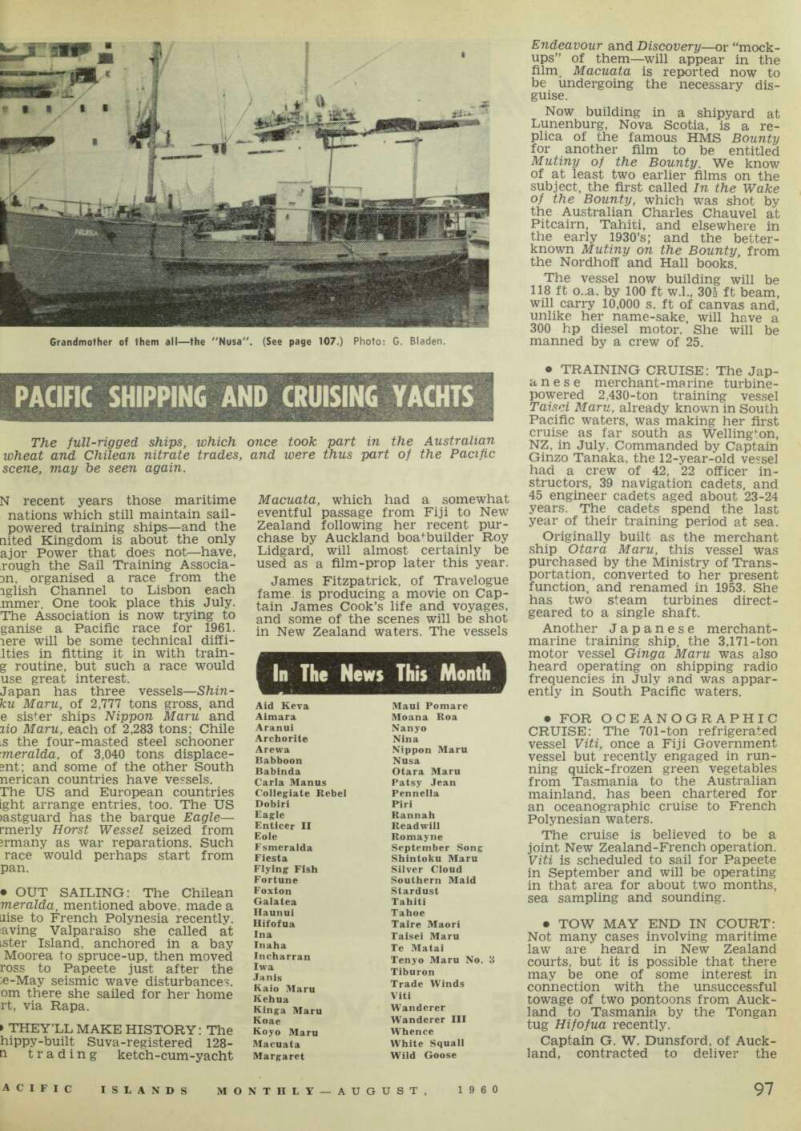
Grandmother of them all—the "Nusa". (See page 107.) Photo: G. Bladen.
itoons for their owners. He en- ;ed the Tongan tug to do the on a towage agreement.
Vhen the pontoons broke adrift the Tasman the tug owners imed that the cause was Act of d and that the contract therem became void. They then imed salvage to tow the pontoons the nearest convenient port v Plymouth Captain Dunsford reyed the right of holding the tug lers to the original contract. till reserving this right, a new tract was then made on different ns, and the tug set out to again ?mpt delivery of the pontoons, at a time. But in heavy wea her first pontoon developed a leak. k, and almost hauled the tug m with her when the shpgear ed to operate immediately. he owners of the tug then de- ;d to withdraw from the job; tug was recalled to Tonga via :kland, and the second pontoon lay undelivered at New Plymouth late July. hless there is an adjustment, of court, it is likely that Capi Dunsford will seek compensai on the basis of the first con- :t which he maintains required tug owners to deliver the toons. It could be an interestmaritime legal case. Weather in Tasman Sea in mid-winter is ideal for easy towage and the its which took place were Dably no cause for surprise. - is possible that the remaining toon may now be taken in tow a New Zealand coaster which been sold to an overseas buyer,
Target Cleared: The
sian rocket target area, centred 3 3° miles west of Palmyra, declared safe for navigation m on July 8, immediately after Russians had fired the second
of two rockets. The first was fired on July 6.
The original announcement said that the area would be unsafe for navigation from July 5 to July 30.
According to American reports, the two rockets landed in the defined area. • HELP YOURSELF: According to a Government notice published in Rarotonga, the owners of the remains of the wooden, Australian built, 304-ton vessel Rannah, which has been on the reef close eastward of the entrance to Avarua Harbour since 1954, have renounced all claims.
The wreck is considered an eye sore and will be demolished by the Government, but for a period of three months from June 21 any per sons who wishes to help themselves to portions of the wreck may do so.
Rannah was originally taken to the Cooks by Mr. D. C. Brown, a Rarotonga trader. Anchored off shore in a blow, her cable parted and she drifted high onto the reef.
She was surrendered to the insur ance underwriters, and by them sold to a New Zealand syndicate who wanted her engines.
Having stripped these and other equipment, the syndicate re-sold the hull for a small sum to other Rarotonga interests, who hoped to salvage most of her timbers, but the vessel was very solidly fastened and the timber —Australian hard wood —was very tough, so only a part of the hull was dismantled.
Since then the wreck has repre sented a menace, as it could pos sibly be thrown into the Avarua Harbour in heavy weather. • ON THE WAY: When this appears Moana Roa, the new New Zealand Government vessel for the NZ-Cook Islands trade, should be on her delivery voyage via Panama to
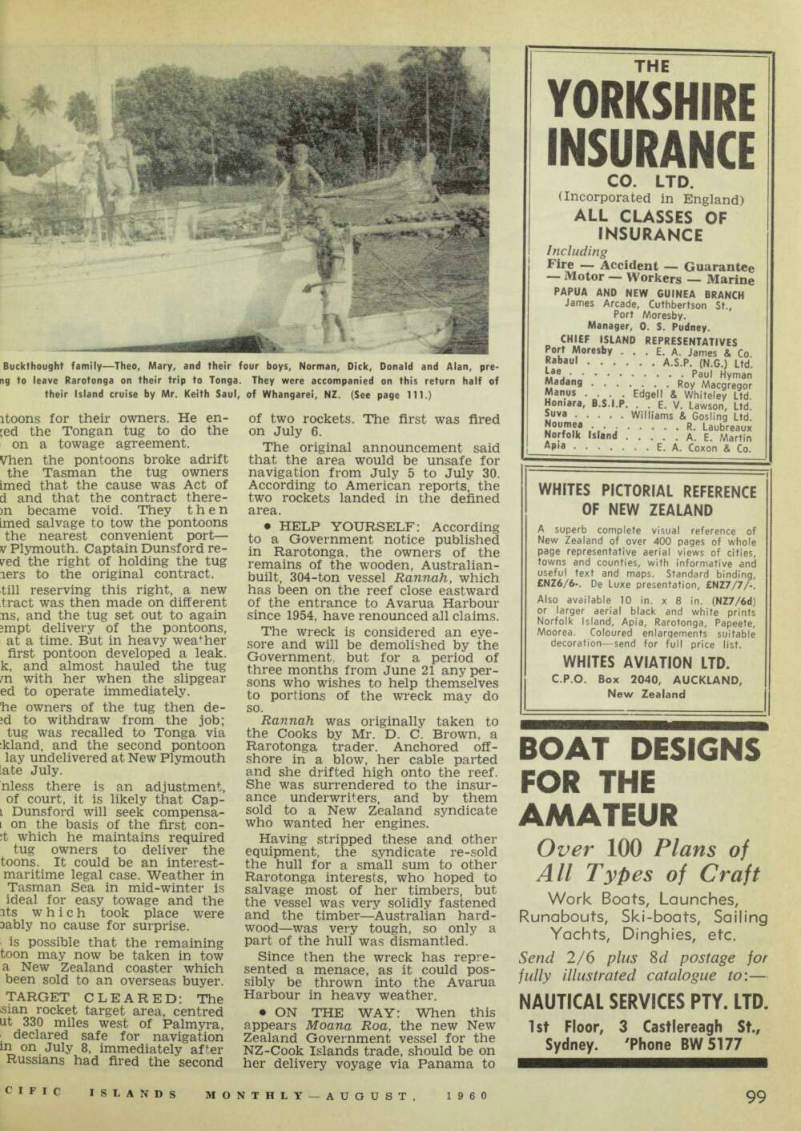
Buckthought family—Theo, Mary, and their four boys, Norman, Dick, Donald and Alan, pre [?]ng to leave Rarotonga on their trip to Tonga. They were accompanied on this return half of their Island cruise by Mr. Keith Saul, of Whangarei, NZ. (See page 111.)
larotonga and Auckland. She com peted trials on July 12. Her cargo rom the UK will include some new ;enerator sets for the Rarotonga tower station, motor vehicles, and ither general cargo.
She is probably the first vessel to iring a direct UK cargo to Raro onga in many years.
It was announced on July 16 that le Government vessel Maui Pomare, t present on the Cooks run, will e offered for sale as soon as the ew ship arrives. • PERSONAL: Mr. Len Colton, f Maui Pomare is still out of action Plowing an accident in Auckland i mid-May. He had been promoted > Chief Engineer early in the year hen the former Chief, Mr. F. J. vans, was sent to Scotland to super se the installation of machinery i the new Moana Roa.
Mr. R. Sheppard, lately Chief igineer of Suva-registered Bahinda, is joined Maui Pomare until Mr.
Diton is again fit for duty. • INTO THE BREACH: As a re lt of South Pacific Trading Com tny’s two-masted schooner Tiare aori breaking a connecting rod id cylinder head in June, the 135n motor vessel Dobiri, also based the Cook Islands but owned by iptain Hugh Williams, took over e schooner’s petrol run from ipeete to Rarotonga.
Dobiri took some tomatoes to ipeete on the east-bound run. She is to be in Papeete over the period the July celebrations.
• For Survey In Japan: The
ibaul-based wooden motor ssel Piri, 263 tons, purchased a ar ago from ICI after operating • many years in the trans-Tas m explosives trade, left New itam for Japan in June with a rgo of scrap metal
After undergoing a refit there she will return with a general cargo.
Piri is owned by a syndicate headed by Mr. Frank Dyer.
• New Ng Small Craft; The
48-ft workboat recently completed for the Papua-New Guinea Admin istration by Capricorn Charters, ship builders of Maryborough, Q’ld, arrived in Port Moresby after an uneventful delivery voyage in early July.
The vessel has been named Aimara and will be used in the Port Moresby area. • FOR RABAUL: The 225-ton steel twin-screw motor vessel Inaha, built 1923, cleared Auckland on July 3 for Rabaul direct. She was pur
chased by New Britain Electric Co., of which Mr. A. Avenall is head.
No information as to her future trade was available in Auckland in July.
Captain M. Calder was in com mand, with ex-part-owner Lewis Graham as chief engineer and some Suva men as crew. • HANDED OVER: Also from Auckland, on July 7, went the 243ton wooden vessel Aranui, for de livery to new owners at Tahiti as recently reported.
Captain Ron Barnett, who de livered the 209-ton Foxton to other owners at the same port recently, was in command. Aranui was owned by Winstane Ltd., of Auckland, and
ABOVE: "Pin”, the [?]baul-owned ex-ex [?]sives vessel, is now Japan for refit. [?]ee this page.)
RIGHT: “Viti”, the [?]ip that during the [?]r was Fiji's navy [?]d which was sold [?]ter it to a group of -servicemen who [?]ed her in the trans [?]sman trade, will he French Polynesian [?]ters in September a scientific job. [?]ee page 97.)
lad been in the coastal cement rade.
• Showing The Flag: The
loyal Navy’s submarine HMS I nchorite, 1,385 tons surface dis ilacement, a unit of the Fourth Submarine Squadron whose base is ,t Sydney, visited Suva, Apia, and fukualofa in July, causing a great eal of interest in each port.
Commanded by Lieutenant W. L.. )wen, the black-painted, 280-ft raft, with 522 painted on her tall treamlined conning-tower, took lembers of the RNZAF and a few ther people on a short cruise out f Suva while some of Anchorite’s ersonnel boarded a RNZAF Sunder md flying-boat for a detection Kercise.
The submarine had a total com lement of 64. Most of the men were dieted with the RNZAF during le stay at Suva.
• Narrow Squeak: The
lartered Banno Line freighter icharran, owned by Williamson & 0., of Hongkong, touched the reef i the west side of Suva main issage as she left that port for autoka in heavy rain in the early Durs of June 29, under a local lot.
The ship returned to the wharf id a diver made a day-long ex nination of the after part of the arboard side. No damage was und and the ship was making no ater so she sailed after a delay about 30 hours..
• In Western Samoa: Cap
in Charles Smith, head of the estern Samoa Marine Depart ent and Apia’s Harbour Master, Id PlM’s roundsman in July that :e port’s new pilot boat, being lilt locally at an estimated cost of ,000-£9,000, should be completed ’ mid-1961.
Designed by James Miller & Sons, Fife, Scotland, from sketches bmitted, the 115-hp, single-screw, knot launch will measure 541 ft x ft x 4i ft draught and will lvc a small forehold for light >use cargoes.
Captain Smith said that five new arine lights have been established local waters since last September id work is in hand on another.
Apia had 102 overseas ve-sels rough the port last year, totalling 5,000 tons, all of which are sub set to pilotage. The Harbour aster’s duties also include the sur y of about 30 local small craft.
• She Serves The Fleet;
ie Japanese tuna-fleet mother ips which call at Suva between ily and November each year are uipped to meet almost all the needs the vessels which they tend. They rry large quantities of machinery ares fishing gear such as the big ass buoys, light buoys, and radio lacon buoys, cartons of frozen
■it-fish, and foodstuffs—mainly
rice, barley, beancurd, and canned Japanese mandarins.
They also have well-equipped hospitals and a pool of spare key men to provide replacements while the sick are under treatment.
Dr. Hajime Hatoyama, of the mother-ship Tenyo Maru No. 3, said in Suva in July that he and his assistant handle about 30 cases per day, mostly men from the fishing vessels rather than the mother ship’s own crew or workers.
On an average there are only one or two serious accident cases per month. In the event of major operations men from other depart ments of the ship with war-time
medical experience are called in as male-nurses to assist.
One, or perhaps two fishing vessels are serviced by the mother shiP at sea each day. On an aver a^e each fishing vessel returns to m °ther-ship at about three ?lf ek J y r A in ( w £ eri . the y have ab^ t s i! tons ° f fisb aboard, dr H! e N °‘ ? wil i S a ™ t to £ s . of bait a ™i of ic iL from J the mother-ship be ween the end of May and the time that she hands over to her relief, Koyo Maru in September, by whin she will have taken aboard—and transhipped—her quota of 5,700 tons of fish other than sharks. (Over)
• Those Handy Buoys:
hose 12-in., net-covered, luna ngline glass buoys mentioned ige 103, have more uses than even e Japanese may have figured.
In the Tokelau atolls in July it a s noted that probably every cond household had one of them mging up as a fresh water cen tner. The projecting eye, to which e fishing line is normally attached, d been knocked off to leave a con nient hole.
Many of these buoys, presumably it by the Pago Pago-based tuna et, come ashore on the reef und coasts of the three atolls— d perhaps a few might even be ved ashore when the lines are d within canoe-reach of the mds.
» Beep-Buoys, Too: Less
fful to a Tokelau housewife but hnically more interesting, are the lio-beacon buoys used by the la longliners in poor weather. A i-shaped object enclosing a neat ;le radio transmitter and with a t whip aerial, these buoys are ached to the commencing end the 50-mile longline. fhe transmitter sends an identi ty signal—usually a letter and a ure —during one minute in every ee. When the entire line is laid the ship tunes the beacon-buoy on her direction-finding receiver i the ship cruises back to the
starting end to commence picking up the line. In bad weather it may
srxr-
The beacons operate in the band 1605-2850 kc/s and have a daylight range of about 50 miles. The beacbn signals, incidentally, are a clue as to whether tuna long-liners are operating in your vicinity. Some of these beacons may be heard almost any night—when the range is naturally much greater—in the Fiji area during the fishing season. The little transmitters are crystal-controlled and have an output power of 3 watts. The buoys weigh about 16 kilograms. • THE BIG LIFT: A good many people in Fiji would be surprised to know that the 209-gross ton local
vessel Adi Keva was brought from Holland where she was built in iq?7
gs- H HSS
V* 0 ane
rQis^Prove this happened we
takpn^ l^ sear( f. * or a P hoto ptm J? l Tvyr tlme ’i a PP eared Snf/jH. >? lay l ’ 1939 ’ but unfor has - lo ?® been disposed ° f and the on smal block destroyed, The shi P was then named Le Pnoque— which means The Whale and was on delivery to Noumea. We d ° n °t know what the vessel’s dis- Placement tonnage was at the time °. f the lift . bu t even 20 years later it would be classed as an interest ing heavy lift.
• Doing The Rounds- Ran
tain G. W Dunsford of Aucktod'
shipbroker and representative for Pacific Islands Shipbuilding Com pany of Hongkong in Island areas other than New Guinea, visited Fiji and New Caledonia in July, and was likely to visit the Solomons and New Hebrides in August on his re turn from Hongkong, where he went to complete the business of order ing a new 500-tonner for the Northern Steamship Company of Auckland. He was investigating new ship or second-hand ship tonnage requirements in the Islands.
E This Month’S Bottle:
This month’s bottle message comes from Mauke, Cook Islands. The bottle was tossed overboard by French lone-handing yachtsman Guy Clabaut, of the yacht Eole at a point just south of that island
[?] 80-man detachment of Seabees from Mobile [ ?]truction Battalion 10 have been on Canton [?]d since May building a telemetry-tracking [?]on. The Seabees will be there till end of year, and will construct four radar towers, buildings to house personnel and gene [?]rs, put in several miles of underground [?]e and will repair existing roads and con [?]t some new ones. It all has to do with [?]e Sam's Project Mercury—the “National [?]nautics and Space Administration's manned [?]e vehicle programme".
[?]e US Navy cargo carrier, “Pvt. Frank [?]rca", shown here, was taken out of moth for the job of carrying building supplies food for the personnel. The other picture [?]the detachment's own signboard. —US Navy photos.
May 2 last, and was found in 5 last week of May by a gentle m named Kimiora, who had the Dd sense to pass it on to the right arter.
Phis was a short and unexciting ft voyage.
» Veteran’S Watery Grave:
e old Nusa, which has been part New Guinea’s seascape since • German days, was expected, in ly July, to be shortly taken out e Rabaul harbour and scuttled, lat remained of her, that is—she i already been pretty thoroughly pped of anything valuable, ler last owners were Messrs, n Pak and Freddie Chan. Accord to Mr. F. Werner, of Bialla ntation (he and Mr. Janke, of dlo Plantation, Kerevat, are be ed to be the only old German lers left in the Territory although re are a number of part-German dents), Nusa was originally the rol vessel of German District icer, New Ireland. usa was “captured” when the tralians landed in New Britain 1914 and expropriated with the of German-owned property It been reported that when she a German patrol vessel she had s mounted on her, but Mr. ’ner says that this was not so, tough the Australians may have mted one gun after her cap ne was the oldest vessel afloat md the Territory—the date of building, and her builder are, e uncertain, although in July i her age was put at 54 years, wooden construction, 85 ft long of 112 tons gross, 53 tons net. ler latter days she was powered i Ruston Hornsby 204-hp diesel.
• Correction. Please: A
couple of Suva correspondents have already taken us to task for in accuracies in the paragraph about the sale of Moala to R. G. Symes’ interests in BSIP (PIM, July, page 109), which we reported had been sold through the agency of Cap tain W. L. Kennedy, Sydney.
Moala was one of four ketches (Taveuni. Macuata and Koro being the three others) which were built about the same time, but by Charles Whippy, Suva boat builder, and not by Millers Ltd., as stated.
The ketch Koro, which sounded like Cora in the telephone message we received, appeared in that latter disguise—and there just isn’t any such ship, not ex-the Whippy yard anyhow.
[?]ymayne", which arrived in Honolulu July 7, r should be back in home port at Vancouver.