The Month's New Reading
pp. 86-95 · Read in the full issue

With Judy Tudor
Like everyone else in this age, authors, too, are gadding about. They still write stories from the home front; but they also roam far and wide to provide exotic backgrounds for their plots and their stories.
THIS month’s collection provides a case in point, and there is no longer any excuse for not know ing something about what goes on in the world, even if you, person ally, never leave the haven of your own fireside chair.
You can learn something about the Spanish character; about the Arabs as a people and a political force; about the wiles of the North African: what happens when Greek meets Greek; and what a pack of newshounds are like when gathered for the kill at an Austrian mountain resort.
It all tends to broaden the mind; and, perhaps, encourages us to stick our noses into other countries’ hi i ci TIPQQ In the reading sense, there is nothing of much moment in this dull, mid-year period, but most of the books offering are entertaining and readable.
Buffoon in Old
School Tie
THE larger catastrophe of World War 11, which began in the year that saw the end of the Civil War in Spain, has largely blotted out detailed memory of that earlier conflict. Except, of course, for the Spaniards who lived through it; and those of other nationalities who, at the time, and for frequently mis guided reasons, went to Spain and took sides.
Spanish politics, even today, are still something of an enigma. Gen eral Franco’s dictatorship, as the last remnant of Fascism in Europe, is naturally calculated to make those who normally see Pink, see Red; and he has, undoubtedly, a short way with those who buck the regime.
The average middle-aged Spaniard whom you meet casually, is full of fun. will talk about almost anything under his pleasant sun, will go to extraordinary lengths to be friendly and helpful—but will pull down a metaphorical steel shutter over his face if the conversation veers towards what he did in the Civil War.
The younger intelligentsia, who missed the Civil War, will some times discuss current politics, but few harbour revolutionary ideas.
Dictatorship is not ideal, they say, but in the present state of Spanish
development, it is the only solution.
They will quote chapter and verse to show how much better off Spain has been since Franco than before.
The visitor who goes to Spain, ex pecting a patriot burning to save his country from the yoke of re pression, to be lurking behind each bush, would be sadly disappointed The overwhelming mass of Spaniards, young or old, are united about one thing: anything—dicta for ship, if you want to call it that — is better than Civil War and the political chaos that preceded its out break in 1936.
As a background to this almost universal frame of mind in present day Spain, and the adequate reasons for it, you might search much further and fare worse than The Spanish Pimpernel, by C. E. Lucas Phillips, the British writer who has already achieved best-seller class with Cockleshell Heroes, the Escape of the Amethyst and other ad ventures based on real-life war time escapades.
It can be said of this story— and no doubt will be said by those Pinks we spoke of, who see Red — that it is biased and presents only the brutality of the Republican forces. This is, of course, true to a certain extent, as the story is of an Englishman, Christopher Lance, who was living in Madrid at the time the Civil War began, and through a long chain of circum stances, found himself smuggling out of the country, victims whom the Republicans had marked down for death.
Civil War Brutalities
As such it is a ghastly chronicle of the cruelties and inhumanities of this side; but if it makes the reader feel any better, he may with assur ance tell himself that the sins and brutalities on the Franco side were unlikely to be one whit less. There is a facet of the Spanish character which we other Westerners, for want of a better word, call “cruel”. (Although a few years later, the Germans, by their acts cancelled any right to be called civilised.) The Spanish War was the cul mination of 300 years of bad gov ernment and half a dozen acute years of muddled narty-politics. In 1931, King Alfonso XIII went into exile to pave the way for a blood less revolution and the establish ment of a Republic. This, however, did not suit the revolutionaries
amongst the Spanish political parties, and at a later stage Largo Caballero, “the Spanish Lenin”, was declaring; “Spain must be destroyed in order to make it ours; on the day of vengeance we shall not leave a stone upon a stone.” Other revo lutionary-minded citizens wanted to see “waves of blood that would redden the seas”. They got what they wanted.
The 12 parties that formed the Left, and ran the first Republican Government after Alfonso’s exile spent their time unprofitable fight ing one another and persecuting the Church and were defeated at the next election. But the Rightist gov ernment that followed did no better and in 5i years there were 26 changes of government. Spain was totally unsuited to the western pat tern of parliamentary democracy.
At the beginning of 1936, the Leftist parties formed the Popular Front and in the elections in Feb ruary of that year, were returned to office in the Cortes (Spanish parliament). The Popular Front was composed of a medley of parties in-
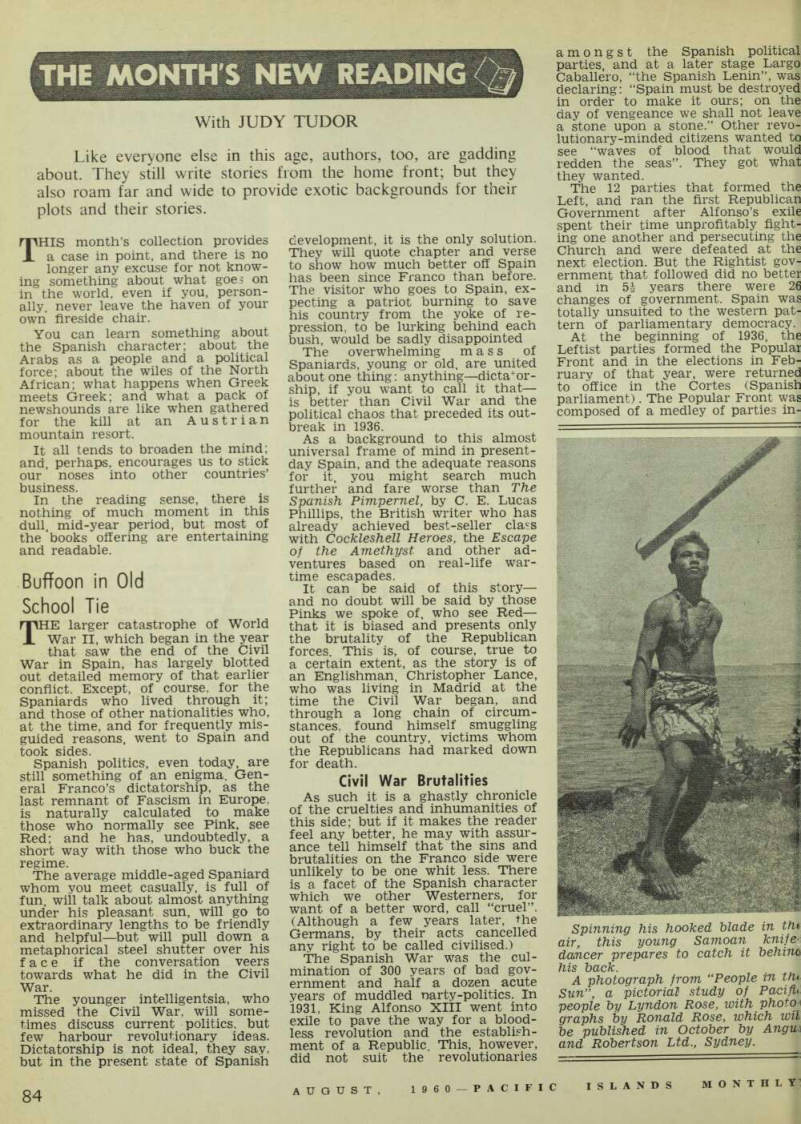
Spinning his hooked blade in th[?] air, this young Samoan knife[?] dancer prepares to catch it behind[?] his back A photograph from “People in th[?] Sun”, a pictorial study of Pacific people by Lyndon Rose, with photo[?] graphs by Ronald Rose, which wi[?] be published in October by Angu[?] and Robertson Ltd., Sydney.
eluding Socialists, Anarchists, home rule parties of Basques and Cata lans who joined up for their own political ends, and, of course, Com munists. As the Civil War got into Its stride, and Russian advisers were brought in, the Communists, yho had at first been a very small party, indeed, assumed more and more power.
A Mixed Bag
On the other side of the fence, he Right wing parties were just as nixed a bag. They included Liberals, Radicals, the old Carlist party and -something quite new—the Spanish r alange. Like the Communists, the r alange started off as a very minor >arty, and assumed more and more tower as time went on.
There were two other traditional orces in Spanish politics the Jhurch and the Army. However, ince the exile of Alfonso in 1931, he Church had suffered extra rdinary persecution and at the ime of the outbreak of Civil War r as virtually broken. To show one 3lf in the habit of a nun, or the arb of a priest was to invite mrder from the first mobster one let.
The Army at this stage had a isproportionate number of officers, nd one General in every 100 fidiers. It was more interested in olitics than fighting efficiency, but s general inclination was towards le Right.
However, the Republicans had iken care of this, to a certain ex ;nt, and had promoted some Gen •als and senior officers, out of sight, ne so promoted—to be GOC anaries—was General Francisco ranco.
The triumph of the Popular Front the February, 1936, election was dlowed by the release of political risoners who immediately formed lemselves into armed bands to llage, assassinate, burn convents id churches. At the same time, each ilitical party and each big trade lion trained its own private army r the same purpose.
The real Civil War was triggered i July 18, when the military garri n in Spanish Morocco revolted, id to it, to take charge of affairs, iw General Franco. They rose, so icy declared, not against the law, •ut for the law. so that law and ithority should rule ... for the fety of the people”.
This was the background against tiich Christopher Lance—Criminal i. 1 to the Spanish Republicans; vanish Pimpernel to the rest of e world—operated in the first 18 onths of the Civil War. In the last months he rotted in a Republican ison as Franco’s forces pushed the into their final corner yond Barcelona.
H , e J was a civil Engineer and 3r ked,fo r a firm that was based i English and Spanish capital. In e years between 1931 and 1936 he
had surveyed railways, built bridges dams and hydro-electricity projects all over Spain and Morocco; he and his wife, Jinks, had made friends amongst the foreign colony in Madrid and amongst the Spanish themselves.
Just Their Usual Form
They had become inured to the explosiveness of Spanish politics and during the first of the troubles in 1936, refused to take them seri ously—it was just “part of the usual form”. But as Franco’s forces crossed from Morocco and began a drive on Madrid—a drive that was to take years, bogged down just 46 miles from the capital—even the ebullient Lance, was forced to take note.
His own business had been “nationalised”, but he soon was made an honorary member of the British Embassy staff and when the Madrid Embassy was thrown open for English nationals, his was the self-appointed task of running the show.
But instead of the 300 or so British subjects who were expected to take refuge in the Embassy, hundreds of others, marked down as political targets, suddenly dredged up from somewhere, some slim claim to British protection.
Most of these people could not speak English, some had been, in the past, actively anti-British; but were bewildered, human beings in great fear—many of them had seen members of their families butchered before their eyes—and as such they had claims on Lance’s sympathies.
Assuming, like a cloak, the de ceptive inanity of the foreigner’s idea of an Englishman abroad, act ing the cheerful buffoon, jollying the Spanish officials along, understand ing these people and their foibles, their sacred siesta and the Spanish way of doing and looking at life, he manoeuvred hundreds of people out of the country under the noses of officialdom.
But by the end of the 1937 summer, even Lance could see that the pitcher could go to the well too often. He chose three desperate cases to be “shipped”—then he would go back to England himself.
Last Throw The last case, the son of Franco’s chief of staff, was the most desperate of all—his life was “balanced on a knife edge”—the difficulties of get ting him away almost insuperable.
But after incredible feats of bare faced daring, it was accomplished— the last instructions given the young man being that he must not show his face until he reached a neutral port, and then he was to disappear, silently.
Unfortunately, the young man not only got off the ship to stretch his legs in Gibraltar, but he made a political speech leaving a trail a mile wide that led directly back to Lance.
The fat was in the fire now, and in early October. 1937, Lance was arrested by the Republicans. The Civil War dragged on for almost another 18 months and as Re publican territory shrank and shr a nk towards the southern Pyrenees, so was his prison shifted, and so also did his lot become more miserable and desperate.
In the winter of early 1939, as the result of the war became clear, the Republicans began to dispose of their prisoners. Each morning 30 or so in Lance’s prison were killed by machine-gun—those not killed mercifully in the first effort, being shot in the head by revolver, at short range. Lance’s number on’the list Was 250. (Over)
It was midnight when he was kicked out of his cell for the last time. With a Cockney prisoner who also had run foul of the Communists, he was taken a long way into the mountains, where they met an tndian prisoner. It was, thought Lance, evidently to be a British affair, with their bodies —for inter lational reasons—buried far in the Pyrenees where they were unlikely ;ver to be found.
Then out of the darkness came i strong, English voice: “I’m skrine Stevenson,” it said. “I’m form the British Embassy, and I’ve :ome to take you home.” (SPANISH PIMPERNEL. Published by [einemann. Australian price, 22/6.)
Monsoon in
Somaliland
)NE thing you can be sure of con cerning thriller writer Victor Canning is that you are never are where, in a literary sense, he > going to pop up next.
Last time, we seem to remember, r e left him in Majorca; now, in 'he Burning Eye, his characters re disporting themselves in ad entures on an isolated spot on the omaliland coast. And as far as one m see, the background is authentic aough in both cases. This despite le fact that Mr. Canning himself ves in an Elizabethan farmhouse i Kent, and raises hens and carna ons when he is not writing thrillers The old Cambria had been badly owed in Bombay and when she tet the full force of the monsoon l the Arabian Sea, she took on a erce list. The captain had only le solution—to make for a small lettered port on the Somaliland )ast, put the dozen passengers Jhore, and try to restow the cargo.
Everything went according to plan, ccept that Suguli, the port in ies f ion, proved to be even more )d-forsaken than anticipated (it as in charge of one Italian officer iffering from malaria), and on te evening following the landing the passengers and the ship’s )ctor, Cambria quietly turned Ttle in the harbour and sank with 1 hands.
Within a few days the survivors id inadvertently got mixed up ith local politics, which with the imali chiefs were of the direct, mple but final kind. WTh all these gradients, Mr. Canning manages dish up quite a repast of colour, an d interesting background.
BURNING EYE. Published by StoUghton ’ Ltd - Australian
hriller With
ultural Background
I ARY STEWART is also one X who in the writing sense, gads. e f - My Br °ther Michael, set m that country which Byron
Shelley (and others) wotted of. To wit—Greece.
This is a story of the land of the Gods in high summer, when the grass on the Parnassus is withered brown, and the heat hangs over the Aegean Sea like an electric blanket. In time it is modern—with sufficient of the ancient thrown in to provide a short university course in Classical Greece.
There is now quite a school of this sort of thriller—fast-moving modern story against a more cultural back ground, and in this field Mary Stewart is very good, indeed. It isn’t everyone’s meat, of course. Some people prefer to take their classics straight, and their thrillers in the same way—the sex and the beat ’em-up-and-leave-+hem-for-dead of the tough American school.
Camilla Haven, in Athens on holi day and to forget one love affair soon finds herself involved in another with Simon Lester, who h in Greece to find out what really happened to his brother, Michael, 14 years before.
Michael was a member of a special force that “fed” the Greek guerillas during the German occupation.
Although it had been supposed that he had been killed in the course of duty, Simon soon learns that he had, in fact, been murdered.
Michael, too, was something of a classical scholar and the enigmatic message he was able to send before his death is finally unravelled under dramatic circumstances 14 years later on the slopes of Mount Parnassus. (MY BROTHER MICHAEL. Published by Hodder and Stoughton. Ltd. Australian price, 18/9.)
Pope, in Private
A POTENTIALLY famous writer has to be really quite far-seeing in order to provide successfully for any future volume of “Selected Letters”.
Alexander Pope, the satirical poet of the early 18th century, seems to have been just that man—either by providentially keeping copies of his correspondence with friends; or by having the sort of friends who kept his letters—quite rare in these modern days, in our experience.
Pope, in fact, seems to have gone a step further and actually edited the first volume of his own “Letters” and had them published, by a ruse, in his own life time.
And why not? What writer worth his salt has not fathered some literary gem in private that he con siders worthy of a bigger audience?
Pope just carried things to a logical conclusion.
Oxford University Press has quite recently produced a volume of Pope’s letters in the World Classics series.
Although uniform with the other pocket-sized volumes in the series, this small book packs in about 400 pages of the poet’s prose—sufficient to show not only what kind of man
Pope was, but to give interesting ex cursions into the times in which he wrote.
It was, as is clearly shown by some of his letters to the acknowledged female wits of his day, a somewhat bawdy period and the poet’s letters are not confined only to thoughts on a higher plane.
The Oxford University Press has now over 500 books in this particular series, but alas, even the cost of reading the classics has gone up considerably and the smart little volumes can no longer be bought for a couple of bob.
(Letters Of Alexander Pope.
Published by Oxford University Press.
Australian price, 12/9.)
Golden Age of
Arab Influence
THE well-produced picture and story book called The Arabs, re cently published by Harry B.
Ellis, Middle East correspondent of the Christian Science Monitor, is de signed mainly for children, but their parents will find it interesting, too.
Ellis shows how, as long ago as 3 500 BC, the nomadic people of the Arabian Peninsula began to spill out from their fearsomely arid land to populate the more fertile parts of the Middle East, and to become the Babylonians, the ancient Egyptians of the Nile Valley, the Hebrews of Palestine, and others.
But it was not until a child called Mohammed was born in Mecca about the year 571 AD that the necessary spiritual impetus was given to these nomadic people to found an empire.
The Golden Age of the Arab Em pire lasted six centuries, at a time when Europe was experiencing a dark age and when local kingdoms were little more than partly-civilised tribes. In its hey-day, Arab influ ence reached from China to Spain, and Baghdad was the cross-roads of the world.
During this period, when Euro pean cultural life was at a stand still, all the great works of Greece and other ancient civilisations were being translated into Arabic, and with other books on history, medicine, philosophy, astronomy and geography, were being funnelled into Europe through Spain.
One hundred years after the death of Mohammed, in 732 AD, the Arabs reached their northern-most point and were defeated at Tours, in France, by the grandfather of Charlemagne.
But the Moors (as the Arabs were called in North Africa) stayed in Spain until the 16th century, although their influence was on the wane 200 years before that.
Today, Moorish culture is grafted permanently onto Southern Spain; the dark skinned people, the ancient Martello towers that mark every headland, and the magnificent Moorish buildings that are now
preserved as national monuments, are all reminders of Arab influence.
Cordova, in its day. was the seat Df Arab learning; the point from ivhich the arts and sciences were lisseminated to ignorant Europe.
The Arab Empire began its in jvitable period of shrinking when ;he Mongols destroyed Baghdad in L 258; but the Arab Empire was dif ’erent to other empires that have •xisted before or since: It had its nspiration in a religion, and ilthough the Empire it created no onger exists, as such, Islam, the eligion, goes on. About one person >ut of six in the world today is a Joslem. (THE ARABS. Published by Brock ampton Press. Australian price, 15/6.)
Fhe Man With
lo Ethics
FT is well-known, of course, that L newspaper men are, by and large, a poor lot. And that when hey get into the lone-wolf, foreign orrespondent class they’ll stop at othing to get their sensational tory. As my old grandmother used d say, they’ll skin a louse for its ide.
However, even knowing these lings, Paul Townend’s sensafion reating and sensation-seeking in irnational correspondent Paddy Porchbearer of Truth) Chipper eld, needs at least two glasses of idka before you can get him down ith a gulp.
For, of all the nasty purveyors of msationalism for the uninhibited lasses, he’s The Lot, and the only ling that really keeps the reader egging away through his dirty oings in The Man on the End of le Rope is the virtual certainty tat something unpleasant will catch p with him in the end. In this le reader is, in a way, correct; but i the other hand he is wrong, also, i fact, the end is quite a trick.
High on the face of an Austrian p swings a man at the end of an pinist’s rope. Weather, circum ances and other factors, some igmeered by the Torchbearer him ;lf, combine to keep him there some me.
Who is he? He could be a climber ho had failed on the mountain ice before; but it could also be a mous European playboy, lately dis ipomted in love. But whoever he , handled right, he’s news.
Apart from the uncertainty of lowing whether the fellow gets off ie rope alive, and whether the irchbearer gets his just deserts, the ory also contains a lot of stuff ?• newspaper ethics; Whether s right to feed the masses what iey want—that is, tripe. Or whether ie should run a “responsible, sober” •urnal and slowly go bankrupt, it is a question that newspaper :opnetors have been pondering for ie last couple of generations, and hich most of them have been solv
ing to the quiet content of their bank-managers. (THE MAN ON THE END OP THE ROPE. Published by Wm. Collins, Ltd.
Australian price, 13/3.)
Two For
The Schoolroom
TWO recent additions to the grow ing list of the “Simple English Reader’’ type of book, are Stories of Old Samoa and Pawidu Gets His Goal. The latter is de signed for school reading in Papua- New Guinea native schools; and we presume that the collection of Samoan folk tales is primarily for youngsters in that Territory. How ever, both could be used equally well in Australian or New Zealand primary schools.
Fanaafi Ma’ia’i, who wrote Stories of Old Samoa, has had a brilliant academic career. In 1957 she became Western Samoa’s first university graduate. After gaining her MA with first-class honours at Victoria Uni versity College, Wellington, NZ, she went to London on a James Mac intosh scholarship and is currently completing a doctorate of philosophy at London University’s Institute of Education. She will then return to NZ, to become lecturer in Education at Victoria College. (Published by Whitcombe & Tombs Ltd., NZ price, 3/6.) Pawidu is written by David Powys, a school-teacher in New Guinea, and it is published by Dominie (NG) Ltd., whose parent company in Sydney is a supplier of all school requisites.
Small readers for New Guinea native schoolchildren have been published by or for the South Pacific Commission, but this is, we think, the first excursion of private
enterprise into the business of pub lishing school books for NG children.
There should be considerable scope for this sort of thing in a Territory of two million natives who are mak ing their first fumbling escape from total illiteracy. (Price of Pawidu Wins His Goal is 2/9.)
Troubles Follow A
Canadian Vision
ONE warm summer’s day, a young girl called Valerie Rivard, re ported to her neighbours in a small French-Canadian community on Canada’s St. Lawrence River that she had seen a vision on the beach. They believed it to be the Virgin Mary.
The vision threatened to turn the strong Catholic community up-side down, as many of the locals saw their village becoming as famous as Lourdes and Fatima. Others saw no good in the business.
In time, however, because of the strange forces at work, the problem was overcome and the villlage settled down to normal life again. Peace lasted 12 years. Then an American journalist, with a contempt for the Catholic Church and its miraculous claims, arrived at the village to ex pose the child’s vision as a fraud.
What happens then is told in The Empty Shrine, a novel of a miracle and its aftermath which New York born author William Barrett handles with great feeling. Apart from its religious angles, in which Barrett does a good public relations job for the Catholic Church, the book con tains a wonderfully detailed pen picture of village life among the French-Canadians simple people, hard working, narrow minded, shrewd. The book is of special in
erest to Catholics but is recom
mended for anybody looking for a
ood novel. (THE EMPTY SHRINE. Published by [einemann, Ltd. Australian price, 22/6.)
that’s New In Paper Backs
THE YELLOW SNAKE, by Edgar Wal ce. There aren’t enough modern thriller riters to keen supply near demand. This irticular Wallace is a dip back to the ■ehistoric times of 1926. A classic of its nd—maybe. But a bit dated, at that.
Jreat Pan).
King Solomon’S Ring, By Konrad Z.
irenz, was first published by Pan in 1957 ?beo it was reviewed here). This is the cond printing of what experts claim is e most fascinating animal book ever.
Ire At Pan).
The League Of Gentlemen, By John
land. The Rank Organisation has made movie with an array of Britain’s best ting talent based on this story of a gang ex-Commando officers who turn their nds to crime—and especially bank rob
Ry. (Great Pan).
IHE ISLAND DOCTOR, by Rona Randall, slight little trifle about love and so forth the glamorous Caribbean. (FONTANA, How Spine).
HIRACLES, by C. S. Lewis. If you don’t ieve in miracles, Dr. Lewis tells you y you should. The biggest miracle of is the Christian belief that God be ne Man. Once believing this, all other racles are easy. (FONTANA).
)Octor At The Crossroads, By
zabeth Seifert. According to modern, ion-for-females, it is a terribly glorious ng to fall in love with a doctor, marry ‘ or work with one. It probably proves it all women—especially novelists—fall love with their doctors. But a GP’s life i be fraught with frightful pitfalls— -1 Miss Seifert here tells us some of
M. (Fontana).
lARCH THE NINTH, by R. C. Hutchin- This one is also about doctors, but erent: No glamour. This American tor, in Europe with a relief organisa i, performs an operation on a wanted war criminal, and thereafter puts iself on the wrong side of the fence. 5 whole thing is complicated by the fact t the American falls in love with the :i’s wife. (FONTANA).
Our copies from Wm. Collins (Over si, Ltd. Australian prices for the above all 3/9.)