Hurricane Proofed
pp. 84-85 · Read in the full issue
Norfolk Island's Merchant Navy
It Was Home Produced And Hurricane Proofed
By Raymond Hoare
Although the first sight of Norfolk Island’s tall pine trees delighted early Navy men, the trees were found to have too many knots for the tall spars of the sailing ships of the day and virtually all of the Island’s shipping has come from outside.
With one exception — the “Resolution” — which was built, launched and worked from Emily Bay as NTs first and last venture into a home-produced Merchant Marine.
THE idea was born in the years preceding 1923, when Islands’ produce was in strong demand on the New Zealand market. “Let’s have a stout, well-found schooner of our own!” was the cry. So popular was the idea, that a com mittee was formed and shares taken up by several who were able to afford them. This was surely a worthy and profitable venture.
So she could be fitted out after launching, it was necessary to have a vessel of shallow draft to enable her to enter Emily Bay through the narrow opening in the reef.
Later it was decided to build and launch her at Emily Bay, the only protected anchorage at Norfolk Island.
Plans were procured, argued over, altered here and there and finally a start was made. Resolution was to be 61 ft 6 in. overall, with a beam of 17 ft and a depth of 7 ft 5 in.
She was to be 59 tons gross and 29 tons nett.
Men were sent into the bush for natural bends to form the stem and ribs. A Norfolk pine, selected for the keel, was felled, and wTh dif ficulty, the 70 ft log was taken to the
building site, pit-sawn, adzed to shape and squared up.
As the ship took shape, it was decided that full-size natural bends were too difficult to find, so com posite ribs—that is, ribs made up of sections of natural bends—were used instead. Most of the timbers were pit-sawn on the site, Norfolk pine being used for the keel and planking while framing was of island-grown olive and ironwood.
Bounty Descendants
At last, in 1926, the hull was finished, and, with the words, “I name thee Resolution ”, spoken by the then Administrator’s wife, Mrs.
Leane, the ship slid down the ways and settled in her natural element.
She was then schooner-rigged, and with a crew of Islanders, captained by Parkins Christian (a descendant of Fletcher Christian of Bounty), Resolution was ready to meet the long rollers of the Pacific.
Some concern was felt as she was towed through the gap in the reef —there had already been dis cussions as to whether the sails should be used to help her through the passage.
As she had no engine and the wind was somewhat abaft the beam, it was decided to have some sail to assist those towing. This proved a mistake, as the ship had no way on her and the general effect of the added sail was to make the vessel travel sideways, like a crab, and she struck the coral on her starboard side and bumped heavily three times before getting clear.
With produce stowed in her hold,, Resolution then set sail on her ■ first trip to Zealand..
Head winds and calms caused the; voyage to be rather protracted (some i say she took 10 days to make the; 600 miles), and a great deal of her cargo was spoiled. Although funds; were, by this time, at a low ebb, aj (very) second-hand engine was; fitted in Auckland and once more; Resolution put to sea.
Despite the motor the ship con tinued to make poor passages. Soon/
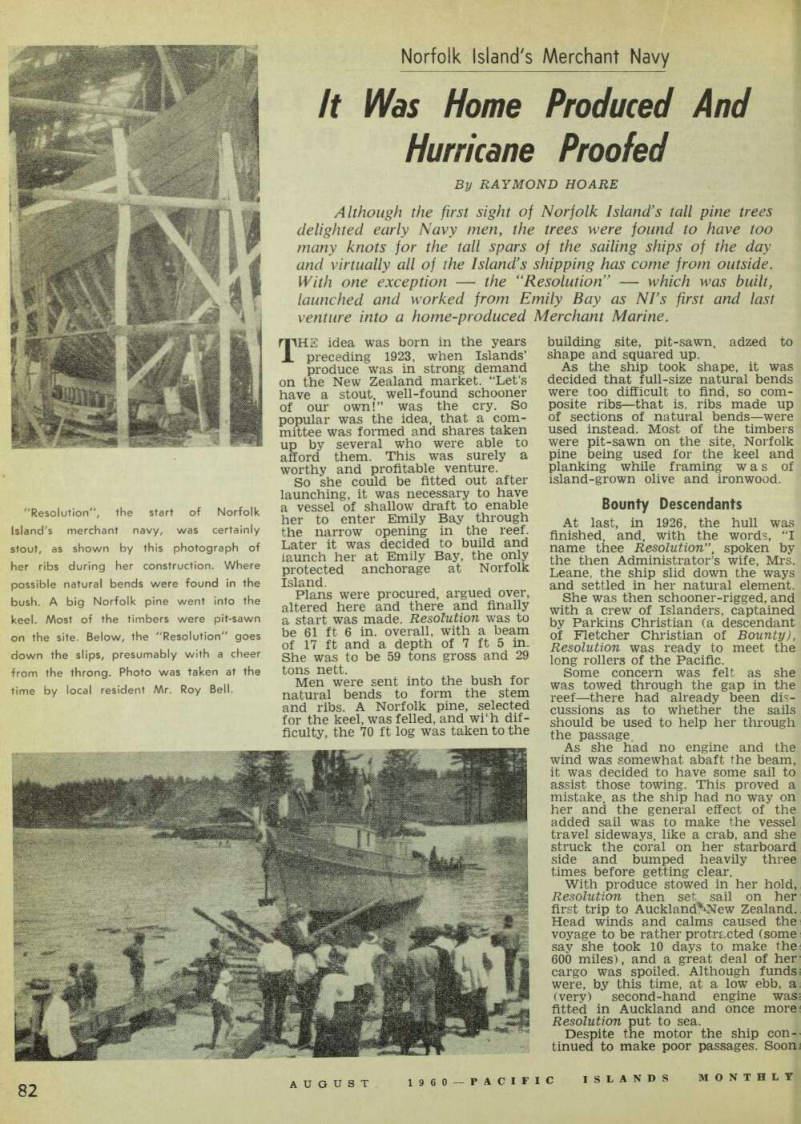
''Resolution", the start of Norfolk Island's merchant navy, was certainly stout, as shown by this photograph of her ribs during her construction. Where possible natural bends were found in the bush. A big Norfolk pine went into the keel. Most of the timbers were pit-sawn on the site. Below, the "Resolution" goes down the slips, presumably with a cheer from the throng. Photo was taken at the time by local resident Mr. Roy Bell.
, writ being nailed to her mast on ler final trip to Auckland.
As there were no further funds orthcoming from Norfolk Island, he was heavily in debt. This led to he ship being put up for sale. 1Z shipwrights inspecting Resolu ion pronounced her “30 per cent, tronger than normal construction”.
In September, 1927, she was pur hased by Burns Philp (South Sea) ltd. and after minor alterations she ailed for Vavau, Tonga. Based there tie was employed in the Niuafoou leppels trade until, in October, 529, Burns Philp transferred her to iji for inter-island trade based on evuka.
It is said that during this stage f her career she was caught in a urricane and tossed up among the alms of a coconut plantation. But samined and pronounced undam ped, Resolution resumed her normal fe.
In October. 1941. the old war orse was again transferred, this me to New Hebrides and based on ila.
Hurricane Proof
In March, 1948, she was making le 60-mile voyage from Emae to ila when she was caught in hurri me weather, and with her engine ly now a 30-hp Fairbanks Morse) nt of order and extensive amage, was driven to the east Dast of New Caledonia. She was )wed back to Vila by the Aus ■alian ketch Avalon (herself now o more) where she arrived on pril 6. Repaired, the ship entered pain the New Hebrides inter land trade.
Just over a year later. Resolution isappeared mysteriously from her toorings in Vila harbour and after >me fruitless searching fur L her held it was found that she had ist sunk at her anchorage, pparently no attempts were made
to raise the vessel—possibly it was considered uneconomical.
But one can’t help wondering if, somewhere along the rocky cliffs or perhaps on one of the few beaches of this seagirt isle of Norfolk, there may be barnacle-encrusted timber from Resolution come home to rest at last.
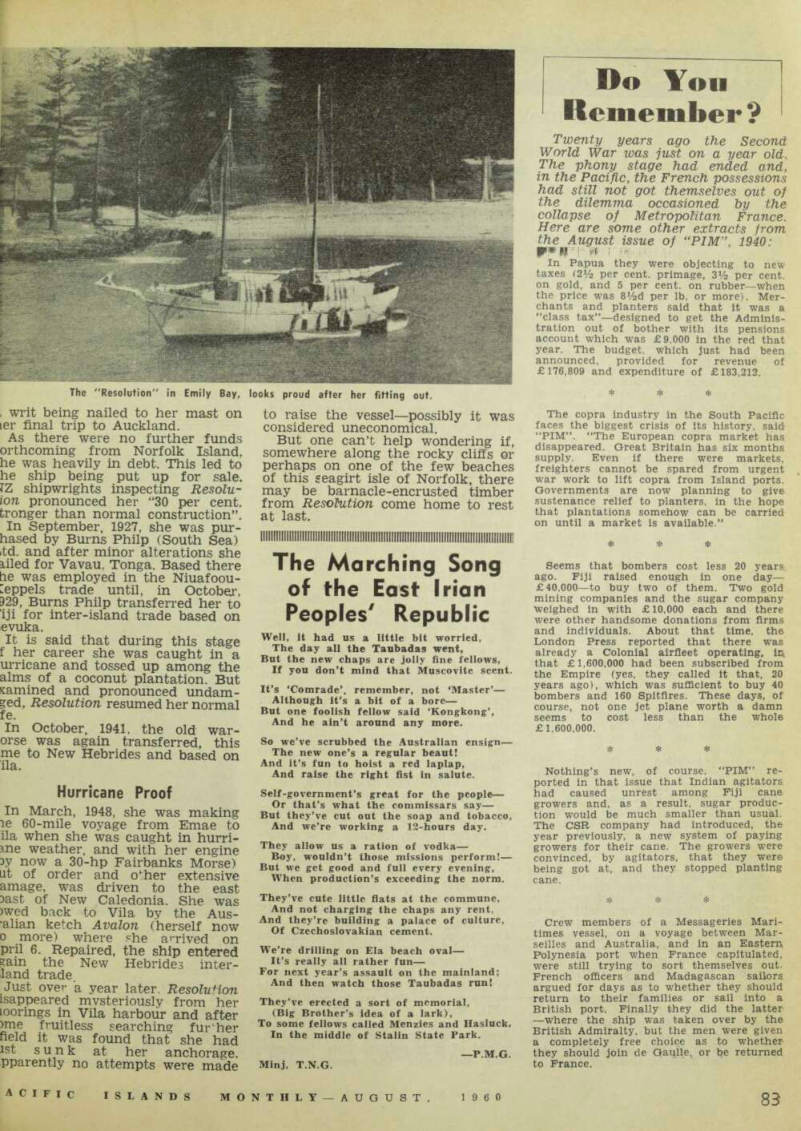
The "Resolution" in Emily Bay, looks proud after her fitting out.