One Man’s Paradise
pp. 82-97 · Read in the full issue
Basil Hall Recollects
For These Two Men, Island Memories Make These Two Stories . . .
It was a perennial argument in Suva as to whether Frank Exon, of Telecommunications, or Dr. S. M. Lambert, the local representative of the International Health Division of the Rocke feller Foundation, had the thickest lenses in his spectacles.
ONE introduced me to the other, and so I met the man who later wrote that delightful book, A Doctor In Paradise, which was pub lished in 1941 after Lambert had left Fiji An American of vivid personality, spectacles made little difference to the doctor’s many activities, although on one occasion I remember they played a part in an inquiry into his fitness to drive a motor car.
I was with him that day, and he had already scared seven bells out of me the day before during a drive along the coast, when, talking two hundreds words to the minute, his eyes seemed to be everywhere but on the road.
It was only a matter of time before we hit something, and the fact that the impact when it came was limited to a glancing blow that scored the side of a ramshackle timber lorry, could as easily have been the doctor’s fault as a case of carelessness on the part of the Indian lorry driver.
The police inspector looked as if he might have his own ideas, but in the end, after a court case, the doctor got away with it—as he
did so many times in the 20 years he spent fighting hookworm, yaws and other tropical complaints.
I had first met Lambert at a Rotary luncheon in Suva in 1938, and was at once given to understand that he liked Australians; at least, those of us who had no theories of their own on tropical medicine.
He knew plenty of people in Aus tralia, for it was in Northern Queensland that he took over his first hookworm campaign in 1918, before going on to tackle the same thing in Papua and New Guinea.
Blazed a Path
In the years between, Lambert and the team of experts who grew up round him, blazed a path through the South Pacific to the lasting benefit of those who live there.
Hookworm may still give cause for anxiety in outlying parts, but there are now few examples as bad as they were in the Rewa and Navua districts of Fiji, where, at the beginning of the Twenties, 95 per cent, of the population was in fected. An ailment as old as man kind, the Greeks were ravaged by the same blood-sucking scourge that was known hundreds of years be fore Moses told the Children of Israel to watch what they were do ing.
As Lambert used to say, “The investigation of hookworm is no job for a florist”. It’s a sordid, smelly but specialised business that only an enthusiast in the field of public health would undertake.
To mention Dr. Lambert is to think of the Central Medical School in Suva that has become one of the best known things of its kind in the world. But it’s worth remember ing that the present school was not the first institution to train Fijians to look after the health of their own people. Better equipped and more comprehensive, the present school grew out of the one Lambert helped to found in 1928, which, in turn, was an enlargement of the original school begun in 1884, to provide selected Fijians with a three year course in practical medicine and surgery.
Thus much had been done before
One Man's Drive
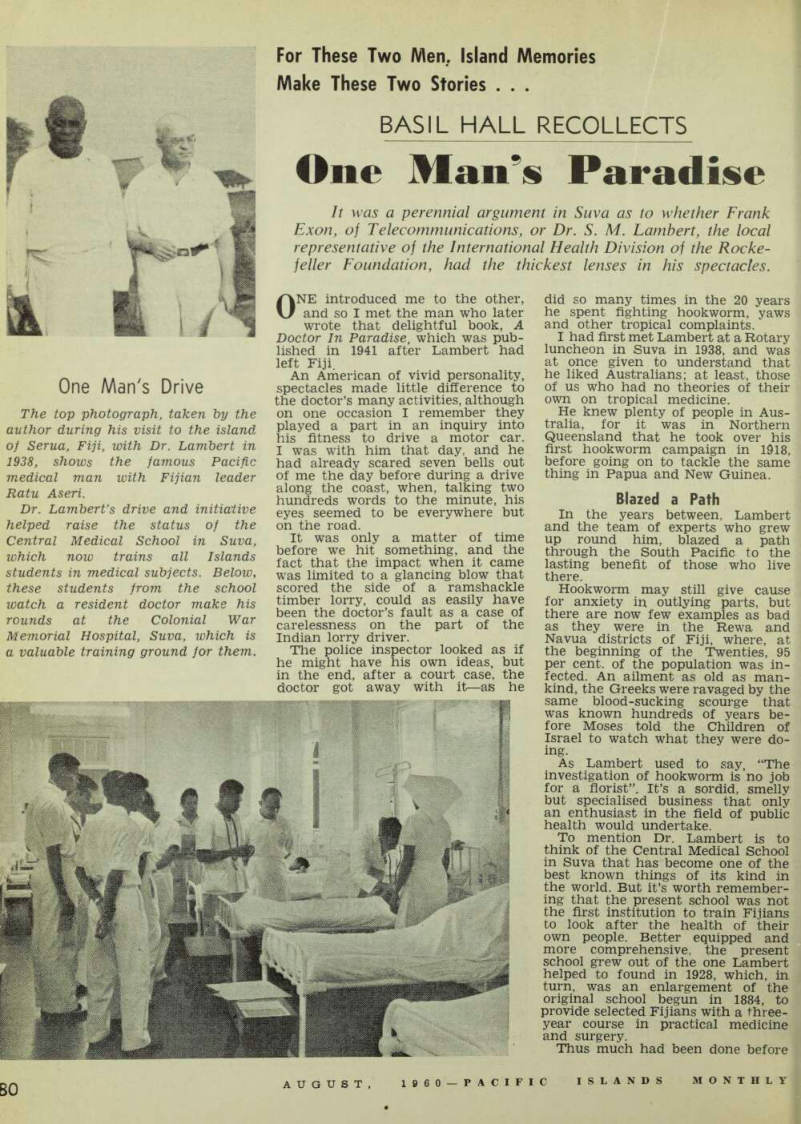
The top photograph, taken by the author during his visit to the island of Serua, Fiji, with Dr. Lambert in 1938, shows the famous Pacific medical man with Fijian leader Ratu Aseri.
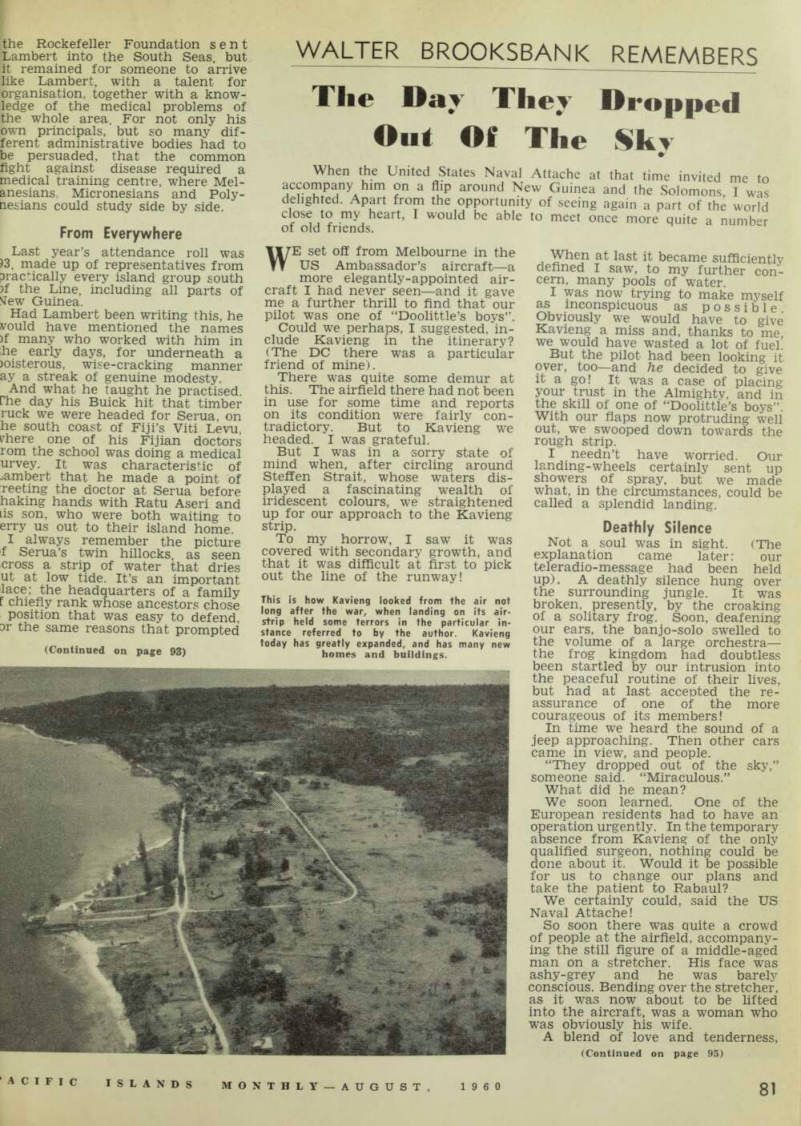
Dr. Lambert’s drive and initiative helped raise the status of the Central Medical School in Suva, which now trains all Islands students in medical subjects. Below , these students from the school watch a resident doctor make his rounds at the Colonial War Memorial Hospital, Suva, which is a valuable training ground for them.
the Rockefeller Foundation sent Lambert into the South Seas, but it remained for someone to arrive like Lambert, with a talent for organisation, together with a know ledge of the medical problems of the whole area. For not only his own principals, but so many dif ferent administrative bodies had to be persuaded, that the common fight against disease required a medical training centre, where Mel anesians, Micronesians and Poly nesians could study side by side.
From Everywhere
Last year’s attendance roll was )3, made up of representatives from practically every island group south )f the Line, including all parts of yew Guinea.
Had Lambert been writing this, he vould have mentioned the names )f many who worked with him in ;he early days, for underneath a >oisterous, wise-cracking manner ay a streak of genuine modesty.
And what he taught he practised rhe day his Buick hit that timber ruck we were headed for Serua, on he south coast of Fiji’s Viti Levu, inhere one of his Fijian doctors rom the school was doing a medical urvey. It was characteristic of .ambert that he made a point of reeting the doctor at Serua before hakmg hands with Ratu Aseri and lis son, who were both waiting to erry us out to their island home.
I always remember the picture f Serua’s twin hillocks, as seen cross a strip of water that dries ut at low tide. It’s an important lace; the headquarters of a family f chiefly rank whose ancestors chose position that was easy to defend, Dr the same reasons that prompted
(Continued on page 93)
Cakobau, the last “King” of Fiji, to establish himself on the 20-acre island stronghold of Ban.
Soon in Stride Lambert was hitting his stride even before the formality of the welcoming kava ceremony was done, and just as he once “ballyhooed a Yankee’s message” to a hookwormy part of Australia, so now he edged the customary polite exchanges aside in order to get to the reasons for his visit.
I noticed in the discussion on TB that followed, that the views of the Fijian doctor were treated with the utmost respect. This was part of a policy designed to build up the standing of the Central Medical School and those who had graduated from it.
No one who has seen the work of these men in the field doubts the ability of the Islands races to absorb and practise what they learn. But in Fiji the native doctor —or Assist ant Medical Officer as the term went —has to contend with obliga tions that go back a long time.
Here everything belonging to the family or clan is more or less common property, and the pre scriptive rights of “kere kere” had the same meaning in Serua as in other parts of the Colony.
“What my brother has is mine,” they say. and so the tailored shirt or lava lava, a fine new wrist watch or anything else belonging to a visiting relative can be demanded by connections in remote degree.
In most cases, the victim sees to
it that the score is evened up in some vay, but Lambert’s sense of fitness vas outraged by the thought of his foung doctors returning from patrol n little more than their birthday suits, and he was forever plugging ;he theme that professional stand ng deserved a better reception.
During his lifetime Dr. Lambert ;ave everything he had to the jeoples of the Pacific, and the laradise he knew grew up around dm.