Saibai: It's Sinking, But
pp. 81-95 · Read in the full issue
It's Still Home
The Torres Strait island of Saibai only one and a half miles from the New Guinea mainland although it is Queensland State territory is slowly being submerged.
By Dora Elizabeth Burchill
A ROCK wall has been built along the beach to keep out the seas from the 40 yard wide and one mile long Saibai, but every year the water in the village well be comes saltier.
Two hundred coloured people live on the island now, but 400 others have already turned their backs on Saibai for life at a new home directly south on the Australian mainland at Cape York Peninsula.
They moved in 1948, not because the island was sinking but because of malaria. Although the swamps are sprayed, mosquitoes continued to be the menace of Saibai. For three months of the year they are almost anbearable; bad enough during the lay but at night like hordes of fly ng ants. The natives then exchange ;heir lava lavas for long cotton ;rousers.
Fires are made with a certain ;imber that keeps smoking. When moving away from the village, a imb of this smoking timber is carried to ward off attacks by ;roops of zinging mosquitoes.
The big 1948 trek to the mainland vas led by Bamaga, last of the VTamooses (head man) bringing his ;ribe, like Moses of old, to the 3 romised Land. By sea and land ;hey travelled under his faithful, ;heerful leadership, eventually ;ettling on an area of plain country vhich was named after him.
They Love The Mainland At first the people were homesick mt now they love Bamaga and have 10 desire to return to Saibai, and t seems likely that those who clung o their Islands home when the trek >egan will one day join them. For Bamaga is no shanty town; rather t is the rooting of an ideal.
Today, 400 Saibai islanders live here under the protection of the Uist. Government in rent free, neat umber houses surrounded by gardens of colourful shrubs and vegetable plots. In the school the hildren are taught civic pride. The mildings were made from local imber milled on the spot.
The latest development is tobacco growing, and an experimental plot las proved successful.
On Saibai itself, the people live n corrugated iron huts with wooden ioors; and still remaining are a few ncturesque grass huts adroitly hatched from coconut palm leaves.
The children attend school in a modern fibro and timber building, and are taught by a native Govern ment teacher. All are under the care of the Q’ld. Govt, and the Church of England. The people are highly religious, attending services regularly in the handsome lime stone Holy Trinity Church, presided over by an ordained priest trained at the native Theological College at Moa Island, Torres Strait.
Owing to the nature of Saibai, agriculture is limited. Sweet potatoes and pumpkins are raised on elevated plots of earth shovelled in from the edge of swamp land, the ring of water surrounding pro viding moisture during the dry season.
The are mangoes and coconuts in season. Barramundi weighing up to 40 lbs, turtles speared on the reefs and dugongs hunted in shallow waters provide excellent food.
On one recent hunt, 11 dugongs were speared. These remarkable sea cows weigh half a ton and pro duce six gallons of oil. The oil is procured by rendering down the meat in four gallon petrol drums.
It has highly medicinal qualities and is sent from Saibai Island to Thursday Island for use in the Tuberculosis Hospital.
A local nurse is in charge of a Medical Aid Post at Saibai and daily radio contact is made with Thursday Island, and the General Hospital when necessary. Thursday Island is the medical headquarters for Torres Strait.
Cedar Canoes
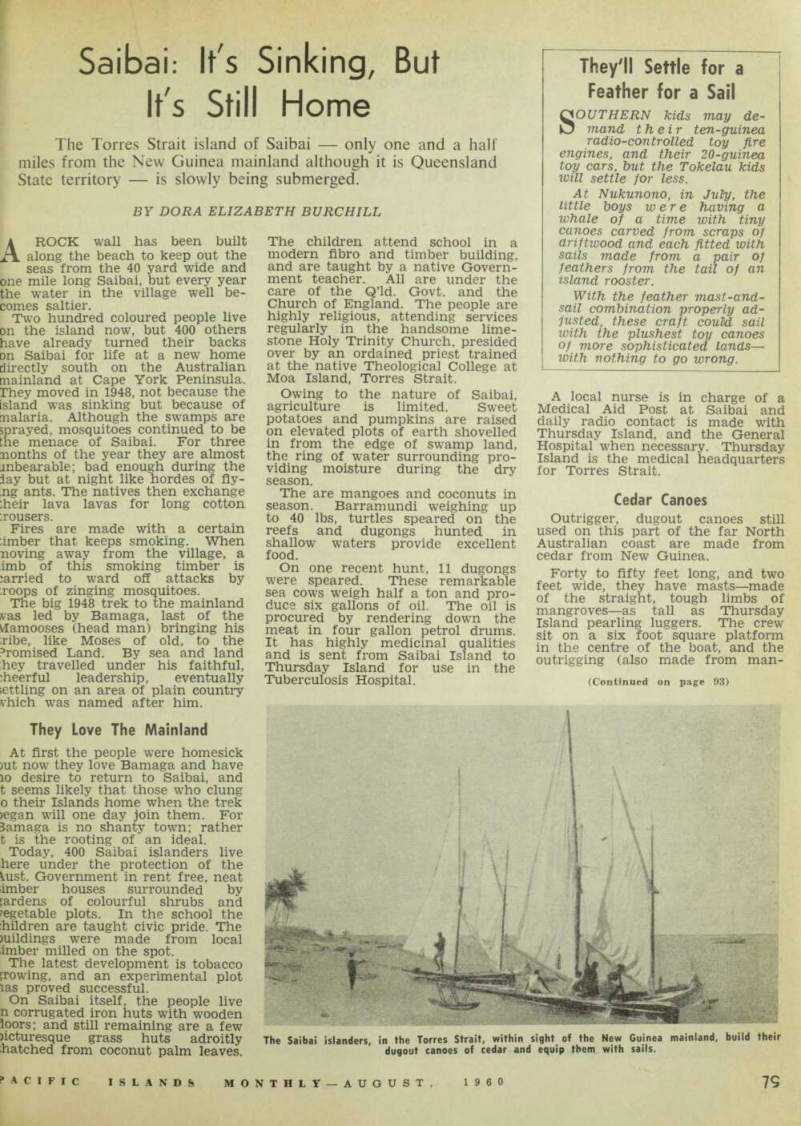
Outrigger, dugout canoes still used on this part of the far North Australian coast are made from cedar from New Guinea.
Forty to fifty feet long, and two feet wide, they have masts—made of the straight, tough limbs of mangroves—as tall as Thursday Island pearling luggers. The crew sit on a six foot square platform in the centre of the boat, and the outrigging (also made from man
(Continued on page 93)
The Saibai islanders, in the Torres Strait, within sight of the New Guinea mainland, build their dugout canoes of cedar and equip them with sails.
>ves) extends fifteen feet each e. k strong guest of wind can be n coming from nor’east 200 yards ay, and to save the boat sinking m the pressure of the wind the w take to the outrigging until las passed. Saibai Island’s nearest nt to New Guinea is about one i half miles, where natives can seen walking along the beach. )m the nearby New Guinea inland villages the natives come ce a week to trade with the inders. They also come from up ; rivers, bringing coconuts,
bananas, yams, sago, geese and pigs.
In exchange they receive rice, flour, soap, calico, bullets, and other commodities. Such goods as rice, flour and sago are kept dry in narrow timber boxes shaped like a long stick, and lined with palm leaves.
This trading is a very agreeable arrangement, for the nearest “shop ping centre” for the New Guinea natives is 50 miles away at Daru, headquarters of the West. District of Papua, where the regular cargo boat from Port Moresby terminates its run. Saibai islanders row across to the New Guinea mainland for fresh water or to hunt wild pigs in the bush with their mongrel dogs.
Though good church com municants, one hear references to belief in evil spirits on Saibai.
Recently I heard of a young man who went across from Saibai to New Guinea to get some hair oil from the Puri Puri man there so that a certain girl he sought to woo would be attracted to him by the pungent scent.
I didn’t hear how he got on.