Why Travel To Europe
pp. 51-55 · Read in the full issue

Sydneysider At Home Base
Why Travel To Europe To Freeze To Death?
And nvw the winter of our discontent . The season for gales, flu, rain and cold ; for end-of-financial-year blues ; and, on July 31, I.T. (for Income-Tax) Day.
yrow, in regard to the latter, there has been a change this year, with the Tax-Gatherer diom one usually visualises as an verstuffed Shylock hacking pounds f flesh from most tender parts, ppearing in the unaccustomed dis uise of Santa Claus.
This is due to Treasurer Holt’s budget of almost a year ago. ilthough it was, on the whole, a lothing-for-Nobody, he did relent d the extent of a 5 per cent, rebate n personal income-tax..
Most taxpayers forgot all about bis, but when the Income-Tax Re am forms were handed out this ear, there it was at the bottom of age three, in the tiniest type in the rinter’s repertoire: “Less 5 per cent, sbate”.
Taxpayers were inclined to over >ok it altogether, but in his Faery ay role, the old Tax-Gatherer bent ver backwards and has promised i deduct it himself in the cases here taxpayers have suffered from oor eye-sight.
In this country, of course, we not nly have Pay-As-You-Go taxation -which means that the Federal 'reasurer gets his rake-off, through ix stamps or group certificates, as Don as you have earned anything; ut in the matter of finding out ow much you owe, it is also a Do t-Yourself scheme.
There, in a tiny square on page iree, too small to fit the average ixpayer’s handwriting or income, i a space reserved for “Taxpayer’s alculation Based On His Own In- Dme”, and here you figure just hat you reckon the damage is.
You then compare it with your ix stamps (or group certificate) nd, in a space on page one, you rite in what extra you owe the
ax-Gatherer; or alternatively, what
ou think he owes you.
This year, due to Mr. Holt’s muni ficence, it is calculated that five out of six taxpayers are owed some thing, and that in the State of NSW alone it will total no less than £3O million.
You will be pleased to know that your Sydneysider (according to her private calculation on page 3), is one of the five, and that at this very moment, the Commonwealth of Australia is in the unhappy posi tion of owing her £B6/19/-.
It will, no doubt, take six months before this magnificent sum is back in my hands; and although my Conscious will know perfectly well that it is all my own hard-earned dough, by then my Sub-Conscious, like the Sub-Consciouses of all those other five-out-of-six taxpayers, will be perfectly convinced that it is a beautiful, free handout from the wonderful, generous Australian Gov ernment.
And, for a Government Depart ment, I think that’s pretty good psychology.
(For those with devious minds, who might be led to think that £B9/19/- is one-twentieth of the tax I pay, and who then are tempted to go on to calculate me (some fabulous income—let me disillusion them. Due to some horrible shocks of a few years ago, when I was forced to perform on page one, on the line reserved for “Additional Amount Payable to the Taxation De partment”—all due to Provisional- Tax, which is a longer and bitterer story—the accounts department here has instructions to take, not only the amount the Government says I
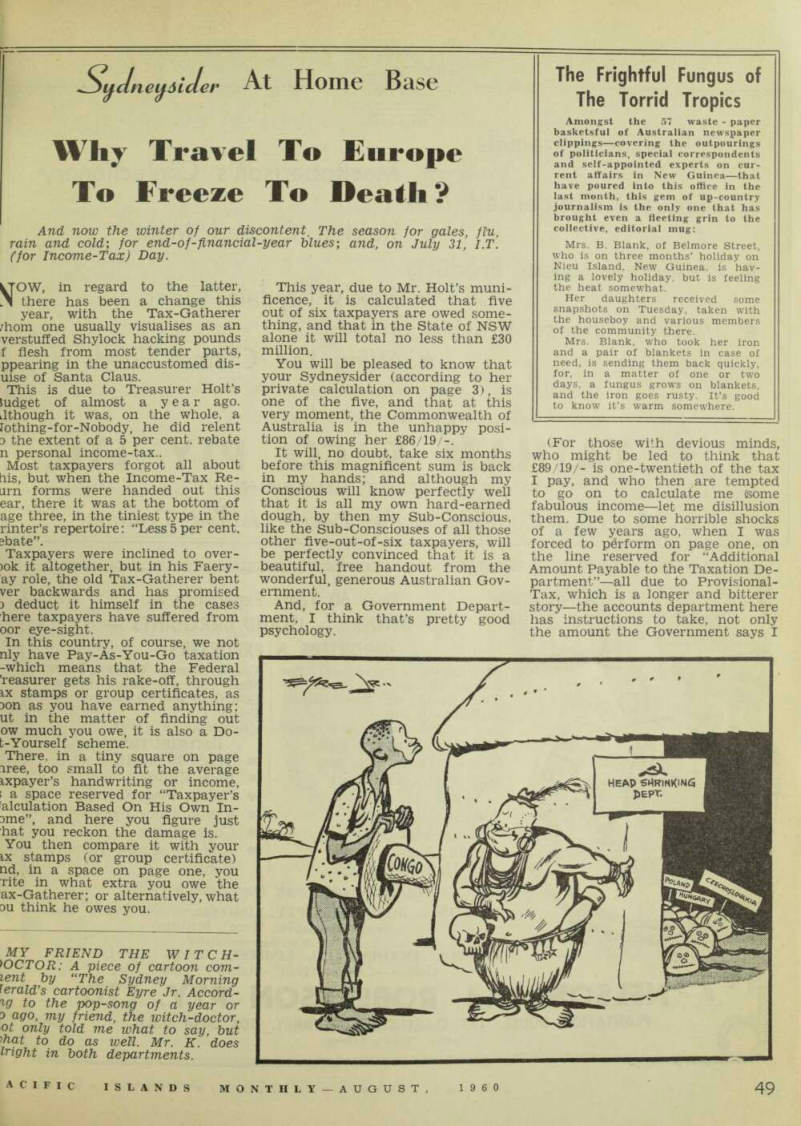
My Friend The Witch
[?]OCTOR: A piece of cartoon com [?]ent by “The Sydney Morning [?]erald’s cartoonist Eyre Jr. Accord [?]ng to the pop-song of a year or [?]o ago, my friend, the witch-doctor, [?]of only told me what to say, hut [?]that to do as well. Mr. K. does [?]right in both departments.
owe it out of each month’s salary cheque, but a nice, round, extra sum as well. This extra is designed to cushion me against the worst slings and arrows of the Taxation Depart ment, and this, if my figuring on page three is correct, has paid dividends this year).
Wanted Some Winter Grit Six months ago, I was writing about snow-bound wanderings in Europe. We had, I think I said, the long white roads of France to our selves, as we worked our way down through Normandy, to the Mediter ranean, into Spain and on to Barce lona—the snow and ice still with us.
I don’t know what excited me so much about that. The same thing is currently happening in all parts of NSW that are over 3,000 ft eleva tion, in one of the coldest winters since heaven knows when.
Yesterday dozens of vehicles were held up on the Western Highway near Lithgow (one of the most miserable holes in NSW), because they couldn’t negotiate the snow and ice on the road.
The difference between here and Europe, of course, is that (1) we aren’t used to it; and (2) winter grit.
The motoring Antipodean visitor to Europe—England, anyhow— in summer, is struck at once by some thing new on the roads—the gravelled area that appears every mile or two, between the road-edge and the fields, where vehicles can pull off the road out of the way of the ceaseless traffic. These areas are called, and labelled, “Lay-bys”. (In Australia a lay-by is a very different thing—it’s a form of deferred pay ment for goods, used mostly by vomen. You see something you want, pay a deposit of a few shillings in the £, the shop puts it away and keeps it for you for from three to six months at no extra charge.
Huge sections of retail business are devoted to “Lay-bys”—and there is no counterpart of this type of merchandising in Europe).
But back to motoring: The visitor to Europe in winter sees something else besides lay-bys that’s different.
Beside the roads, at frequent inter nals, especially on hills and curves, are piles of fine gravel. On the Con tinent they are just there; in the UK they have little notices stuck an them: “Grit”; or sometimes, ‘Winter grit”.
The drill is that when your car wheels won’t grip, you scatter the ?rit on the ice or snow—then, Bob’s your Uncle, off you go.
If the freeze lasts long enough, or is extensive enough, local road gangs come out and do it for you— as they did in France and Spain after the first day or so of the big January freeze up.
But in Australia—no winter grit: so when it freezes on the Table lands, road traffic halts until the thaw —fortunately rarely more than a few hours.
Central Heating is
Just for Sissies
By and large, the Australian has not yet learned to fiddle with his climate to the same extent as in Europe, America or even South- East Asia.
Probably the most enervating,
dehydrating and tropically fatiguing place on this earth is a London de partment store during the mid winter sales; and there is scarcely a hotel or public institution worthy of the name, from Gibraltar to John O’Groats, which is not equipped with central heating. (At the other end of the scale, some of the hotels, restaurants and public places in tropical Asia are so ferociously air conditioned that they strike ice into your marrow, and send you scuttling for cardigans and sweaters).
In Australia however, particularly from Sydney northwards, it’s a
xation to grin and bear it, even : the temperature soars to 110 egrees in summer, and icy westerlies ring on pneumonia in winter.
The idea has some merit in a [imate that has three very cold lonths, two steaming Turkish-bath lonths, and seven other months of scellent weather, but taken to ex emes, it is not calculated to make ■iends, or influence overseas visitors -except against us.
Twice during the month I’ve had ) go out to the Overseas Terminal b Kingsford-Smith airport. Once to ieet a pre-breakfast arrival: and ?ain, to farewell a Fiji friend, he Fiji friend had been held up lere for four hours when I arrived.
He was purple in the face and as walking around stamping his ;et for fear they’d drop off with hat he imagined might be frost- Ite. He told me, with a glazed look i his eye, tha f he had had 17 cups f coffee (nothing stronger is mailable, of course) in the sloppy, lain-store style cafeteria, in order > try to keep the cold out.
Even more recently, an American mrnalist has had a tilt at the ime establishment—he says it’s the orst International Terminal in the orld. This is, from my own expen se, an exaggeration; but so little saggeration that it doesn’t matter. ; is, anyhow, the only airport, of ny international pretentions what yer, where a policy of deliberately 'ying to freeze customers to death i pursued.
On none of my winter excursions out there have I seen as much as one small electric radiator in the whole barn-like fibro and wood ex tent of it.
The Thirteen-and-Four
That Isn’t There
The time is rapidly coming when, in the currency sense, we will be on the same level as the Spaniards, Italians. Greeks, Indians and others who find it necessary to carry around wads of filthy little notes and pockets full of worthless metal coins in order to transact the business of the day.
But instead of pesetas, drachma and the rest, we’ll be carying suit cases of £1 and 10/- notes in order to cope with the grocer and the butcher and baker.
According to figures issued re cently by the Victorian Institute of Public Affairs, the Australian £ of today will buy only what 10/- bought in 1948-49; and only what 6/8 bought in 1940.
In this race to inflationary ex tinction, we are closest to the UK, whose £ is worth only 37 per cent, of what it was, in the buying sense, before the war. Both of us compare unfavourably with New Zealand, whose £ is worth 42 per cent, of its pre-war value; America, whose dollar is worth 49 per cent., or Canada, wffh a dollar worth 50 per cent.
Even better off are the Swiss, with a franc that is worth 55 per cent, of its pre-war value; and West Ger many (we beat them, remember in World War II), with a mark that buys 52 per cent, as much as the pre-war mark.
The Victorian Institute also sup plies the recipe for dealing with this galloping inflation: • Business management should promote good industrial teamwork and employee relations upon which an enthusiastic effort could be based. • Management should aim at reasonable and not excessive profits and charge reasonable and not excessive prices. • Employees should make efficient use of their working time, also the materials and equipment they use; they should observe rules and keep a look-out for ideas to increase efficiency. • Government should have a responsi bility to give real leadership to combat inflation. They have a duty to re strain their spending to what the economy could afford.
What a hope! In mid-July, and affecting the August-October quarter, the basic-wage, cost-of-living ad justments went up 18/- per week in Victoria (where they have removed control on rents), 7/- in Adelaide, 6/- in Hobart, 5/- in Perth, 3/- in Sydney and 2/- in Brisbane; the NSW Miners’ Unions have asked the Arbitration Court for a 35-hours week and the NSW Government (Labour) is supporting them; Iron workers’ Unions are asking for the same thing; Federal unions are petitioning the courts for three weeks’ annual leave (four weeks for shift workers) instead of the pre sent two; some of the big industrial companies have been announcing some of the biggest profits ever; some of the most fantastic take over bids in the history of the Com monwealth are cause for current comment; while any private in vestor who is getting less than 10 per cent, on his investment feels that he’s being got at.
Who amongst the above is going to make the first sacrifice in the business of Putting Value Back into the Australian £—a catch-cry, I seem to remember, from the elec tion policy of a fellow named Menzies, before the Liberal Party romped home in a landslide vic tory in 1949.
Why fly yourself when you can go by jet? American collectors are [?]homing interest in New Caledonian native birds, and small shipments are [?]eing made by air. This container holds 40 little finches all set to make he Pacific crossing from Noumea.
Photo: Fred Dunn.