More Hotels :: Fewer Tourists
pp. 41-45 · Read in the full issue


From Some Notes Made In Fiji
By R. W. Robson
One gets the impression that Fiji is not doing all that might he done to stimulate the tourist traffic, and that the stream of tourists moving through the archipelago this 1960 season ' is less than in previous years.
r[ERE does not seem to be any authority or agency in Fiji with the necessary power, or imagina tion —or funds —to really sell Fiji’s tourist attractions to the world.
It is a pity. The world wants what Fiji has to sell; and Fiji desperately needs the revenues brought by tourism.
However, the industry which owns and operates hotels in Fiji is doing its share. The reproach, that tourism cannot be fully developed in Fiji because there are not enough hotels, can no longer be employed. Never have I seen so much hotel-building going on in Fiji at one time.
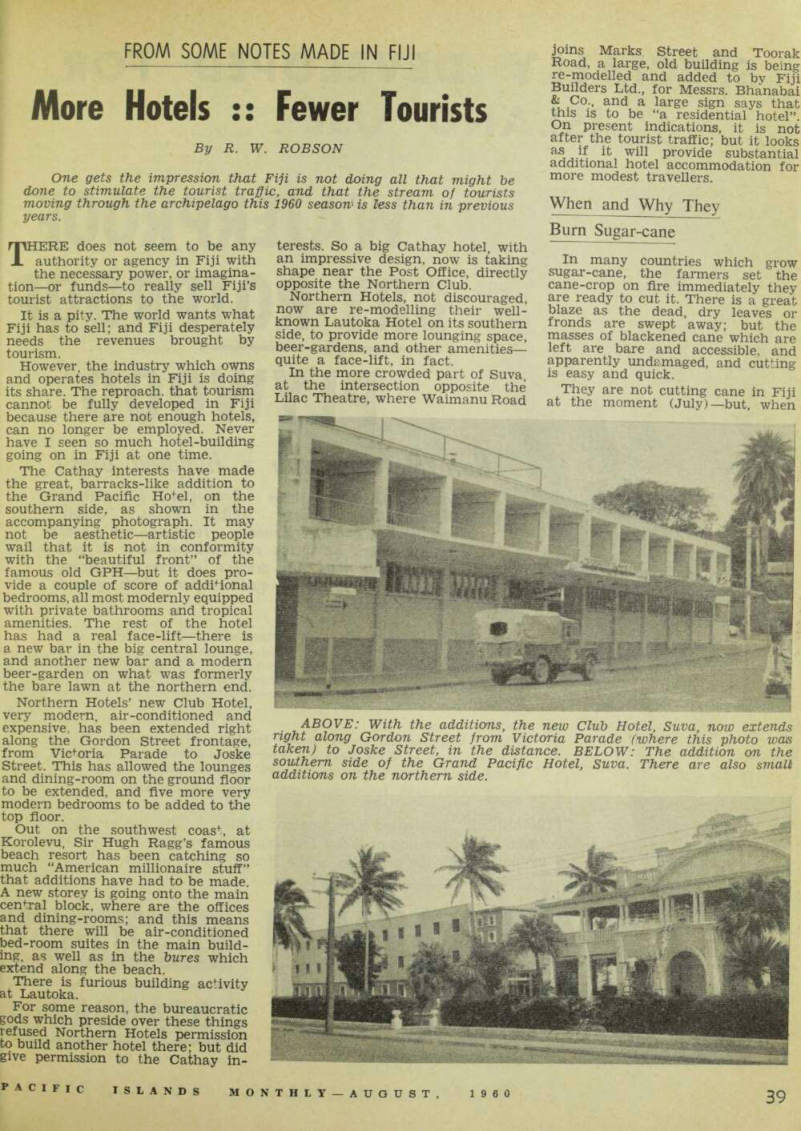
The Cathay interests have made the great, barracks-like addition to the Grand Pacific on the southern side, as shown in the accompanying photograph. It may not be aesthetic—artistic people wail that it is not in conformity with the “beautiful front” of the famous old GPH —but it does pro vide a couple of score of additional bedrooms, all most modernly equipped with private bathrooms and tropical amenities. The rest of the hotel has had a real face-lift —there is a new bar in the big central lounge, and another new bar and a modern beer-garden on what was formerly the bare lawn at the northern end.
Northern Hotels’ new Club Hotel, very modern, air-conditioned and expensive, has been extended right along the Gordon Street frontage, from Victoria Parade to Joske Street. This has allowed the lounges and dining-room on the ground floor to be extended, and five more very modern bedrooms to be added to the top floor.
Out on the southwest coast, at Korolevu, Sir Hugh Ragg’s famous beach resort has been catching so much “American millionaire stuff” that additions have had to be made.
A new storey is going onto the main central block, where are the offices and dining-rooms; and this means that there will be air-conditioned bed-room suites in the main build ing. as well as in the hures which extend along the beach.
There is furious building activity at Lautoka.
For some reason, the bureaucratic gods which preside over these things refused Northern Hotels permission to build another hotel there; but did give permission to the Cathay in
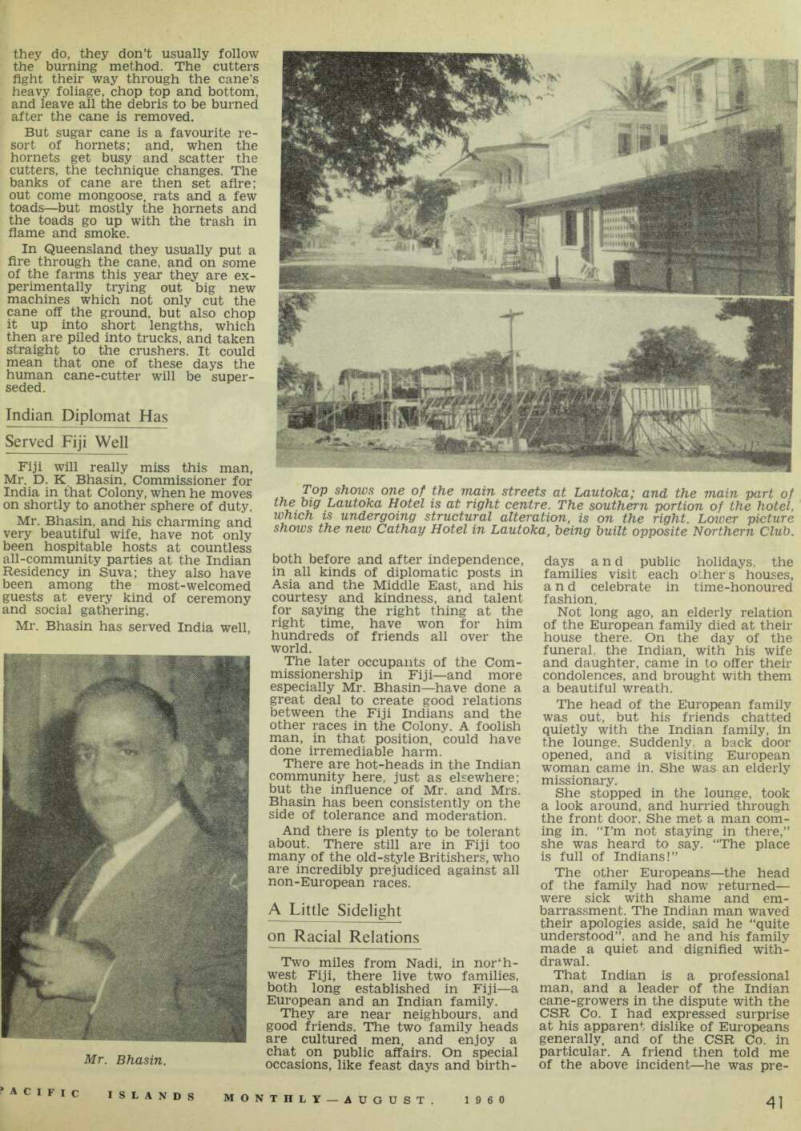
terests. So a big Cathay hotel, with an impressive design, now is taking shape near the Post Office, directly opposite the Northern Club.
Northern Hotels, not discouraged, now are re-modelling their well known Lautoka Hotel on its southern side, to provide more lounging space, beer-gardens, and other amenities— quite a face-lift, in fact.
In the more crowded part of Suva, at the intersection opposite the Lilac Theatre, where Waimanu Road
joins Marks Street and Toorak Road, a large, old building is being re-modelled and added to by Fiji Builders Ltd,, for Messrs. Bhanabai & Co., and a large sign says that this is to be “a residential hotel”.
On present indications, it is not after the tourist traffic; but it looks as if it will provide substantial additional hotel accommodation for more modest travellers.
When and Why They
Burn Sugar-cane
In many countries which grow sugar-cane, the farmers set the cane-crop on fire immediately they are ready to cut it. There is a great blaze as the dead, dry leaves or fronds are swept away; but the masses of blackened cane which are left are bare and accessible, and apparently undamaged, and cutting is easy and quick.
They are not cutting cane in Fiji at the moment (July)—but, when
ABOVE: With the additions, the new Club Hotel, Suva, now extends right along Gordon Street from Victoria Parade (where this photo was taken) to Joske Street, in the distance. BELOW: The addition on the southern side of the Grand Pacific Hotel, Suva. There are also small additions on the northern side.
they do, they don’t usually follow the burning method. The cutters fight their way through the cane’s heavy foliage, chop top and bottom, and leave all the debris to be burned after the cane is removed.
But sugar cane is a favourite re sort of hornets; and, when the hornets get busy and scatter the cutters, the technique changes. The banks of cane are then set afire; out come mongoose, rats and a few toads—but mostly the hornets and the toads go up with the trash in flame and smoke.
In Queensland they usually put a fire through the cane, and on some of the farms this year they are ex perimentally trying out big new machines which not only cut the cane off the ground, but also chop it up into short lengths, which then are piled into trucks, and taken straight to the crushers. It could mean that one of these days the human cane-cutter will be super seded.
Indian Diplomat Has
Served Fiji Well Fiji will really miss this man, Mr, D. K Bhasin, Commissioner for India in that Colony, when he moves on shortly to another sphere of duty.
Mr. Bhasin, and his charming and very beautiful wife, have not only been hospitable hosts at countless all-community parties at the Indian Residency in Suva; they also have been among the most-welcomed guests at every kind of ceremony and social gathering.
Mr. Bhasin has served India well,
both before and after independence, in all kinds of diplomatic posts in Asia and the Middle East, and his courtesy and kindness, and talent for saying the right thing at the right time, have won for him hundreds of friends all over the world.
The later occupants of the Com missionership in Fiji—and more especially Mr. Bhasin—have done a great deal to create good relations between the Fiji Indians and the other races in the Colony. A foolish man, in that position, could have done irremediable harm.
There are hot-heads in the Indian community here, just as elsewhere; but the influence of Mr. and Mrs.
Bhasin has been consistently on the side of tolerance and moderation.
And there is plenty to be tolerant about. There still are in Fiji too many of the old-style Britishers, who are incredibly prejudiced against all non-European races.
A Little Sidelight
on Racial Relations Two miles from Nadi, in north west Fiji, there live two families, both long established in Fiji—a European and an Indian family.
They are near neighbours, and good friends. The two family heads are cultured men, and enjoy a chat on public affairs. On special occasions, like feast days and birth
days and public holidays, the families visit each others houses, and celebrate in time-honoured fashion.
Not long ago, an elderly relation of the European family died at their house there. On the day of the funeral, the Indian, with his wife and daughter, came in to offer their condolences, and brought with them a beautiful wreath.
The head of the European family was out, but his friends chatted quietly with the Indian family, in the lounge. Suddenly, a back door opened, and a visiting European woman came in. She was an elderly missionary.
She stopped in the lounge, took a look around, and hurried through the front door. She met a man com ing in. “I’m not staying in there,” she was heard to say. “The place is full of Indians!”
The other Europeans—the head of the family had now returned— were sick with shame and em barrassment. The Indian man waved their apologies aside, said he “quite understood”, and he and his family made a quiet and dignified with drawal.
That Indian is a professional man, and a leader of the Indian cane-growers in the dispute with the CSR Co. I had expressed surprise at his apparent dislike of Europeans generally, and of the CSR Co. in particular. A friend then told me of the above incident—he was pre
Mr. Bhasin.
Top shows one of the main streets at Lautoka; and the main part of the big Lautoka Hotel is at right centre. The southern portion of the hotel, which is undergoing structural alteration, is on the right. Lower picture shows the new Cathay Hotel in Lautoka, being built opposite Northern Club.
sent and witnessed it. So we should not judge too harshly— there often is more in these things than meets the eye.
Good Cheap Houses For Artisan Classes of Fiji Nothing is better calculated to promote “peace, order and good gov ernment” in any community than plenty of suitable housing; and, in that respect, the Fiji Administra tion and its instrumentalities are doing a praiseworthy job.
Here are photographs of dwellings newly erected in selected areas at Laucala Bay, Lami, and other suburbs of Suva, designed to pro vide a modest wage-earner with a suitable place in which to live.
For example, the neat little house shown in the centre photo, has two bedrooms, a kitchen and sitting room, bathroom and lavatory, elec tric light and city water; a Euronesian and his wife and child Dccupy it at a rental of £6/10/- per nonth; and the regular payment )f that rental gradually gives them complete ownership.
These housing projects are the special hobby of Mr. John Falvey, VTLC, who is assisting the Govern nent Housing Authority in vari ms ways. He takes an active in erest in their promotion and de
velopment. Millers Limited are carrying out the work at Laucala Bay, and a special enterprise headed by young Brian Derrick is creating a neat little suburb at Lami, over looking the Bay of Islands.
This is all to the good. Some very dreadful slums—the only resort of unfortunate Indian families—have been tolerated at the back of Suva for too long—these housing projec f s should be the counter to them.
Fiji Now Is Eating
Home-grown Capons
For some months now, every three weeks, 2,000 day-old chicks have been taking off from Sydney in a trans-Pacific airliner for Suva, Fiji Three months later, they are fat capons, dressed, cellophaned and frozen, ready for the chef.
Every hotel and restaurant in Fiji and scores of private citizens, are reaching out for this attractive new line in locally-produced food— the demand persistently outstrips the supply.
This is the praiseworthy private enterprise of Mick Boulton and Vic Jackson, two young men of Suva, Fiji-born and formerly facing apparently dead-end jobs.
Their initiative and energy gained for them the support of the De partment of Agriculture and the
Industrial Loans Board; they acquired suitable land out at Lami; built suitable brooder, weaning and fattening houses; brought in elec tricity and water; introduced gadgets for automatic feeding and watering got the peculiar kind of equipment that removes feathers, helps clean the birds and deep freezes them— and now the business is running like a well-oiled machine.
Mick Boulton showed me over the establishment—separate sheds where gentlemen fowls (he calls them “boys”) at various stages of growth sit in clean wire cages, and eat, and eat, and eat.
It is essentially a place for males; but in one little house, all by itself, there sat a dozen “girls”, immobil ised in small wire cages of peculiar construction. Food and water go in at one end, and brown eggs come out at the other. The egg is auto matically guided from the hen into a padded channel, and rolls down a little ramp under her floor into a compartment in front of the cage. To see the consternation on the face of the “girl” as the new laid egg appears suddenly in front of her, is alone worth the price of admission.
At present, most of the consider able quantity of food needed for these thousands of capons is im ported; but the two young men are actively planning local production —which, of course, will further stimulate local industry.
It is part of an all-out effort which Fiji is expected to make in the job of feeding itself and cor respondingly reducing imports.
Examples of [?]rtisans’ houses [?]hat are being [?]ilt by housing [?]uthorities in Suva,Fiji.
Top: A vista of [?]eat white [?]ottages, over - [?]ooking Laucala Bay, Centre: Typical [?]ottage at Lau [?]ala Bay.
Lower: One of [?]he cottages at [?]he new suburb at [?]ami.
Mick Boulton and helper, with a capon, just dressed, labelled and frozen.