Wild Night
pp. 35-36 · Read in the full issue

When the Tidal Waves Hit
In Avatiu
By R. Boyd
The tidal waves that spread right icross the Pacific in May, following levastating earthquakes in Chile, caused some excitement when they lot amongst a trio of visiting yachts it Rarotonga, Cook Islands.
JJUNDAY, May 22, was a pleasant 5 enough day, particularly when you had just spent three rather lectic weeks at sea.
Three yachts had left Whangerei, n Northern New Zealand on the ame day, April 30, and I had sailed ,s crew on one of them, Nina, now wned by Theo Buckthought. On oard as well were Theo’s wife, Mary, nd their four young sons. We tied p at Avatiu Harbour on the north ide of Rarotonga on the afternoon f May 21, and were followed, early he next morning by Kehua. Patsy ean could be expected any time.
'ahiti, an American ketch, was Iready in port.
We spent most of Sunday drying ails, etc., and generally relaxing ut at 9.15 that night our relaxa ion was disrupted in the most larming manner.
Returning to Avatiu in response ) a telephone call, I was astounded ) see three boats sitting high and ry, held upright only by their looring lines and the frantic efforts f those on board, using spinnaker □oms and what-not for legs.
Two tidal waves had been experi enced and, as I arrived, the third ave came surging in. There seemed ) be no chance of an early let-up, ) it became imperative to get the imily ashore. This was made com aratively easy when the tide surged at again, and I was able to walk it to the boat and place the kids i the dinghy, floating alongside i a couple of feet of water.
A hospitable bystander rushed lem off to bed in her nearby house, ad they knew very little of the laos that followed.
It wasn’t necessary for me to use le dinghy to go back aboard Nina; just walked out and climbed up le bobstay! Theo was working vali atly with a boom and I set about iing the same. It was impractical > think of heading for sea (where e would no doubt have been safe) >r the other two boats were tied p in front of us and each of us was 'cured with half a dozen lines. All e could do was try to keep in ie narrow channel and hope that ir lines would weather the terrific rain they were called upon to and.
As the waves continued to surge
in and out it became obvious that something had to give. Kehua was soon performing acrobatics with only a stern line holding her, dragging her bilges noisily and dis dainfully across every available stretch of shallow water, and try ing hard to wreck herself.
At one stage she lay right down on her beam-ends. Tahiti soon joined in the fray and was rushing hither and thither, doing her best to poke her bowsprit through the other boat’s topsides. She managed to crack five of Kehua’s good kauri planks before she came to grief her self, and sank.
Masts Snap
The bowsprits on the other two boats snapped off like matchsticks as the boats charged one another, and on board we were completely helpless. The night was so dark it was impossible to see what was go ing on ashore. Our thanks went out to the kind fellow was left his car lights burning for four hours, and directed at us.
When one wave surged out, Kehua and Tahiti leaned towards each other, their rigging tangled and as they came upright again, there was a sound like a rifle shot as the New Zealand boat’s mainmast snapped off near the base.
On board Nina we had managed to keep things fairly well under control until Tahiti came back wi f h sufficient force to break our star board chain. This left us virtually without any bow line, and as the waves had now been going on for a couple of hours without any sign
of a respite, we took the advice of a knowledgeable local and pulled the yacht as far as possible up the beach, making fast to a convenient power pole.
Kehua by this time had climbed half-way up the stone jetty, and her crew, having made everything fast, had abandoned ship, first strip ping off the broken mast and rigging.
Having done quite some damage to everybody else, Tahiti holed her self several times on a large, coral head, and settled sedately on the bottom. Throughout it all, “Smithy”, her owner and lone crew, never lost his sense of humour.
At its worst, the tide had been rising and falling a maximum of about 12 ft but at 3 a.m. the surges had settled down to about three or four feet, and the interval, which had been as little as seven or eight minutes, was considerably greater.
The worst was over.
Some Got Away to Sea Things had not been good at the other harbour —Avarua—either.
Fortunately only one of the local trading boats, Dohiri, was in port, and her flat bottom had saved her from serious damage. The Union Co. launches, warned beforehand, had to put out to sea, where they spent a day and a half killing time and catching a few fish.
Next morning, the surges were still running fairly consistently, though much smaller and with many hands, and a jeep to tow her, Nina was soon back in the water.
About midday the harbours again began to emp'y out, so Nina and
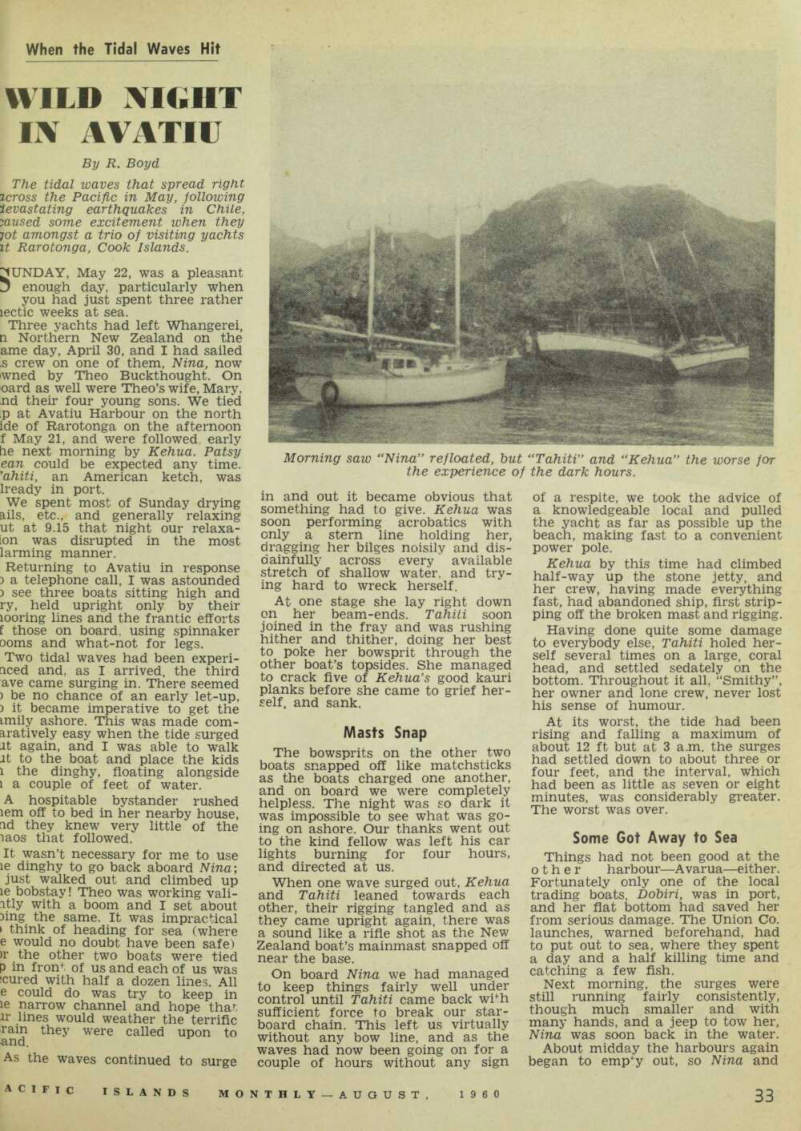
Morning saw “Nina” refloated, hut “Tahiti” and “Kehua” the worse for the experience of the dark hours.
Dobiri put to sea, to see it out ini safety. The Dobiri remained out for the night, but with the uncertainty of a broken rudder fitting, it seemed! best for Nina to head back in. Our 1 entrance was rather more sedatei than the exit, when we had shot out,, literally “on the crest of a wave.”' Nina has never moved faster.
Back in harbour we spent a mod erately fiuiet night, and by Tues day, in spite of another warning: over Radio Australia, things werei virtually back to normal and our thoughts turned to the question of the repairs that must be carried out.