Copra's Lokg-Term
p. 25 · Read in the full issue
No Boom in Sight
Look Is Fair
DURING July and early August, copra prices rose, but not as much as might have been ex pected in view of the fact that Messrs. Khrushchev and Lumumba joined with Dr. Fidel Castro in pro viding the kind of world tension that traditionally benefits this market.
According to figures issued by the P-NG Copra Marketing Board in early August, the price of copra on the London market between the be ginning and end of July, improved to the extent of £Stg.4 (from EStg.66/16/4 to £Stg.69/16/3) ; how ever, consumers did not show any signs of being stampeded into panic mying. And the average for July vas lower than June.
Probably they are waiting until eopra stabilises at that “sensible”
Mice that was mentioned in PIM n June—a price that it has now lust about reached, although for a :ommodity sold on the world market, vho can say when it has ‘stabilised”?
London c.i.f. prices for Straits- Borneo copra, published in PIM in he last 12 months, are interesting n that they show that the rot >egan to set in in April.
Prices, at the beginning of each nonth, have been: September, 1959, ‘Stg.B3; October. £Stg.94; No vember, £Stg.94; December, £Stg.B6; (anuary, £Stg.93; February, £Stg.9l; tfarch, £Stg.9o; April, £Stg.B3/10/-; tfay, £Stg.Bo; June, £Stg.7s; July, ■Stg.6B/10/-; August, £Stg.7o/10/-.
A bad typhoon in the copra pro lucing area in the Philippines at :nd of June had no apparent affect >n copra prices, up to the end >f July, although if much damage vas done to the plantations, this ould be felt in the coming months.
Seed Crushers Meet The Annual Congress of Inter lational Seed Crushers’ Association vas held this year in London, July 9-22, and was addressed by Mr. r. C. A. Faure of Unilever Raw Materials Division. Although Mr. r aure’s short-term survey didn’t ndicate any new boom in any of he edible-oils producing commod
ities, in the long term it seems that it would be foolish to neglect those coconut trees —yet. He calculates that by 1975 world consumption of all edible oils will have risen by 16 million tons per annum on present figures.
There seems to be n 6 reason to suppose that copra will x not have its share of this increased consump tion —and in territories where palms are already 50 or more years old, it seems to suggest that a vigorous replanting scheme might be in order.
Mr. lan McDonald, of the P-NG Copra Marketing Board, calculates that by 1970, Indonesia will be a copra importing country instead of an exporting one, for no other reason than its over-age trees, half of which are already 50 years old, or older.
Banno Bros. Copra Business
The entry of the Japanese firm of Banno Bros, into copra buying in Fiji has not developed into any kind of copra war.
Bannos and Island Industries Ltd. (a W. R. Carpenter & Co. subsidiary) have agreed to pay the same price; and the WRC company has agreed to grade all copra and pass it over its weighbridge. The grower then decides who he will sell it to.
That’s on the surface; underneath the competition probably is still as keen as ever—which is as it should be. Even producers who sell all their copra to Island Industries, feel that having another buyer in the Colony is a very good thing.
The Japanese firm buys only at Suva and Lautoka, but seems to be prepared to buy even the smallest quantities. It stores its copra in rented premises at Walu Bay in dustrial area and ships it out in chartered ships, which load mainly with ore and top up with copra.
It is possible that if they stay in the copra business Bannos will in stall the gear to do their own moisture-content grading.
Nz Commissioner
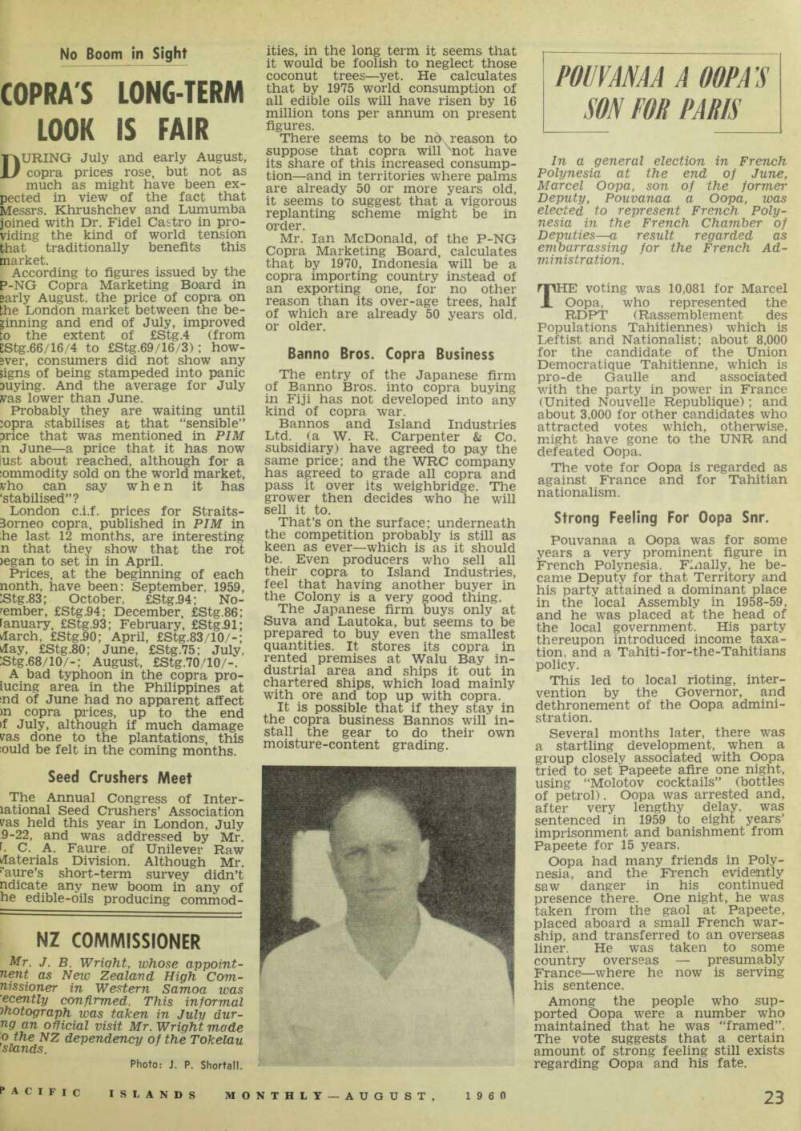
Mr. J. B. Wriqht, whose appoint ment as New Zealand High Com uissioner in Western Samoa was [?] tly confirmed. This informal motograph was taken in July dur ng an official visit Mr. Wright made O[?] the NZ dependency of the Tokelau 'stands .
Photo: J. P. Shortall.