Indian Lawyer
pp. 19-149 · Read in the full issue
Battle of The Sugar-Cane
Fiji Defied By An Elusive
At the end of the first week in August, it seemed that sufficient Indian cane-growers in Fiji were breaking away from the stubborn, anti-CSR leadership of the Indian lawyer, Mr. A.
D. Patel, to enable the Colony’s four big sugar-mills to begin crushing in mid-August. But Mr. Patel still was fighting all classes in Fiji in his attempt to prolong the deadlock.
Police and troops were sent to Labasa, August 10. (See p. 147.)
THE milling of a magnificent cane crop should have commenced on June 21, to enable Fiji to supply the world with its raw-sugar quota of 199,000 tons, worth about £8 millions.
The late start—for which “the Patel gang” is primarily responsible —will rob Fiji of some of those millions. Even if the Cuba-USA quarrel should result in Fiji’s sugar quota being increased, Fiji now will be unable to take advantage of it.
The Fiji deadlock goes back into 1959—see July PIM, page 29.
It was created partly by CSR Co. fumbling and ineffective propaganda in its relations with the contract cane-growers; and partly by an anti - CSR Co. drive directed by Mr. A. D.
Patel, which in character and pur pose has become more suspect in recent months.
Mr. Patel succeeded in rallying all the contract cane-growers (95 per cent. Indian, 5 per cent. Fijian) to a unanimous refusal to supply cane on terms offered by CSR Co.
In M a y-J un e the Company apparently recognised that a com bination of circumstances over which it had no control had created some genuine grievances among cane-growers; and in early June it made substantial concessions which apparently would allow the cutting and crushing operations to begin on
June 21. A section of the growers then were fully prepared to cut cane; but the Patel influence remained dominant, and a final agreement was avoided by an extraordinary series of hedgings and twistings.
Milling did not begin as planned.
Late in June, the Company put off some 1,400 mill-workers who had been standing by, and closed down the mills. (Lautoka, Ba, Penang, Labasa).
Mr. Patel did not conceal his pur pose. He declared in June they would drive the “greedy” and “monopolistic” CSR Co. out of Fiji, for the good of the colony, and carry on the great sugar industry there by means of small crushing plants and co-operative effort.
Fiji generally jeered at the fan tastic plan. The Fiji Times pointed out the strong resemblance between the ideas of Mr. Patel, in Nadi, and those of Messrs. Castro and Guevara in Cuba.
An increasing proportion of the growers became impatient with, the deadlock—they could see economic ruin approaching. So could most Fiji business men. Tempers became frayed.
Attempt to Murder
High Official
Although more and more cane growers, led by moderates like Vijay Singh, MLC (one of the most alert and influential Fiji-Indians), J. P.
Bayly and Adhodhya Prasad, showed readiness during July to be gin cutting, the Governor and CSR Co. struggled for complete agree ment, rather than breakaway. They knew that very ugly, subversive elements were behind the no-com promise section, and they feared disorder, burning and shooting.
Their fears were justified on July 12, As Western Commissioner H. G. R. McAlpine stepped from his car at his home two miles from Lautoka at 11 p.m., someone fired two barrels of a shot-gun at him from a distance of 50 feet, wounding him seriously in groin and hand.
The miscreant escaped. The Com missioner is making a good recovery.
This has been followed by several cane-fires, deliberately started.
Public reaction to the shooting was strong, and representatives of all the cane-growers were finally brought to still another meeting with CSR Co., in Lautoka, about July 21.
The Elusive Patels
The Company made further con cessions—in regard to the propor tion of each man’s cane to be taken, and extension of the crushing season another fortnight, to a date in January next.
On Saturday, July 23, complete verbal agreement was reached. It was decided that it should all be put into a formal document, to be signed at a further meeting at 2 p.m. on Sunday, July 24.
The canegrowers were to meet at 11 a.m., at Nadi, and then go on to sign the agreement in Lautoka.
But next day, the Patel group ducked and dodged; and despite the utmost efforts of the moderates, they could not be brought to a meeting.
So, after a couple of adjourn ments, the moderates met the CSR men late on July 24, and the growers who signed included J. P.
Bayly (Fiji Kisan Sangh), Vijay R.
Singh (Labasa Kisan Sangh), Isikeli Nadalo (Nadroga Fijian Growers), Maleki Dakui (Ra Fijian Growers) and Ratu M. Latianara (Ba Fijian Growers). It was estimated that they represented 65 per cent, of growers.
Anticipating that the Patel section (about 35 per cent.) would ulti mately sign, a settlement was offici ally announced in the Fiji Times on Monday morning, July 25.
Within 24 hours, it was known that the “Patel gang” would not sign; that it had been joined by Mr. D. B.
Lakshman; and that it was prepar ing a new set of conditions for sub mission to the Company. Why the head of the Millworkers’ Union (Mr.
Lakshman) should have joined Mr.
Patel in this enterprise, no one at tempted to explain—it served only
(Continued on page 147)
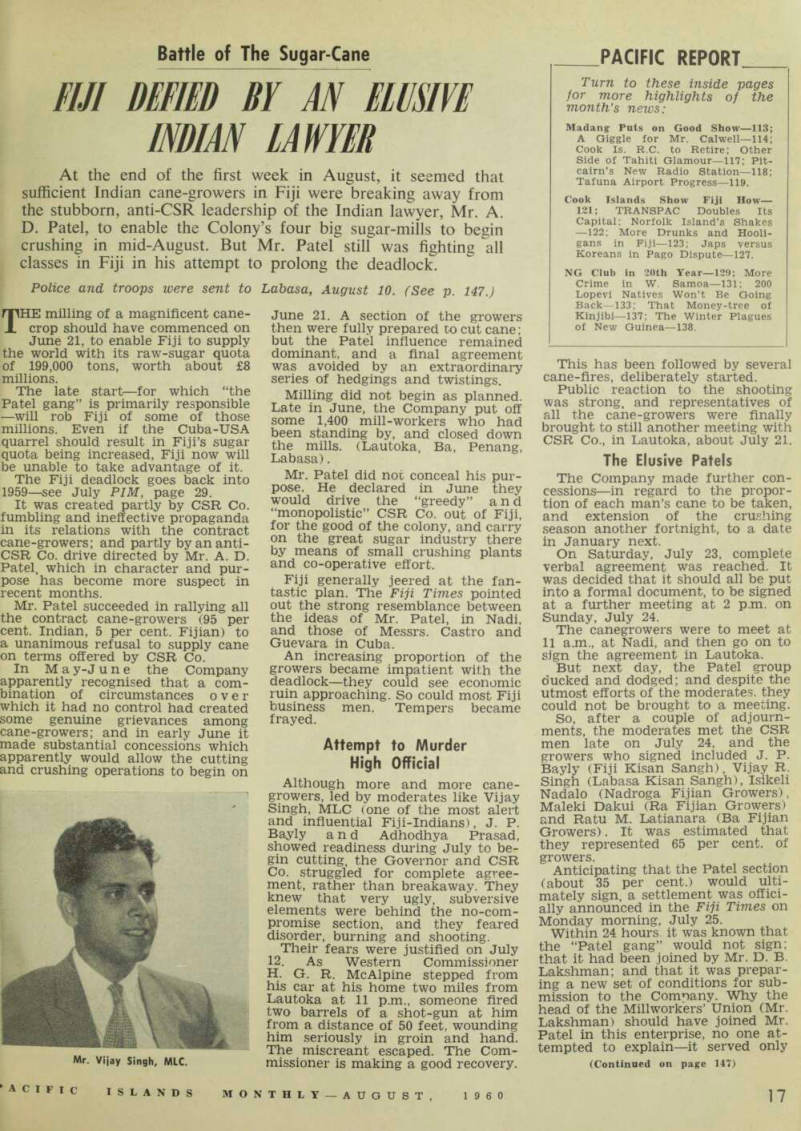
Mr. Vijay Singh, MLC.
to make confusion more con founded.
By the end of July, the deadlock was in four dimensions. • The Government and the busi ness community were expressing growing uneasiness at the prospect of grave economic trouble. • The CSR Company was grimly waiting. (It announced on August 2 that the July 24 agreement repre sented the final limit to which it could go—the further proposals of the Patel-Lakshman group had been rejected.) • The moderate section of cane growers, led by Messrs. Vijay Singh, J. P. Bayly and Adhodhya Prasad, were anxious to get on with cane cutting, and publicly blamed Mr.
Patel for the continued deadlock. • The small group led by Messrs.
Patel and Koya were as uncertain and elusive as ever—their attitude so strange as to arouse throughout the Colony considerable speculation about their real motives, associations and purpose.
One thing now was clear. Even if the mills commenced crushing in August, the effect of the revenues lost in June and July, plus the general economic difficulty of over population and insufficient produc tion (as described in the Burns Re port) would be felt severely within the next 12 months.
American Sugar Markets
Asked on July 26 whether any approach has been made by USA to purchase the surplus of sugar in Fiji, the Secretary for Colonies said that full information was recently provided to USA on behalf of all Commonwealth countries as to sugar available if required. This included information about Fijian sugar.