Pacific Commerce and Produce
pp. 163-165 · Read in the full issue
They Want More P-NG Capital
or a pleasant change, every -
in June and early July ted to be talking about the
f for development capital in
m-New Guinea.
STRALIAN Prime Minister (lenzies told a Melbourne meet ng that the Territory needed >tment from outside to raise its g standard. rritories Minister Mr. Paul uck said in Port Moresby that Guinea’s future demanded ralian investment, management technological skill, and the irnment wanted the Territory ave all three. columnist in the Sydney ncial Review called for new lopment work in P-NG. ew Guinea is a place for real lopment, the non-sophisticated that built western civilisation,” said. “And it’s in Australia’s . . . When the urgent time ; is drafted there will be a big that only Australian business play.” le columnist, Mr. H. W. Herbert, that now Fiji Industries Ltd. been created by several iralian-Fijian companies to ark on Fiji’s first cement manu uring business, it was time the e sort of thing occurred in New aea. lere could be a “New Guinea istries Ltd.” to embark on pro ng a dozen different basic modities. .1 these views brought support i Australian businessmen, in ing one comment from Mr. K.
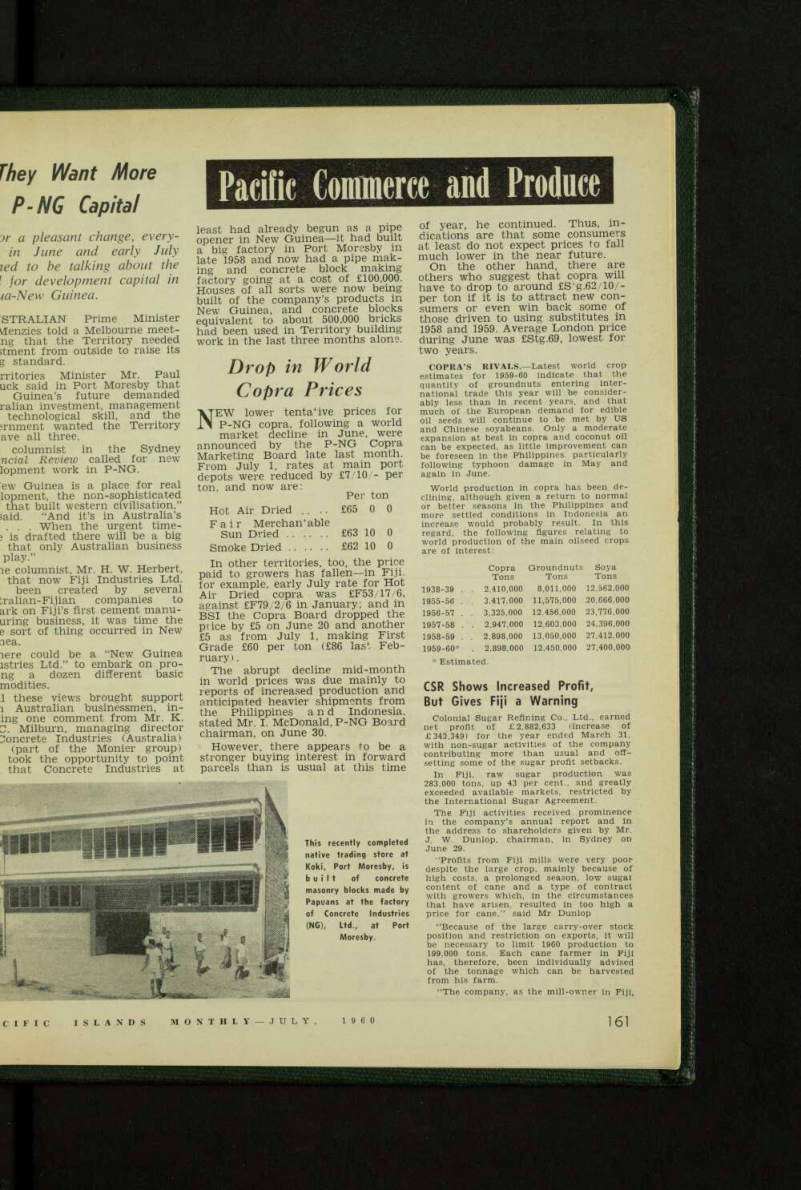
J. Milburn, managing director Concrete Industries (Australia) (part of the Monier group) took the opportunity to point that Concrete Industries at
least had already begun as a pipe opener in New Guinea —it had built a big factory in Port Moresby in late 1958 and now had a pipe mak ing and concrete block making factory going at a cost of £lOO,OOO.
Houses of all sorts were now being built of the company’s products in New Guinea, and concrete blocks equivalent to about 500,000 bricks had been used in Territory building work in the last three months alone.
Drop in World
Copra Prices
NEW lower tentative prices for P-NG copra, following a world market decline in June, were announced by the P-NG Copra Marketing Board late last month.
From July 1, rates at main port depots were reduced by £7/10/- per ton, and now are; Per ton Hot Air Dried .. .. £65 0 0 Fair Merchantable Sun Dried £63 10 0 Smoke Dried £62 10 0 In other territories, too, the price paid to growers has fallen —in Fiji, for example, early July rate for Hot Air Dried copra was £FS3/17/6, against £F79/2/6 in January; and in BSI the Copra Board dropped the price by £5 on June 20 and another £5 as from July 1, making First Grade £6O per ton (£B6 last Feb ruary) .
The abrupt decline mid-month in world prices was due mainly to reports of increased production and anticipated heavier shipments from the Philippines and Indonesia, stated Mr. I. McDonald, P-NG Board chairman, on June 30.
However, there appears to be a stronger buying interest in forward parcels than is usual at this time
of year, he continued. Thus, in dications are that some consumers at least do not expect prices to fall much lower in the near future.
On the other hand, there are others who suggest that copra will have to drop to around £S L g.62/10/per ton if it is to attract new con sumers or even win back some of those driven to using substitutes in 1958 and 1959. Average London price during June was £Stg.69, lowest for two years.
COPRA’S RlVALS.—Latest world crop estimates for 1959-60 indicate that the quantity of groundnuts entering inter national trade this year will be consider ably less than in recent years, and that much of the European demand for edible oil seeds will continue to be met by US and Chinese soyabeans. Only a moderate expansion at best in copra and coconut oil can be expected, as little improvement can be foreseen in the Philippines, particularly following typhoon damage in May and again in June.
World production in copra has been de clining, although given a return to normal or better seasons in the Philippines and more settled conditions in Indonesia an increase would probably result. In this regard, the following figures relating to world production of the main oilseed crops are of interest: Copra Groundnuts Soya Tons Tons Tons 1938-39 . . 2,410.000 8,011,000 12,562,000 1955- . . 3.417.000 11,575,000 20,666,000 1956- . . 3,325,000 12,456,000 23,776,000 1957- . . 2,947,000 12,603.000 24,396,000 1958- . . 2,898,000 13,050,000 27,412,000 1959- . 2,898,000 12,450,000 27,400,000 * Estimated.
CSR Shows Increased Profit,
But Gives Fiji a Warning
Colonial Sugar Refining Co., Ltd., earned net profit of £2,882,633 (increase of £343,349) for the year ended March 31, with non-sugar activities of the company contributing more than usual and off setting some of the sugar profit setbacks.
In Fiji, raw sugar production was 283.000 tons, up 43 per cent., and greatly exceeded available markets, restricted by the International Sugar Agreement.
The Fiji activities received prominence in the company’s annual report and in the address to shareholders given by Mr, J. W. Dunlop, chairman, in Sydney on June 29.
“Profits from Fiji mills were very poor despite the large crop, mainly because of high costs, a prolonged season, low sugar content of cane and a type of contract with growers which, in the circumstances that have arisen, resulted in too high a price for cane,” said Mr Dunlop “Because of the large carry-over stock position and restriction on exports, it will be necessary to limit 1960 production to 199.000 tons. Each cane farmer in Fiji has, therefore, been individually advised of the tonnage which can be harvested from his farm.
“The company, as the mill-owner in Fiji,
This recently completed native trading store at Koki, Port Moresby, is built of concrete masonry blocks made by Papuans at the factory of Concrete Industries (NG), Ltd., at Port Moresby.
has been adversely affected by the working of the 10-year agreement with growers for the purchase of cane. It expired in May and negotiations for a new one have been proceeding for some time. Circumstances altered over the period of the last agree ment, resulting in a reduced proportion of the sugar proceeds accruing to the miller. We have given attention to efficiency, and higher utilisation of plant and other improvements have been ob tained, but the miller has had to face costs for wages, salaries, etc., which rose steadily, and recently more rapidly, and which have had to be met out of his lower share of the sugar proceeds.
“The new cane purchase contract we seek is proving difficult to negotiate. It is designed to promote sound organisation in the industry, to improve our share of the sugar proceeds and to safeguard our financial position in Fiji reasonably. The adjustments we seek can be effected with out materially altering growers’ prosperity.
“There can be no long-term future place or function for private enterprise capital and the expertise that goes with it, if economic or political circumstances take away reasonable security for assets or satisfactory prospects for the rate of earn ings required by the owners of the capital and available to them elsewhere. Great importance for our future prospects in Fiji attaches to the new contract for the pur chase of cane and to the general attitude in Fiji towards capital investment, especi ally capital from outside Fiji.
“Great efforts are being made to find a solution to the problems in Fiji on a basis which will enable CSR to continue to play a constructive part in that Colony, in accordance with our tradition and con tinuing policy. We remain hopeful that a fair solution will be found.
“But failure of income earning ability in Fiji, or even loss of assets there, would be
much less detrimental to the company’s overall financial position than it would have been some years ago, before the diversification and amplification of our activities in Australia,” he stressed.
It was announced at the annual meeting that CSR £2O shares will be split into £1 shares “in association with and as a part of the next major capital issue, whenever this may be necessary”—but no hint as to the timing of this move was given.
Oil Search Pulls
Out From BSI
Oil Search, Ltd., will not proceed with its plan to take out exploration licences to seek petroleum in the British Solomon Islands, as “PIM” predicted last month.
Since last December, the company carried out preliminary investigations in an area east of Honiara, Guadalcanal, but results were not encouraging, it has officially an nounced.
Another Carpenter Take-Over
As part of its policy of diversification, W. R. Carpenter Holdings, Ltd., has en tered the neon sign business by acquiring Neon Holdings, Ltd., of Sydney, biggest neon company in Australia, as a fully owned subsidiary. WRC recently took over two other concerns outside the normal scope of its Islands trading, planting and shipping interests—paper merchandising and flour milling.
Price for Neon Holdings was satisfied by issuing 711,705 WRC 5/- shares, having face value of £177,926. At current market price of around 30/- for Carpenter shares, the deal is worth over a million pounds.
Directors say that earnings acquired are more than adequate to cover additional dividend requirement at the current 12y 2 per cent. rate.
Fiji Fails To Fill
NZ Banana Quota
In the first four months of 1960, |P shipped 60.000 cases of bananas to N( Zealand The quota was 80 000 cases.® These figures were given by S. Raisela field officer of the Agricultural Depai ment. in a radio talk on banana prodU tion from Suva in June.
“People in banana areas think that th( bananas will be wasted because thev ca not be sold to NZ, but I would like! make it clear that the quota which® will accept from Fiji is not being filled he emphasised.
New Zealand will take 20,000 cased month—24o,ooo cases a year, for whi Fiji would receive £264,000. Last ye growers shipped only 73.831 cases, valu at £81.124. Thus £182.876 which cou have come to Fiji remained in NZ. 1 “It is believed that we will not ful our quota this year. Indeed, Fiji cann fill its quota unless banana plantatio are looked after properly. Unfortunate most plantations are overgrown with wee and very neglected,” he added.
Lolorua Rubber Profit
Up—Steady 20 Per Cent. Div. j
Lolorua Rubber Estates, Ltd., Papi earned net profit of £22,496, an lucres of £2,718 (or 13.7 per cent.) for the ye ended April 30.
Unchanged 20 per cent, dividend 1 quired £20,000.
Earning rate on capital moved up frc 19.8 to 22.5 per cent.
Record Production for
Commonwealth-NG Timbers
Commonwealth and New Guinea Timbe: Ltd., jointly owned by the Commonweal Government and Bulolo Gold Dredgii Ltd., had record production for the ye ended June 30.
The Bulolo mill produced 32,000,C square feet of 3/16-inch thick plywood,! well as other sizes, against 28.000,000 I the previous year.
P&O and Orient Co/s
Get Together
The successful introduction to the Pad passenger and cargo service of the I Orient and P. and O. liners under a joi arrangement not long ago has led 1 further integration.
From July 1, the shore establishments the two lines in Australia ceased to open as separate entities and were merged in new company known as P. and 0.-Orie Lines of Australia Pty., Ltd.
The change marks the disappearance! two old Sydney shipping names, as far the Pacific is concerned—Orient Stes Navigation Co., Ltd., and Macdons Hamilton and Co. Pty., Ltd. (though IV will be registered again to carry on ott Australian shipping and airways busines Overseas, P. and O. and Orient s) operate separately, but the Austral! changes are part of an overall plan whei by port agencies and establishments both fleets are being co-ordinated throug out the world. P. and O. now own i Orient shares.
Direct Shipping Would
Assist NZ Goods in P-NG
One possible result of a brisk 12-da market survey of Papua-New Guinea ] Mr. R. J. Inglis, of NZ Department Commerce and Industry, might be t! establishment of a direct shipping servi between Auckland and P-NG.
Mr. Inglis, on his return from the Ten tory, said prospects of P-NG becomingi
et for NZ goods were "exceedingly t”. He added that P-NG merchants importers had welcomed his trade ires.
Lth direct shipping, which I’ll discuss Mr. P. N. Holloway, NZ Minister of tries and Commerce, goods such as inned and frozen meat, butter, cheese ish would be able to compete favour with Australian exports,” said Mr.