Deaths Of Islands People
pp. 149-150 · Read in the full issue
’Tain George Wilhelm
Hagendorn
)tain George Wilhelm Hagen once described as “the rather citizen” who probably saved from bombardment at the out of World War I, died in Syd n June 21, aged 79. He had lived arlingford, near Sydney, for il years. en war broke out between in and Germany, on August 4, Captain Hagendorn was a ut planter at Mulifunua, at western end of Upolu, Western a, then a German Colony, i German warships Scharn , Gneisenau and Nurnberg, at in the South Pacific, appeared ipia, early on September 13; 'ently observed that the place ly was occupied by New Zea troops; and then steamed 25 westward, to Mulifunua, and lied. Hagendorn rowed out, and 'oyally entertained by Admiral t von Spec. 3 Germans were inclined to ard the NZ establishment in but Hagendorn pleaded the ssness of it, and pointed out the New Zealanders had treated Germans in Samoa courteously correctly. e warships sailed away (to •ard Papeete, in Tahiti, a few later); but Hagendorn was ptly gathered in by the NZ lel as a suspicious character and ned in NZ. He later was re el, but at war’s end his Samoan jrty was expropriated, and he in Australia. He was interned i during World War FT, and went to reside in Germany. His had been broken by the wars, to Australia in 1955. His esting story was told in PIM in 1956.
Mr. K. P. Wright
■. K. P. Wright, a famous grazier >mani, Quirindi, Northern NSW, died in June, aged 76, made , e valuable contributions to tical knowledge of animal andry and plan f ation condi i in Viti Levu, Fiji, some 50 3 ago. out 1908, then aged 25, he went his father, the late Mr. P. P. ;ht, to Fiji, and they at first rubber and bananas at Nai ) Koro (ten miles west of Suva). r, they ran sheep and cattle much success on a large area le Sigatoka Valley, an article in PIM of January, Mr. Wright described how his evement in producing first-class e at Sigatoka for export to Syd drove him out of the Colony.
British Colonial Office gentle in 1915-16 forbade the export
of cattle from Fiji because it was feared that the local prices for meat might be raised. Mr. Wright, in dis gust, then sold his properties in 1917 to Messrs. Bryce and Howard, of Brisbane, and left Fiji, and settled in NSW.
In 1908, Messrs. Wright and Son imported 1,298 sheep from Australia, and for nine years they shore some 2,000 sheep each year at Sigatoka, and sold the wool in London and the surplus sheep to the CSR Co.
Mr. Wright said, after a visit in 1957, that he found the sheep in dustry now was extinct and the people had forgotten it was ever carried on in Fiji. “The property has deteriorated beyond recognition.
Homestead, yards, sheds and pad docks have disappeared, and the land is a wilderness. . ”
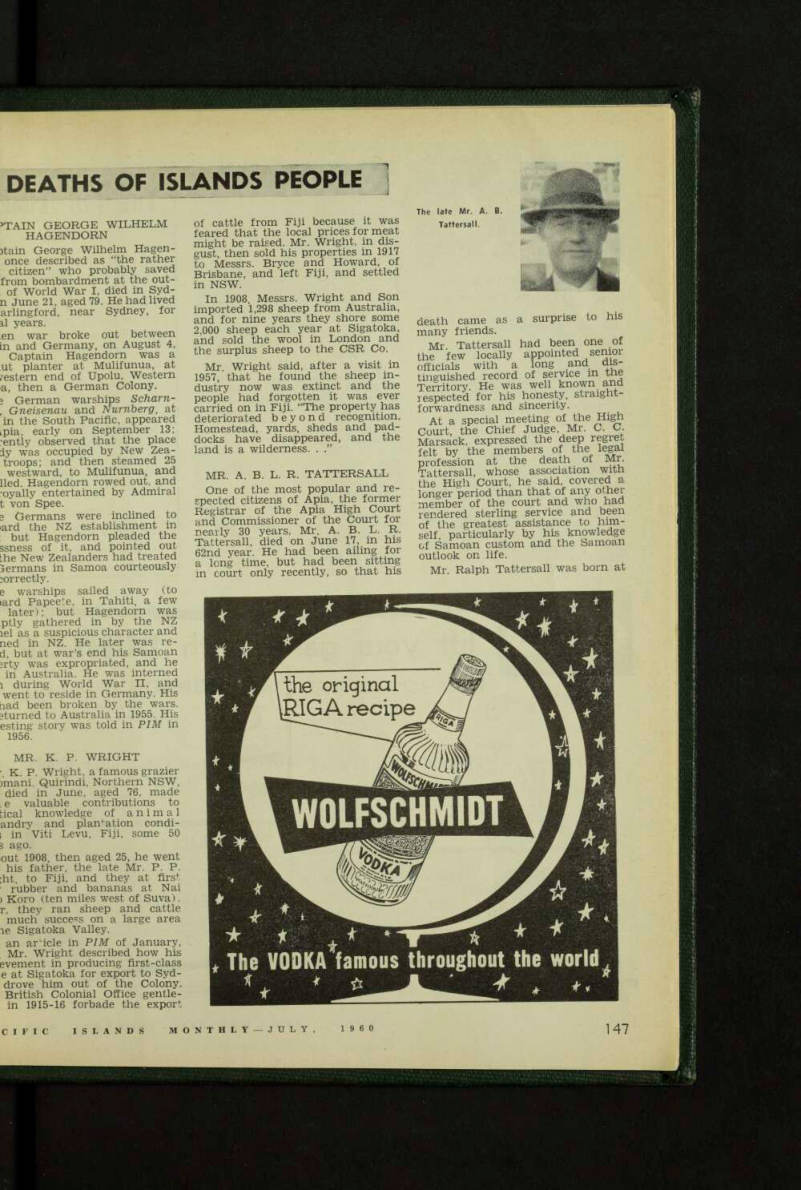
Mr. A. B. L. R. Tattersall
One of the most popular and re spected citizens of Apia, the former Registrar of the Apia High Court and Commissioner of the Court for nearly 30 years, Mr. A. B. L. R.
Tattersall, died on June 17, in his 62nd year. He had been ailing for a long time, but had been sitting in court only recently, so that his
death came as a surprise to his many friends.
Mr Tattersall had been one of the few locally appointed senior officials with a long and dis tinguished record of service m the Territory. He was well known and respected for his honesty, straight forwardness and sincerity.
At a special meeting of the High Court, the Chief Judge Mr. C. C.
Marsack. expressed the deep regret felt by the members of the legal profession at the death of Mr.
Tattersall, whose association with the High Court, he said, covered a longer period than that of any other member of the court and who had rendered sterling service and been of the greatest assistance to him self, particularly by his knowledge of Samoan custom and the Samoan outlook on life.
Mr. Ralph Tattersall was born at
The late Mr. A. B.
Tattersall.
Apia in 1898, where his father, Mr.
A. B. L. Tattersall had been one of the pioneers as a photographer well known to tourists and visitors to Apia.
The funeral was attended by a large and representative gathering.
The deep sympathy of many friends was extended to the widow, Mrs.
Dora Tattersall. Two sons live in New Zealand.
Mrs. Hen A Wolfgramm
Mrs. Hena Langi Wolfgramm, wife of Charles A. Wolfgramm, member of a well known Tonga family, died suddenly at Auckland in her 46th year on June 25.
The funeral was attended by a large number of the Tongan residents of Auckland.
Mrs. Wolfgramm is survived by her husband and three children.
Rev. Brother Alfred
The senior member of the Marist Brothers’ teaching staff, Apia, West Samoa, Rev. Brother Alfred, died there peacefully on May 28 at the age of 80. Born in Switzerland, he had taught at the Marist Brothers’ school at Apia for 63 years—having arrived in Samoa at the age of 17.
Generations of pupils, both Samoan and European, owe their education to him and remember him with love and gratitude. Some of the most prominent citizens of West Samoa were among his pupils.
A very big crowd attended his
funeral after solemn requiem, at Apia Catholic Cathedral, at which Rev. Father Ross officiated.
Mr. George Kingsley Roth
A man whose life and work were closely integrated with Fijian affairs for 30 years, Mr. George Kingsley Roth, died suddenly in a London theatre on June 30, aged 57.
An Oxford-educated Englishman, he joined the Colonial Service as an administration cadet in 1928 and, except for a couple of years in Zanzibar, he spent his working life in Fiji. He and his wife left the Colony in 1957, and he then filled a position in the Cambridge Museum of Ethnology.
Mr. Roth was a cultured, scholarly man, and took a deep interest in the Fijian race, and gave invaluable service to the Fiji Museum. He served the Colony in various public offices, such as the Town Board, and the Defence Forces. He became As sistant Secretary in 1943, and Secre tary for Fijian Affairs in 1944. He was responsible, in the next ten years, for a great deal of the Fijian Affairs organisation.
Kingsley Roth had his cri f ics; some of his work was condemned forthrightly in the Burns Report, but he was a charming, sociable man who made friends easily, and was held in high regard by all classes in Fiji. He was awarded the QBE in 1954.