Pacific Report
pp. 117-147 · Read in the full issue

The month’s round-up of news and pictures of people and ents, from PIM correspondents in the South Pacific.
Could Have A
Jy-Made Fishery
e Taiyo Gyogyo (Ocean :ry) Company of Tokyo, largest ig company in the world, is m :ed in establishing a tuna fish lase in Fiji.
Iwao Kitayama, business man of the Tenyo Maru No. 3 tuna at present operating near Fiji, in Suva in June that his com was interested to know what Fiji Government’s attitude i be in this matter, and an ish-speaking official would be ig at Suva in July to seek m ation on the subject, e idea might be to base the ership Tenyo Maru No. 3 at a port to use her as a floating ry completely self-contained it for liberal supplies of fresh r—at least 50 tons per day would quired. The company would ex to pay duty on all fish handled igh the floating factory and provide a useful revenue to at no cost, local labour would need to be oyed, but if this were a point jsue the employment of local
fish-handlers for the stowage of fish in the refrigeration chambers of the vessel would be open to discussion.
Tenyo Maru No. 3’s fish output is controlled by the Japanese Fishery envisaged, she might have a larger QUO t a She would operate the year p ound iik e the bases at Pago Pago and Pa nikulo.
TT n nw <?hp has had to serve SS* i 9 n thl AntarcUc! 1 but '**•a base lactor y snip - Fiji interests have been negotiat ing with another smaller Japanese company over the past year in re the establishment of a tuna J ann at Lev uka. The latest pro , would involve no Fiji capital P c U hiect to the availability of
SSld be put "into
operation almost immediately. (It not SU it the Levuka interests, ho wever as the main idea there was to e industry pointed out that
one problem which might restrict the location of the floating factory would be the discharge of blood and offal though this problem would not be insurmountable.
The company’s interest in such a base stems from the fact that in anything but smooth weather con ditions it is not easy for the fishing vessels to transfer their catches to a mothership on the high seas, and much less easy for a large freezer vessel to load from the mothership.
That is why this is currently carried out at anchorage in Suva harbour.
The Fiji Government derives little revenue from these operations at present.
Getting Down To
Work on Manihiki
The Cook Islands Administration —or the New Zealand Government which provides the finance —took a long time to appreciate the great value of the mother-of-pearl re sources of Manihiki lagoon and their future development and conserva tion, but over the past several years something has at last been done.
In recent months a very thorough examination of the lagoon and of the shell beds has been under way.
In the past, no factual information on the life-cycle of these shell fish, the chemical constituents of the water, and the environmental con ditions under which they thrive, has been assembled.
Conservation methods have been sheer guesswork, all or part of the lagoon being declared closed to div ing operations for arbitrary periods.
No attempt had been made by the Administration to transplant shell to other lagoons in the Group.
These things are all now being at tended to.
A New Zealand DSIR team headed by Mr. J. S. Bullivant, MSc, and accompanied by the Cook Islands Fisheries Officer, Mr. Ron
Ball Of The
Season
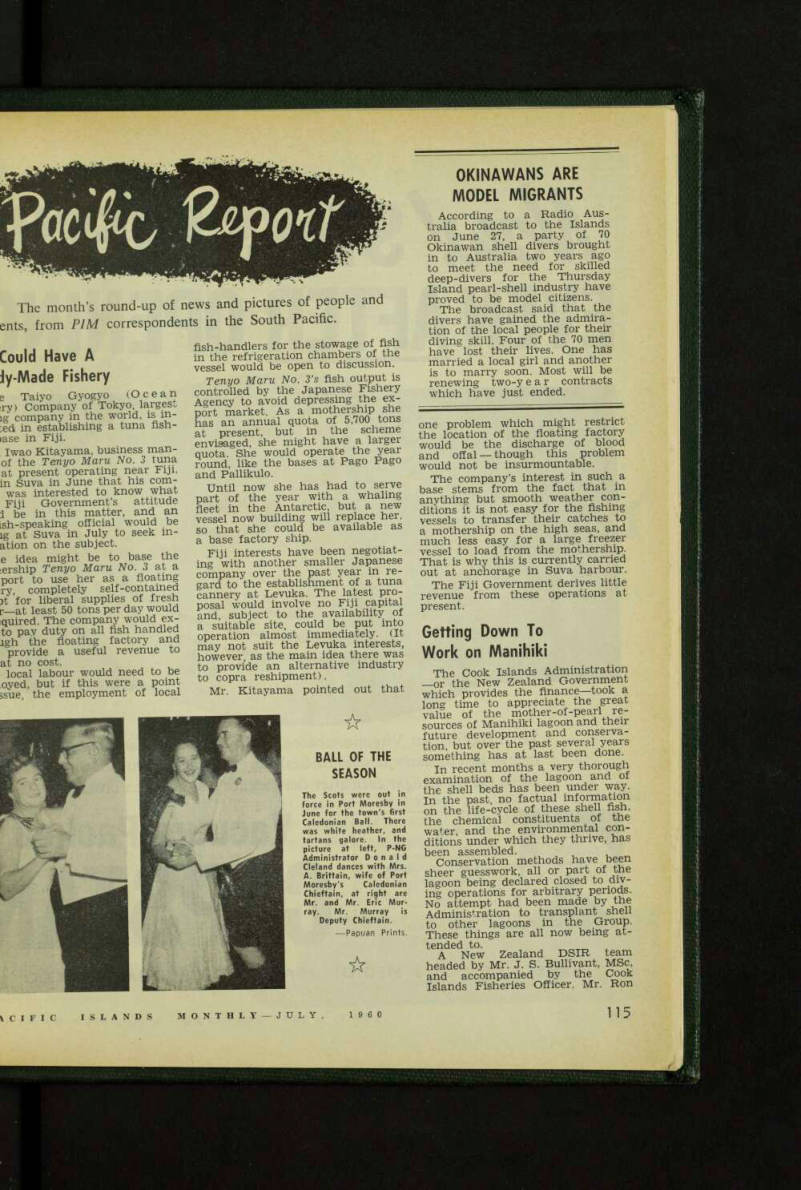
The Scots were out in force in Port Moresby in June for the town's first Caledonian Ball. There was white heather, and tartans galore. In the picture at left, P-NG Administrator Donald Cleland dances with Mrs.
A. Brittain, wife of Port Moresby's Caledonian Chieftain, at right are Mr. and Mr. Eric Mur ray. Mr. Murray is Deputy Chieftain. —Papuan Prints.
ell was to go to the atoll in j to make a hydrological survey, ,ng the temperature, salinity, other chemical and nutrient >erties of the lagoon at various :hs. complete sounding of the lagoon iccurately establish its varying ;hs is also being made with aid of a portable echo sounder, party of four and their assist ! and some 15 tons of equip it was to be transported north a Rarotonga by the local vessel iri. b the same time, as the first in a plan to transfer mother - >earl shellfish from Manihiki to Tokelaus north of Samoa by SAF flying-boat next year, Flight- J. F. Harrison, a pilot of No. 5 dtime Squadron based in Fiji, to visit Manihiki and survey an hting area. ext year’s aerial operation will ► include a further shipment of trochus to Aitutaki. A consign it of trochus transplanted there n Fiji in 1958 has become estab ed.
iter—But Not
The House
'or years past the residents of 21-mile-round island of Raro ga have been pleading with the ministration for a modern water iply to replace the present system Ich delivers mud, twigs, and even poles following heavy rain, low they can have their new tern—but New Zealand will pro e it only on certain conditions.
The conditions are, said Mr.
B. F. Cotterill, MP, who was rep enting the New Zealand Govern nt at the June Legco meeting, it the maintenance and operating ts must be met from a local water e.
Phe capital cost will have to be t mainly by the New Zealand tax yer.
Administration
jys on TP
rhe Cook Islands Administration s purchased from the New Zea id Government the Rarotonga otel (unlicensed), the electric wer scheme, and the public ;ezer.
The sale was, however, almost a ft. For the sum of £50,000, to be id off in easy instalments at the te of £7,000 per annum, the Ad inistration takes over property Drth hundreds of thousands of >unds.
There is an undertaking, however, iat if these services show a profit, ilf of this is payable to the New 3aland Government.
, . i . . .i
Additional Interest In
t / pv * J d
Tonqa S Dried Bananas
, • i Last year when a revival of the dried banana industry was under discussion in Fiji, the Tonga Government was quick to invite the promoter of the industry Mr. B.
Proweller, to go to Nukualofa and tell them about it.
In May, a company formed in Fiji through Mr. Proweller s efforts was
tfmp man rep?esen?ta|
nther mterelts wts ’in Nukualoll
aIOT making 6 proposals To the Tonga Sld'ban^nataduTr* 1011 W “ h * The Tonga visitor was a Dutch
company promoter, Mr. Anton Van impelen, now of New Zealand, and in partnership with an American, Mr. C. E. Davidson. Between them they appear to have access to Dutch and American investment capital, The p ar^ners are promoters only, when they spo t what they consider od inves tment, they thoroughly inves ti ga te it. If it proves sound, th call on the financiers, The partners establish the company nd nit a going concern once
ftVsoundly established.
They have established a number of such companies in New Zealand, all of which were sold out to other Impelen said that he had been in touch with Mr. W. Skudder,
[Tonga, who operates a small dried tana industry of his own. Pre inary investigations into such industry on a large scale in igatapu were promising, and an the-spot investigation was de ad upon. It was not until he ched Tonga. Mr. Van Impelen 1 that he learned that Fiji in -sts had also been discussing ming a company there, and that Proweller had visited Tonga, le said that he had offered to vide all the finance to establish ;600,000 factory which would em y about 60 persons and would be >able, when in full production, of icessing the equivalent of 200,000 es of fresh fruit per annum.
The Tonga Government had made iounter offer that Tonga Produce ard had a 50 per cent, interest, t the promoters preferred full itrol for at least two years until » company was a going concern. ;n they would sell part or all of to the Government, rhe Government insisted on con il of the industry in the long run, d that would be acceptable, mming that an agreed price for ce-over was reached, but there ire certain difficulties in part vernment control in so far as the n-government interests were con med. , Because of the very high cost of ;ctricity in Nukualofa, Mr. Van ipelen said that investigations ire being made now into an iernative source of heat for the iers, using diesel oil burners. If reement could be reached on con -3l of the industry in its early iges, he would be returning to mga about August.
Mr. Van Impelen feels confident at a big potential market is ailable for dried bananas, especi ly in Holland and Germany, pro ded they are packed to suit the
market. But, said Mr. Van Impelen correct packaging is vital-and what may go well in one country may be all wrong in another. . He discounted the Fiji Govern ment’s unenthusiastic statement of some time ago concerning the mwket outlook. The dried banana business, properly handled, would be a thoroughly sound investment, Mr. a Van Impelen said. The: weevil infestation problem that had killed other South Pacific dried banana enterprises presented no serous problem. Modern drying methods could meet the situation, and there was no secret method involved.
New Fiji Index
Goes Up Too
To replace the Cost of Living Indices established in 1943 (one re ferred to the cost of living of the Indian section of the Fiji popula tion in Suva; one to country dis tricts; and a third to Europeans), the Fiji Government has now established a single, new index.
It is intended to serve as a re liable guide to changes in the cost
of consumer goods normally pur chased by Indian and Fijian work men in Viti Levu who earn between £3/0/6 and £B/5/- per week. There is no index now for Europeans.
The new index is the result of a survey carried out by an official of the New Zealand Department of Statistics in 1958.
It is based on an analysis of 90 Fijian and 90 Indian family budgets and covers 103 consumer items.
The new index is based on a figure of 100 for March, 1960. By June, the figure had risen to 101.4.
A new figure will be published each quarter.
Grogging On-
In The Cooks
A committee set up to recom mend revisions to the liquor laws in the Cook Islands is not in favour of any licensed hotels and considers that liquor should still be sold only by the Administration.
The permit system should be much more flexible, however, with beer and light wine freed from con trol to a large extent, and made as cheap as possible to compete with illicit bush-beer.
Spirits should remain under strict control, but the issuing of liquor permits should be removed from the administration of the Health De partment. As at present, permits should be refused to those convicted of offences associated with liquor.
Before the recommendations can be made law, certain legislation has to be passed in New Zealand and it is expected that this will be passed at the next session of Parliament in Wellington.
Suva's Whan Construction
Co. Changes Ownership
One of Fiji’s oldest building firms, the Whan Construction Company, changed ownership in June, Visitors to Suva have often gained the impression from the name that this was a Chinese firm.
This was not so. The man who founded the firm in 1910, Matthew Whan, was a Scot. (Over)
Progress On
Bsip Wrecks
The Japanese salvage company which is cur rently breaking up the old wartime wrecks along the Guadalcanal coast, in the Solomons, in June shipped approxi mately 1,750 tons of scrap metal to Japan on the "Chitose Maru". The vessel was also the first overseas ship to come alongside Honiara's stub jetty after nightfall. A new shipment of scrap will be available within the next few weeks. This photo shows one of the wrecks now destined for Japan.
Tonga School
A recent photo of Tonga College, the Tonga Government's agricul tural boarding school for boys. It is located on its own farm lands in central Tongatapu.
e retired due to ill-health about , and settled in Australia, and management was continued by Felix Emberson, a member of >ld Fiji family. Mr. Walter Whan, m, who owns a newsagency at •rickville, Sydney, has visited at intervals, on his father’s be he business was put up for sale at two years ago and has now i purchased by Mr. S f anford ck, Mr. Emberson’s son-in-law, • first visited Fiji as a service i in the United States Navy was later an inspector of air t with Pan American Airways. !r. Gluck is now a principal of Asiatic Animal Import Company san Francisco, a firm which im :s a great many of the monkeys fired in the United States for ntific and medical purposes. [r. Emberson will continue in the lagement. here had been suggestions that front half of the company’s lable site opposite the Boys’ immar School on Victoria Parade . Kimberley Street corner, would offered for sale, but Mr. Ember said at the end of June that such decision had been reached. ; firm would continue in business, he sale price was believed to be fie vicinity of £25,000.
Japs Get Them
In The End
Following the signing of a con tract with a Japanese firm of scrap iron merchants, a team of fully equipped Japanese specialists is ex pected in Noumea during July to start cutting up and shipping away wrecks on New Caledonian reefs.
Work will be started at Noumea where some half-dozen hulks are lying on the bottom close to the nickel smelters.
These hulks are one-time nickel ore carriers and have been an eye sore for many years. Indeed, dur ing the last war the Japanese radio
more than once claimed that they were ships sunk by Jap planes.
Following the disposal of the hulks, the team will work on the many wrecks situated around New barrier reef second Caledonia is b;arner ieei, longest m the worm, ,
Qne Dead in
[gS TrOPIOUeS Fire
r \ , The chef lost his life and other staff members suffered injury when fire destroyed the staff quarters. dining room, lounge and bar of Tahiti’s best known hotel, Lea Tropiques, in mid-June, Les Tropiques is a bungalow-type
hotel consisting of many separa buildings, with the guest accomra dation completely detached from tl public buildings. Had the hotel be< of the single-unit type, damage ar perhaps loss of life, would have be< much greater.
Apart from the personal losses ii volved, the damage has come at tl height of the tourist season whi accommodation is always short. 1 The hotel’s managing director, W Arne Hogsted, who was at Honolu when the fire occurred, later ai nounced that no reservations wou be cancelled but requested visito to reconfirm bookings, because tl major portion of the hotel’s fil had been destroyed.
Damage was partly covered by ii surance.
According to a Honolulu report !
June, a San Francisco financier ai real estate developer, Mr. Robert I Fraser, has announced there th he plans to build two hotels Tahiti. “All I need is the okay fro the Governor of Tahiti,” he sai but he declined to give details. I later left by air for Tahiti.
Fraser arrived at Honolulu fro Acapulco, aboard the 73-ft keti Te Matai, which he recently boug from a Buenos Aires millionaire.
Rough Road for
Viet Namese Repatriates
Noumean newspapers in June pu lished a report that an agreeme; had been signed between the Freni Government and the North Vi Nam authorities, which will perir the repatriation of some 6,000 Vi Namese at present in New Caledoni This colony of Viets in the Coloi has been responsible for much hea burning amongst New Caledonia: who have often petitioned to ha them repatriated.
No official confirmation of the ai nouncement has been made but is believed correct.
First departures by ship are e: pected to be around September nej It is freely stated that only tho who wish to leave will be repatriate This is not exactly what the Nt Caledonians want —they would lil to see all go.
The great majority of the Vi Namese have manifested their d sire to be repatriated often enoug and they will take the chance if offers.
Soon after the rumours started fly, it was reported that Vi Namese were buying large quantiti of transportable goods in Noumi stores. One store sold 100 bicycl In a few days; another was sellii expensive fountain pens in lari quantities.
Since the departure of the Soul Viet Nam delegation from Noumi some months ago, fhere has be( silence on the Viet Namese probler The delegation visited New CaL
nia to survey the actual position Viet Namese in the Colony. On parture a spokesman for the dele tion said that Sou f h Viet Nam mid put no obstacles in the way repatriated Viet Namese who nded at Saigon and finally Pro eded to Hanoi (North Viet Nam) that is what they wished.
It seemed then that progress m patriation was at last being made However, a sour note was injected to the proceeding later in June hen it became known that the mth Viet Nam Government con ■mned the rumoured agreement be veen France and North Viet Nam -claiming that it was the only jthority to be consulted on any lestion of Viet Namese living Droad. , , Nonetheless, New Caledonians were ill hopeful that the first lot of jpatriates would be leaving in Sep ;mber.
mti-Filaria Drive
i Cook Is.
A carefully organised project to radicate the filarial mosquito from ,tiu Island in the Cooks has been nder way for some months. Similar rejects have been carried out in 'rench Polynesia in recent years.
The project is being controlled by )r. McCarthy, Permanent Research )fficer for the New Zealand Medical lesearch Council and is a pilot cheme for a general attack on this lisease (whose ou f er manifestation s the swellings of elephantiasis) in
membef a oT S Atfu’s th pop g X&n E fir7t
2-!S»Tcs
known as Banocide (identical to Hpfra/an) the strength of this dose befn?Tradually increased over a two-yeai period by which time it KS that the disease will be wiped out. ... n .
Niue Will Get
.. . u I
More Housing Help
As the result of the visit of a delegation from Niue Island to Wellington in April, the New Zealand Government announced early in June that it was making a grant
sJructio^ofhouses to replace those
MMSSSe it
would have taken many build all the houses destroyed. The delegation sought the provision of 30 qualified carpenters to assist the unskilled local labour force of 230 m under the original grant the 700 houses destroyed could only be re placed at the rate of 250 a year, assuming that all work on public buildings was halted. The Niue Legislative Council and the Resident Commissioner con Q s^? re d. that it was absolutely essential that woik on the repair of public buildings be pressed ahead.
ANDS VISITORS. Recent visitors from the [?] nds to the Polynesian Association of Sydney [?](top) Fred Pasene, from Niue, accompanied Ria Clarke, Don Clarke and Marie Morehu, NZ. (Lower), Miss Kitty Cokanasiga, of Suva, [?] is nursing in Sydney, with Mr. Pat Dwter Kairuku, Papua, and Fergus Anderson of Rigo, Papua. -Tele-Photos.
te Your Case
d Send It, Too
he adoption of collapsible ninium containers for the citrus t export trade from Cyprus, to overseas market suggests that eone might make themselves a i business and at the same time he means of raising the financial irn to the Cook Islands growers. i the Cook Islands fruit trade New Zealand, the growers pay roximately 7/3 for every li bel case in which they export ir oranges. The sawn timber :ions for these cases are im bed by Cl from New Zealand, led together at shipment island, L used once only. Apart from actual cost the sawn timber Lipies valuable space that could occupied by other cargo on the th-bound voyages from NZ. ’o meet the problem, the Cl Ad listration some years ago began establish stands of fast-growing :wood timbers in some of the ithern Group Islands. They have yet quite reached the milling ?e. ’he aluminium containers which re just come into use in Cyprus
are the idea of a man who has been expounding their virtues for 20 years without much support.
Each container holds the same quantity of fruit as the standard carton previously used. About 30 per cent, of the surface area of the six aluminium plates forming each container is perforated with one inch ventilating holes. The plates are hinged together in such a way that the containers fold completely fiat for return shipment, thus cut ting down on shipping costs. Labour involved in nailing together wooden crates is eliminated. In many cases the aluminium crates, after being emptied of fruit in Germany, Switzerland, and other countries, are repacked with eggs, fresh vege tables, and other types of return cargo.
The inventor, Mr. Jacob Mouchly, who established a £20,000 company to have the crates manufactured in Germany and Switzerland, charges the shippers 1/6 per voyage hire fee which is about one-quarter the cost of a wooden fruit crate of the same capacity in Cyprus. The growers or exporters thus save 4/6 on every crate of fruit exported and Mouchly recovers the cost of his investment after about 20 voyages.
NG Euronesians Struggle
For Citizenship
Nothing yet has been done in Papua-New Guinea to make it easier for Euronesians to become Australian citizens. This privilege was extended to Chinese, who fulfilled certain re quirements, several years ago. Last year the Minister for Territories said that negotiations between his Department and that of Immigra tion were proceeding on this matter —but so far, apparently, without re sults.
At the June meeting of the Kokopo Town Advisory Council, a letter to a prominent mixed blood resident, Mr. Harry Spanner, from the Aus tralian Department of Immigration was read, and subsequently described
as a “slap in the face” and “almost insulting”.
Mr. Spanner is a member of the Kokopo TAG and said that he has been trying for naturalisation since 1952 without avail. The latest letter said,’ in part: “The question of naturalisation was recently con sidered by the Government and it is considered that your case is not one
for approval.”
No reason was given for the re jection. Mr. Spanner considers that because of the Australian Govern-
RUNG: Denis Payne and John Wakeford, completing terms of service with Cable and [?] ess, Ltd., at Suva, have departed for vaca [?]in the United Kingdom, and for reassign to other stations of the world-wide C. and W. system.
Enough To Make A Chap Blush
Net result of a mannequin parade, held in Port Moresby to help the Red Cross £15.000 Appeal along, was a cheque for £175 and a lot of fun for every one.
Eleven of the town’s prettiest young women took part; so did six of the town’s scaredest-looking young men. Recruiting the young women for the job presented no problems. The male mannequins were volunteers without the option. They were all employees of Steamships Trading Company which supplied all the clothes that were shown and the personnel to organise the parade including Alcea Avery who compered the show.
At first the young men loped up and down the cat-walk dragging their young women in their wake, as nervous as rabbits who expect a double barrelled shot gun to pop out of the nearest vase of flowers. But with the help of the audienpe, who showed them early in the piece that they were going to be the hit of the show, they slowly relaxed—as shown by the samples in our photographs.
Our photos were taken during the grand parade at the end—hence the tuxedo accompanying Heather Joan John’s sports “skort” (lower picture). With her is Bryan Holdcroft. At top is Maureen O’Brien and Des. Martin. —Photos by Papuan Prints.
merit’s refusal to listen to his re quest, it is refusing him one of th( basic human rights—nationality! laid down in the United Natioa Charter, to which Australia is 1 party.
The Kokopo TAG supports Mi Spanner’s appeal and the Ministi for Territories has now been ad vised of this fact. i
They're in the Toad Trade 1
-Why Not You?
Some months ago PIM reports that the Otago Medical School, Nei
Zealand, was desperately seeking
regular supplies of frogs in lard qualities and was prepared to pa; air freight on them plus a casl price to anyone in New Zealani We suggested that there might b a market for the toads, giant o otherwise, which are common enoug] in some Islands’ territories.
As the result of a news item re porting that a consignment o “frogs” had escaped from thei container aboard the vessel Galli bound from Suva to Dunedin, N 2 in June, PI M’s Suva man learnq that the Queen Victoria School ii Fiji has in fact sent four consigrj ments of toads to Canterbury Uni versity since 1957—about four gros of toads in all—and has receive 2/- per head for each, plus the cos of the freight. Caught by the Fijia: boys of this school, the toads hav provided a useful item of schoc revenue. There were 12 dozen toad in the Gallic consignment.
The toads need very little atten tion during transit. They can surviv without food for long periods an only require to be kept reasonabl damp.
P-NG's Cocoa and Coffee
Production
In 1958-59. 4,253 tons of cocos valued at £1,491,847, and 969 ton of coffee, valued at £456,037, wer exported from Papua and Guinea.
This represented an increase ove the 1954-55 export of these com modities of 3,147 tons of cocoa an 862 tons of coffee —a phenomens development of two important in dustries.
Australia is the main buyer c both cocoa and coffee from th Territory. The balance goes to th United Kingdom, Germany, t h Netherlands, Japan (cocoa only) an Hongkong (coffee only).
Young Fijian's Mountain
Enterprise
In a project being carried out i: the Fijian province of Ra. a youn villager has organised youths of hi age group into an industrious wor force.
iey have built a large barracks lative materials high on the i-capped, reed-covered hills e their village. Under their rous leader they have, in the few years, cultivated many s of yaqona (the root from ;h kava is made) on the pre ;ous slopes. They work in the ten by day, sleep in the barracks light, and return to their village at week-ends. ie Burns Commission’s report on s land and population problems les out this project for special mendation. “We consider this dopment, with its spirit and •gy, to be an excellent example Fijian enterprise and initiative, irving of high praise.”
lio Scare in
w Hebrides
p to late June, no further cases polio had been reported from ito, New Hebrides, reviously three cases, one fatal, , been reported. n anti-polio vaccination cam yn, with Salk vaccine from Aus ia, is currently being carried out. lanes landing in Noumea from New Hebrides are being checked I a vaccination campaign in New edonia will be started as soon as cine arrives from France.
ar Against N. Cal/s
imon Drivers
Eighty-five New Caledonians, in ; first four months of 1960, had ;ir driving licences suspended periods ranging from two days
permanently.
;f this average is kept up through-
marriage of New Guinea interest the Miss P. Weimess to Mr. Paul Rainer.
It took place in Port Moresby. —Papuan Prints.
the year, 1960 looks like being cord. 1959 there were only 140 ensions for the whole year.
sy're Dumping Eggs
1/- Each
istralia is again in the bad :s of certain New Caledonians — poultry farmers. When price of I eggs rose to 179 francs (about ) per dozen, permission was n to import eggs from Australia, plies were flown in from Aus ia and sold for 130 francs — it 12/-. This caused local pro >rs to reduce their price to 140
Lcs
idignant “letters to the editor” i appeared in the local Press ising Australia of “dumping” ip eggs on the New Caledonian ■ket to the detriment of local iucers. However, says our imea correspondent, the public ch has to pay is not making any ;est. (Current price of large hen 3 in Sydney is 6/6 per dozen, ch housewives regard as com
ely outrageous).
;kel Helps Recovery
N. Caledonia's Economy
i comparison with a year or two , New Caledonia is now regarded being in a satisfactory economic it ion. his is due to record exports of iel-ore to Japan and smelted al to France. he new electric smelters at imea that came into operation in :il reached their full potential put in June —of 1,000 tons of e refined nickel; it is anticipated t this output will be maintained, lodernisation of the old thermic tion of the smelters will soon be ier way, and when completed it ;xpec f ed that the cost of produc nickel from the Noumea alters will be considerably reduced, to now the industry has been
heavily subsidised by the French Government. but these subsidies are nvnppfpri to cease this vear expected to cease mis yeai. . w , A „
Goroka Volunteer Soldiers
/I TL l tL * n
Go Through Their races
A different kind of entertainment was given residents of Goroka, Eastern New Guinea Highlands on the night of June 26 when a military tattoo was held at the Sports Ground, This was the first attempt by a small unit in New Guinea to stage such a show and considerable diffipultips wptg fSiCGd.
Cant Frank Hoeter was the organiser and as CO of the unit gave a commentary of the proceedings for the benefit of the spectators.
Guests included Mr. H. P. Seale, District Commissioner for the Eastern Highlands and Mrs. Seale and Brigadier S. Eskell, OC 14th Inf.
Bgde. (HQ), 2 Division, from Aus tralia.
A demonstration of squad RUd rifie drill by the newly formed Cadet unit from the Goroka Central School, under the command of Cadet Lieut.
Hiob, began the night. This was the youngsters’ first public appearance and they got loud applause from the crowd. . . , A teams race, m which three teams had to a rifle, Owen machine pun and Bren gun over a set distance (it was won by Sgt. K.
Turners team), was :followed by a realistic night patr 'o\ by members of “O” Coy. in which <in &tt&ck w&s made on an enemy-held building, Parachute flares, imitation grenades, shells all added to the fun.
The Cadet unit and ptplice from the Goroka Police Training Depot then combined to demonstrate the changing of the guard, and a con tingent of Tolais gave the onlookers
[?]]RTURES; Mr. and Mrs. Peter 0. Dunn [?]eft Suva in the "Orsova" recently. Mrs. was Miss Robin Crowe —until the day be [?] sailing. Mr. Dunn had spent 3£ years [?] uva with the Geological Survey Branch.
a study in rhythm with a series of dances.
The tattoo concluded with a march-past by all participating units, led by the Police Band from the Training Depot. The salute was taken by District Commissioner Seale, who complimented Capt.
Hoeter for his initiative in staging such a show.
Who Marked That Fish?
Chief Engineer P. M. Stephen, of the Fiji-based vessel Tui Cacau hooked and landed a crevally— known in Fiji as saqa (pronounced sang-gai) when his ship was passing
Tavea Island, north coast of Vanu Levu, at about 10 a.m. on June 2 Branded in black figures three-quarters of an inch high, c the left upper ’midships area m
a number—possibly several number
The consecutive figures 517 cou] be identified, with a figure 2 an possibly another figure nearer tt tail. Nearer the head were ah some marks which could not I identified. The figures 517 were c an area which had the appearanl of having been scraped, leaving] light patch. There also appeared be a few very fine strands of nyld thread embedded in this area.
A number of organisations a: marking fish—the United Stafc Fish & Wildlife Service, Japan® fishery research organisations, tl Australian CSIRO, and possibi fishery officers in New Guine Noumea, Rarotonga, and Papeel The tuna fishing organisations bas< at Pago Pago and Pallikulo ms also be marking fish. No organisl tion in Fiji is known to be doing s The crevally is a far-ranging fis so this one could have come fro a considerable distance. It weighs 7 lbs gutted—the ungutted weigl was not recorded —and measured : inches overall. These fish are knov to weigh in excess of 100 lbs some cases, so this one was evident young.
The US Fish and Wildlife Servi usually now mark their fish by pas ing a fine length of plastic tubii through the back muscles. Insii the tube is a number. This numb will never fade and will always 1 legible. It is not known wh methods are being used by oth organisations. The marking is usual associated with growth, movemei and migration studies. The peop who marked this fish, which is beii held by the Department of Agi culture in cold storage in Su\ would no doubt be interested in tb catch —even if only to see the i: effectiveness of their numberii system.
The marked fish.
ios Ship Their
Fiji Copra
ano (Oceania) Ltd. shipped : 630 tons of copra from Fiji apan late in June per their ;ered vessel Incharran. This :he first shipment by the com since they entered the Fiji i market late in May (PIM, ). They have come to an agree with Carpenters over prices, the 630 tons, 230 tons was >ed from Suva and the re der from Lautoka. The same 1 also loaded about 650 tons jrap metal, 500 tons of man se and 3,500 tons of iron ore.
Employers Form
Inion Too!
,th the Fiji labour unions gain iteadilv in strength, some of the
fipal ‘employers formed their
association in June, vied the Fiji Employers’ Con- Jive Association it includes the Company, Pacific Biscuit Com r, Joong King Loong, Morris strom & Cos., G. B. Hari & Cos., =l. Carpenter & Cos., and Burns p (SS) Cos. Ltd. The first pre it is Mr. L. M. Sherwood, of the , Cos wording to a statement, the ciation’s operations will not ex to “regulation of relations be m employers and employees” but Id aim to promote amicable re ms in this field.
ko Inquiry Report
lected Soon
summary of the findings of the rt of Inquiry into the loss of Tongan tuna fishing vessel Teiko to be issued late in June, but to poor communications with : territory it was too late for in ion in this issue of PIM. , is understood, however, that inquiry was open to the public,
and that evidence was given that the vessel did carry an inflatable dinghy of Japanese manufacture Teiko was lost in Tonga in March, with the loss of 22 lives. nrm r x
The BSIP Gets
Cheaper Petrol
Bulk petrol installation in the ■Rqip has resulted recently in a to thp installation of bulk diesoline and motor spirit tanks by Shell at Honiara all fuel entered the protertorate in 44-gallon drums at a price of 4/2 for diesoline and 4/9 for petrol. The new installation has resulted in the reduction of 7d. a gallonof diesoline and 6 id. for motor |p iri t
Sir John Gutch On
GEIC Farewell Visit
The High Commissioner for the Western Pacific, Sir John Gutch. who retires towards the end of this year, in June made a farewell visit to the Gilbert & Ellice Islands Colony. Sir John, accompanied by his wife and son (acting as aide-de camp) , travelled on the Coral Queen via Sikaiana. It is expected that the High Commissioner will be on tour for a fortnight.
On his return from the Gilbert and Ellice Islands he was to make a farewell tour of the Western Dis trict of the Solomon Islands; this tour to include the Treasury and Shortland Islands.
Army Crosses
/ Guinea
party of native Pacific Islands ment troops crossed New Guinea i coast to coast in June, right ugh the middle of some un rolled territory occupied by the Kukukukus, who gave the 3S some anxious moments, i occasions a party of 60 armed iors screamed and yelled at the 01, shouting down abuse from steep hillsides. le patrol included one native ;eman, and was led by one Euro i officer, but it had no Native irs officers. Patrol members :ed at least 300 miles, which is iderably more than the direct mce between the main points he trek—Kerema, in the Gulf 3 apua, and Menyamya, in the obe district. le patrol was led by Lieutenant Adamson, 25, formerly of NSW, has been with the Pacific ids Regiment (P-NG troops with ipean officers) in the Territory more than three years, aey set out from Port Moresby ird an Army vessel on May 30, went to Kerema. From there, patrol went three hours up r by boat, and started walking June 1. The walk took 22 days— final stage of the journey from ;e Creek, in the Morobe District, being made by truck, he patrol crossed the big un brolled stretch so as to familiarise If with the country, to make tact with the natives and to
i some operational training,
ay of the villages it passed mgh had never seen an army form before, and some had not a a white man. hey were the first troops to carry army’s new 7.62 mm self-loading
Each man carried a 60 lb pack and lived on restricted army rations, plus local foods bartered as they went along.
The long trek took the patrol as high as 9,000 feet when crossing the Watut Divide, near Menyamya.
They forded many rivers and walked up one river for about three hours.
The patrol usually camped in the open and reported that the country was “very miserable”.
About 10 other Army patrols have been operating throughout the Terri tory this year, and in early July two of them were still out—one operating from Morobe to Kairuku, and another from Ambunti to Tele fomin.
Work Goes Ahead On
Restoring Vila Storm Damage
When the new village school at Fila Island, near Vila, was officially opened on June 8 by Acting British Resident Commissioner C. H. Allan, it had the distinction of being the first of the hurricane : damaged village schools to be rebuilt in the New Hebrides.
The new school, of a double class room was originally erected in 1958, and destroyed in the first blow of last December. The people of Fila Island did the reconstruction work, with the help of a skilled car penter from Australia. Its new iron roof provides catchment for much of the village water supply.
Meanwhile in Vila reconstruction work is still going on in other direc tions. In June, of a total of 15 pre cut houses freighted into Vila from Australia the previous month, eight had been completed, and work on the others was well under way.
Help Came The
Long Way Round
An emergency signal sent out by a 247-ton Japanese fishing boat, the Sachi Maru, which went aground on a reef at Aneityum, New Hebrides, on June 28, was picked up in Port Moresby, and air-sea rescue stations alerted. As a result, the French naval sloop Francis Gamier, which was recently established in New Caledonia again after a long absence, arrived at the scene— directed by a French Lancaster from Tontouta airport.
The sloop found that the 28 mem bers of the crew had reached shore safely, so landed provisions for them for several days. The fishing boat was reported to be a total loss.
Some Action on
New Britain Development
Land development is going ahead in New Britain’s Warangoi valley, a stretch of land which has created great interest in the last few years —mainly because the Administration had previously refused to do any thing about development there.
But when the Administrator, Brigadier Cleland, visited the valley in early July, his first visit in three years, he found instead of the almost virgin bush and timber, blocks being cleared for planting all up and down the valley.
Of 33 Vunadidir native settlers who started in January, four have their clearing. All 33 have
[?] C. Adamson, with the native constable (on [?]ft) and members of the Pacific Islands [?]ent party which crossed New Guinea in June.
Photo: Pat Robertson.
KOKODA WEDDING. An important social event for Papua was the wedding in June of Miss Kathleen Mary Kienzle, of Mamba Estate, Yodda Valley, to Mr. John Hardy. The guests arrived from Port Moresby aboard two DC3 aircraft.
The couple will live at the plantation. —Papuan Prints.
t houses and have their families re and food gardens, bout 15 European settlers are eloping blocks averaging 400 acres h In addition, Mr. John Chipper, Rabaul, who has always been an husiast for the Warangoi and d cleared and planted a 380-acre ck there three years ago is now eloping a similar block, a tmra which is already planted, m ex-service settler, G. (‘‘Blue’’) rris. former Registrar of P-Nb -operatives, has a 298-acre block, re :han half of it cleared and 300 cocoa trees planted. He re itly won prizes at the Kokopo ow for his poultry and pigs. He >ects to have 45,000 cocoa trees ,nted by June next year. )n the opposite side of the valley ,m the area at present being de oped are thousands more acres Government land suitable for joa which should allow an ex ision of the Warangoi settlement.
Administrator Cleland, while at haul also announced that there s a clear and definite policy for e development of the Talasea ea of New Britain.
District Officer F. Kaad had Advisory the Administration had already purchased 5,500 acres of native land in the Talasea- Cape Hoskins area, and another 7,800 acres had been offered for sale by the natives.
The land already purchased and other land likely to be available would provide land for European and native settlers, including native ex-servicemen, said Mr. Kaad.
BSIP Orders Replacement
• i/M i • //
For Traqic Melanesian
3 i. t, The BSIP Government has now given a firm order for a vessel to replace the MV Melanesian, lost in tragic circumstances in the Solomons two years ago with the loss of many The Scots firm of Herd and McKenzie have successfully tendered for an 88-ft wooden vessel to cost about £A83,000. Speed will be about eight to nine knots, there will be a cargo capacity of 3,000 cubic feet, and the vessel will be sheathed with nylon instead of copper. This is renorted to keep down maintenance costs.
The Melanesian, and the present
touring vessel of the High Com missioner, Coral Queen, were both built of steel in Hongkong, and the Government thus seems now to show a preference for a return to wooden vessels of UK construction.
Delivery is expected to be in 1961, although no date has been given officially.
P-NG Will Launch
Another Loan
Papua-New Guinea’s first post war loan, launched last April, turned out to be such a success that the Australian Loan Council is happily locking forward to bigger and better loans. It has approved a borrowing in the Territory of £500,000 for 1960-61.
The April loan was aimed at £lOO,OOO, which was reached in five weeks, after a poor start, and finally over-subscribed by £20,000.
Administrator D. M. Cleland an nounced on July 1 that the ov subscription would go towards the new £500,000 target, and there would be a continuance of sales of certificates to natives. The balance might be sought in different forms of security, such as special bonds.
Loan money is to go towards Terri tory development.
Cooks to Process Fruit
Subject to a satisfactory agree ment being reached soon regarding the supply of fruit and the pro vision of certain facilities in Raro tonga, the firm of W. Gregg and Co of Dunedin, NZ, should have a citrus juice and pineapple can
GUINEA ROTARY. It was quite a gala [?]ion when the newly formed Rotary Club Brok in the New Guinea Highlands was [?] ted with its charter in late May. There [?] ow three Totary clubs in the Territory -at [?] Moresby, Lae, Gorka, and a provisional [?] Rabaul.Top photo shows the offical table [?] Goroka charter night, when visitors in [?] the presidents of other Territory clubs. [?] to right Mr. Bill Johns (Port Moresby, [?] and Mr. Lex Fraser (he is a Rotary Inter [?]nal counsellor and came from Queensland [?] resent the charter), Mrs. and Mr Tom [?]ton (Goroka), Mrs. and Mr. David Dickie [?] A few days after the top photo was [?] Mr. Bill Johns (left) handed over his [?] Moresby post to incoming president Mr. O. [?] (right)in the presence of the visiting Mr. [?] Fraser, at a function in Port Moresby.
Photos: R. Schumaker, and Papuan Prints.
y plant in operation next year. report on the projected new astry, which would provide at ,t a partial answer to a use for -standard oranges, or oranges ch cannot be shipped to New land through shipping difficulties any time, and would give the eapple industry a valuable boost, ►eared in March PIM (p. 135). ince that report, the Adminis :ion has agreed to make avail s space and freezer facilities in new Rarotonga Central Packing ;d and Cool Store for the use of company, t has also apparently been agreed ,t the actual purchase of the it from the growers would be idled by the Administration along h the citrus involved in the pre it fresh-fruit export trade.
Ireggs are also interested in er products in the Cooks and uld consider canning fish if sup bs could be assured.
>umea Can't Make
ds Meat
;n early July, Noumea, New ledonia, entered its fourth meat s week with none of the parties icerned in the “strike” looking e giving in. Graziers stopped iding meat into Noumea in June ten the Government refused to ow them to put up the price. So : most people have managed—by ying canned meat and eating >re fish. Some imported frozen itton has also made an appear ce in local butcher shops.
Such meat as there is is at a jmendous price sausages, for ample, are the equivalent of 10/r lb, which works out at about S per sausage.
Says our Noumea correspondent: .ny tourist who fancies a couple fried sausages for breakfast here ould think twice about it.”
If tempted to add the traditional g to it, he should think three nes—they are 1/- each, too.
New Guinea Won't Treat
Lepers By Isolation
The Australian Administration of Papua-New Guinea has fired the first shot in an intensive war to oust the scourge of leprosy from the Territory, an AAP-Reuter re port from Port Moresby said in June.
Adopting a new technique in treatment it is setting up a chain of clinics for the mass treatment of the country’s estimated 8,000 lepers.
Instead of shutting patients away in isolated colonies, medical officers will travel from village to village treating sufferers in their own en vironment.
Each officer will be based at a clinic with nursing sister amd several native medical orderlies, while only the worst leprosy cases will be hospitalised Dr. D. A. Russell, of the Depart ment of Health in Port Moresby, explained: “Patientswill continue to live as much as possible in their own family groups.
“We believe that isolating a leper does more harm than good, except in extreme cases, “Here in New Guinea the most common form of leprosy is non infectious, and 39 the patient can safely continue living at home, “That is why we hope to extend this new method of treatment as far and as often as possible, The first of the clinics, to be
built at Orokolo, in the Papuan Gulf, is a joint venture between the Ad ministration and the London Missionary Society, The Mission will build the clinic with a £A1,500 aid grant from the Mission to Lepers, an international organisation based in the United States.
It will also supply the staff but all equipment, maintenance and salaries will be met by the Administration.
According to medical authorities, leprosy rates behind malaria and tuberculosis as the third major health problem among Papua-New Guinea’s 1,800,000 natives.
It is a disease common to all parts of the Territory but certain areas have a much higher incidence rate than others.
In the Orokolo region, a recent survey found 120 lepers in a six square mile area—one of the highest casualty figures in the Territory.
According to Dr. Russell, leprosy in Papua-New Guinea poses two serious problems.
He explained: “Firstly there is the high rate of infection and secondly in most cases it leaves the victim a helpless cripple.
“This is because this form of leprosy attacks the peripheral nerves —those in the arms and legs.
“Thus, apart from arresting the disease, there is also the problem of rehabilitating the patient.
“If he is left to his own resources he would soon die. After all, what can a man do if he cannot use his arms and legs.
“If the patient is treated in hii own environment, his family or clai gradually can be taught to assura] the responsibility of looking aft® him.
“In isolated colonies this woul| be impossible.” (See “A Patient’s View of Makogai”, I page 79.)
The Territory Discusses
Punishment By Strap
A 15-year-old native was orderej a strapping by a Port Moresby courl in June for having stolen a shilling’ worth of wheatmeal. The magia trate, Mr. L. Foster, ordered tha he be given two strokes with £ leather strap.
In evidence, the boy said h( worked full-time for £2 a weel without rations or quarters. He hac stolen wheatmeal after spending al his money on sweets, cakes anc “lolly” water. He had not eaten foi two days. [A Native Regulations Ordinance says a person under the age o] 18 cannot be imprisoned for offences committed under a Native Affairs Ordinance. The Ordinance says 2 Court of Native Affairs may ordei an offender to be privately whipped for such an offence. A person up tc 14 may not receive more than five strokes.]
LAE WEDDING. Mr. and Mrs. Peter Emery after their marriage at St. Mary's Catholic Church, Lae, in June. She was Miss Trixie Chard.
There was a big reception at the Masonic Hall, Huon Road —formerly Emery Road. The bride groom is a member of one of Lae's oldest families.
following this case, the Minister • Territories, Mr. Paul Hasluck, ced for a departmental report on rporal punishment in the Ternlater still, on June 24, the sistant Administrator, Dr. John mther, told a Press conference in irt Moresby that strappings dered by magistrates for juvenile tive offenders were no worse than ose meted out in many Australian bools. . , . £ „ This type of punishment was lai tter than putting such offenders gaol with hardened criminals, : said. . . . .
Dr Gunther said the Admims ation’s Secretary of Law had been structed to investigate the matter.
Administrator Brigadier D. M. eland had called for a full report i how often the magistrates dered strappings and under what rcumstances. .
Dr. Gunther added, “Such pumsh ent is handed out only on rare icasions.
“These occur where a young fender deserves some punishment ; a reminder that he cannot con nue to break the law, and where 101 amongst criminals certainly ould not be correct.
“As yet in this country, we have 3 institutions for juvenile offend •s,” Dr. Gunther said.
onga's "Only Way
0 Survive"
Speaking at the opening of the onga Legislative Assembly in June, rince Tungi, the Prince Regent in le absence of Queen Salote, re ared to overseas troubles.
“Are we not all aware of the state f affairs in the world today?” he aid. “Tidings of disorder and hard hip involving millions of people ving under conditions of great suf ering and fear are common daily ccurrences. .
“We have been made to suffer he effects of such disorders in ountries nearer us, and thereby we hould learn to value more and re am firmly our peaceful way of life, ,s that is the only means by which 1 small and poor country like ours ould survive.
“So let us not imitate indiscrim nately questionable examples set rom outside, but let us hold on to >ur unity with renewed vigour.”
SRC Health
Members Meet
The South Pacific Commission’s health programme was being studied at a meeting in Noumea, New Caledonia, July 12-20, by the health members of the Research Council.
Specialists from France and Eng
land attended the meeting as con sultants. They were Professor H.
Gounelle, a leading French authority on nutrition; and Sir Selwyn Selwyn-Clarke, a specialist in public health.
This is the first time since 1957, when the whole of the activities of the SPC came under critical scrutiny, that the Commission’s full health programme has been reviewed. A report and recommendations of the meeting will be considered at the annual meeting of the SPC, which begins in Noumea in October.
Time Payment Was
His Downfall
A 26-year-old New Caledonian, Aurelian Cazeau, appeared before the Assize Court in Noumea in early July and was found guilty of hav ing murdered a young Viet Namese,
New Club
"The Most Elegant Sports Club" in Fiji is how they are describing this modern new club house officially opened in June on behalf of the Nadi Sports Club. It was built at a cost of £15,000 on land donated to the club by Mr. A. B.
Edwards in 1911. There are tennis, bowls, squash, a children's playground, and later there will be a swim ming pool.
q Uy. He was sentenced to life
prisonment. ,
Jazeau’s crime was one of tne st brutal and most stupid in the tory of New Caledonia. Worried his creditors, he sold his car to ; Viet Namese, who was a popular itballer, and arranged to pick a up, collect the purchase money ,000 francs, or £300) and go to
; registration office.
Jazeau. however, drove his victim a lonely spot on the road and >t him dead with a rifle.
Ie dragged the body into the shes after stealing the 60,000 ncs and went off to pay his debts, hiding one to a gendarme.
Vhen the Viet Namese was missed ; police had no difficulty in re istructing the crime and soon er his arrest Cazeau confessed, [is defending counsel declared that zeau was a victim of “credit”, was credit that made possession his car possible and it was this • which had caused his fall.
Che widow of the victim was arded one million francs damages sOOO). It is a little obscure as to v she will ever collect it, as the irderer has no possessions and ; remainder of his life is to be ;nt in prison.
hiti To Choose
luvaana's Successor
;t was reported from New ledonia in early July that in an ction held in Tahiti recently to the vacancy caused by the im sonment of former Deputy, uvaana a Oopa, Pouvaana’s son, ircel, was leading the poll. Final ult of the poll has not been re ved.
Deputy Pouvaana a Oopa was •ested after disturbances in peete in 1958 and charged with iempted murder, arson and illegal ssession of arms. He was kept in d 1 for almost a year without a
trial and in October, 1959, was sentenced to eight years imprison ment and banned from living in Papeete, for 15 years. He is now in France.
A win for his son in the by election would, reports a corre spondent be considered a “slap in the face for a Oopa’s political enemies.”
Queen Honours For
Island Territories
In this year’s Queen’s birthday honours the award was announced of the Most Excellent Order of the British Empire to two residents of Western Samoa.
The Prime Minister, Hon.
Mata’afa Fiame was made a Com mander of the Order (CBE) and Mr. Mamea Matatumua an Officer of the same Order (OBE).
Mr. Mamea Matatumua has re
[?] GAN MEDICOS These men are Tonga's Assistant Medical Officers, photographed with the [?] dom's Acting Chief Medical Officer, Dr. W. A. E. Robertson, of Melbourne (front, centre), at [?] 1960 annual conference, held recently in Nukualofa. During the conference, president of [?] Tongan AMO's Association, AMO Alo Eva, urged that an attempt should be made to affiliate [?] all AMO Associations whose members are graduates of the Central Medical School, Suva.
Photo: Hetting
cently retired from the Government Service after a record of 40 years of service as chief interpreter and Registrar of the Land and Title Court at Mulinu’u.
Among the honours conferred in the BSIP and New Hebrides were; Mr. M. D. I. Gass, the BSIP Chief Secretary, CMG; Mr. S. Kodavaru, of Choiseul, and Miss M. Fagan of the Melanesian Mission, New Hebrides, both the MBE; and Father E. Sabatier of the Catholic Mission in the Gilberts, the MBE (honorary).
In Fiji, Ratu Penaia Kanatabatu Ganilau, Economic Development Officer and Roko Tui Cakaudrove, was given an OBE.
Mr. Deodatt Singh, for di s tinguished service to Scouting in Fiji; Rev. George Ratcliffe Hemming, for distinguished service in the sphere of social welfare; and Rev. Setareki Tuilovoni, for distinguished services in the sphere of au U an W MBE in the Methodist Church .
Desmond Murray McGusty Deputy Superintendent of Police, for distinguished police work since 1946, was awarded the Colonial Police Medal.
une Lieaa, Une m|Urea
Dc Id
*" Cxpiosion
a native warder at the Honiara prison was killed, and another in jured in an explosion in the prison gardens in late June. The men were burning-off rubbish when the ex plosion occurred. The dead man was from Tikopia. The injured man, Timothy, from San Cristoval, was wounded in the chest and was flown to Port Moresby hospital aboard a special Shell company aircraft that arrived in Honiara on July 3. Sister Joy Bell accompanied him. Port Moresby hospital had a chest specialist standing by for the opera tion—one of a medical team which happened to be doing special work on P-NG natives,
Thpv Want Tn A net
1 VVdnT lu MUST ‘
In The New Hebrides
The New South Wales Air Force Association, which is an Australian ex-servicemen’s body, decided at its annual meeting in Sydney in June that it would like to see Australia
take over Britain’s partnership in the New Hebrides.
The association passed a resolu tion, moved by Mr. P. C. Alexander that “this assembly considers thai the British Commonwealth’s interest in the New Hebrides Condominium should be transferred from the British Government to the Aus tralian Government.”
Some speakers said Britain tool little interest in its administratioi of the group.
Mr. Alexander, who is Federa Treasurer of the association, pointec out later that the Federal Counci would have to approve the Stati body’s resolution before it could b( passed on to the Australian Govern] ment as an official association opinion.
BSIP Public Servants
Want More Money
The Solomons’ Civil Servants As sociation, at Honiara, has the sara complaint of the P-NG Public Ser vice Association—the high cost o living. In June, the Honiara bod] held a meeting in which there wa some vigorous discussion on cost and the end result was that thq decided to press for an all-round in crease in salaries.
Association chairman is Dr. Bo Roberts, and membership, which ha been quickly growing, is now 256.]
P NG Tells The Minister
What It Thinks
Australian Minister for Territorid Paul Hasluck had a big day i Rabaul on July 11, during his five day survey of what native and Euro pean Territorians think about hi new Legislative Council proposal (See p. 17).
European, Euronesian and nativ groups had been hurriedly as sembled in Rabaul from other part of New Britain. New Irelam Bougainville and Manus to stat their minds to Mr. Hasluck.
European organisations such a Town Advisory Councils, Taxpayer Association, Planters’ Associatioi Chamber of Commerce, etc., were a fully represented and all said the were of the opinion that ther should be more elected Europea members —probably three from eac electorate instead of one as at pre sent; and more native member both elected and appointed. (Thes recommendations followed closel those made in 1954 in a report b a Legislative Council Select Com mittee; the report has been kept o: ice by the Australian Governmer ever since.) The natives who saw Mr. Hasluc —about 100 of them apparentl were not so concerned about th composition of the Legislativ Council, but they did discuss self government and convinced them
yes and the Minister that they ren’t quite up to it yet. delegation of three from the tive Ex-Servicemen’s Association l s accompanied by Mr. Don rrett, who until a few weeks ago s Liaison Officer for the Pacific ands Regiment in Port Moresby me, PIM, p. 21) The delegates re Tapioli Matpulpul, Military ;dal winner from New Britain, o killed 74 Japanese during the r (he is also Mr. Barrett’s natation overseer); Samison Gila, New Ireland; and Sergeant tjor Bapi, of the Royal Papua w Guinea Constabulary.
Papioli told the Minister that it uld be time enough if the ildren’s children of his generation irted to think about self-govern ;nt; in the meantime the people ould be more concerned with get ig themselves educated for it.
M the end of the meeting, when Hasluck asked if there were ything else any native would like discuss, one got up and said that ey appreciated what Australia had ne and wanted Australia to stay the Territory. They were not ady for self-government yet.
The only person who cast a sour
note was again Epinery Titimua who had created a diversion at a meet ing held by Administrator D. M.
Cleland a few weeks earlier by ask ing when the Australians were go ing to get out, and leave the natives to manage their own affairs. He put the same question to the Min ister—and got the same answer: That it will be some time yet.
In Lae, Mr. Hasluck heard roughly the same views from the native people as he had heard in Rabaul— they wanted more representation, but not self-government yet.
But the Europeans gave some more varied opinions.
Goroka planter lan Downs, former District Commissioner, MLC and now President of the Highlands Farmers and Settlers’ Association, told Mr. Hasluck that reports of Mr.
Menzies’ statement on New Guinea’s future had done a lot of harm to investment in the Territory.
Mr Downs pointed out that the charter of his association supported a policy of integration of New Guinea as a State of Australia.
Discriminatory laws such as native administration regulations would have to be removed so the native people could be brought under the
Hube people from Pindiu, in the Morobe [?] rict of New Guinea, are finding it a lot [?]er of get their coffee to market now that have their own airstrip, officially opened [?]une (see page 69). These photographs, by Vellacott-Jones, show District Agricultural [?]er E. R. Wilson supervising removal of [?]ee from a storage building into a waiting [?]raft and below, three Hube leaders, who [?] others helped to organise labour for the [?] ding of the new strip. They are active coffee growers themselves.
same responsibility as anybody else.
They should be given full Australian citizenship rights, although first a plebiscite should be held.
Mr. Mick Leahy, farmer, and one of the Highlands pioneers, said the Europeans had no security in the Territory—they had less than five years, and all they could do was salvage what they could.
Mr. Lloyd Hurrell, a former ADO and now a farmer of Wau, told Mr.
Hasluck that Territory investment was at a standstill. It should be encouraged by an assurance of com plete indemnity in the event of sequestration of property.
a t l„
" Replacement rOT The
nrQ l M a;..
"w m Ihe Air Britain’s new civil airliner, the turbo prop Avro 748, made a suc cessful first flight in June—less than 17 months after its builders, the Hawker Siddeley Group, decided to go ahead with the project.
The importance of the 748 in the aviation world is that it has been designed as a replacement for the famous DCS, work-horse of the air ways, and still a vital aircraft in places like Papua-New Guinea, The new 748 aircraft, which can
carry from 40 to 48 passengers I a cruising speed of 265 mph an can operate from short and poorl prepared airstrips, is due to begi operations with two independq British operators by the beginna of next year.
Tinginagalip Natives
Win Their Appeal
Eight natives from the RabJ village of Tinginagalip, in tl Supreme Court in June won the appeal against their conviction an sentence for having failed to pg Local Government Council tax.
The appeal was regarded as i important one (see PIM, May, p. 20 The natives had been sentencl to a month’s gaol for having failj to pay their tax to the Vunadiq Council. The Tinginagalip villa] people were closely connected wil the Navuneram incident of 191 when two natives were shot deg by an Administration patrol duril a tax collection and census.
Mr. Justice Gore upheld tl natives’ appeal on the ground thi a Village Book admitted in evideri in the lower court hearing shou not have been admitted.
The win for the natives was r garded as a technical one, but son Administration officials said tin were concerned lest many othl natives regarded it as a straight-oi win for those who didn’t want 1 pay their taxes.
The Native Local Governmd Council Ordinance would have j be reviewed following the success! appeal, officials said.
"Too Many Traffic
Accidents" in W. Samoa
West Samoan officials are becon ing concerned at the increasii number of traffic accidents.
In one recent fortnight at lea six accidents were reported, wii two persons dead and several i] jured.
Some critics say too many drive are found to have been drinkin and also that there should be mo: care exercised in the issuing of drr ing licences.
Salt-Making Trials
In Fiji
The Fiji Geological Surve Branch is carrying out sea-wat( salt-recovery trials near Nadi i investigate the possibility of a con mercial salt industry, one of tl recommendations of the Bun Commission Report.
At present Fiji spends aboi £23,000 annually on imported sa so there would appear to be scoi for such an industry—as the Gilbe: and Ellice Islands Colony has alread observed. It plans to try exportiri salt to Fiji.
nerally speaking, conditions for making by seawater evaporation r , sunshine are far from ideal e oceanic islands of the tropics, to the high humidity and rain nditions in the Nadi area, on eeward side of the high island iti Levu are probably about as as can be found in Fiji, as a ■ deal of the moisture in the ,e Winds is precipitated out in all in the interior due to the icing cooled as it is forced up the mountain slopes. This re in the rainfall being much less tie lee side—a fact very evident i flying across Viti Levu, e evaporation is being tested with the use of black polythene [ trays, the black surface help to retain the sun’s heat and increasing the evaporation rate, m dye, wind breaks, and vary lepths of salt water in the trays also being tried. ie experimental work will con i until about November.