S“ill MSS
pp. 103-115 · Read in the full issue
Pacific Shipping And Cruising Yachts
Lloyds of London celebrated a birthday in May and while \e insurance side of that great organisation does not look with articular favour on Pacific inter-island traders, this seems a fan pportunity to recall just exactly what Lloyds is, and is not.
of two entirely separate 5
Shipping. ’
he Corporation is a society of ut 2 000 individual elected mem- , who deposit a substantial £*• indiVidUally aCCePt ln ' MV J Co?oni? W with ek Lloyds I *for yds “headquarters ‘ The SSfM le™riters q then decide how much, inv of this total sum they are pared to risk One may take £lOO ?h another £lO 000. Generally, v each have many small sums L on a great many separate p S sS that g the of any one 0 will not be great for any parliar underwriter. mrnoration has many ndrcds asenetes all over the
S“ill MSS
veying ships and other property, 1 assessing damage. lie Corporation also, in the days ore radio, operated a world-wide ;work of lighthouse and other nal stations and provided a sere of information to owners and mts concerning passing vessels. day there are less than 200 of jse stations operating but the rporation gathers its information
Shipping Index,
ich gives the latest information the whereabouts of an average 1 500 shins of over 100 tons gross all nnti(ma?ities in A 2OQ t pages of ,Siing at as well as the P flmous oyds List daily shipping news-
paper, and several other valuable The May birthday concerned the other branch of Lloyds—Lloyds Register of Shipping, a society founded for the survey and classi
"emb°e f rs In
1 The first. edition of the now “of which is kept up date by monthly supplements—was published in 1760.
This organisation, too has repre sentatives all over the world to m spect shipping, buildings, machinery, etc., under construction or repair, to see that it meets Lloyds speci fications.
About 42 per cent, of the worlds effective tonnage is at present classified with Lloyds, the latest
information^on SSfWSW?
Monowai’S Future; Last
year, when the Union Co.’s Monowai called at Suva on an Islands cruise, the Ftp Times precipitated a ™ witch hunt aboard the vessel by announcing that she as t° be J lald off and put up for sale in 1960.
The report was strenuously denied from Wellington—but, as predicted, the anno uncement was duly made SQme months later .
This year, as the vessel bade her farewells to the Pacific Islands in a final June cruise, another predic tion as to her future was afooLThis came from the Pacific Area Travel Association’s official bulletin PaciHc Travel News.
In the April issue, in publisher Frederic M. Rea’s Trade Winds column, was this morsel; “Spencer Weaver’s Hotel Tahiti is coming along very well —nine Poly nesian bungalows nearing comple tion, each with two units, and more under construction. This is the only ‘major’ hotel development (in Tahiti) so far, but there is this possibility: Union Steamship Com pany may sell Tahiti their 10,000ton Monowai, which could be tied up in the harbour, transformed into a floating hotel capable of handling 350 visitors. Sounds good!”
Well, it could happen, perhaps as an interim measure, for one or two years, but from what could be learned in June it appeared most unlikely that these interests would find the necessary finance.
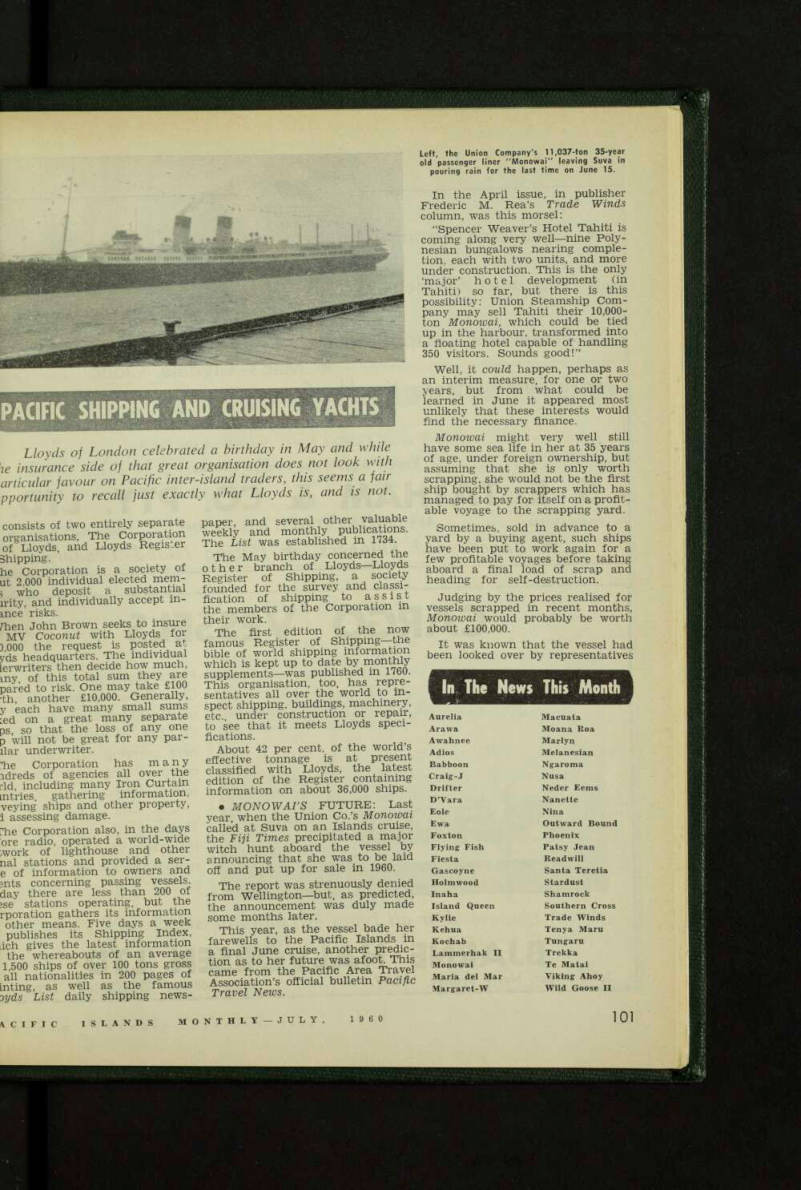
Monowai might very well still have some sea life in her at 35 years of age, under foreign ownership, but assuming that she is only worth scrapping, she would not be the first ship bought by scrappers which has managed to pay for itself on a profit able voyage to the scrapping yard.
Sometimes, sold in advance to a yard by a buying agent, such ships have been put to work again for a few profitable voyages before taking aboard a final load of scrap and heading for self-destruction.
Judging by the prices realised for vessels scrapped in recent months, Monowai would probably be worth about £lOO,OOO.
It was known that the vessel had been looked over by representatives
Left, the Union Company's 11,037-ton 35-year old passenger liner "Monowai" leaving Suva in pouring rain for the last time on June 15.
a Japanese ship-breaking firm,
a Hongkong shipping company, latter with a view to putting ship into the passenger trade in 1 East waters.
Those Near Misses: Cap
i G H. Edwards, who was navi ine officer in Monowai during 000 miles of the 140,000 miles t the ship sailed as an armed rchant cruiser during the Second rid War, and who travelled as a senger in her on her last Islands ise in June, told in Suva of how jg Japanese submarine fired two pedoes at Monowai just outside ia in January, 1942. ►he was escorting the Australian op ship Taroona from Lautoka to va, at the time. Fortunately for Twwai, the torpedoes, which were course for the target, collided 1 exploded when nearing the ship, e submarine commander saw the fiosion, thought he had made a I and surfaced, to be met with ivy fire from Monowai which :aped.
Dn January 11, a week or so rlier, this same submarine had >bed some shells across the hills ;o Pago Pago Harbour in a night :ack. A Pago Pago correspondent id that ironically each of the zen shells just missed worth iile targets, and the very first Ivo hit and demolished a house rmerly owned by a Japanese sident. One US Navy officer and ie enlisted man were slightly junded during the attack.
•Down For Refit: Making
>r first visit to Suva since her de rery voyage from Sydney in May, 56, the Sacred Heart Mission’s fdney-registered 79-ton, twin rew, wooden motor vessel Santa eretia arrived in Suva from the ilberts for refit on June 8 and was
[?] the "Macuata", which was in trouble been Suva and New Zealand in June. See [?] page 107 and other photograph on page At right is the "Maria del Mar", Noumea [?] and third to bear the name in the Rea trade of Emile Savoie and his asso [?]ates in post-war years. See page 105.
pected to be there for over a mth. Captain Peter Teke of ru was in command, Peter Man ua, chief engineer, that veteran the Gilberts, Brother Joseph tutier as, “let us say a sort of percargo”, nine other crew-men, d two schoolboy passage-workers, rhe little ship had cleared Tarawa ay 20, called at ten islands on the n south, and had departed Funa ti June 3 direct for Suva. She ought no cargo but had some rap-metal as ballast, Santa Teretia was built by W. •amm and Sons, of Nowra, NSW, r Mr. Gramm’s own use. She was mmenced in 1949 but circum ances prevented her completion itil 1952, when she was named lie, but she was never put to work, le ’Mission purchased her in 1955, id certain alterations made, and ie was relaunched January 28, 56, as Santa Teretia, taking the ime of at least two predecessors the Mission’s Gilberts service, ie measured 79 ft x 201 ft x 6h ft •aught. A double-ender type, she is >wered with pair of 98-hp Ruston Hornsby diesels—which were idly in need of an overhaul. Dur- Lg the past four years the ship as been beached at Tarawa for Dttom cleaning, but this year it as essential that she come to Suva >r certain work which could not be andled at Tarawa.
Among her crew members was aim Nabuti, who was awarded the ueen’s Commendation for Bravery >r diving from the ship to save a nail girl who had fallen over oard one night some months ago hile the vessel was at sea.
• Emergency Call; The
foumea-based Maria del Mar, under ommand of Captain R. Le Pironec, lade an unscheduled call at Suva n June 4-5 to bunker. Making one
of her quarterly government charter trips to Wallis and Futuna north east of Fiji, the 20-ton vessel met bad weather all the way. She was homeward bound with 30 deck and two cabin passengers and 80 tons of copra aboard after having made three shuttle trips between the two French island groups. Commandant Renee Thomas, chief of the gendarmerie in New Caledonia, was one of the cabin passengers, making his official rounds.
This ship is the third to bear the name in the Noumea trade of Cap tain Emile Savoie and his associ ates in post-war years. She was pur chased late last year in Auckland as Marua and renamed. A month or two earlier the New Guinea vessel Kokoda had been purchased and given the name, but she was sold again and renamed Liro. The first
When "Macuata" left Fiji late in May in her new role as a yacht these were the people manning her (right front, Capt. Henry Simpson, and next to him Mr. Roy Lidgard, the new owner). However, she struck trouble and re turned and in a renewed voyage in June the composition of the crew was changed. Below, LC 120, "Pacific Star", which originally be longed to the Pacific Islands Salvage Company, Rabaul, and later got into trouble in the New Hebrides, was recently sunk there by owner Reece Discombe. Here she is just before she finally turned over.
iria del Mar was the ex-NZ ister Margaret-W, sold to Jap ese ship-breakers in March, 1957. e was delivered there by Captain Ime, who delivered Gaitcha to peete as reported last month, ptain Le Pironec called at Suva t February in command of .madora del Mar. (A misprint PIM gave the tonnage of Gaitcha 24 instead of 274 tons).
• Mothership Zone Ex
JNDED: When the Japanese tuna ithership Tenya Maru No. 3 made r first call of the 1960 season at ,va in mid-June, the Japanese jvernment Fisheries Agency in ector, Hachiro Miura, reported at the South Pacific zone in which 3thership fleets are permitted by 3 government to operate, has this ar been extended westward to 160 grees East. Last year the western ait was 170 degrees East, and iters west of that meridian were served for the independent vessels it attached to any mothership iet. One effect of the change could that many more Japanese tuna igliners will be sighted in Southern >lomon-New Hebrides-New Cale mia waters this year. The southern nit of the mothership zone is 25 ;grees South, and there is no re riction to the Eastward.
This zoning of the mothership jets is a purely Japanese internal •rangement. It came about through ■otests by the independent boat vners, who have to send their small lips far from their home ports to nd the best fishing grounds. There icy naturally operate at a consider ate disadvantage to the boats at iched to mothership fleets. • FOR SOLOMONS? A crew was ;anding by in Suva late in June waiting word from Auckland that le sale of the New Zealand coaster naha, 255 tons, had been completed, t was thought that the Vila egistered, 37-year-old twin-screw, rooden vessel would be going to a loniara buyer. With Foxton, do wered in May to Papeete, Inaha ras purchased for resale last year y an Auckland syndicate.
• Resisting All The Way;
7he ex-BP trading ketch Macuata, /Inch was towed back to Suva on ler first attempt to reach Auck and in May, was in trouble again n June. She sailed from Suva again in June 6 and ten days later was breed to ask for assistance due to mgine trouble, and other problems.
Some of the sails also blew out. The Auckland Fairmile launch yacht Wgaroma, owned by Mr. J. Lawler — i friend of Mr. Roy Lidgard, owner af Macuata —was despatched to tow the ketch from a point 340 miles aorth of Auckland. Aboard the Fair mile was Mr. Jim Lidgard, who flew back to New Zealand after helping to prepare the ketch for the voyage south. Ngaroma is a standby vessel for the Search and Rescue Organ isation.
Warrant Officer Mike Tiller, of the Laucala Bay RNZAF station in Fiji, on leave and acting as navigator, was hit on the head with one of the booms and was in bed for a day or two.
• Back In Harness? The
ketch Trade Winds, more or less a sister to Macuata, which is now a yacht, was planning to move back from the yacht category to a work boat again in May, when it was re ported by travellers from Apia that owners Rusden and Copsey were negotiating to put the vessel to work in the area. Trade Winds is the former Tonga Copra Board’s Aoniu.
• He Sailed In A German
RAIDER: Bound for the UK as a passenger in Orsova in June was Mr. Dan McMahon, of Auckland, who will probably be joining the New Zealand Government’s new Moana Roa as Radio Officer. During the Pacific War the McMahon family was returning aboard the coaster Holmwood after a tour of duty as officer in charge of the NZ Post & Telegraph Department s radio station in the Chatham Islands when the ship was inter cepted by a group of German com merce raiders.
The McMahons, the officers and crew, and a large number of live sheep, were taken off Holmwood and the coaster was sunk by gunfire.
The McMahon’s joined of victims of other sinkings in the raiders, which then sank the liner Rangitane out from Auckland before heading for Nauru to sink five more vessels lying off the phosphate island.
By then the raiders were so crowded with prisoners that the Germans were forced to get rid of some—which they did at Emirau Island, north of New Ireland. The marooned party was eventually brought to Australia and Dan MCMahon returned to work with the
P & T. Reaching retiring age a few years ago he decided to join, the Union Company radio staff and since then has served in several ships on the Islands run.
• Cruise Rearranged: The
New Zealand coaster Marlyn, under charter to a large group of New Zealand South Island people, shed a number of her personnel in Suva in June, following some domestic problems aboard.
The converted Fairmile, after do ing some local inter-island cruising, returned to Suva with radio trouble on June 17, and sailed again for Lau Islands on June 20. Plans to head east for Samoa and Tahiti were abandoned and the vessel was to return to New Zealand via Nukualofa.
Marlyn , which has a 60-ton re frigerated hold and a 40-ton gen eral-cargo hold and is powered by a pair of 200 hp GM’s giving her a service speed of 11 knots, was for sale, with a starting-price ticket of £NZI7,OOO, when at Suva.
• Uk Will Build Them:
Three new wooden vessels for the British Solomons Government, one 80-ft replacement for the ill fated Melanesian, and two 65footers, are to be built in the UK.
Whether they can actually be built and delivered from there to the Solomons at a lower figure than is possible by building in Australia or New Zealand is not stated in the official announcement, but this is presumably the case. It would seem likely that the vessels may be shipped out as deck cargo.
• Poking Around; An Un
identified warship which passed be tween Guadalcanal and Savo on April 14 caused a good deal of speculation in the Solomons; but it eventually turned out to be HMAS Gascoyne on an oceanographic cruise. (Over)
In Suva in June on her first visit since her delivery from sydney in 1956, the "Santa Teretia II"
Standing third from left in this photograhp by "PIM" man Jin Shortallis Brother Joseph Gautier.
Sixth form left, wearing a pullover, is John Nabuti, who was awarded a medal for bravery re cently. See story on page 130, and for a photograph of "Santa Teretia II" see page 109.
I Trial Voyage; The Geic
ony Wholesale Society’s 20-ton rigaru made a run south from Gilberts to Suva in June to d a general cargo of CWS sup ;s on trial. Due to a period 9f ikness in the copra trade the ship 3 able to be freed for the voyage, rmally, cargoes for Tarawa come ect from Hongkong, or in phos ite ships via Ocean Island, the ter involving trans-shipment. An asional tramp calling at Tarawa load copra also brings direct ■go. If it is found that the cost landing cargo ex Fiji is favour e, further occasional voyages may made by CWS vessels.
Captain J. B. Wallace, of Glasgow, 0 has been with CWS for the >t two years, was in command of ngaru. Mr. D. Lopian, CWS mer mdise manager, came south to ndle the shipment. The vessel mght 800 empty drums and 400 ;ks of empty beer bottles from rawa. She met very bad weather the Fiji group. A call was made Funafuti in the Ellice Group.
» Still Rolling In: From
Imerston Island, in the Cooks, mes word of another bottle jssage found there in the first half May by Mrs. Alice Manuka. The ?ssage indicated that the bottle d been tossed from the Standard icuum tanker M. E. Lombardi, 125 tons gross on August 8, 1959, 8.19 S and 145.05 W—about 270 lies due west of Nukuhiva. It had us travelled about 1,200 miles uthwest, but there was no know g how long it had taken as it may ive been lying on the beach for □nths before being found.
It will be recalled that this tanker ;nt to the assistance of the 222n Japanese fisheries training vessel oyama Maru when the latter sssel sprang a leak 170 miles north ist of Palmyra Island in February . (March PIM, p. 113). •TSUNAMIS; The tsunami (tidal ave) of May 23 did little damage 1 boat harbours or yachts in the awaiian Islands. Most yachts went ) sea to wait it out. Some small □ats and outrigger canoes were
washed ashore. Some of the boats that remained in the Ala Wai Boat Harbour went aground and heeled dangerously over when the water went out. Mostly frayed nerves and a new respect for tsunamis resulted. • ISLAND QUEEN, a 65 ft motor vessel, was recently purchased from the assets of the defunct Hawaii Water Transport Company for ferry service between Tahiti and Moorea.
The Island Queen and her sister ships provided fast, regular service between Oahu, Molokai, Maui and Hawaii until the high cost of opera tion forced the company out of busi ness Departure time was set for the middle of June with a stop at Flint and Caroline Islands to pick up 40 tons of copra.
• Cruising Newcomer: Be
lieved for the first time, an Italian passenger ship, the 10,002-ton Ger man-built 21-years-old Aurelia will make an Islands cruise from Syd ney in August. Originally named Huascaran, sold to the Canadian CPR Line in 1947 and renamed Beaverbrae, and purchased by her present owners, the Cogedar Line of Genoa, in 1954, she is a diesel-elec tric vessel powered by three engines magnetically coupled to a single shaft.
Calls will be made at Nukualofa, Suva, and Noumea before the ship returns to Sydney. She will arrive at Suva on the evening of August 21 and remain for 24 hours at that port.
• Master’S Ticket Next:
Visiting his home port of Suva in June was Mr. George Williams, 26year-old grandson of that well known Fiji master, the late Captain Frank Williams, and son of Mr. and Mrs. George Williams. George, junior, served first in the mission ship John Williams VI, then five years ago joined the Union Com pany. Since then he has qualified as second mate and lately as mate, so is well on the way to joining the very small band of Fiji-born seamen who have qualified for a foreign going master’s certificate.
• Was Once A Gunboat:
Nusa, oldest ship operating out of Rabaul and formerly a German steam-powered gunboat, is being broken up at Rabaul. The 54-year old vessel, now diesel-powered, has reached the end of her economic life.
For the last 35 years she has been a copra-carrier on the New Britain and Bougainville coastal trade.
Nusa was in use by German Gov ernment for patrol duties when Australia occupied Rabaul in 1914.
Until three years ago the oldest ship operating out of Ilabaul was the motor vessel Bellbird, which caught fire and sank off the New Britain south coast in 1957. Four people lost their lives.
• Newcomer Took Richest
SHIPMENT: On her first run in a new direct service between Europe and Papua/New Guinea ports, MV Neder Eems took out of Rabaul a cocoa shipment valued at £75,000. It was the biggest single shipment of cocoa ever to leave a P-NG port, and went to England and Europe.
The 10,000-ton Germa n-built vessel was the first in a regular nine-weekly schedule being operated jointly by Nederland Line Royal Dutch Mail, and Royal Rotterdam Lloyd. . ±1 Neder Eems and other ships in the line also become the biggest vessels to go into regular schedule through P-NG ports. The ships carry 12 passengers, and their equipment in cludes mechanical hatch covers.
• It’S Official Now; Cargo
and passenger transport by native canoes on the Papuan coast (paddles, sails or outboard motors) has be come such big business that authority has investigated the legal and safety factors involved.
The result is new legislation from the Papua-New Guinea Legislative Council to control and licence the newly-developing traffic.
• New Home For Mo Ala:
Burns Philp’s small vessel Moala, which in recent years has been based on Santo, New Hebrides, has been sold to R. G. Symes Ltd., of Honiara, BSIP. It was expected that
Below, the "Santa Teretia II" in Suva in June—see photo on page 107.
At right is the "Gaitcha", recently delivered to Papeete from Noumea.
"Gaitcha" was built in Tasmania in 1945.
she would, reach her new port earl
in July.
Moala was built for Burns Phi|
by Millers, Suva, about 1947, an
was virtually a sister ship t Taveuni (later purchased by Die Brown, of Rarotonga), Cora an Macuata. She was sold through th
agency of Captain J. Kennedy, Syd
ney shipbroker.
News of Cruising Yacht
• TREKKA’S owner John Guzzwell Victoria, BC. has been awarded the covet* Slocum Award by the Slocum Society fi his four-year lone-handed circumnavigate via San Francisco, Hawaii, Samoa. Ne Zealand, Australia, South Africa, Ascer sion, Barbados, Panama, and again Hawa in his 20-ft. o.a. Laurent Giles-design* self-built yawl.
The Slocum Society announcement sa] that Guzzwell is honoured not because 1 sailed round the world in the smalle! yacht, but because he made the voyaj without incident. The award is only mad when fully merited and is not a regula award.
Guzzwell, by his cruise, joined the sele< band of lone-handed circumnavigator Joshua Slocum, Alain Gerbault, Han Pidgeon (twice), Edward Miles, Alfre Peterson, Jean Gau, Marcel Bardiau: Louis Bernicot, and Vito Dumas. • CRAIG-J and Dayton J. Lalonde t California, now at Sydney, are possibl candidates for a future Slocum Award— Lalonde can, as he hopes, make the fastei single-handed circumnavigation wither mishap. We are not quite certain wheth* TREKKA is 20-ft. w.l. or o.a. Lalonde saj that his craft is 20-ft. o.a. and 18-ft. w. approximately. • PHOENIX of Honolulu—the 50-f ketch which caused all the excitement i 1958 by flouting the US government’s ba on entering the Eniwetok nuclear bom testing area, should be back at Hiroshima Japan, the port where she was built, whe this appears. (See opposite).
Dr. Earle L. Reynolds, owner and maste of the ketch, received two years’ gaol fo the offence after a number of legal battle: but in March the Supreme Court of the U granted his release, subject to certai conditions, and permitted him to sail fo Japan to again take up a university ap pointment there as visiting Professor o Anthropology at Hiroshima Women’s Col lege. The doctor has an appeal case lodge with the Supreme Court against his con viction, but it may be some time befor this comes up.
Many people in the South Pacific me and liked the Reynolds’ family during th course of their world cruise prior to th test area incident. With them on the wort cruise were Japanese university student Niichi Mikami, Motosada Fushima, am Mitsugi Suemitsu, all experienced yachts men.
Dr. Reynolds was attached to the Atomi Bomb Casualty Commission at Hiroshim; after the war, and it was from that ex perience that his active opposition to al nuclear bomb testing stemmed. He wa also convinced that his government <3i< not have the right of interfering with navi gation, even of American vessels, on th high seas. • STARDUST, the Sydney Fairmile which has been in Fiji waters since abou last September, cleared Suva on June 11 for Taveuni, Wallis Island, Pago Pago Suwarrow, and Papeete. • SHAMROCK of Wellington, NZ, will
Smith family, which returned to Suva e 4 after local cruising, departed again outer islands on June 20 and will then and for Vila or Noumea—depending on the ds—thence probably New Guinea and itralia. i BABBOON, 52-ft. American-registered ooner, still lay at Suva late in June ler a caretaker crew. Mr. and Mrs. Paul ier, now in possession, returned to the to recruit a crew for the voyage to ifornia. > VIKING AHOY, owned by Mr. Burns bber of Invercargill, NZ, and lying idle Walu Bay, Suva, for the past two years, I probably sail for New Zealand in July, e sturdy twin screw motor cruiser has sly been re-engined and was being gener i prepared for sea in June. > READWILL, converted clinker-built (boat which crossed the Tasman from iney to Auckland in September-October, ■B, with Messrs. A. Svedlund of Sweden i A. Taumees of Estonia, and which ided off for Polynesia some months ago, s in trouble at Rarotonga on June 4. tering Avarua Harbour the 29-ft. engine s ketch was set on the reef and suffered ne damage. There were four men aboard ; yacht, which is said to be westbound ck towards Auckland. • ARAWA, a 34-ft. sloop manned by •. and Mrs. Gerald Hunter, and bound im New Zealand to Tonga in May, put ck to Russell from a point 130 miles out, th a leaking water tank, and arrived that port May 28. With the owners are o sons and another crew member. They ire sailing for Nukualofa again as soon repairs were completed. • NANETTE of Whangarei, NZ, a H-28pe manned by Charlie Capon and M. sarlove, cleared that port for Brisbane on ay 29. This is the ninth yacht to leave hangarei on a deepwater cruise this ason. • FLYING FISH, a 60-ft. ketch ap irently based in the Hawaiian Islands, eared Kailua direct for Papeete late May. • KYLIE, 39-ft. steel yawl of Sydney in bich Harry Fink and companions made a uise to Auckland and return at the be nning of 1954, was to sail for Russell, Z, and Polynesia ports en route for the S in April. We have no report of arrival Russell up to mid-June and do not row whether she actually left Sydney. • STARDUST, 34-ft. Gulfweed-type ketch
with UVz-tt. beam and 5Vz-tt. draught—no connection with the Sydney Fairmile men tioned earlier—was to clear San Diego for the Hawaiian Is. and later for the South Pacific in July. Louis and Jessie Bendixen are the owner-navigators. A Welsh terrier named Curley sails before the mast. • PATSY JEAN with Don Silk, his wife, daughter Patsy Jean, G. Fell, and K. Saul aboard, which cleared Whangarei, NZ, April 30, arrived at Aitutaki May 26, next port Rarotonga, where Don will commis sion his rebuilt ketch SlßEN—reported as renamed NEW SIREN, the latter uncon firmed. • WILD GOOSE II of Seattle, Wash., with owner Max Wyman, skipper Black burn, and others aboard called at Christ mas Island, Penrhyn, and the Marquesas in May and after visiting the Tuamotus and Tahiti was to call at Rarotonga. This yacht was at Hiva-oa Island when the
tsunami wave of May 22 did damage to shore facilities there. A report from Pen rhyn where she had arrived on May 2, said that this 300-ton yacht is on a two year world cruise. • NINA, 34-ft. yacht of Tauranga, NZ. which was one of those in Avatiu Harbour.
Rarotonga, at the time of the May tsunami and was last month reported as un damaged, did suffer some straining. She put to sea before the second senes of waves arrived on May 23, but was found to be leaking and has been undergoing some repairs since then. This yacht is manned by Mr. and Mrs. Buckthought and their four children, and Bob Boyd who last year was a crewman in PATSY JEAN. • KEHUA of Whangarei, NZ, with Selwyn Mathison, Peter Ashcroft, Don Beer and John Pettit, and TAHITI owned by Lorrin Smith of Honolulu and based
irotonga. both suffered extensive e during the above tsunami incident atiu Harbour, Rarotonga, and are auled up on the beach there.
OUTHERN CROSS II, a 44-ft. steel is heading for the South Pacific lodney Wesley Garrett in command, uver newspapers say he plans to ssionary work in the Islands.
He Search For Drifter: In Our
issue (page 109) we discussed the for Mr. J. P. Moore of Wellington, nd his yacht DRIFTER, and men that though Mr. Moore said he had in one of the New Zealand forms r out details of his yacht prior to r, and had handed this form to a , it had never reached the Search tescue authorities. Mr. Moore, in a ly letter, now tells us that the form anded to Search and Rescue within ays of his SOS signal being inter 1. ‘ “PIM’s” authority for saying that ;tails did not reach the SAR was the of a discussion with the SAR Co itor in the Auckland Office of Air tment. Perhaps the Wellington rities did not consider it necessary rise the Auckland co-ordinator, as we no reason to doubt that the state of both parties are correct. State which appeared in the Press during ir search and later, and which ap- J to originate from the SAR authori certainly did not suggest that the had reached the correct quarter, as is stated that inquiries had shown DRIFTER had no radio equipment d capable of sending the 500 kc/s Is now known to have eminated from acht. is also worth noting that the correct dure is for a yachtsman to make sure the form is correctly lodged prior to ture. [M” does agree with Mr. Moore’s con >n that the regulations now proposed ic control of off-shore voyages by the Zealand Government are unreasonable mduly restrictive. “PIM” believes that ig as a yachtsman is not going to en er the lives of others he should be 0 go where he pleases within the limits ternational law—and free to sign away ghts to any search and rescue opera- The proposed regulations deny the r right and impose a strict control 1 could have the effect of effectively g the worthwhile spirit of adventure iated with deep-water cruising.
EOLE, steel double-ender of France, Guy Clabaut lonehanding it, was at tonga in May, westbound from Papeete e the yacht arrived in July, 1959. port in the world cruise was given robably Noumea. We have no precise Is but believe this craft to be about a oter. Clabaut operates on the amateur i bands, details unknown. Clabaut Its no English.
EWA. gaff-rigged ketch, left Honolulu 14 for Tahiti via Kona, Hawaii with ;r Jerry Yatsunoff and two crewmen rd.
AWAHNEE, cutter, left Honolulu June 4th skipper-owner A. L. Griffith and hter; Michael Bates, Nancy Higgins 6 year old son; E. C. Jones, wife and ?ar old son. They will spend about 10 on Maui and Hawaii and then sail Flint Island to make observations of a temperatures and sea life, and on French Oceania for a three-month le.
TE MATAI, 73-foot ketch, motor-sailer leave Hilo June 16, with owner-skipper Fraser and crew of three, plus seven engers for French Oceania and the ; Islands, to return in a year or so.
Bob plans to visit many of the islands he missed with his former boat, KURU. • KOCHAB, 40 ft. ketch from London, arrived at Hilo, Hawaii, June 8 after a 17 days sail from Manihi in the Tuamotus.
Skipper-owner John Evans credited a help ful current in helping make the fast trip.
Also aboard was Dick POhe of Auckland, NZ. She will leave in August for US west coast and, eventually, Jamaica. • FIESTA, 72 ft. schooner, just com pleted a movie contract as “The Wackiest Ship in the Army”. Owner Martin Vitousek is removing the temporary additions made to make her conform to Hollywood’s version of a South Seas trading vessel. When work is completed, plans are for a trip south. • OUTWARD BOUND, owned and sailed by John Caldwell and family, and currently on a westward-round-the-world cruise, called at Port Sudan in mid-March and in April sailed off into the Red Sea. Our news comes from Bill Reed, now stationed in Port Sudan, who is the unofficial welcome-committee for cruising yachts.
Another yacht which he says will eventu ally cruise the Pacific and which also was in Port Sudan at about the same time as the Caldwells, was TAOS BRETT 11, sailed
by another cruising family—Claude Graf and wife and four months old baby. • ADIOS —A couple of weeks in Port Moresby were apparently enough for Tom and Jan Steele of this ketch. They arrived on May 24 and were gone again by June 3, bound Darwin via Thursday Island and thence into the Indian Ocean and Red Sea —a route that is becoming just about as popular with cruising yachtsmen as the Pacific. The large boom on the main-mast caused a couple of raised eyebrows in Moresby where this rig has not been en countered before—the Steeles use it for two square sails instead of the conventional twin spinnakers. • D’VARA and the Bradfields are still in Madang, NG, where they went originally to wait for an engine spare, and probably to see also that the skipper’s leg was com pletely seaworthy. He tore a muscle on their trip between Port Moresby and Rabaul and Mrs. Bradfield had to sail the yacht virtually single-handed. • LAMMERHAK 11, of Haifa, reported last month as clearing Rabaul for Indian Ocean ports, turned back at Kavieng to wait for better conditions. The 23-ft. yawl and lone-voyaging owner Joseph Havkins are now back in Rabaul.