Oil Drum!
pp. 88-89 · Read in the full issue
Tribute To A 44-Gallon
By Lew Friday
As a sign, or harbinger, of civilisation, the 44-gallon oil drum has become as universal in the tropics as the flying machine or the Land Rover. Wherever life, and some sort of industry, no matter how humble, goes on, these drums turn up to play their part in village existence.
THE war threw them up as flotsam and jetsam in places where they had never been seen before, P° st “ war boom in copra and other cash crops, bringing in
mnhn^ 6^ 6 ’
mobile and the tractor, has seen their conversion, in isolated townships, at anchorages, on plantations, l n^L t jlL! ill ?f e lc a Q nd f ° n Eu I r °P ean homesteads, to uses formerly unareamea oi.
I had many a good bath in a 44gallon drum in the days before Pearl Harbour, when a Japanese named Noda, at Ounia, on the south-east coast of New Caledonia, used to grant me prior use of his modest bathing shed before he nightly
undertook the bathing of his own large family, from his wife, who was an Indian, to the smallest tot.
A sim iiar bath, with a second drum for heating the water, was installed, this time in the open on another property 15 miles away which at the time had a Japanese caretaker p The usual heavy afternoon rain did not matter once you were steeped in this welcome tub.
But my eyes were not properly opened to the modern uses of the modest oil drum until I visited New Guinea. Here I found it universally put to service, often enough in as sociation with cement, You can earn the gratitude of
native villagers by procuring thei empty drums.
I witnessed the contentment c one community, at Lambon Islam near the southern tip of New Ire land, when the MV Marr, on whid I was a passenger, pulled in wit some of these gift drums on board
A Thing of Beauty!
Tondavi, the plodding, sincere ol Luluai of the village, drew me asid and pointed down through 18 fee of clear water in which the core fish (those things the touris brochures go into raptures about were darting hither and thither.
I thought it was these bright be ings he wanted to show me, bn no, it was a number of prosai cement-filled drums holding up th solidly constructed wharf which i the village pride!
What they wanted the newl arrived drums for was to build ; copra-drier.
I saw some of these easy-to-buil driers at work in other places ii the Rabaul area; they were bein used for cocoa drying as well. Th flues are constructed of as many a ten petrol drums from which botl ends have been removed. Thes drums are jointed by metal collars 4 ft wide.
The joints are packed witl asbestos tape, and the co 11 a tightened by means of two bolt passing through brackets of angl iron riveted to the collar. Th South Pacific Commission’s maga zine and pictures have given detail of the construction.
In plantations far afield you corm across large cooking vessels left be hind by the Japanese for frying the daily ration of wheatmeal cake: for the labourers.
But on other plantations the top of drums are used as baking trays They are put on coals and the sun face of the metal smeared wiT coconut oil. The lid proves a goo( cooker of cakes for the labour line since it can hold the heat evenly for hours.
They're Ovens, Too
Once oil drums set in cemen made good ovens at the old native hospital in the “Matupit Farm’ area of Rabaul.
As a water collector, drums an placed at the base of coconut palms just where the first slant straighten*
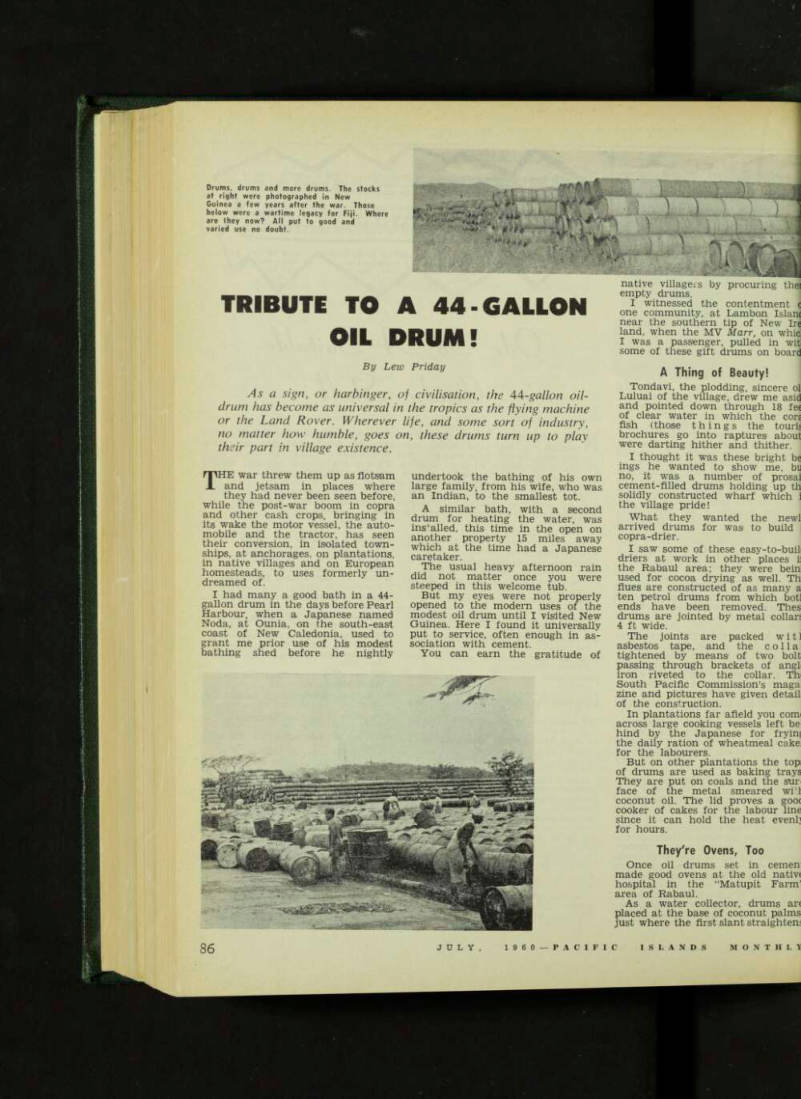
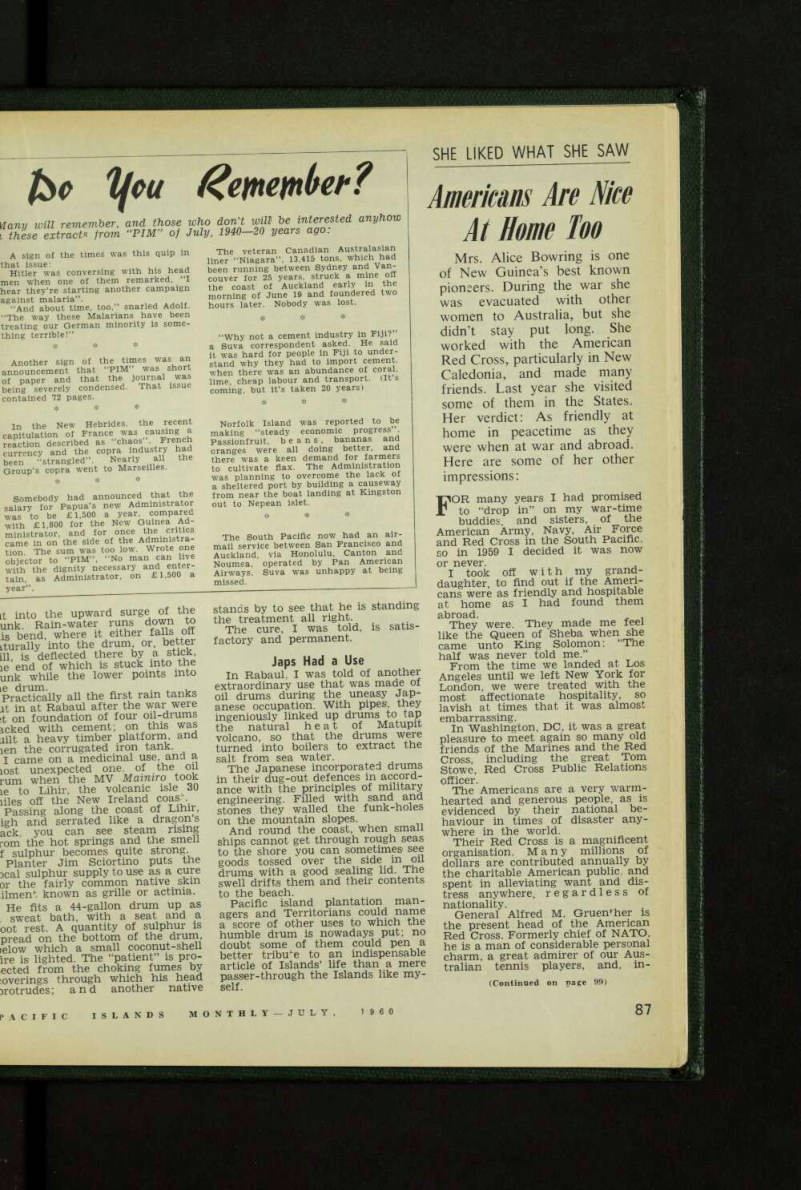
Drums, drums and more drums. The stocks at right were photographed in New Guinea a few years after the war. Those below were a wartime legacy for Fiji. Where are they now? All put to good and varied use no doubt.
intn the unward surge of the
n SrSrS.?
f %er
ill is deflected there by a stick, ic end of which is stuck into the unk while the lower points into ie drum. , Practically all the first rain tanks it in at Rabaul after the war were t on foundation of four oil-drums icked with cement; on this was lilt a heavy timber platform, and len the corrugated iron tank.
I came on a medicinal use, and a lost unexpected one, of the oil rum when the MV Mainiro took ie to Lihir, the volcanic isle 30 hies off the New Ireland coas L .
Passing along the coast of Lihir, igh and serrated like a dragon’s ack you can see steam rising rom the hot springs and the smell f sulphur becomes quite strong.
Planter Jim Sciortino puts the Deal sulphur supply to use as a cure or the fairly common native skin ilment known as grille or actinia.
Up fifq o 44-eallon drum up as S bath 4 Ihh a seat and a oot rest A quantity of sulphur is oread on the bottom of the drum, telow which a small coconut-shell ire is lighted. The “patient” is proected from the choking fumes by ■overings through which his head irotrudes; and another native
stands by to see that he is standing . is satis factory and permanent, u-.j-.iie® Japs Had a Use In Rabaul, I was told of another extraordinary use that was made of oil drums during the uneasy Jap anese occupation. With pipes', they ingeniously linked up drums to tap the natural heat of Matupit volcano, so that the drums were turned into boilers to extract me sa lt from sea water, The Japanese incorporated drums in their dug-out defences in accord ance w ith the principles of military engineering. Filled with sand and stones they walled the funk-holes on the mountain slopes, An d round the coast, when small ships cannot get through rough seas to the shore you can sometimes see goods tossed over the side m on drums with a good sealing lid. The swe ll drifts them and their contents to the beach.
Pacific island plantation man agers and Territorial could name a score of other uses to which the humble drum is nowadays put, no doubt some of them P o^ pen a better tnbu e to an indispensable article of fsiands’ hfe than a mere passer-through the Islands like my self.