When The Walrus Came,
p. 85 · Read in the full issue
You Waded Ashore
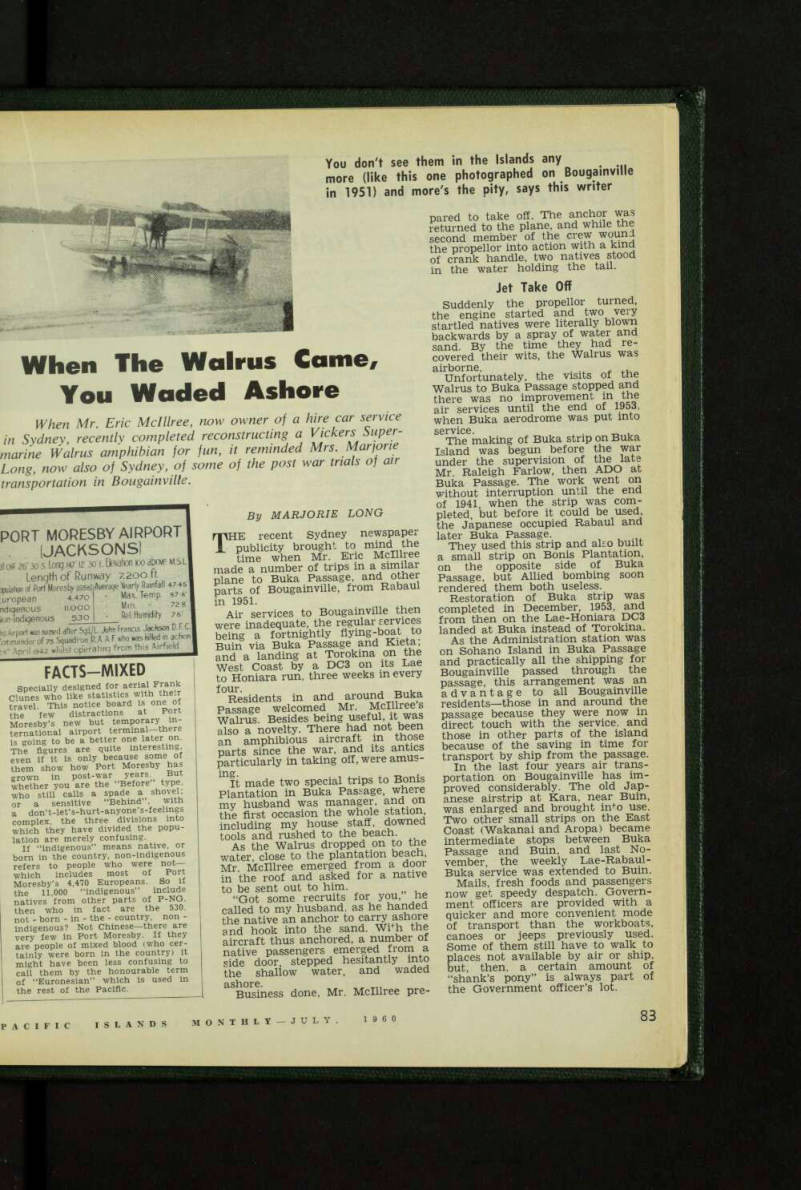
When Mr. Eric Mclllree, now owner of a hire car service in Sydney, recently completed reconstructing a \\ cker * Su ? er marine Walrus amphibian for fun, it reminded Mrs. Marjorie Long, now also of Sydney, of some of the post war trials of air transportation in Bougainville.
By Marjorie Long
r;E recent Sydney newspaper publicity brought to mind the time when Mr. Eric Mclllree made a number of trips in a similar plane to Buka Passage, and other parts of Bougainville, from Rabaul in 1951.
Air services to Bougainville then were inadequate, the regular services being a fortnightly flying-boat to Buin via Buka Passage and Kieta, and a landing at Torokina on the West Coast by a DCS on its Lae to Honiara run, three weeks in every f °Residents in and around Buka Passage welcomed Mr. Mclllree s Walrus. Besides being useful, it was also a novelty. There had not been an amphibious aircraft in those parts since the war, and its antics particularly in taking off, were amus m|t made two special trips to Bonis Plantation in Buka Passage, where my husband was manager, and on the first occasion the whole station, including my house staff, downed tools and rushed to the beach.
As the Walrus dropped on to the water, close to the plantation beach, Mr. Mclllree emerged from a door in the roof and asked for a native to be sent out to him. „ “Got some recruits for you, he called to my husband, as he handed the native an anchor to carry ashore and hook into the sand. Wi h the aircraft thus anchored, a number of native passengers emerged from a side door, stepped hesitantly into the shallow water, and waded ashore Business done, Mr. Mclllree pre
pared to take off. The anchor was returned to the plane, and while the second member of the crew wound the propeller into action with a kind of crank handle, two natives stood in the water holding the tail.
Jet Take Off Suddenly the propeller turned, the engine started and two very startled natives were literally blown backwards by a spray of water and sand. By the time they had re covered their wits, the Walrus was airborne. , ..
Unfortunately, the visits of the Walrus to Buka Passage stopped and there was no improvement in the air services until the end of 1953, when Buka aerodrome was put into service The making of Buka strip on Buka Island was begun before the war under the supervision of the late Mr Raleigh Farlow, then ADO at Buka Passage. The work went on without interruption until the end of 1941 when the strip was com pleted but before it could be used, the Japanese occupied Rabaul and later Buka Passage.
They used this strip and also built a small strip on Bonis Plantation, on the opposite side of Buka Passage, but Allied bombing soon rendered them both useless.
Restoration of Buka strip was completed in December, 1953, and from then on the Lae-Honiara DC3 landed at Buka instead of Torokina.
As the Administration station was on Sohano Island in Buka Passage and practically all the shipping for Bougainville passed through the passage, this arrangement was an advantage to all Bougainville residents—those in and around the passage because they were now in direct touch with the service, and those in other parts of the island because of the saving in time for transport by ship from the passage.
In the last four years air trans portation on Bougainville has im proved considerably. The old Jap anese airstrip at Kara, near Buin, was enlarged and brought use.
Two other small strips on the East Coast (Wakanai and Aropa) became intermediate stops between Buka Passage and Buin, and last No vember, the weekly Lae-Rabaul- Buka service was extended to Buin.
Mails, fresh foods and passengers now get speedy despatch. Govern ment officers are provided with a quicker and more convenient mode of transport than the workboats, canoes or jeeps previously used.
Some of them still have to walk to places not available by air or ship, but, then, a certain amount of “shank’s pony” is always part of the Government officer’s lot.
You don't see them in the Islands any more (like this one photographed on Bougainville in 1951) and more's the pity, says this writer