Tropicalities
pp. 83-84 · Read in the full issue
Pacific Islands Monthly
Magazine Section
Mitiaro has always been ;scribed as one of the lesser ands of the Southern Cooks, now turns out that it isn’t
- or not quite, anyhow.
LISTING maps give the island an area of 2,529 acres, or about four square miles. But photo phs taken from an official air ft at 6,000 ft now reveal that iaro’s true size is 5,500 acies, .ch is almost double 0 they’ve announced that ntue iaro is the fourth largest in the ire Cook group of 15, coming 3 r Rarotonga, Mangaia and Atm.
Unfortunately, whether double its ; or not, a lot of Mitiaro is still imp and makatea.
Mystery Lights
UI and New Caledonia lately have both been having an out break of mysterious lights in have been reported by erll people in Suva and Noumea the last couple of it have disappeared at a fast late, \f ter several weeks, Fiji authonti^
Ven~ -
iteorological balloons sent up by ather forecasting stations neai va. The balloons are Jtfed with hts when they are used at night- Phis may have laid Fiji’s ghosts, t in New Caledonia no such ex mation has been offered.
Footnote ; Sydney people m late ne also got into the act, when
ey reportld “mysterious brilliant
een lights flashing across the sky .
Mystery Sounds
S if mystery lights were not L enough, the South Pacific is also having trouble trying to loca.e vstery sounds. .
Are they Russian submarines, omic fallout, pieces of sputniks, Little Green Men? , The Cable and Wireless people anklv do not know what has been msing cable traffic disturbances 1 the Suva -Fanning Island sector nee February, 1959. They have had Fiji Government geologist meverybody knows, any metal Dject touching a radio aerial can mse a noise in the loudspeaker, he same thing can happen to tele raph cables—the ends of which for mile or so near the shore are rmour-covered to prevent this kind f interference.
Any electrical device operating near ie unarmoured sections of the deep
water cable could cause interfernatura? I magn e in the earth.
The trouble has been occurring about five times a month, and it lasts from five to 15 minutes. It was severe during the tidal waves set off by the Chile earthquake in May, and hurricanes and heavy weather increase the frequency. There have, however, been intervals as long as 26 days without interference.
Mr. R. E. Houtz, the geologist, has offered one possible explanation— that the trouble arises from a bed of iron sand. But it’s only an idea.
The mystery has not yet been solved.
Just Lost, That s All T H p uv a gaol missed aprisoncrin 1 SSSSsTaIr he « u p p rls f oJ uniform, walking down a forest trail a few miles away.
iSfSLSSIrtSS;
when he He was glad to Fccaoer's Tribute P . tore recent visit to New Guinea by Fre d Hargesheimer. the former American wartime pilot wbo was sb ot down over New Brita in and escaped after many months living with the natives (PIM, May, June ). has brought to light som e information on a little known organisation called the Royal Air Forces Escaping Society, society has as its membership men Qf the Br iti S h Commonwealth air forces who escaped from behind enemy lines. The chairman of the
Aust.alia^branch, Captam
ahho g. part of the island,
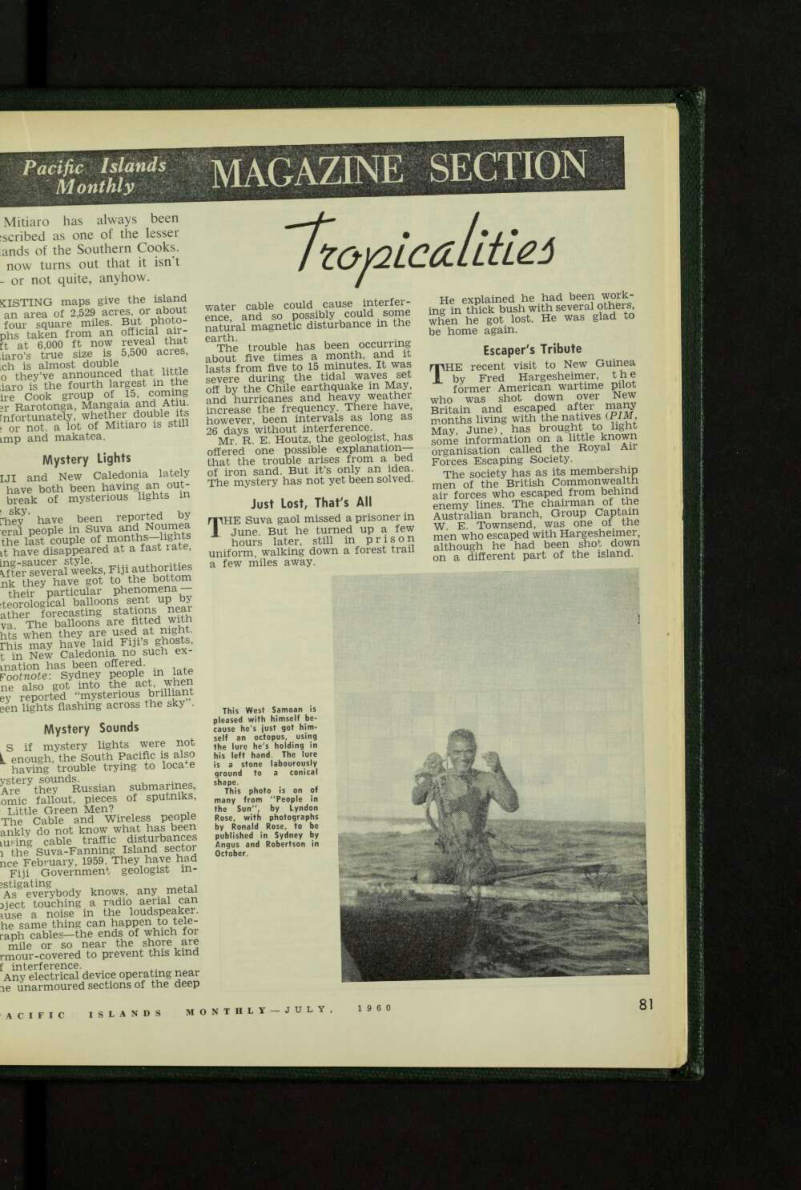
This West Samoan is pleased with himself be cause he's just got him self an octopus, using the lure he's holding in his left hand. The lure is a stone labourously ground to a conical shape.
This photo is on of many from "People in the Sun", by Lyndon Rose, with photographs by Ronald Rose, to be published in Sydney by Angus and Robertson in October.
Bill Townsend is now boss of the Royal Australian Air Force at Williamstown, NSW, and he said in June that the Australian branch of the society used its money to help those who had helped its members during the war. On occasions it erected tablets over the graves of those helpers who had died. The society intends to erect one on the grave of Paramount Luluai Golpaik, who died in New Britain last year, and who was awarded the MBE for his help during the war.
Bill Townsend has heard (cor rectly) that there is to be a memorial erected to Golpaik by a group of Rabaul people, and he’s been making inquiries lately to see if the Escaping Society tablet can be erected at the same time that the memorial is unveiled.
There are 700 members of the organisation of the society.
There are 60 eligible for the Aus tralian branch, of which 50 are registered.
Dugout Express
A MIGHTY dugout turned up at Honiara from the weather coast of Guadalcanal recently. It was 25 ft long, and took nearly two years to make. Twelve men brought the canoe (named Geona, which is said to be an old local name for Guadalcanal) from Talise, some times paddling and sometimes, sail ing.
Object of the visit: The builders hope to get a loan from the Gov ernment to buy an engine so that they can freight cargo and passengers to Honiara.
He Is Now A Five-Starred
General!
WHEN the publisher of the Pacific Islands Monthly , Mr.
R. W. Robson, returned to his desk in May, from a world-wander, he found awaiting him an honorary commission in the Territorial Militia of Guam, couched in these terms:
This is to certify that R. W. Robsdi is hereby commissioned an honoran
General Of The Guah
MILITIA, and is entitled to wed upon his lapel five miniature goU stars in a half circle (if he can ge them). It also entitles him to al the rights and privileges pertainm to his exalted position, including hi lifelong friendship for the peopt\ of Guam.
In Testimony whereof, I hav i hereunto signed my name and causei the Seal of the Governor to bi affixed this 20th day of October 1959, Agana, Guam.
Richard Barrett Lowe,
Commander-in-Chief and Governed As this probably is the only oppor tunity he will have, in a long life time, of becoming a five-s:arrec General, the modest publisher of th( PIM now is following up the matte] avidly—even if it means that h( must call some day in person upor the former genial Governor o] American Samoa and of Guam, ir his retirement at Alexandria, Vir ginia, USA.
The Long Way Round
PUKAPUKA atoll, in the Northerf Cooks, is probably one of the most isolated inhabited islands in Polynesia, rarely receiving more than four ship visits per year anc sometimes only two.
Mr. Athol Rusden, skipper of the yacht-cum-trading craft Tradt Winds, said that when he called there last year in the yacht Mana wanui, bound for Honolulu, the local authorities asked if he would mind taking the school children’s examination papers and posting them to Rarotonga from Hawaii, as otherwise it might be months before the results could be known —bj radio—at Pukapuka.
The papers eventually reached Rarotonga per favour of the air lines. as a result of Mr. Rusder explaining the situation to Par American Airways in Honolulu There was no charge.
They Created Records IN a sense, the Law is particularly fair in Tonga—there are now three Tongan lady lawyers whe have been admitted to the Supreme Court.
Latest of the trio qualified with credit last February, and has since established herself as the firs* woman to stand for Parliament in the Kingdom of Tonga. (The elec tions were held in May). She is Mele ’Umukisia Tu’ipulotu. This was the first occasion that women have had a vote.
Another woman candidate was Tuna ’Ulukalala-Ata, wife of the Honourable Minister of Police, who, a late report indicates, came fourth on the poll for Tonga*apu and caused her male opponents some anxious moments.