Frisbies
pp. 65-69 · Read in the full issue
Another Member of The Family Writes About—
Life With The
Robert Dean Frisbie, the American novelist, died 12 years ago in Rarotonga.
He passed on his gift to one of his children, Johnny, who is, however, probably more interested in providing a memorial to Papa Ropati than in becoming a professional writer.
FEW men have earned the continuine: love and respect of K children to the degree that Robert Dean Frisbie did. Few have earned it under such extraordinary circumstances, for none of the background of their lives together in Polynesia might be regarded as
child-psychologist-approved.
It is something of a shock to realise that it is 12 years since Frisbfe died in Rarotonga. A new generation has been born, or moved into the Pacific; a generation that nrobablv knows nothing of the books Frisbie wrote Mr. Moonlight’s Island, Island of Desire and others.
He was of the same generation of writers as James Norman Hall and Charles Nordhoff, and since these three men are now dead, this phase of Polynesian writing has ended. No one, at any rate, has yet appeared to take their place.
Now, to keep Frisbie’s memory alive, comes Johnny (Florence) Frisbie, second child of Frisbie and Ngatokorua-a-Mataa, a Puka-Pukan girl, with a story w£ ic h might pave been called Our Life With Father, but has emerged under the tit e The Fnsbies of the So The book was published in America towards the end of last year, but so far has not appeared in an edition English, edition. brm£nt y nf the five b F b r£bie h chilSen, and her highly developed sense of
responsibility early made her Frisbie’s first lieutenant, when the mother died ol the Cook Islands’ perennial —e TB soon after the birth of the last child.
Charley, the first born, was adopted out of hand by a relative, j n the Polynesian manner. Jakey appeared 16 months after Johnny, and at suitable intervals, so did Elaine and Nga. Charley and Jakey both went to New Zealand shortly before Frisbie died; the girls, with Johnny in the lead, to Honolulu one after the o her. They graduated from High School there, and later achieved amei as Polynesiani dancers —although Johnny had, first, a spell of two years as secretary to a US Army colonel in Japan. j n 1953, s he married an American, carl Hebenstreit, a TV personality a t a Honolulu television station.
They now have a young son, and an even younger daughter.
Johnny’s new book is an enter taining account of a brood of part- Polynesian youngsters who lived a Swiss Family Robinson life in some Qf the mogt delightful parts of the pacific, the centre of their existence being always their erratic, gifted and unpredictable father. oinerficial amrle for That is tne supernciai angle, lor those who are makm S their flrst acquaintance with the Frisbies. For others, who knew Frisbie and Frisbie’s books, there is a great deal
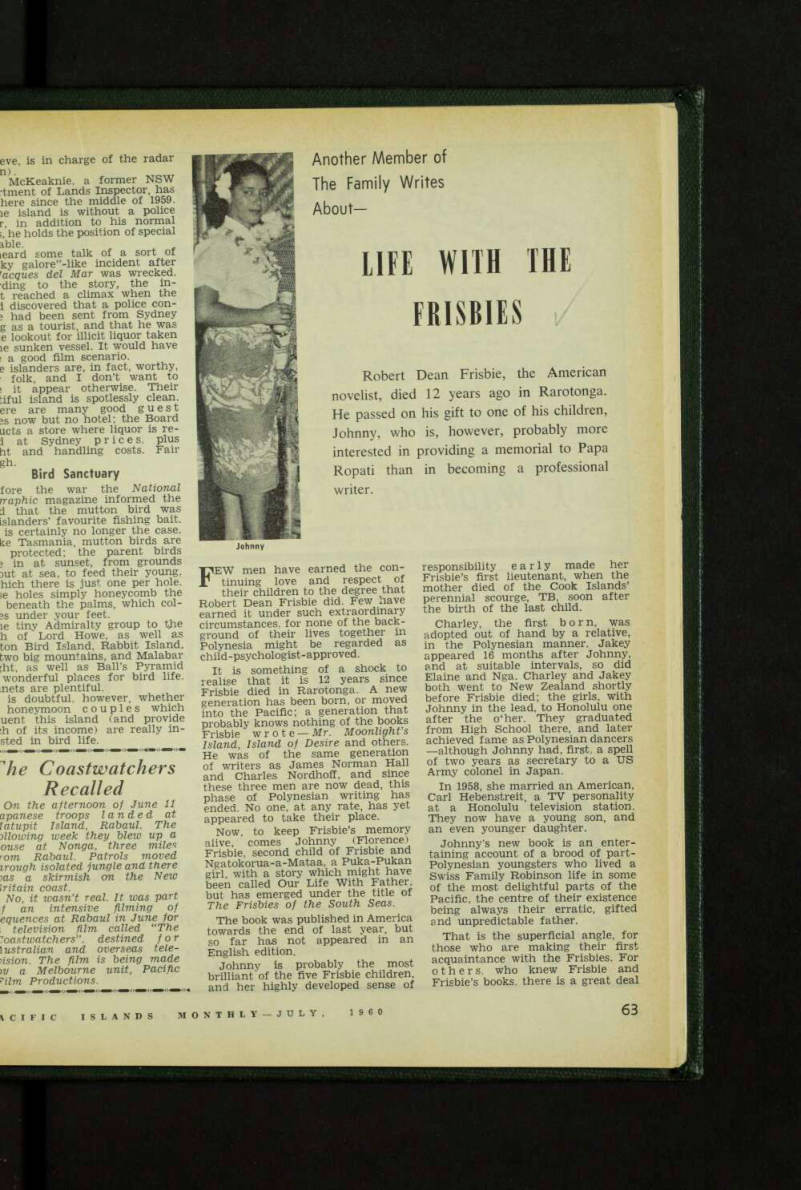
Johnny
:e than that in this tribute from daughter. ,obert Frisbie’s father was a iker who later embraced, in turn, umber of the odder religions of erica. The young Robert and his 3r brother Charles, spent four their most formative years in a aastic sort of establishment called ja Yoga Academy, while their tier was going through a phase Theosophy.
The Pension Helped Vith his mother, Robert had a y close relationship right up to time of her death, even though the last 20 years of it, it was intained only by correspondence, n 1918, Frisbie was discharged m the US Army with TB and a i pension of 45 dollars a month, ich, as his daughter records, in er years sometimes meant the ference between starvation and a nfortable existence in the South eifle. \t this time, Frisbie had already id everything he could about the nth Seas—and particularly every ng written by Robert Louis svenson, who was his idol. It was ibably no coincidence that Frisbie lowed RLS in taking his TB to 5 Pacific. kfter working for a year as a re rter, he had saved enough to irt his adventure. He went to hiti in 1920, and Polynesia there ter became his home. He died in irotonga, Cook Islands, in No mber, 1948.
By all social standards, his life is certainly unconventional. He d those 45 dollars a month, and thin himself undoubtedly the opensity for becoming a suc ssful beachcomber —still a very sy thing to become in the )lynesia of the 1920’5.
But there were several reasons of Laracter why the easiest path was ;ver taken. Early background may ive had something to do with this, it even more, was the determina m to keep his family of four part alynesian children together after ieir mother died.
Hammered Out His Books In Polynesia there is no difficulty l disposing of children, and the amour for these children, from ieir maternal relatives, was an em arrassing problem of its own. He mid have farmed them out, and ane on his way. Instead, he kept iem with him, made a family life jr them that, while it was not scactly according to the best prin [ples of the Mothers’ Union, had le happiest results.
But the thing that, most of all, aised him above the pattern that rtiite men usually made in the touth Seas in those days, was his writing. Frisbie took writing sen iusly. Like most writers, he no
doubt hoped to make money from his efforts, but this was not the dominant objective.
As Johnny tells it, he was a “hard” writer; he hammered out each sentence, and belted each word into place; he experimented with styles, and became despondent when he felt he was not achieving suc cess. He was never satisfied with what he had done, and was always striving for something he —but not necessarily his publisher or his public —felt would be better.
In the last years of his life Frisbie was a very sick man, and it is likely that he never ever did achieve his
full literary potential; he still seemed to be experimenting around, when Time caught up with him.
Towards the end, spurred on by a desire to leave a legacy for his children, his literary output was stepped up. It was at this stage that he collaborated with Johnny in Miss Ulysses of Puka Puka. As Johnny s English was then sketchy, it was obvious that there was more Robert than Johnny in this book, although the style was completely different from anything he had pre viously written. This was fitting, of course, for a story told by a teen ager who, with her part-Polynesian
side, lived with a let’s-face-the facts-of-life simplicity; and with the other, tried to be the ycung European lady minding her manners and the lessons Papa had taught idea was probably a deliberate gimmick on the part of Frisbie to catch the best-seller market, and it had every ingredient for this except one —luck. It sold moderately well, but it just did not get that nod from Dame Fortune that sends the public scuttling like rabbits to send sales into the millions.
Johnny’s current story lacks some of the deliberate and engaging naivety of Miss Ulysses— which is natural from a now mature young
woman writing entirely under her own steam. But it is, in its own right a pleasant and entertaining story of Polynesia, and one into which has gone a great deal ot tecn nical skill and know-how par ticularly in the way pieces of earlier and private RDF writings have been lasting memorial to one of that almost extinct of fine Pacific writers who flourished in the years between the wars —and one of which, we think, Robert Dean Frisbie himself would have been ex traordinarily proud.
(The Frisbies Of The South Seas.
Published by Doubleday and Co. Inc., New York. >