Im Seed, Nevingation
pp. 63-65 · Read in the full issue
And Honeymoons
Ord Howe's
Odd Angles
By Lew Friday
hough, like some others, it itside the coconut belt with i PIM is normally concerned, Howe has become a vital tional centre tor aircraft rsing Pacific routes, and as still belongs. radar and weather station, rhose masts rise on the heights verlooking Jim’s Point and le Beach, is to the outside I far and away the most mi nt building there, wer and Lidgbird, Gibraltar and over 2,500 ft high, stand nels at the southern end of even-mile long crescent-shaped and in superb solitude, 11 more ; to the south, is that extra tary rock, 1,500 feet high, known
all’s Pyramid.
ese isolated features have ys been landmarks for ship between Noumea, Port Vila, Sydney. tourist isle now, Lord Howe “dinkum Pacific” in the old ing and trading days. French el Company colliers, Noumea id from Newcastle or Port bla. still look on it as the half milestone for home. And kum Pacific” is the reef which 3ses the lagoon on the more :ered side. ell south of the Great Barrier it is the most southerly coral in the world; and is alive with of the recognised island type, iding the “dream” fish which s you those nightmares, i this reef at low tide you may the bones of Captain Savoie’s >oner Jacques del Mar, which t aground, her engine out of an, in 1956. On her to mea from Sydney, she had been missioned to take the islanders r four-monthly supply of stores grog. re-war this vessel was a Tas lian dredge, the Wombat, be dng to the Ulverstone Marine rd, but with shipping so much lemand during the war, she was tted as a cargo carrier. She had been in French hands long be i she went agound. saw Lord Howe a few weeks ago. n the deck of the Adelaide iliary schooner Jillian Crouch, ise master, Captain Roy Simms,
was based on Noumea during the war with the schooner Evaleeta, carrying stores round the islands for the Yanks and recruiting hundreds of Loyalty Island natives for Noumea docks.
A friendship based on wartime experiences led him to take me to Lord Howe with him, on the same sort of mission that had ended so unluckily for the Jacques del Mar.
We unloaded a few hundred 44gallon oil drums and a few hundred cases of beer, which the 200 islanders will share with their tourists.
Revival in Seed Trade
Our second purpose was to bring back the largest consignment of Lord Howe palm seed to reach Aus tralia since the war. The variety we freighted is known as Kentia forsteriana, and it’s quite a different Kentia than those grown in New Guinea. The seeds take at least nine months to germinate.
Sydney seed merchants will send overseas all they don’t want for local use, and the palms, when grown, will decorate the world’s night-clubs, and the palm courts of luxury hotels and liners. With string orchestras, ukuleles, an artificial moon and a girl in a hula skirt, they will give people who have never been there, the illusion of the glamour of Pacific nights.
A small contribution to our Aus tralian economy, these hardy and ornamental palms are also in de mand for weddings and church ceremonies, municipal functions, and concert platforms. Europe was a big buyer in the days when the islanders depended entirely on this trade, and is buying again, as are Japan and the Americas.
The Island Board is delighted to see the trade revised. The Jillian brought back 313 bags, each con taining two bushels (120 lbs), and
each worth £lO landed in Sydney.
No wonder the young men, in weather that caused us to shift our anchorage more than once, set to with a will, lightering out the seed in steel barges towed through the reef by their launch Viking 11.
As there is now no passenger shipping service to Lord Howe, the tourist industry which keeps the island going, depends entirely on the Ansett-ANA seaplane which leaves Rose Bay twice weekly. But there is now talk of an airstrip for land planes—a question about which opinion is divided.
Civil Aviation Dept, officials from Sydney have been there to survey and advise on two possible sites — one between the settlement and Ned’s Beach, and the other between the lagoon and Blinkie’s (or Blinkenthorpe’s) Beach.
The problem is that at these only two suitable places the island is less than a mile wide.
The chairman of the Lord Howe Island Board, Mr. A. G. Kingsmill, who is Under-Secretary of the NSW Chief Secretary’s Dept., and the vice-chairman, Mr. W. J. Broadfoot, who is Under Secretary for Lands, visited the island recently.
They Call Them Mister
The Board is now studying the feasabilhy of finding a landplane with a vertical takeoff. If this comes about, small and lonely Pacific islands with difficult topography and lack of space might well profit from Lord Howe’s example.
Other, local, considerations are that a strip would mean cutting into the island’s palm reservations; also it is desirable to avoid any pos sibility of erosion of the limited land available for grazing and gardens.
The present Superintendent of Lord Howe is Mr. J. H. McKeaknie, apparently one of the two people to whom the islands give the title of “Mister”. (The second “Mister”,
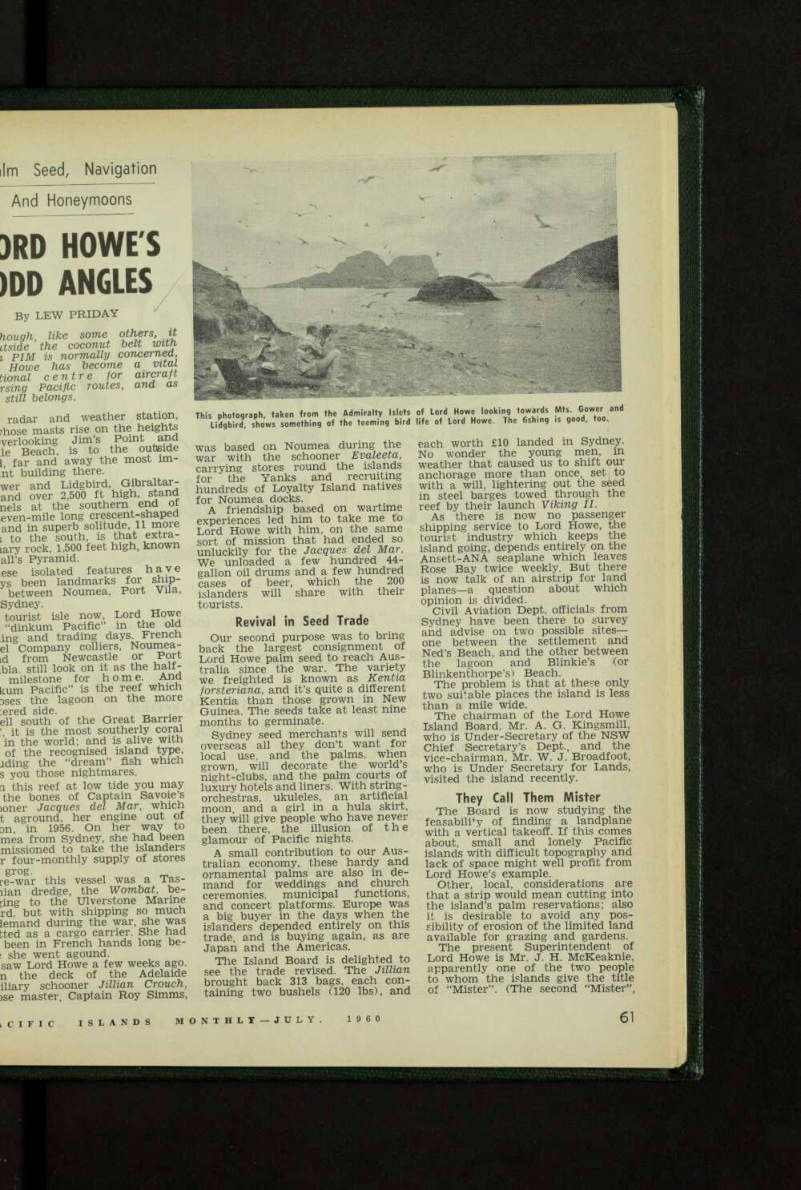
This photograph, taken from the Admiralty Islets of Lord Howe looking towards Mts. Gower and Lidgbird, shows something of the teeming bird life of Lord Howe. The fishing is good, too.
eve, is in charge of the radar n) McKeaknie, a former NSW 'tment of Lands Inspector, has here since the middle of 1959. le island is without a police r in addition to his normal 5, he holds the position of special able. . . teard some talk of a sort of ky galore”-like incident after r acques del Mar was wrecked, ■ding to the story, the in t reached a climax when the i discovered that a police con j had been sent from Sydney g as a tourist, and that he was e lookout for illicit liquor taken le sunken vessel. It would have i a good film scenario, e islanders are, in fact, worthy, folk, and I don’t want to ; it appear otherwise. Their tiful island is spotlessly clean, ere are many good guest 3S now but no hotel; the Board acts a store where liquor is re i at Sydney prices, plus hi and handling costs. Fair gh.
Bird Sanctuary
fore the war the National iraphic magazine informed the 3 that the mutton bird was islanders’ favourite fishing bait, is certainly no longer the case, ke Tasmania, mutton birds are protected; the parent birds j in at sunset, from grounds jut at sea, to feed their young, hich there is just one per hole. 5e holes simply honeycomb the beneath the palms, which col -3S under your feet, le tiny Admiralty group to the h of Lord Howe, as well as ton Bird Island, Rabbit Island, two big mountains, and Malabar ;ht, as well as Ball’s Pyramid wonderful places for bird life, nets are plentiful, is doubtful, however, whether honeymoon couples which uent this island (and provide :h of its income) are really in sted in bird life.