Back To Kangaroos
pp. 55-59 · Read in the full issue
Sydneyiider At Home Base Back To Kangaroos In Wine Sauce
When I walked into the still overseas terminal at Brisbane and the Customs guard said: “Put your bag there , lady”, I knew I was home.
.THOUGH in the previous six months I had been called madam, ducks, love, madame, >rita, senora, memsahib, missie the nicest-sounding one of all, ink—sinabada—this was the first y” with a hint of an i instead >r the Australian returning home, e is, of course, more than a »ting. This is where, in the toms sense, Nemesis finally •hes up. i the months immediately before, may have got used to seeing nchmen being keel-hauled by a nch douanier, while you were sed through the barriers with a le • or to seeing homing Spaniards aging their hands with anguish le the magnificent border guards ichalantly waved you on; or to ig nonchalant yourself, as polite persistent UK Customs officers ~d-degreed Englishmen. For you v had only the wish that your y in their country would be
asant. , .
5ut now it’s Australia, and you Australian, and it says so in ir passport and the sheaf of ms you filled in before arrival, ere is no escape. ... „ ’ve never found out whether irists get the same welcome-mat atment from Customs officials in s country as they do elsewhere, e usually got worries of my own such times.
jr Bridge Costs More
But now we’re back in Sydney
vn, what’s new? .
Dne thing that’s new is the in cased toll on the Sydney Harbour idge. Since the Bridge was opened years ago, the toll had been 6d r car and driver and 3d for each ssenger. The toll has now been ►ped to 1/-, flat rate.
This happened about two months o I was told indignantly by a toll eper when I offered 6d, and cording to friends who live on the Drth Shore, at the time the increase •ought forth a stream of protests
from residents on that side of the harbour. Not that it did any good.
The toll is up, and doubtless there it will stay. , , .
No one, of thought to storm Parliament House 200,000 strong; no University students did snake dances in front of the Premier’s residence, or ran around with placards saying “Go Home, Mr.
Hills”, or “We don’t like you, Mr.
Hills”. (Mr. Hills is the State Min ister wot done it).
It seems to me that democracy, and the alleged rights that go with it have become poor, weak tools in our hands and that we could learn a trick or two in this department from our Asian friends.
Mr Hills’ reason for the increase was not that the cost of living had gone up, but that, as a shilling was a “good round sum”, it would help to prevent congestion at the toll gates. How Mr. Hills works it out that 1/- is a rounder sum than 6d, no one has explained; and although it looks on the face of it that Sydneysiders will make on the roundabouts what they lose on the swings, this, in fact, is not so.
Although the Harbour Bridge benefits the whole State, and just about everyone in Australia patronises it at some time, it is residents of the North Shore suburbs who pay most of the debt on it.
They stream over the bridge each morning into the chy to work and stream out again at night and the average load per car is one or two persons. There has to be four before there is a benefit from Mr. Hills “round sum” of 1/-.
There was a time when Sydney siders were proud of their old coat hanger bridge, but in the last decade they have got browned off about the contraption.
Not only is it the biggest traffic bottleneck in the State, but it is obvious that we will never pay for it. Even after 28 years, we are still about £8 million in the red, and the money taken from motorists does nothing much more than pay the
interest on the loan that financed it, and the wages of the fellows who paint it and man the toll gates.
Case of the Striped
Car-cushions
New, too, is the cult of the car cushion, for motorists must have something to divert themselves. A few years ago it was plastic dicky birds that, in matched pairs, were stuck on the windscreen or back windows. With the motion of the car they pecked at each other.
Then there came the car-sick strap. This was a rubber strap im pregnated with metal. It was fixed under the bumper and trailed on the road. The theory was that It dispersed static electricity and pre vented car sickness.
Gone now are both dicky birds and car-sick straps, and in their place is the striped car-cushion.
These are of the drawing-room, scatter-cushion size, spiked in the middle with a button, with bright stripes on white to “go” or con trast with the car’s decor.
They may be bought in depart ment stores or in some of the classiest petrol palaces, and pre sumably their theoretical use is to ease the aching back of driver or passengers.
But that’s not how it works out.
There they sit in pairs, more viewed by following traffic than used; spaced equidistant on the shelf below the back window like china shepherdesses on a Victorian mantelpiece; pre served unsullied in their original beauty, some even in their original polythene wrappings. (Over)
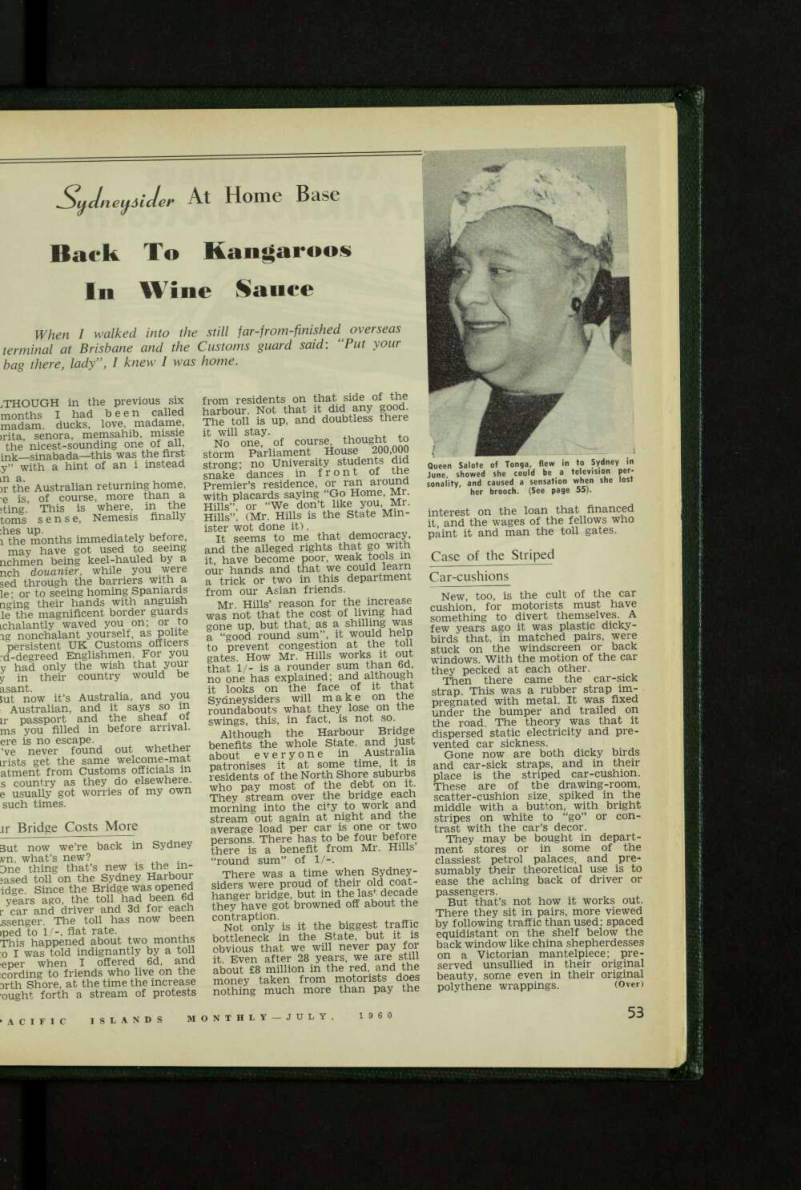
Queen Salote of Tonga, flew in to Sydney in June, showed she could be a television per sonality, and caused a sensation when she lost her brooch. (See page 55).
unt the car cushions next time are in Sydney.
it Happened to
Royal Brooch
to Sydney recently came Queen te of Tonga, on a five-day visit, ight off the TEAL plane, wear i new, flowered hat, she walked the television cameras to prove she was a natural TV per lity. Modest, with just a trace shyness in her manner, but ing and unhesitating, she said was here to visit friends and 0 a little research on early Tonga the Mitchell Library. She m ted that work was in progress compiling the archives of the gdom of Tonga. sxt morning it was on . Some re between coming off the plane entering her car for the city, en Salote had lost what was re ;ed as a “very valuable brooch . 1 vain, Queen Salote said it wasn t *y valuable” at all —it had just mtimental value because it had a given her by Prince Tungi. ut the newspapers weren’t going lave any of that—Royalty doesn t le to Sydney every day and lose brooches. What resulted was the rest piece of fuss since King John ■ the English Crown jewels m How S the Royal Jewellery was it”, screamed the midday posters, i both evening dailies ran a series front page pictures to show at t what point at Kingsford Smith port the brooch must have dis- Deared off the Royal coat lapel.
Vhat Queen Salote really lost was j of those carved mother-of-pearl ivers that come from Tahiti. As itume jewellery, they are very at ,ctive indeed, but their cash value £2 or £3—not the ransom in imonds, emeralds and rubies the
wspapers suggested.
Four Sydneysider had a replica ot i Royal brooch and it was much mired, but, alas, it met a far less >pectable fate than Queen Salote s. ended in four pieces some months o when the clasp came undone id it fell onto the marble floor of Spanish bar.
But driven on by the publicity, L of the airport’s myrmidons got work shifting, raking and shovel ig and after a couple of days, the neen’s brooch was found —on the ibbish heap. ed Wine
/ith Kangaroo
Everyone knows about kangaroos, ay “Australia” to any foreigner in le remotest recesses of America or urope, and he will immediately re ly; “Ah, yes. Kangaroos.” It is ard to convince any of these people lat there are millions of Australians ho have never seen these animals utside a zoo. So, so far as foreigners
are concerned, Australians are stuck with kangaroos, although, inside the country, it is obvious that some people are more stuck than others.
Out west, where they are in hundreds of thousands, they are re garded as vermin; almost as big a pest as the rabbit before myxoma tosis, and for the same reasons— namely, the damage they do to cattle and sheep pastures.
It’s now open-season for them, anyone can hunt them and as a big man-kangaroo is capable of travel ling at 30 mph in top gear, and goes in 20 ft leaps, it can be fun.
So much for kangaroos on the hoof. In the past year, a few enter prising souls have got another idea and are selling kangaroo meat as a
human food. A few thousand tons of it have already been exported— to Europe, particularly West Gei many, where there is a perennial shortage of meat; and to the United States where there is a specialised demand for exotic foods.
And now the fly in the oint ment: All meat for human con sumption, domestic or export, is killed under Government supervision in Australia and is certified free from disease. Kangaroos, of course, are not slaughtered in any recog nised abattoirs; and after killing, the meat is snap-frozen and goes onto the market without any health certificate.
So far there has been no trouble at point of delivery, except in
, « rectmirant which tiey where one re jjjnc has
ia £ serving kangaroo
L But it P co“d come from when it sets around ; the meat leaves here without i whole thing so 6 far‘with* no solution ™roo meat on a “food news” iion. A French chef from a Sydrestaurant was brought along; > a wine expert.
'he chef said kangaroo meat was ilesome delicious—and then went why It was.
P ,, -Drsofnn vmi first eet ,ike Mrs. t yo thpn ou ,r kangaroo steak then you even n b°Uer'stlllf in ? clareh°Ster
that time, you take it out of the liquid, sear it quickly on both sides, then return it to the pan and simmer slowly in the wine. Result: Magntflque!
R “Now, burgundy IS from
S .Tone d o °f the
probablTit
“ a \fL& one heck of a 0 ( trouble for meat that has no spec i a i virtues (except being naturally tough like old boots), anyway.
There is a thought in it, however, With all that prospective meat bounding about out there, and with iamb and beef prices reaching record —™ not be i o n| before » man to Go West
M^Sep^ ®