[?]T’S Almost The Same
pp. 39-45 · Read in the full issue
R. W. ROBSON takes a Dogs-to-Doves Look at Fiji
As It Ever Was
Suva.
Like an ashamed girl, with her hand over her eyes, central /a still keeps unsightly boards over her shop windows, which re smashed by the hoodlums in the December riots. But this not altogether fair comment on affairs as they are at the iment.
central shops like Stinsons, ho took a cruel beating, now it up the shutters every even- Boots, the Chemists, whose w display used to constitute de of the town’s Triangle, have iken them down since last De >r—a daily, disconcerting re >r to the citizens, who would d forget the wretched incident, h Carpenters and Burns Philp, w side, suffered window-smash nd a bit of looting. At week- Carpenters are sternly boarded >ut most of BP’s windows are
not. Does this represent conflicting views among the commercial Top Brass, regarding the probabilities of the future? ..
I prowled around among all the communities, alert for a word or a look which might show anti-Euro pean feeling. I had been told on occasions, that the snarling and in sults of the December rioters were symptomatic.
But, so far, I have found no evid ence of marked deterioration in the relations between European, Indian, Fijian and Chinese. It was hooligan ism rather than political rancour.
Unquestionably the hoodlum gangs were egged on by some very un pleasant, subversive people among the Indians, Fijians and Euronesians.
But unpleasant people, and hoodlum gangs, are always with us. They just don’t get the chance to cut loose, like they did on December 10.
They never again will get the chance, if the regular police do their duty. (But, I will add, in parenthesis, that frequently at night, and week ends, one sees bits of incipient hooliganism around the streets and hotel bars which should not be per mitted in a well-policed city. Too many idle, silly youths loafing about in this place, with apparently noth ing to do.) A Time for
Co-operation
Some private people are making plans for liquidating their properties and moving away. Company directors study balance sheets and wonder what to do. Bank managers sit in front of their shaving mirrors, practising that implacable, cold eyed look that goes with “No”.
Myself. I think the danger of anti- European developments has been overdrawn. A tendency to unplanned hooliganism in the towns of Viti Levu is the inevitable outcome of the country’s present inability to absorb the battalions of lads who are growing up and seeking jobs.
This was foreseen years ago. The fact that little or nothing has been done, in a planned way, to take care of the problem is the measure of the incompetence of the British Colonial Office.
The riots, as riots, had no signific ance beyond the fact that unem ployment and poverty and hopeless ness are naturally breeding hooligan ism They could have been settled in an hour or two, if the police had been used as police should be used.
But they have great significance as a pointer to what will happen if the root causes are not removed.
With great respect, I suggest that the occasion does not call for liquida tion and packing, but for full blooded co-operation with the authorities in dealing with Fiji’s fundamental problems.
The Colonial Office is awake, at
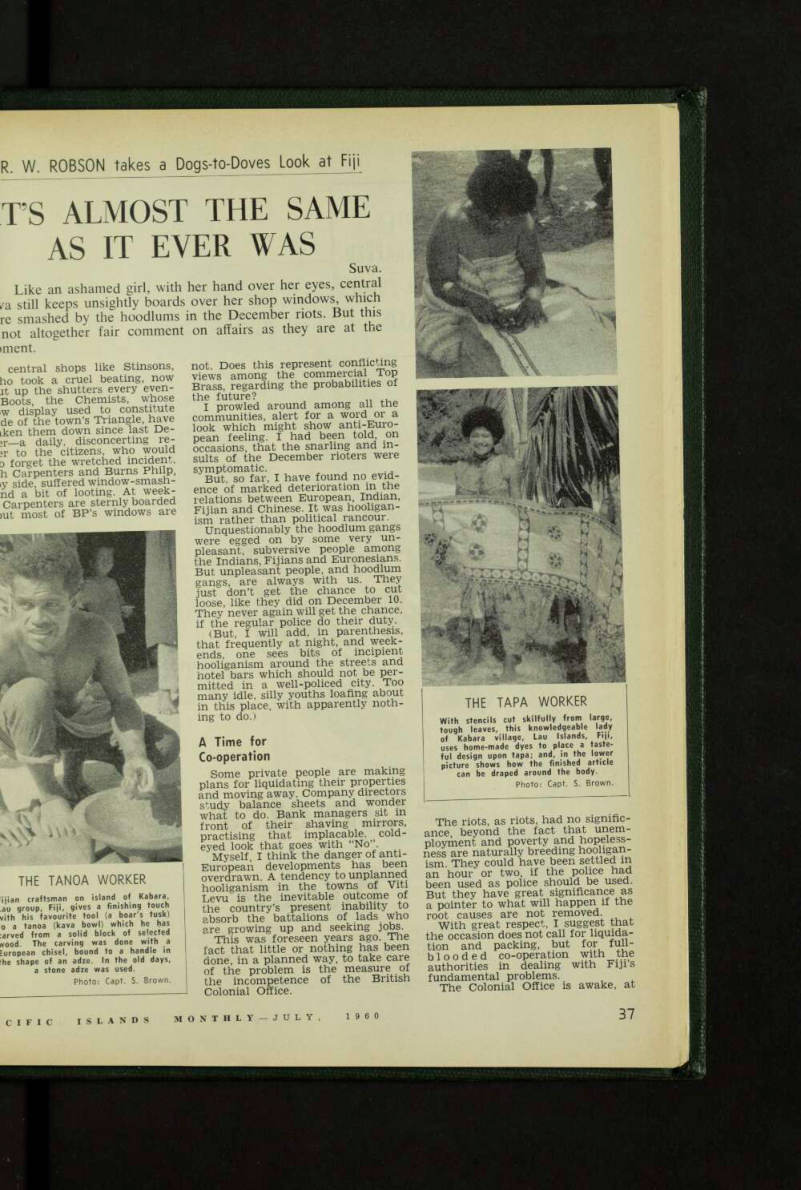
The Tanoa Worker
[?]ijian craftsman on island of Kabara, [?]au group, Fiji, gives a finishing touch with his favourite tool (a boar's tusk) [?]o a tanoa (kava bowl) which he has [?]arved from a solid block of selected wood. The carving was done with a European chisel, bound to a handle in the shape of an adze. In the old days, a stone adze was used.
Photo: Capt. S. Brown.
The Tara Worker
With stencils cut skilfully from large, tough leaves, this knowledgeable lady of Kabara village, Lau Islands, Fiji, uses home-made dyes to place a taste ful design upon tapa; and, in the lower picture shows how the finished article can be draped around the body.
Photo: Capt. S. Brown.
ist and in a mood to get things It is late, but not too late— hat is, if the said authorises ret a united effort from the ’s of the five communities n, Indian, European. Chinese Suronesian).
Pig and
Lived Dogs
angements for filming the sue il Fiji novel, Long Pig, were ■j well complete, when some in the politics which govern ilm world caused a postpone of the project, t the making of the picture in course, seems certain; and the dll bring a bunch of film stars, a large sum of money, into The job probably will be done
ie exceedingly pleasant south
coast of Viti Levu somewhere Korotogo. where author Russell man has his home, reman, an Australian news r man with a French wife some ite means and an exceedingly pendent spirit, made his home iii about 12 years ago. He has i a good deal of freelance wnt but now he need not worry any x—his Long Pig has already at -d the kind of sales figure which doubting publishers into ids-for-life. . lother Foreman book, a sequel Long Pig, is being given final )e. and already has been sold, ing unseen. , , , 3W the author, well-endowed, has V feet. So has Madame—Pans ;. But there are four dogs, inci sively pedigreed and greatly be d All animal-lovers know the iy of the choice. . . .. a he dogs come romping in to the emails’ big, cool lounge, whence see a perfect picture of palms lagoon and foaming white reef, isieur and Madame hurriedly put lv their travel folders, and stare amedly at the dogs How can y go away and leave these trust creatures? think Fiji may see the Foremans und for a while yet. What is the mal life of a pampered dog?
Suva Also Has
Its Pigeons
These übiquitous pigeons! I thought as I watched about one thousand of them perching atop the buildings of Boots, the Chemists, i Suva, that they must be the world s most widely-spread bird Six months ago, I noticed them bowing and cooing in a s< l in Lima, Peru, just as they do in Martin Place, Sydney.
In all the ensuing weeks, as we visited cities in Florida and Ber muda, Britain and Southwestern Europe, and all across Southern Asia to Hongkong, I looked for
pigeons—and I never missed out In some places where they P® rc^, ingly on the heads and shoulders of people who feed them regularly London and Malaga and Naples and Srinagar come especially to mina they are a much -photographed tourist attraction. . Was this world-wide distribution of the pigeon (or dove) deliberate or accidental? I have never read or heard any authority on the subject.
Psychology and a Bar-Room Floor The hotel manager, having joined us in a drink, looked down at his feet, and cursed. . . , “Dirty bastards” he exclaimed.
“They throw matches, and spit, and throw cigarette ends and even their beer on the floor. Look at it.
We looked. “Permit holders?’ I suggested. A .
“No, Europeans of a certain type.
The Fijians and Indians don t do the things that some of these low class people do.”
Then the manager told us about a hotel-keeping friend of his in New Zealand. He had this dirt problem in his bar—so he had the floor covered, wall to wall, with a good carpet. They thought he was crazy; but from that time on, the nuisance disappeared—the “types” were so conscious of the luxury conditions upon which their feet rested that they automatically put their cig
Tonga's
Influence
This house of unusual type was designed and built of concrete blocks, in the village of
Dakuiloa, Oneata, Lau
group, Fiji, by Fijian school teacher Gade Ovetaga, who is seen in the photograph. It is of solid European materials, designed to withstand the occasional hurri canes, and it conforms to the Fijian idea of how a house should be shaped. The rounded ends show the Tongan influence, which is still strong in the Lau Islands.
Photo; Capt. S. Brown.
be debris and their spittle in places reserved for same, 'sychology, eh?” said the man “l’d like to try it here, but t a feeling that Sir Hugh would tubborn about it.” is Inclined to :e it at Home a and large, Australian flour >ably is Fiji’s most important le foodstuff—the Colony pays a £1 million to £2 million per um for it. A . . . ow, there is a project afoot for erection in Fiji of a flour mill. argument is that it would be *h cheaper to buy wheat abroad, mill it in the Colony. This is eaction to the fact that, while tralia sells Fiji millions of nds worth of goods each year,
Australia buys remarkably little
Z^b^asa
rS oP beer and 7'S
number of cigarettes. Now, a local brewery caters efficiently for the local thirst; and two rival tobacco factories are supplying the population with millions of cigarettes.
Thus very large sums already have been saved In Fiji’s precious overseas exchange.
tnfha and KeS 2A
Now Fiji will have its local product —employment here for funds and men (unless the Japanese undercut again) and no call on overseas funds.
So far, the flour-mill is only a few sheets of typed material, and some drawings.
Outboard Motors Destroying
Fijian Waist-Lines
That well-known picture of the lean, brown Fijian, standing up and poling or paddling his canoe along the quiet waterways of the Fijian rivers, is now being shattered. Tfle outboard motor has arrived, and transformed river life. Fijians are fatter. . , The modern “outboard” is cheap, reliable and can be fitted to the s"ern of almost any craft. Some of
lapeliest boats lying in front ; Royal Suva Yacht Club are ed by luxurious outboards, ng all the gadgets, urally, the Fijian has no wish ive at paddle or pole when n squat down in front of a lit f le outboard, and get there quarter of the time. It is just atter of scratching up the sary cash, or persuading the :eeper to extend credit a bit.
5 is a Wild Dog
mce in Fiji
ere are people in Fiji who be that sheep-farming could be ed on profitably in certain i, for food purposes, rather ’for wool. t . tcks of sheep have been esco rt on some of the islands in past, but all have disappeared.
The factors against them, it seems, are partly tropical disease, but mostly wild dogs. . , Dogs roaming the uninhabited valleys and jungles of Vanua Levu and Taveuni have become a very great nuisance. Planters and settlers try to combat it by poisoning; but the marauders’ numbers are con stantly added to again Indians’ reluctance to take life of any kind. .. , In most communities, the dog population is kept down by the prompt drowning of unwanted litters. But the Indians will not kill the pups, and a large proportion of these mongrels, seeking susten ance, naturally go bush, and prey on anything they can find.
I am told that in certain parts of Taveuni the dog danger is so great that village women will not allow their small children to wander away into the bush, out of sight.
the beginning of a wedding feast-two turtles were caught by young Fijians at Waoqori Lau group. photo: Capt.s Brown