That's Different
p. 35 · Read in the full issue
lessons in Table Manners included Koki Has a Guest House
From a “PIM” Correspondent about three years since the Salvation Army quietly set them- Is vi in PapZ-New Guinea. In that time timber of social activities but their greatest contribution to the Ttcene is the Transit Hostel at Koki , Port Moresby. In the words ntless politicians have been using for countless generations it a long-felt want.
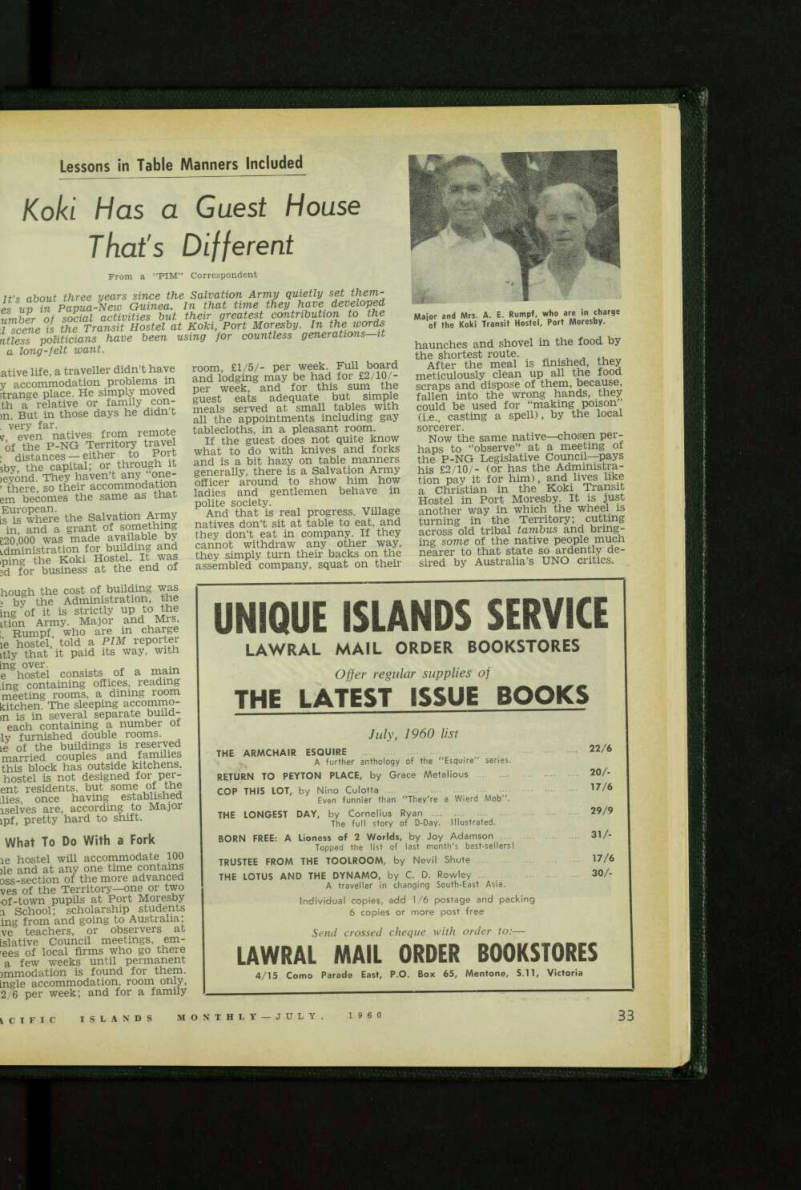
ative life, a traveller didn’t have v accommodation problems in strange place. He simply moved th a relative or family con >n. But in those days he didn t . very far. . v even natives from remote of the P-NG Territory travel ; distances —either to Port by. the capital; or through it >eyond. They haven t any one ’ there, so their accommodation em becomes the same as that the Salvation Army in, and a grant of something E 20,000 was made available by administration for building and ping the Koki Hostel. It was Bd for business at the end of hough the cost of building was > by the Administration, the Lng of it is strictly up to the ition Army. Major and Mrs 1 Rumpf, who are in charge le hostel, told a PIM reporter itly that it paid its way, with ing over. „ . e hostel consists of a main ing containing offices, reading meeting rooms, a dining room kitchen. The sleeping accommo m is in several separate build each containing a number of lv furnished double rooms. ie of the buildings is reserved married couples and families this block has outside kitchens, hostel is not designed for per ent residents, but some of the lies once having established iselves are, according to Major ipf, pretty hard to shift.
What To Do With a Fork ie hostel will accommodate 100 )le and at any one time contains □ss-section of the more advanced ves of the Territory—one or two of-town pupils at Port Moresby i School; scholarship students ing from and going to Australia; ve teachers, or observers at islative Council meetings, em cees of local firms who go there a few weeks until permanent immodation is found for them, ingle accommodation, room only, 2/6 per week; and for a family
room, £l/5/- per week. Full board and lodging may be had for £2/10/per week, and for this sum the guest eats adequate but simple meals served at small tables with all the appointments including gay tablecloths, in a pleasant room.
If the guest does not quite know what to do with knives and forks and is a bit hazy on table manners generally, there is a Salvation Army officer around to show him how ladies and gentlemen behave in polite society.
And that is real progress. Village natives don’t sit at table to eat, and they don’t eat in company. If they cannot withdraw any other way, they simply turn their backs on the assembled company, squat on their
haunches and shovel in the food by the shortest route. .
After the meal is finished, they meticulously clean up all the food scraps and dispose of them, because, fallen into the wrong hands, they could be used for “making poison (i.e., casting a spell), by the local sorcerer.
Now the same native —chosen per haps to “observe” at a meeting of the P-NG Legislative Council—pays his £2/10/- (or has the Administra tion pay it for him), and lives like a Christian in the Koki Transit Hostel in Port Moresby. It is just another way in which the wheel is turning in the Territory; cutting across old tribal iambus and bring ing some of the native people much nearer to that state so ardently de sired by Australia’s UNO critics.
Major and Mrs. A. E. Rumpf, who are in charge of the Koki Transit Hostel, Port Moresby.