Fiji's Economy
pp. 31-33 · Read in the full issue

Patel and Co. Versus The Rest Sugar Deadlock Threatens Fiji's Economy
Standing in Fiji’s fertile fields, between the mountains and sea, from Raki Raki right around to Sigatoka, in Viti Levu, along the rich northern plain in Vanua Levu, there is one he best crops of sugar-cane in the Colony’s history.
une 21, an army of Indian i Fijian cutters should have amenced work in the fields, e four big mills at Lautoka, snang and Labasa, should ommenced crushing, to turn ne into at least £8 million, the sugar industry’s annual ution to the Colony’s now onomy. on July 14 the cutters were le mills had paid off approxi -1,400 mill-hands nothmg im to do. isands of cane-growers stood ntly on their little hill-tops, itched endless miles of cane ripened feathers in the soft vind. and seeming to cry: I am, grown rich and fat on abour and your land, burst th sweetness. Come and get id hurry up before I begin ivel back into the earth.”
i equal impotence—and with
g rage—all classes in Fiji ealising that if this deadlock n the Colonial Sugar Com md cane-growers were to con an economic disturbance iting to disaster would fall the Colony within a few s. the cause of it all? the face of it, this is an icilable dispute between com and cane-growers regarding erms and conditions under cane should be cut and de ictuality, it can be traced to nost incredible hatred of the :o. by a small group of Indians up to the present—have been ;d to assume the leadership > growers, and whose thinking loured by extreme racial iveness. e-Saw of a World Market i dispute itself has a history traced i years ago, the company made the growers —now about 95 per Indian, 5 per cent. Fijian—a ict governing the purchase of cane. World economic condi and the international sugar et have changed much since and generally in favour of ;rs. recent years, under this con
tract, the growers have done very well. The company has not been so happy—it contends that, while Fiji growers have prospered, its returns from its Fiji investment have steadily shrunken.
Nevertheless, in 1957-58 prospects seemed good, and the company urged the growers to plant more and more cane. The growers did.
The company introduced to the growers new cane varieties de veloped in Queensland. They were phenomenally successful, adding to the sugar crop.
Prospects changed at the end of 1958. Early 1959, the company began begging the growers to reduce pro duction, and warning that much cane already growing would not be needed.
But, already, it was too late — there was great over-production in 1959; and in 1960 it is clear that the cane, from a generous season, extraordinary richness of new varieties, and the vigorous growth of the 1958 ratoon (second cutting) crop, could produce 300,000 tons of raw sugar, instead of the 199,000 tons stipulated under the quota.
The old, ten-years contract ex pired at the end of May.
The company, since 1959 has been trying to negotiate a new and very different contract, at a lower rate, and under conditions which mean that only enough of the 1960 cane will be taken to produce 199,000 tons of raw sugar—which will mean that a startling proportion of this magnificent 1960 crop will not be required.
Bewilderment The farmers, of course, resisted any lower rate. And, being simple men, they were completely bewildered by the crop position—they planted lavishly in response to company urging, and now the company can take only part of their cane.
As everyone knows, there is critical over-production of sugar through out the world, and only the quota system introduced through the In ternational Sugar Agreement has kept the industry steady in the vari ous countries concerned.
Fiji’s export of sugar is rigorously controlled by the quota fixed each year: and the price similarly is con-
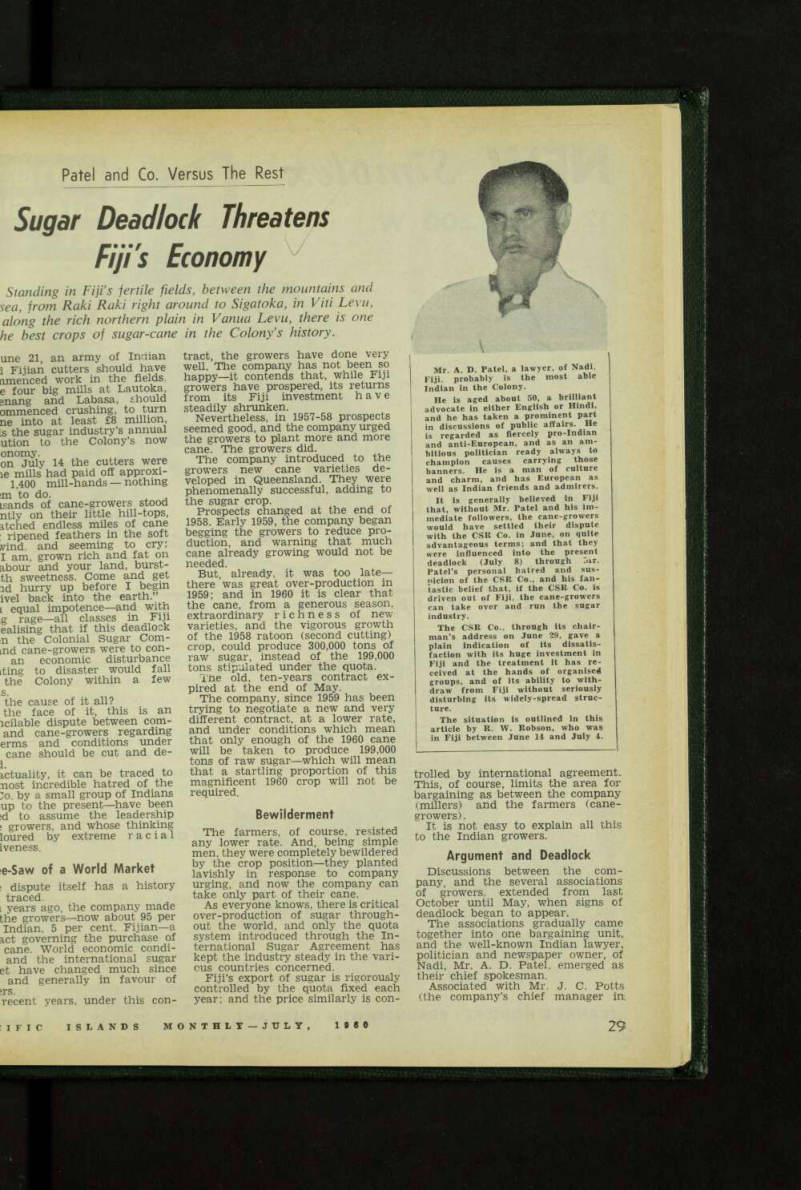
Mr. A. D. Patel, a lawyer, of Nadi, Fiji, probably is the most able Indian in the Colony.
He is aged about 50, a brilliant advocate in either English or Hindi, and he has taken a prominent part in discussions of public affairs. He is regarded as fiercely pro-Indian and anti-European, and as an am bitious politician ready always to champion causes carrying those banners. He is a man of culture and charm, and has European as well as Indian friends and admirers.
It is generally believed in Fiji that, without Mr. Patel and his im mediate followers, the cane-growers would have settled their dispute with the CSR Co. in June, on quite advantageous terms; and that they were influenced into the present deadlock (July 8) through I.ir.
Patel’s personal hatred and sus picion of the CSR Co., and his fan tastic belief that, if the CSR Co. is driven out of Fiji, the cane-growers can take over and run the sugar industry.
The CSR Co., through its chair man’s address on June 29, gave a plain indication of its dissatis faction with its huge investment in Fiji and the treatment it has re ceived at the hands of organised groups, and of its ability to with draw from Fiji without seriously disturbing its widely-spread struc ture.
The situation is outlined in this article by R. W. Robson, who was in Fiji between June 14 and July 4.
trolled by international agreement.
This, of course, limits the area for bargaining as between the company (millers) and the farmers (cane growers) .
It is not easy to explain all this to the Indian growers.
Argument and Deadlock
Discussions between the com pany, and the several associations of growers, extended from last October until May, when signs of deadlock began to appear.
The associations gradually came together into one bargaining unit, and the well-known Indian lawyer, politician and newspaper owner, of Nadi, Mr. A. D. Patel, emerged as their chief spokesman.
Associated with Mr. J. C. Potts (the company’s chief manager in
in carrying on discussions, Vlr. Nicholls, the company’s inspector in Fiji, and Mr. >od, a top executive there.
Jr Patel were Mr. J. P. Bayly 3 a well-known Fiji farmer ivestor, the chairman of the of the farmers’ unions; Mr. another lawyer who is in ti in cane-growing and politics, Jr. Prasad, an organisation company tried to show that, v of world conditions, and its to show a reasonable profit Fiji investment and opera and the ever -rising costs in t could make no substantial sions. The growers insisted In view of the profits shown e company’s balance-sheets, ie undertakings implicit in the ,ny’s 1958 urgings to plant the company could afford to he 1959 rates for cane, and I reasonably compensate the rs for all cane grown in 1960, ot cut. , , rs and days and weeks passed national economics we re i, balance-sheets challenged,
faith questioned,
quick thrusts and impassioned mce of Mr. Patel were blunted
Dent against the stony-faced
sivity of Mr. Potts, and the less of his associates to answer lever pleading with grim jics. dlock came in June. Actual r spread through the Fiji com ;y when it appeared that the would not begin crushing on 21.
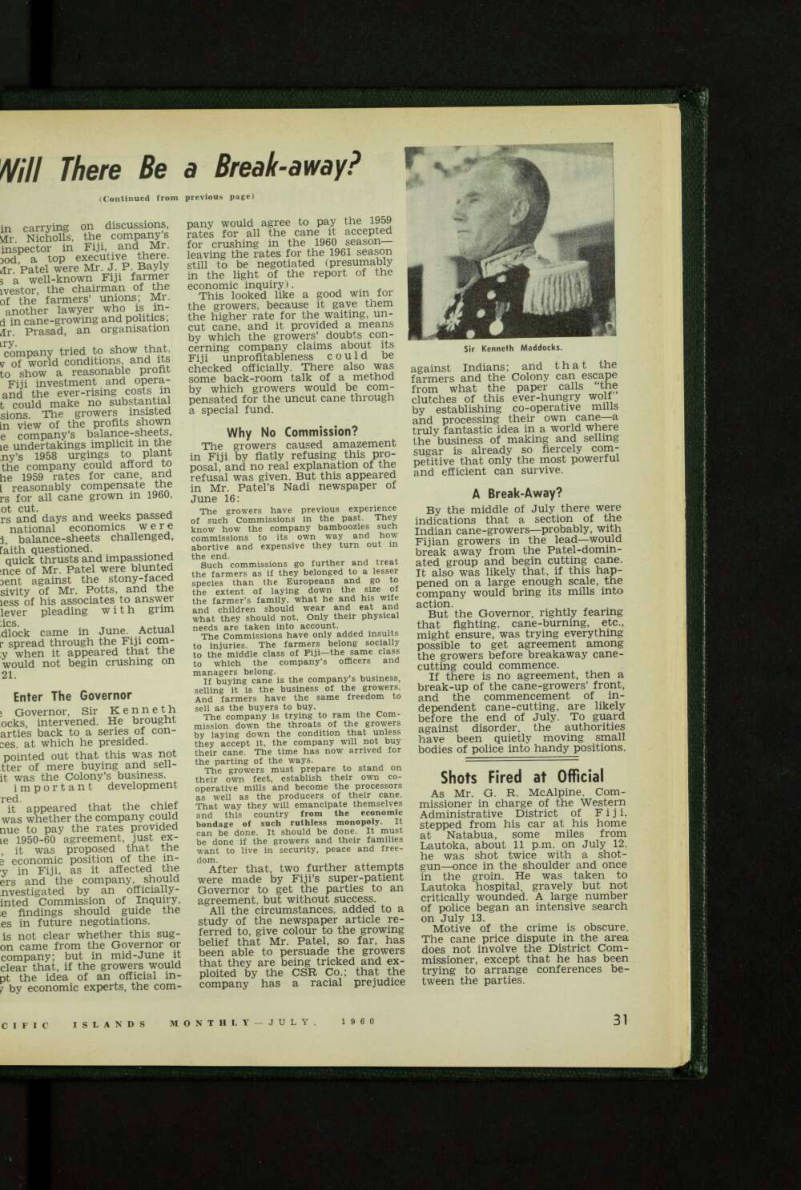
Enter The Governor ; Governor, Sir Kenn e t h ocks, intervened. He brought arties back to a series of con ces, at which he presided, pointed out that this was not tter of mere buying and sell it was the Colony’s business.
important development
red. it appeared that the chief was whether the company cpuld nue to pay the rates provided le 1950-60 agreement, just ex it was proposed that the =» economic position of the in ■y in Fiji, as it affected the ers and the company, should nvestigated by an officially inted Commission of Inquiry, e findings should guide the es in future negotiations, is not clear whether this sug on came from the Governor or company; but in mid-June it clear that, if the growers would pt the idea of an official m / by economic experts, the com
pany would agree to pay the 1959 rates for all the cane it accepted for crushing in the 1960 season — leaving the rates for the 1961 season still to be negotiated (presumably in the light of the report of the
economic inquiry). , ,
This looked like a good win for the growers, because it gave them the higher rate for the waiting, un cut cane, and it provided a means by which the growers’ doubts con cerning company claims about its
Fiji unprofitableness could be
checked officially. There also was some back-room talk of a method by which growers would be com pensated for the uncut cane through a special fund.
Why No Commission?
The growers caused amazement in Fiji by flatly refusing this pro posal, and no real explanation of the refusal was given. But this appeared in Mr. Patel’s Nadi newspaper of June 16: The growers have previous experience of such Commissions in the past. They know how the company bamboozles such commissions to its own way and how abortive and expensive they turn out in the end. . .
Such commissions go further and treat the farmers as if they belonged to a lesser species than the Europeans and go to the extent of laying down the size of the farmer’s family, what he and his wife and children should wear and eat and what they should not. Only their physical needs are taken into account.
The Commissions have only added insults to injuries. The farmers belong socially to the middle class of Fiji—the same class to which the company’s officers and managers belong.
If buying cane is the company’s business, selling it is the business of the growers.
And farmers have the same freedom to sell as the buyers to buy.
The company is trying to ram the Com mission down the throats of the growers by laying down the condition that unless they accept it, the company will not buy their cane. The time has now arrived for the parting of the ways.
The growers must prepare to stand on their own feet, establish their own co operative mills and become the processors as well as the producers of their cane.
That way they will emancipate themselves and this country from the economic bondage of such ruthless monopoly. It can be done. It should be done. It must be done if the growers and their families want to live in security, peace and free- After that, two further attempts
were made by Fiji’s super-patient
Governor to get the parties to an agreement, but without success.
All the circumstances, added to a study of the newspaper article re ferred to, give colour to the growing belief that Mr. Patel, so far, has been able to persuade the growers that they are being tricked and ex ploited by the CSR Co.; that the company has a racial prejudice
against Indians; and that the farmers and the Colony can escape from what the paper calls the clutches of this ever-hungry wolf by establishing co-operative mills and processing their own cane—a truly fantastic idea in a world where the business of making and selling sugar is already so fiercely com petitive that only the most powerful and efficient can survive.
A Break-Away?
By the middle of July there were indications that a section of the Indian cane-growers—probably, with Fijian growers in the lead—would break away from the Patel-domin ated group and begin cutting cane.
It also was likely that, if this hap pened on a large enough scale, the company would bring its mills into action. . , „ But the Governor, rightly fearing that fighting, cane-burning, etc., might ensure, was trying everything possible to get agreement among the growers before breakaway cane cutting could commence.
If there is no agreement, then a break-up of the cane-growers’ front, and the commencement of in dependent cane-cutting, are likely before the end of July. To guard against disorder, the authorities have been quietly moving small bodies of police into handy positions.
Sir Kenneth Maddocks.