Commentary
pp. 27-28 · Read in the full issue
Dr Moves Awaited On
i Burns Plan
Fiji’s chief industry—sugar paralysed by a millowner negrower deadlock (see article 29) Fiji has not been in a to deal with the urgent recom itions of the Burns Report n those who resist as of the Report a political economic and ;al crisis is approaching and jomething must be done about n iio co-ordinated, constructive s towards reform are the milling dispute threatens locate the country’s major in y, which brings m about £8 ns per annum. ’s harassed Governor seems to arking 18 hours a day on his cting troubles. *re are 124 recommendations - Report, covering almost every of administrative and industrial most observers see it the ipal and most important re -5 may be placed in two groups nely, (a) the merging and mlining of the Central and n Administrations, so as to greater economy and efficiency, to assist the communities m ral, and the Fijians in par \x, in (b) the more effective Df the Colony’s available land, lat the present population of 00, and its rapid natural m ;e, may be better provided for. present, the Government is entrating on the task of S Fijians a clearer and a better
irstanding of the. Report
the beginning, either through ranee or by design, some lead men and some important media the communities, and espea the native people, a very dis >d and misleading view of the Drt. They judged it by then* per -1 reactions to various bits of it, reas it must be examined as one grated plan, designed to keep Colony out of the worst of the lomic doldrums it n ow reaching, as a result of the ire of the British Colonial Office nake plans to take care of an aordinary situation, ne situation, of course, is well vn* but it may be outlined agam > because it explains both the plexity and the urgency of the Diems; The Colony’s economy is dom ;ed by the first immigrant com lity, which is European (mainly
tralian), and comparatively
01.
More than half the population
now is Indian, and consi ts of a comparatively recent second im migrant community—increasing rapidly and generally landless. 3 The Fijian community lives generally under a village communal system; and competes very litUe with either of the two immigrant communities (three, if. or Jf OT S 5,000 Chinese, mostly traders) .The Fijians are a proud, virile, highly intelligent race of Islanders, in creasing rapidly in numbers. 4 The land generally is the in alienable property of the Fijians and a large proportion of it is not bB wfthin that situation, there is room for great misunderstanding, calculated misrepresentation and racial antagonism. Unbalanced pre sentation of the Burns Report has accomplished some of this already, especially among the Fijians.
The Governor has been active in bringing his field staffs togstheir and instructing them, so that they may in turn explain the proposals to both Fijians and Indians. But it is a colossal task. In September or October, the Burns plan should come before the Legislative Council for considera tion. If the Council adopts it, many of the most important recommenda tions, in both (a) and (b) above, will go forward for rapid imple mentation. A Natural Resources Council will be set up and a most carefully selected Development Com missioner appointed to direct and co-ordinate the whole plan, and, what is most important, large sums will be made available from the Colonial Development Fund.
But before the Legislative Council meets, something vital has to be done— namely, the plan must gam the goodwill and support of the Fijian community. And that, at the moment, is far from accomphshm The Fijian villagers are awaiting guidance from their leaders; and most of the leaders, in this matter, so far, have been affected asi ™uch by prejudice and misinformation as by a clear understanding of the Ppiiort The Governor has countered this by having the whole Report trans lated into Fijian and, it has been printed and published for the Gov eminent by the Fiji . mes-e™ of the biggest and quickest printing jobs ever done in the Colony. The Report now is out among the Fijians; and the Fijians, this month are discussing the plan at their several Provincial Councils.
The Governor, meanwhile, is con ferring frequently with the younger Fijian chiefs, especially those in the Administration. .
Next month, data and mstruc
tions will go from the Fijians’ Pro vincial Councils to the Great Council of Chiefs; and the latter then will give directions on the matter to their representatives in the Legis lative Council. . ...
But time is running very short, and it is exceedingly harassing for the Governor that his careful plans in this respect should be disrupted by the stubbornness of the cane growers in refusing to settle the sugar dispute. , Meanwhile, quite a number of the Report’s minor recommendations are being put into effect. They in clude : Expenditure on new planting or replanting of coconut plantations, up to £l.OOO p.a. (instead of £5OO p.a.) is now deductible for income tax calculation. . .
More money is being spent on the Rhino ceros beetle eradication campaign. The fund is being expanded by an increase of the copra tax from 17/6 to £1 per ton. and the Government is increasing its contribution similarly.
The tender system of purchasing Govern ment stores has been adopted; and, since last November, this has shown a saving of £4,000 per month.
Encouragement is being given to the building of smaller hotels, by reducing the amount of private capital which must be invested to qualify for Government assist ance. The amounts, previously £75,000 in Suva and Lautoka and £60,000 elsewhere, are now £50,000 and £30,000. In ex tensions of existing hotels, the sum has been reduced from £20,000 to £lO,OOO.
But nothing on a scale likely to have a perceptible effect on the Colony’s economy is likely to take place until the plan has been through the Legislative Council, and until a Development Commissioner is available to plan, co-ordinate and drive. Little can be accomplished until departments, communities and corporations are lined up in a planned united effort—and that is a big task for a big man. ☆ ☆ ☆
And This Is Our
Policy For New Guinea
WE have been asked what is PI M’s policy on the future of New Guinea. PI M’s policy is, as it always has been: A fair deal for the native people, and the sort of Territory that its most responsible citizens —at present, Europeans want it to be.
We believe that three generations of Australian administrators and public servants have —within the limits of the inequalities of life and of human frailties —seen that the natives have got a fair deal.
We believe that the 3,000 Euro pean public servants now in the Territory can be trussed to carry on that tradition, and that when they have erred, it has been in exaggerated mother-henism towards the natives; and that, if there is to be any realism in the stepped-up rate of political, social and educa tional advancement that the Minister
for Territories has announced, in creased responsibilities must go with it. The natives must give as well as take.
We believe that the best people to decide the future of New Guinea are not theorists sitting on their backsides in Moscow, Melbourne, New Delhi or New York, but the people within the Territory, native and European; and that, given time, a political set-up acceptable to all will be found.
We believe that the biggest obstacles that Territorians have to overcome in the orderly advance ment of the Territory are (a) the Australian Press, which never misses an opportunity of belittling all sections of the European community in the Territory or of slanting stories with headlines and in nuendoes; and (b) the uninformed and apathetic Australian public which has no interest in the Terri tory; that, if Australians were as single minded on the subject of New Guinea as an earlier generation was in 1884, there would be no shopping around of NG’s future by aliens with ideological drums to beat.
We believe that New Guinea is important to Australia; and that Australia is vital to New Guinea, if it is not to be over-run by Asia.
We believe that the Administrator of P-NG and the Assistant Admin istrator, both of whom have recently berated Territorians for talking “insecurity,” are occupying ivory towers; and that Territorians, look ing around at the Congo, SE Asia, South Africa. Cuba and a dozen other countries; reading newspaper articles; and listening to politicians of all countries disposing of the Territory as if it were so much over produced wheat, not only have good reason to feel insecure, but also for selling up and getting out—if they can.
But we believe, too. that there is no need for panic, and that if NG is to have this 30-years’ grace which the Minister thinks desirable, this present phase of namby-pambyism, where everyone is being thrown self government even if it kills them, may have passed; and that even the New Guinea natives might then when the time comes, be of the opinion that collective security is better than fragmentary nationalism.
At Last, Some
Action From Mr. Hasluck
AUSTRALIAN Territories Minister Paul Hasluck was undoubtedly right when he said in Port Moresby in July that there was not the slightest difference in outlook between anything Prime Minister Menzie<? had said about New Guinea’s future and anything he had said.
But if the Minis f er thus meant to convey that the Prime Minister,
himself, and the rest of Cabinet, have been in complete agreement about the way things have been handled in New Guinea lately, then he is not on such strong ground.
The evidence indicates that Mr.
Hasluck has been given a kick by his colleagues and told to get a move on. Nobody has questioned his good faith. His trouble simply is that he has been talking too much when he doesn’t need to talk at all, and not at all when he should.
His latest statement on P-NG Legislative Council reform (see p. 17), forced out of him after many months, at last says something con crete. He is definitely going to re form the Legislative Council, and hopes to have legislation ready this year, and he has given us a good idea of how his planning looks.
As PIM has reported in its last few issues, Mr. Hasluck got as far as that principle at least by last March, and although there have been some changes since then there has been no valid reason at all why he couldn’t have made a similar kind of statement on Legco reform be fore this. At the least it would have saved him the necessity of having to explain to the world, as he did the other day. that his decision on Legco reform had nothing to do with all the agitation that has been whipped up recently by the UN
Trusteeship Council.
However, if the delay in Legco re form only involved a matter of months, and in the loss of a little bit of face before UNO, nobody would have very much to complain about.
Unfortunately the situation is not as straight-forward as that, although many thousands of Australians think it is. In their ignorance, they be lieve that the v e never were any problems in New Guinea before the United Nations started making loud noises in June.
The fact is, although there has always been plenty of room for argu ment about just what the future of P-NG should be, there has never been any argument within New
Guinea about the one step that I to be taken before anything! —that is recomposition of the Lei lative Council.
It was as long ago as 1953 tha select committee of the Council \ set up to make suggestions fori improved Legco. And that waJ done simply out of the blue, but! cause there had already been qi a lot of agitation.
The time to act was when It! report was submitted at the beg ning of 1954, but Mr. Hasluck sirri put it on ice.
Those members who had given much time to compiling the rep were thus given another exari of how their own feelings and! thusiasms were given contemptu consideration by Canberra. J It was simply another discoun ing link in the chain of frustrate built up month by month betwl Canberra and New Guinea, w both the Australian Parliament a Australian people unaware of] Papua-New Guinea was control completely by the Minister; it ] no representatives in Federal P liament able to ask pertinent qu tions or to give an outline to) House on just what the situati was in the Territory.
And it was because of this wh series of frustrations on Legco a other matters that New Guinea \ ripe last year for uproar. Upn turned into a revolt with the wa out of the three elected Legco me bers, and finally in the High COl challenge on tax and other math The signs had been there for yei for everybody to see, but it v another case of there being none blind. . . . The tax issue was mer the explosion point.
The New Guinea uproar did fina froth over into Federal Parlianu —introduced there by a number the Government’s own back bench who had been to New Guinea a reported in plain terms just wl the Government’s—i.e., Minister’i handling of things was leading t They were promptly labelled “mouthpieces of white pressi groups!” The exclamation mark ours, for it is still a matter amazement to us why every Em pean in New Guinea should be ] garded as a white supremist, th( for no other reason than to sa the country and ill-treat the nativ The whole of the trouble in t last few years can quite firmly laid at the door of the Minist because of his weakness for politic gobbledegook and evasion, and t cause of the view he holds th nobody can see the way ahead e cept him.
Is it too much to hope that IV Hasluck’s latest announcements ai actions mean that he is at last g ing to turn over a new leaf aj admit that he and the New Guin people both want the same thin in the end, and that it is he ai not they, who are most times 0 of step?
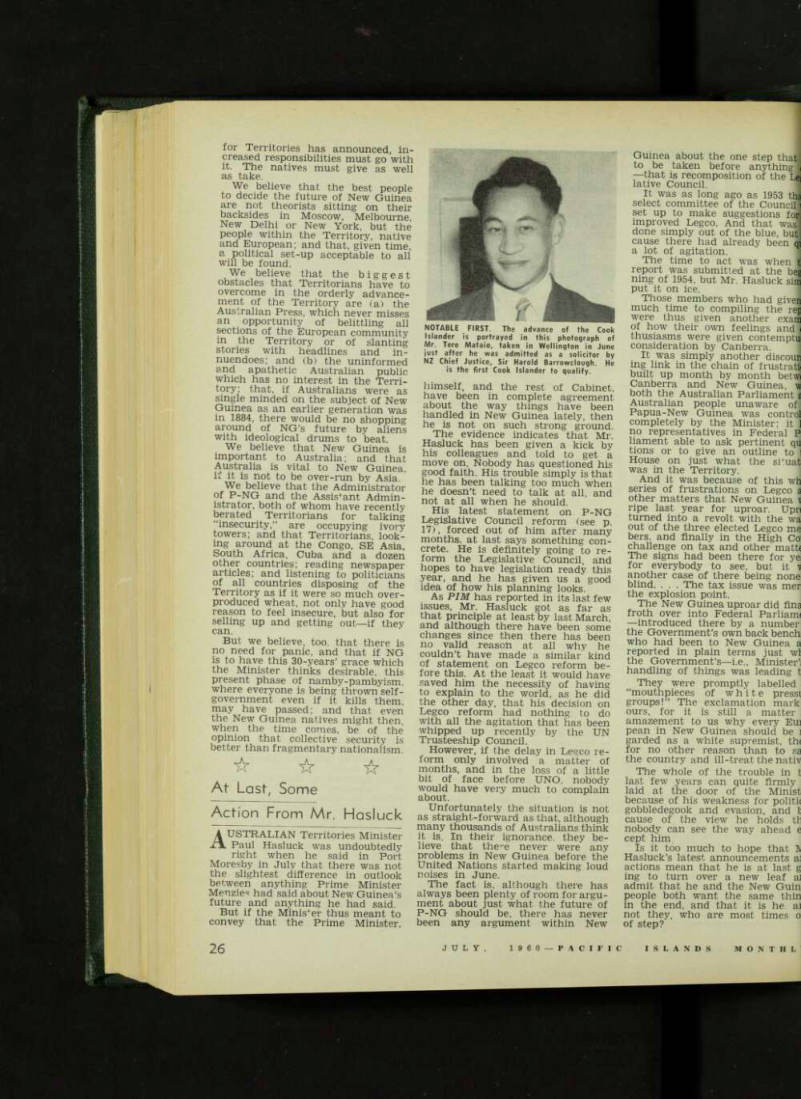
NOTABLE FIRST. The advance of the Cook Islander is portrayed in this photograph of Mr. Tere Mataio, taken in Wellington in June just after he was admitted as a solicitor by NZ Chief Justice, Sir Harold Barrowclough. He is the first Cook Islander to qualify.